Tag Archives: life story

My Quest To Find Enlightenment

Drawing of a gear with an Om in the center

Everyone has heard of enlightenment, but most people don’t care enough about the topic to study or practice it and probably couldn’t even give you a coherent definition of the word. I’m not a genius or a spiritual guru. I’m a poor white trash kid from Texas, but I spent thousands of hours studying and thinking about enlightenment, and I came to some novel conclusions. In order to fully appreciate their meaning, you need to understand why and how I tried to teach myself enlightenment in the first place.

I have an identical twin brother, and we were born two months premature. My twin was born healthy, but my heart was underdeveloped. So I spent most of the first year of my life in and out of the hospital surviving a series of near-death experiences. These factors forced me to be lucidly conscious of my mortality and the surrealness of existence for long as I can remember.

I believe the sensory deprivation I experienced in the hospital during the formative weeks of my development wired my brain to adapt to solitude, stillness, and quiet. This may be where my INTP personality type comes from. Either way, I’ve always been an introvert who enjoys spending time alone thinking, writing and working on long, tedious projects. So my temperament and life situation predisposed me to ponder philosophical questions.

I wasn’t raised rich, with every education opportunity money could buy, but the small Texas towns I lived in had old-fashioned, strict, rigorous schools. So I received a solid understanding of science, history, English and critical thinking skills. I was also put in “gifted and talented” classes from the third grade where I was encouraged to think outside the box. These two education styles shaped how I approach philosophical questions.

Growing up in the Bible Belt, I took Christianity for granted, but I didn’t really practice it until high school when I made a conscious decision to accept Jesus as my savior and devote my life to being a Christian. Then I applied all my skill sets to prove the Bible to be the true word of God, but within a year I found so much evidence that the Bible is mythology, I wrote a book on it.

After losing my faith I plunged into existential despair and read as many religion/philosophy/self-help books as I could, searching for new insights into the riddle of life. I found the ancient Eastern religions and philosophies like Daoism, Confucianism, and Buddhism the most interesting.

The concept of enlightenment, in particular, appealed to me. I already knew enlightenment existed, but my deconversion gave me new motivation to take it seriously. I’d lost the need for faith or salvation, but I still needed a purpose to strive for, and enlightenment made the perfect substitute. It offered a way to become more than I am without having to surrender my life to a mythological deity invented by a primitive tribe to justify their culture.

When I was a Christian, I reasoned that if connecting with God was the best thing we could do, then we should do it. Now I reasoned that if a man has the potential to reach a higher state of mind, then he should, not because God commanded us to, but because it offers the most benefit to the individual. The cost/benefit analysis simply adds up.

I wanted to make the most of my life on a personal level, and I wanted to justify my existence on a philosophical level. To be completely honest, I also thought achieving enlightenment might give me some kind of superpowers. So I approached the study of enlightenment with childlike enthusiasm. To my surprise, my zeal dissipated into disillusionment as I found at least five holes in traditional theories of enlightenment:

1. There’s no agreed upon definition of what enlightenment is.

Hindus, Buddhists, Zen Buddhists, New Age gurus and thousands of other groups have different definitions of enlightenment and instructions to achieve it. There’s no test you can use to prove which definition or methodology is the true one. Ultimately, it’s all one big pile of stuff people made up. Some schools of thought claim enlightenment can’t be labeled or bottled, because that’s the point. It’s beyond words. That idea is vague to the point of being useless. If it does mean something, skeptics can’t disprove whatever it means, but proponents still can’t prove it’s true or disprove anyone else’s theories either.

2. You can’t prove a higher state of mind exists at all

10,000 years of religion and 200 years of psychology have proven if you commit your mind to connecting with Yahweh, Jesus, Allah, Vishnu, a higher level of consciousness, a parallel universe or Elvis, eventually you’ll find something that feels real to you.

There’s no scientific evidence that a spiritual-level higher state of consciousness exists at all, and the burden of proof doesn’t lay on the skeptic to disprove its existence. The burden of proof lies on the self-proclaimed gurus of the world to prove their “higher” state of mind isn’t just a subjective experience that satisfies their subconscious desires, but it’s impossible for them to do that. So their personal testimonies are hearsay.

3. Every self-proclaimed authoritative source contains evidence of lack of authority

Any Hindu Yogi will agree that you can’t put Om in a test tube, but when you look at Hinduism on a whole you’ll find text-book signs of mythology such as an oppressive caste system, astrology, scientifically unsupported statements about the nature of the universe and animistic deities. New Age books on enlightenment are just as baseless. When a belief system contains inconsistencies, absurdities, and culturally relative idiosyncrasies, it casts doubt on its authority on any subject.

The authority of a book doesn’t come from who wrote it, how long it has been around, or how many people believe it. Its authority comes from how rigorously its conclusions have been vetted. If you want to learn about the human mind, then study psychology, not mythology.

4. It’s unlikely that our design is flawed

Some theories of enlightenment claim your average state of mind is inherently flawed, and enlightenment is achieved by eliminating or escaping your base state. Advocates of this school of thought point to stress and crime as evidence that we need to eliminate some part of ourselves. Being a self-loathing Christian, I latched onto this idea quickly and held onto it for a while, but studying astronomy and anatomy led me to the conclusion that it takes less faith to assume our minds work correctly than it does to assume our minds are cosmically/spiritually flawed.

I don’t know if there’s an intelligent creator, or if the universe came into existence by random chance. I don’t know why or how humans came into existence, but I do know that the universe is designed to behave very specifically and elegantly. Subatomic particles, atoms, molecules and solar systems are ingeniously structured to snap together in powerful and predictable ways.

It can be no more of an accident that humans exist in this universe than it is for stars or planets. The amount of forward-thinking it would take to design a universe that can rearrange itself from nothing, into to an expanding gas cloud, that condensed itself into rotating galaxies full of planets that sprouted sentient beings is staggering.

The complexity of the human body is magnitudes greater than the complexity of the planet that germinated us. Our bones and muscles are a series of levers, counter-levers, and pulleys that are positioned to anticipate the need to use opposing forces to create a system of tensegrity that can hold a body upright and perform acrobatics. Humans beings are still years away from designing a robot that can move as nimbly as a human. We’re even farther away from creating a computer anywhere near as powerful as the human brain. We don’t fully understand how the human brain works, but so far we haven’t found anything arbitrary about its design or functions.

If water is supposed to freeze at 32 degrees Celsius and light is supposed to travel at 186,000 miles per second, then the human brain is probably supposed to do exactly what it has been meticulously designed to do by a force infinitely more “intelligent” than a hermit who probably can’t even tell you what the pancreas does.

5. I can’t make a categorical imperative out of devoting one’s life to meditation

If everyone who has ever existed, spent their entire lives meditating in monasteries, we would never have discovered the Periodic Table of Elements. We’d be fighting wolves with clubs and entertaining ourselves around the campfire by making up fantastic, mythological theories to explain what lightning, wind, and the sun are. That’s not the perfection of the human experience. That’s a wasted opportunity.

My conclusion

I can’t tell you what enlightenment is, or if it even exists. I have a theory that I try to apply to my life. It could be wrong in all or part. Take what you can from it. Leave the rest.

Enlightenment is like love. It’s a feeling, a state of mind, and an action at all once. You can be in love and actively love someone. You can’t put your finger on it, but everyone’s lives have been revolving around this intangible force for as long as humans have existed. There’s no definitive book on love, but millions of books have been written about it.

Love is a feeling of attraction between people. Enlightenment is the feeling of existing. It’s how it feels to be awake and conscious of your own individuality. The experience of being you is mind-fuckingly fluid. You slip in and out of states of consciousness constantly. In a single day, you can experience sleeping, waking up, rushing, resting, fearing, loving, fighting, reminiscing, meditating, obsessing, planning, daydreaming, problem-solving, memorizing, fantasizing, hating, hurting, regretting, celebrating, hungering, and giving up.

Each of these states of mind exists because our brains evolved to use them to solve real-world problems. Devoting your life to holding onto or letting go of any one of these is throwing the baby out with the bathwater and sabotaging your opportunity to fulfill your all-around potential. The key to experiencing the most ideal reality is to master every facet of your mind and become the best You that you can be. Through fulfilling your potential, you’ll achieve as much clarity as humans are designed to achieve. You won’t become a higher form of life. You’ll just be more mature, which is profound enough.

You are your reality. Everything you experience is defined by what’s in your head. In order to live in the best mind-space, you need to do at least 7 things:

1. Learn science.

The universe is a big, scary place, but we can study nature and figure out why things happen. Having a basic understanding of science will give you more peace of mind than turning your brain off and ignoring the mysteries of the universe.

Science also gives us the power to create reliable shelters, warm clothing, mass-produced food, medicine, and spaceships. These luxuries empower people to live more comfortable, meaningful lives than sitting on a mountain training your mind to ignore the cold.

With understanding comes peace and empowerment. Ignorance confuses and disempowers us. So if you want to maximize your mind, the first thing you need to do is learn science.

2. Learn problem-solving skills.

Everything you ever do will require you to solve problems. The better you are at solving problems, the better you’ll be at navigating life. The weaker your problem-solving skills are, the less control you’ll have over your life. The more you master the art of problem-solving, the more effortlessly you can stride past the obstacles that stand between you and your goals. This is a far more effective way of achieving peace of mind than clearing your mind and convincing yourself that your problems don’t exist.

3. Learn psychology.

You are your mind. If you ever hope to cope with your existence, let alone maximize the experience of being you, then you need to understand how your mind works. Studying psychology will teach you why you have so many different states of mind and how to control them. Mastering your mind will bring you more peace and fulfillment than denying it.

4. Define and refine yourself.

The universe doesn’t need us. We don’t serve any practical purpose outside of ourselves. Nothing would be lost if we disappeared. Yet the universe went through almost 14 billion years of trouble rearranging itself to create the conditions necessary to create us. If we were supposed to be nothing, then the universe would have made us nothing. I believe throwing away your identity defeats the purpose of existing in the first place. I believe you’re here to be you.

Studying science, problem solving and psychology give you the toolsets to accomplish whatever goals you have. The morality of an action is determined by how much it helps/hinders life achieve the most important goal, and the most important goal is to become the best you that you can be. To do that, you need to define who you are, who you want to be, and then create/execute a plan to improve yourself.

5. Meditate and smell the roses.

Psychology classes can prepare you to be yourself, but the world off-campus is a brutal place full of idiots and sociopaths with agendas. You’ll be pulled in every direction, and every aspect of your mind will be put to the test. If you never spend any time in solitude, focusing your mind inward, exploring and feeling what it is to be you, then the world will force its definition of you onto your mind.

You don’t always have to sit in a quiet room and clear your mind to feel at one with the universe. You can find moments during the daily grind to stop and smell the roses or to take a deep breath and just be. Schedule time in the evening to stop and marvel at the stars.

If the drama of life is too overwhelming, then turn your mind off for 15 minutes to experience the peace that comes from quietly being one with the universe. Once you’ve centered yourself, pick yourself back up and resume your quest with renewed focus.

6.  Do what you love.

Existence isn’t just something you passively experience. It’s something you do. Being a unique individual isn’t only accomplished solely by sitting in a room exploring the space behind your eyes. It’s something you do. The way you actively “be” yourself, is by doing what you love.

Doing what you love will bring you more peace and fulfillment than suppressing your passions. Those passions aren’t unnatural. Nature put them there. Nature gave you the freedom to express, enjoy and validate yourself through doing the things you love. If you’re not doing them, then you’re just letting life pass you by.

7. Love.

Solitude is an important tool in the quest to refine yourself, but if you were meant to be alone, then you would have been the only person to ever exist. If you want a transcendental experience that is more real and powerful than words can describe, then host a dinner party at your house and invite all the most important people in your life. The joy you’ll experience while communing with your loved ones will bring you closer to “God” than cutting yourself off from the world.

If you enjoyed this post, you’ll also like these:

My Goals
My Life Stories (in chronological order)
How to Think Like a Genius

My Quest To Build A Perpetual Motion Machine

“A perpetual motion machine is a hypothetical machine that can do work indefinitely without an energy source. This kind of machine is impossible, as it would violate the first or second law of thermodynamics.”

Despite the fact that it’s impossible to build a perpetual motion machine, many have tried, and all have failed, including me. This is the story of how and why I attempted the impossible.

Two events happened when I was seventeen years old that led to my decision, but in order to understand why those events mattered, you should know a little bit about me. The Myers Briggs Personality Type Indicator says I have an INTP personality, and while that test isn’t perfect, it gives a pretty accurate description of me:

“INTPs are marked by a quiet, stoic, modest, and aloof exterior that masks strong creativity and enthusiasm for novel possibilities. Their weaknesses include poor organization, insensitivity to social niceties, and a tendency to get lost in abstractions. “

I’ve been that way my entire life, and like many other INTPs, I’ve also always had an affinity for puzzles. Growing up I was fascinated by riddles, chess, crossword puzzles, magicians, and Celtic knots.  So when I walked into my high school Economics class one day and noticed some student had left a print out of a chain-mail E-mail on the chalkboard tray that contained a logic problem the E-mail claimed only 5% of the population was smart enough to answer, I greedily stole the paper and took it home with me. It took me five hours to solve the problem, and to be honest, I got a little conceited over my victory until I realized I was naive enough to believe statistics in a chain mail.

The puzzle was hard, but it wasn’t that hard. This made me want to know what my limits really were. So I bought a bunch of puzzle books and worked my way through them with varying levels of success, but after a while they all got boring. I was just rearranging words, shapes, and numbers.  My actions felt tantamount to mental masturbation. I wanted to solve a really hard puzzle just for the fun of it and to test myself, but I wanted to do something that mattered.

This is the state of mind I was in when the second event occurred. I was sitting on the living room floor drawing while my father flipped through the television stations. He stopped it on PBS, which was playing the first episode of Stephen Hawking’s Universe. I watched in awe as Professor Hawking’s sci-fi voice took me on a tour of the evolution of scientific innovation. He amazed me with tales of scientific geniuses who had the ambition and audacity to solve the fundamental riddles of the universe. I’d heard of Galileo and Isaac Newton before, but until then I hadn’t put them on my list of personal heroes.

I watched the rest of the series as PBS slowly aired them. Then I went to the mall and bought the series on VHS with money I’d earned working as a projectionist at a small town, three-screen movie theater.  Every time I watched the tapes I understood a little bit more, but that just made me realize how little I really knew. I wanted to solve unsolved mysteries, but I knew I was never going to solve the problems cosmologists are working on today. Even if I could, I hate math. I wished I could have been born in Copernicus’s time. Back then a clever fellow could make historic discoveries with a few lenses and mirrors without using much math. By the time I was born all the easiest scientific questions had already been answered.

Feeling discouraged, I did some Google searches for unsolved scientific problems and stumbled across an article on perpetual motion. It hooked me immediately. Here was a real-world logic problem that could have a profound potential impact on humanity as well as my self-worth.

I bookmarked every site on the internet that even mentioned perpetual motion, and almost every one of them stated, with varying degrees of belligerency, that anyone who attempts to build a perpetual motion machine is stupid. I understood the reasoning behind the warnings, but they’re a little short-sighted.

Would these same critics ridicule anyone who attempted to solve the world’s hardest crossword puzzle? Time enjoyed is never time wasted. There’s no reason to judge people who want to try to solve theoretical logic puzzles, even when that entails building a useless machine. There are far worse hobbies a person could have, like trolling aspiring inventors on the internet. I knew from the beginning there was at least a 99.99% chance I’d fail, but the worst possible outcome is all my efforts would only amount to me having fun and practicing my thinking skills. If anyone laughed at me for that, then that’s their problem.

After ignoring the Internet’s warnings, I set a goal to design a machine that isn’t a true perpetual motion machine; it would break down eventually, but it would generate enough electricity in its lifetime to make the cost/benefit analysis of building it add up.  The problem with this goal is that it means the machine would have to generate more energy than it uses, which is even more impossible than building a machine that can run without losing energy.

These facts didn’t intimidate me because I learned the secret to solving impossible problems from Captain James T. Kirk on Star Trek: Cheat.

If I couldn’t beat the rules, I would just work around them. Instead of building a machine that runs on its own power indefinitely, I would power it with a relatively inexhaustible energy source like gravity, buoyancy or magnetism. I hoped I could direct them in a novel way that tricks them into behaving counter-intuitively yet technically sound. These are my designs:

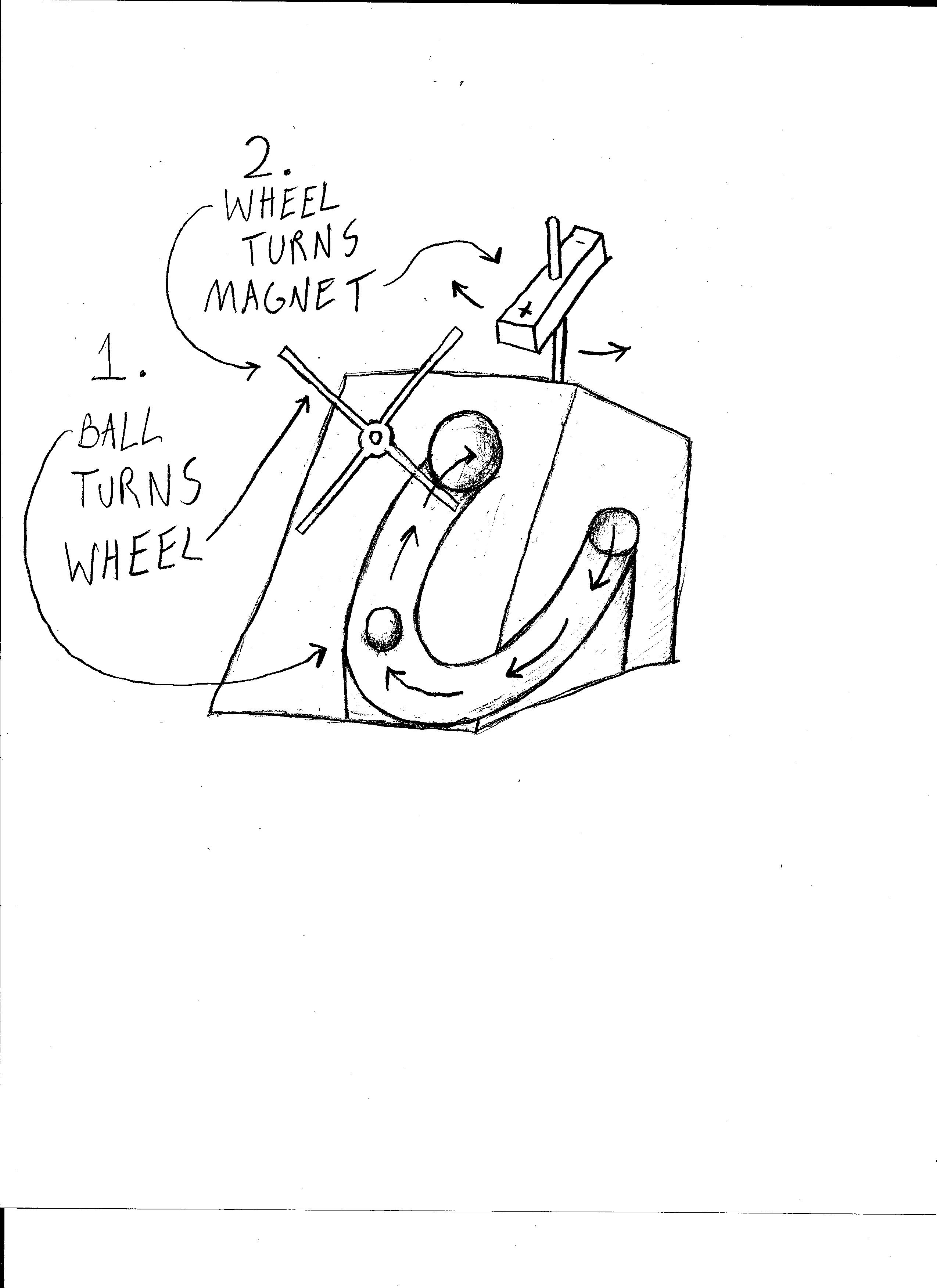
Design for a perpetual motion machine that pulls a metal ball up a ramp with a magnet and drops the ball in a hole that returns it to its starting point

My first idea used magnetism and gravity to pull a metal ball up a ramp. Just before reaching the magnet it would fall down a hole, and roll down a ramp back to its starting point and repeat the process. This idea probably wouldn’t work, because the magnet would just pull the ball over the hole.

Design for a modified ball/ramp/magnet perpetual motion machine in which the ball hits a lever, which pushes the magnet away, breaking the pull.

I thought you might be able to solve that problem by attaching a mechanism that uses the force of the ball to push a lever that either moves the head of the magnet away or pushes the ball away from the magnet, allowing the ball to fall down the hole.

Design for a perpetual motion machine with a piston that is pulled up by a magnet. The piston has a dongle that pushes the magnet away when the piston gets close, causing it to fall to its starting point.

If that concept worked, you could replace the ramp with a vertical shaft and replace the ball with a piston.

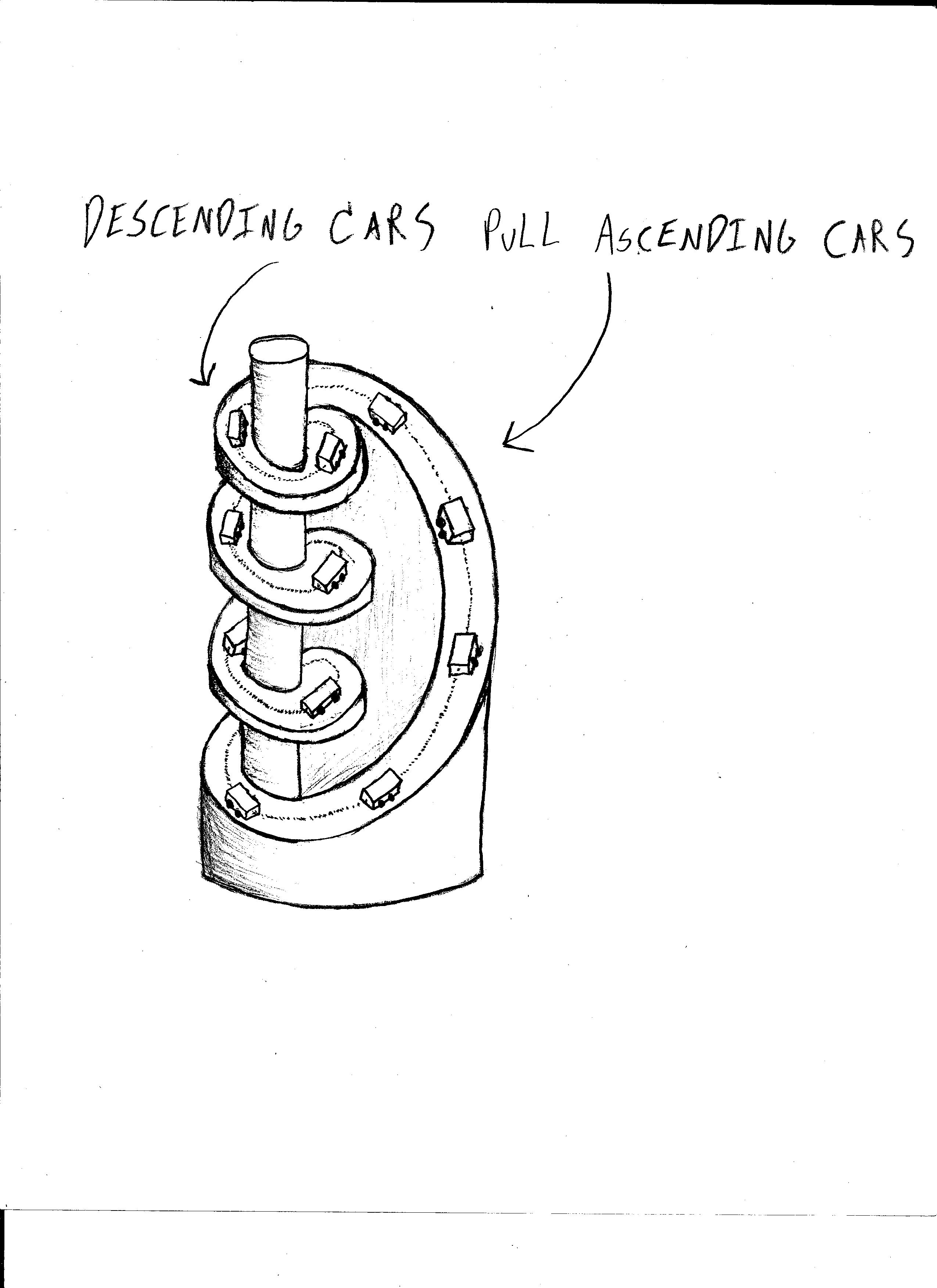
Design for a perpetual motion machine that has a train of rolling down a long, winding spiral, pulling its tail behind it.

Magnets wear out eventually though. So I came up with a design that only uses gravity as the power source: Attach wheels to ten identical rolling weights that basically look like trolley cars. Connect each trolley with identical length strings so they’re all connected in a circle. Put the trolley chain on a long, winding ramp that they roll down. At the bottom of the ramp is a steep vertical slope that leads back to the top of the ramp. The idea is that as long as more trolley cars are rolling downhill, pulling the car behind them, than there are trolley cars being lifted from the end back to the beginning, then the descending cars should lift the ascending cars.

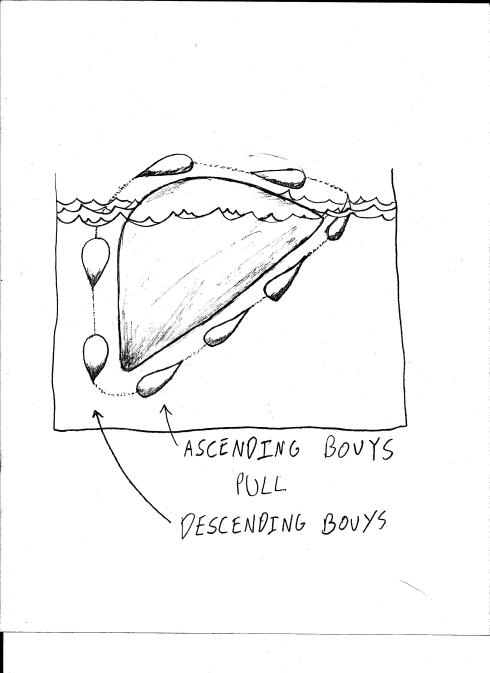
Design for a perpetual motion machine using a train of underwater buoys pulling themselves up a long, triangular shaped ramp to be pulled back down a shorter path.

One problem with the trolley car idea is that it creates a lot of friction. I hypothesized I could improve the idea by turning it upside down and submerging it in water. Instead of using weighted trolleys, connect a ring of hollow buoys following a long, winding path up to a steep decline, where they would be pulled down to their point of origin by the higher number of rising buoys.

Design for a perpetual motion machine using a wheel of magnets pushing away from each other.

I wanted to come up with a design that involved a spinning wheel since that would make it easier to generate electricity. So I drew plans for a wheel with angled magnets that repel off other magnets anchored outside the wheel. I bought a hamster wheel and $100 worth of magnets and proved that this idea doesn’t work. The force from the external magnet that pushes one internal magnet away will prevent the next incoming internal magnet from passing the field of the external magnet.

The wheel could spin if you could turn the magnets off until they’re in position to repel. You could create this effect easily using electromagnets, but that would use more electricity than it produces. The wheel might spin if you could block the magnetic field until the magnets are in the position to repel, but I don’t know of any material that blocks magnetic fields.  The wheel might also spin if the magnetic fields could be redirected with ferromagnetic metal or you used a mechanism to push the external magnet away until the internal magnet is in place to be repelled.

Design for a perpetual motion machine involving a wheel with two ramps that guide balls in the spokes so that more are pushing down/counterclockwise than clockwise.

Even if those plans did work, they still used magnets. It would be better to have a wheel that’s powered just by gravity. In order for weights in a wheel to spin the wheel indefinitely, there would have to be more weights pushing counterclockwise than clockwise. I hoped that could be achieved through the use of two ramps.

At the age of nineteen, I tried building this wheel using paper and straws. It didn’t work. So I took the spokes out of a bicycle and replaced them with cardboard rectangles and golf balls. The balls kept getting stuck and bouncing away until the cardboard bent. So I bought two Erector Sets and made a more stable wheel. I never could get the weights to stay on track.

Having spent hundreds of dollars and hours, I finally decided I didn’t have the engineering skills to build anything. To this day, I still can’t put Ikea furniture together without it being wobbly and crooked. So I gave up trying to build a perpetual motion machine and got on with my life. I’ve thought about paying someone to construct my designs, and I would, but I’m not convinced any of these designs would actually work. Someday when I’m old and have more disposable income, I may pay someone to build all of them so I can decorate my foyer with them.

Even if they don’t work, they would make interesting steampunk decorations. They’d be good conversation starters. You’re welcome to use and profit from my perpetual motion machine designs in any way you want, free of charge.  They’re free domain.

P.S.

My quest for meaningful puzzles didn’t end when I quit working on my perpetual motion machine. In fact, part of why I lost interest is because I had moved on to the next puzzle: the meaning of life.

If you enjoyed this post, you’ll also like these:

My Goals
My Life Stories (in chronological order)
My Art

My Vision for A Secular, Intellectual Monastery

On my “About” page I state that my long-term goal is to build an intellectual monastery. I’ve written a few blogs and comics explaining why I believe we can cure a lot of major world problems by using the monastic community model on a large scale.  You may be wondering why someone would spend so much time thinking about monasteries. This is the story of how and why I did.

I was born an introvert, which predisposes me to want to be left alone in a quiet place, and I’ve come to believe that the events of the first few months of my life predisposed me to the solitary life even more. I spent that time in an incubator in a hospital preparing for, receiving and recovering from heart surgery resulting from the premature birth of me and my identical twin brother. During that time, pretty much the only human contact I received was from a sweet, elderly nurse hovering above me. So my brain adapted to isolation and minimal sensory stimulation.

I showed up to life late and didn’t want to come out of my shell. So I let my identical twin brother speak for me until our parents caught on and made me go to speech therapy. I knew how to speak. The twin studies my brother and I went through showed we had above-average language comprehension. I just didn’t want to get involved with the drama of life. On the first day of kindergarten, I froze in the doorway to my classroom while all the other students stared at me.

As an adult, I’m a completely well-adjusted, functioning member of society. I spend as much time in crowds as anybody else. I can be the life of the party if I need to. I’ve competed in public speaking competitions and managed a computer help desk in a war zone. I’m good at being social. I just need to get away from the crowds and be alone to recharge my batteries more than the average introvert, and I still can’t watch Imax movies or go to theme parks, because all the commotion and sensory overload gives me a splitting headache and wears me out.

People are born all over the introversion/extroversion scale, and there’s no wrong place to be. That diversity is one of humanity’s greatest strengths. We need to understand our personal nature so we can adapt to it. I enjoy being introverted, and I take advantage of the perks it gives me, like the patience to write books and draw intricate pictures.

Back in elementary school, before I was old enough to articulate all of that, I’d daydream about escaping the daily commotion and living in a tree house in the woods. I wanted an orchard of different trees, and I’d build walkways between them and just never leave the canopy.

When I learned about monasteries in middle school history class, I was hooked immediately. I filled notebooks with floor sketches of monasteries and castles, plotted on grid paper.

But living in a castle wasn’t an option in South Texas. I was stuck in suburbia, which is a never-ending cycle of duties, rules, and drama. In high school, I romanticized about living in an insane asylum. As long as I wasn’t forced to take pills that turned me into a zombie, I could walk around in my pajamas, work on my hobbies and have three hot meals a day. It would be the perfect life.

Unfortunately, I’m too mentally healthy to qualify for a free meal. So in my early twenties, I enlisted in the U.S. Air Force and spent four years stationed in Europe… to my surprise. While I was there I did as much traveling as I could afford and got to see a lot of ancient communal living quarters, which inspired me to study up on the places I couldn’t go.

The history of Europe’s monasteries is set to the backdrop of the history of Europe itself, which is an almost never-ending saga of wars, famines, diseases and economic oppression. Monasteries weren’t immune to these forces, but they were insulated from the worst of it because they were self-sufficient. The monks had everything they needed and barely had to work part-time. Meanwhile, the peasants outside the walls were being used as slave labor and not earning enough to survive. Everyone should be as lucky as the monks, and if everybody had lived like the monks to begin with, most of Europe’s bloodshed and misery never would have happened.

I left Europe and the Air Force in my mid-twenties convinced that a monastery would be the best place in the world for me. So I scoured the internet to see what was available and was unsurprised to find they were almost all religious. This is a deal breaker for me because I believe religions are mythologies, and I don’t want to spend my life dancing around a mythology.

Even if I could play nice, most religious monasteries don’t accept heretics. The ones that do still tend to have schedules and rituals that are an unacceptable waste of time to me. The ones that give you the most freedom cost the most money. There are still a few that will let you stay for free, but you can’t stay long term.

As the internet grew I found more monasteries, but never one that was feasible for me. So I got on with my normal life, commuting back and forth between a house I didn’t own and a job I didn’t like. The longer I lived and worked in suburbia, the more fed up I got with the rat race, and the more time I spent escaping to my ideal monastery in my imagination.

After years of fretting, one day I got fed up and decided that if I could create a monastery in my head, then I could create it in the world. After all, I have opposable thumbs, bipedal legs, and a brain. There’s nothing I can’t do if I work on it long enough. So I threw down the gauntlet and said to myself, “That’s where I want to be. If nobody else has built it yet, then I’ll just build it myself.”So I researched how much it would cost to build a monastery, and I found that it would be at least $500,000 if I hired contractors to do it using standard construction methods. Since I didn’t have any money at all, I researched alternative building materials and floor plans to lower costs. I filled notebooks with sketches and notes until I settled on a circular design using sandbag walls.

Design for modular, pyramid shaped monastery rooms that minimize building materials needed Design for an underground monastery consisting of camper trailers with connected rooms Design for a crescent shaped monastery with a ring of underground camper trailersDrawing of a glass greenhouse shaped like a cathedral Drawing of an Airstream trailer in a hollow, man-made hobbit hill

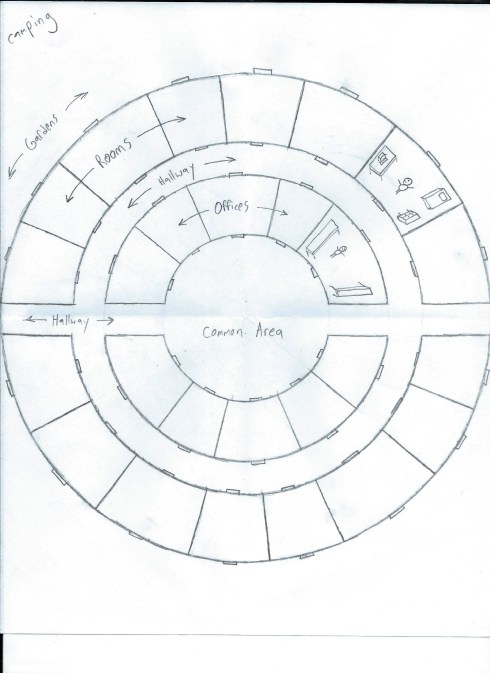
Circular monastery design

Using the circular floor plan, I only need to build half for it to be functional. I could build that for $250,000 and finish the rest later.

That’s the plan. Now I just need the money. There are a lot of ways I could earn $250,000, and I’ve considered them all. In the end, I chose to meet my goal by writing. Some people would say that’s risky, but it’s what I enjoy doing, and it’s what I’d be doing if I lived in a monastery. This way, if I never get my dream home, at least I’ll have done the other thing I wanted to do.

While I’m writing towards my goal, I’m always thinking about new designs and business plans. Monasteries can be easily modified to suit different purposes, and with enough money, I would build multiple versions, but my ideal monastery, the one I’m going to build first, would operate like a long-stay working hostel for the gifted.

Tenants stay for three months to a year. They work part-time for the monastery, and that covers 100% of their room and board. There are no other schedules or rules, but each tenant has to be actively working on a creative project that has significant value to humanity. The monastery will also host retreats and workshops, and there will be a pay-by-donation campground at the edge of the property to generate passive income.

That’s what I’m working towards and why you can always expect new content on The Wise Sloth. If you want to see some random guy on the internet build an intellectual monastery, here’s how you can help.

  • If you’re an eccentric millionaire who can afford to give an eccentric pauper $250,000 just to see what happens, click the Donate button below.
  • If you know an eccentric millionaire who would give a guy like me $250,000 just to see what happens, then send them the link to this blog.
  • If you want to donate a few thousand dollars, I would invest that money in editing my E-books and putting them into print so I can earn $250,000.

Click to donate via PayPal

I’m not going to nickel and dime my way to building this. I’m very grateful to anyone who wants to throw me tip money to show your support, but I would encourage you to give that to The Khan Academy instead. I may never get my monastery, but they’re providing free online education to the world. The world won’t change until it’s educated.  Every nickel and dime they get makes the world less stupid, and that can’t come quick enough.

Khan Academy logo (Click to donate to the Khan Academy)

In lieu of a donation, you can tell your friends about the Wise Sloth and share your favorite Wise Sloth blog on social media. If you’ve read this far, thank you for spending your time with me. You can look forward to seeing more thought-provoking posts on The Wise Sloth, and eventually, you’ll get to watch me build my monastery.

If you enjoyed this post, you’ll also like these:

My Goals
My Life Stories (in chronological order)
My Art

Why Do I Write The Wise Sloth Blog?

Note: This explanation goes into the major life events that led to the creation of The Wise Sloth. If you want the short answer, scroll down and read the last four paragraphs.

The motivation for me to write The Wise Sloth probably started in the first year of my life. I was born prematurely because I have an identical twin brother. He was healthy, but my heart wasn’t done developing. So I had to spend the first few months of my life in an incubator until I was strong enough to survive heart surgery. Over the course of the ordeal, I flat-lined seven times. After the surgery, I was still in and out of the hospital for the next year with pneumonia.

San Marcos, Texas 1984

By the age of six, I had been told a million times how lucky I was to be alive, and since I was raised in the deeply religious state of Texas, I was also told God must have a very special plan for me. Being 6 years old, I believed what I adults told me and often wondered what important mission God must have gone through so much trouble to keep me alive to accomplish. Eventually, I stopped believing God had a plan for me, but I still always carried a sense of responsibility to do something valuable with my life.

My parents divorced when I was six-years-old, and my two brothers and I spent the rest of our childhoods bouncing back and forth between houses, which were on opposite sides of Texas. Our parents were always working and always stressed. So I had very little supervision, and what discipline I got consisted mostly of screaming and spankings. By the age of eight, I started becoming aware nobody was going to teach me how to become a mature, responsible, self-actualized adult. The only way it was ever going to happen was if I taught myself.

I did well in school, but I wasn’t top of my class. I made my first “C” on my report card in middle school when I stopped hanging out with nerds and started hanging out with the bad kids who smoked cigarettes and shoplifted. I made my first “F” my freshman year in high school when I started hanging out with kids who smoked marijuana and stole whatever wasn’t bolted down. I took a lot of drugs in those days and lost my mind a little bit. I couldn’t remember what normal was supposed to feel like, and I would constantly ask myself what reality is.

I started carrying a notebook with me to draw and collect quotes in. Pretty quickly, I started writing my own quips and then essays. The more notebooks I filled up, the less they included pictures and quotes, and the more they included questions and essays. I still carry a notebook with me everywhere I go and write down ideas and sketch out blogs in them. I call them my “ideation notebooks.”

Trippy drawing of myself that I did on the margin of my class notes in high school.

Paris, Texas 2015

At the age of seventeen, I took a larger dose of hallucinogens than I was used to and spent the night talking to God. The next day I threw away my cigarettes and started reading the Bible. Later that year I was baptized in a Southern Baptist church, and my notebooks began to fill up with religious questions and observations. I was particularly obsessed with the question of the meaning of life. I felt paranoid that I would die without being able to say for sure that I made the most out of life, and I wanted to know for sure that I gave my future children the best life advice possible.

So I made a conscious decision to actively and systematically try to figure out life, meaning, maturity, responsibility, and self-actualization to the best of my ability. To streamline the process I created a systematic method of problem-solving based on basic math principles and the scientific method.

After graduating high school I attended a Baptist university where I studied the Bible and social sciences. I hoped to apply my systematic method of problem-solving to the Bible and create the perfect argument for Christianity. However, I barely had to scratch the surface of Genesis before it became undeniably obvious that the Bible is a simple and blatant work of primitive mythology.

By the end of my first year in university, I lost my faith, left school and started drinking and using drugs again. After taking a year out of life to do backbreaking manual labor with felons and immigrants, I joined the Air Force as a computer technician. Working with computers helped me hone my problem-solving skills, and being in the military allowed me to see the world and find new questions and answers that I would never have been exposed to living in small-town Texas. It also gave me time to consolidate my philosophies into a treatise on the meaning of life.

I had only been at my first duty station for a few months before September 11th happened. I watched the planes hit the Twin Towers on the television in my First Sergeant’s office while he handed me disciplinary paperwork for failing my room inspection. I wrote a rebuttal, but it fell on deaf ears. Over the next six years, I watched the American military tear the Middle East apart. I asked everyone in any position of authority I could why we invaded Iraq, and I never got a straight answer. So I started looking for one on my own. The more I analyzed the situation the more I lost faith in our mission. The only explanation that made any sense was that destabilizing the Middle East wasn’t an accident. It was the point.

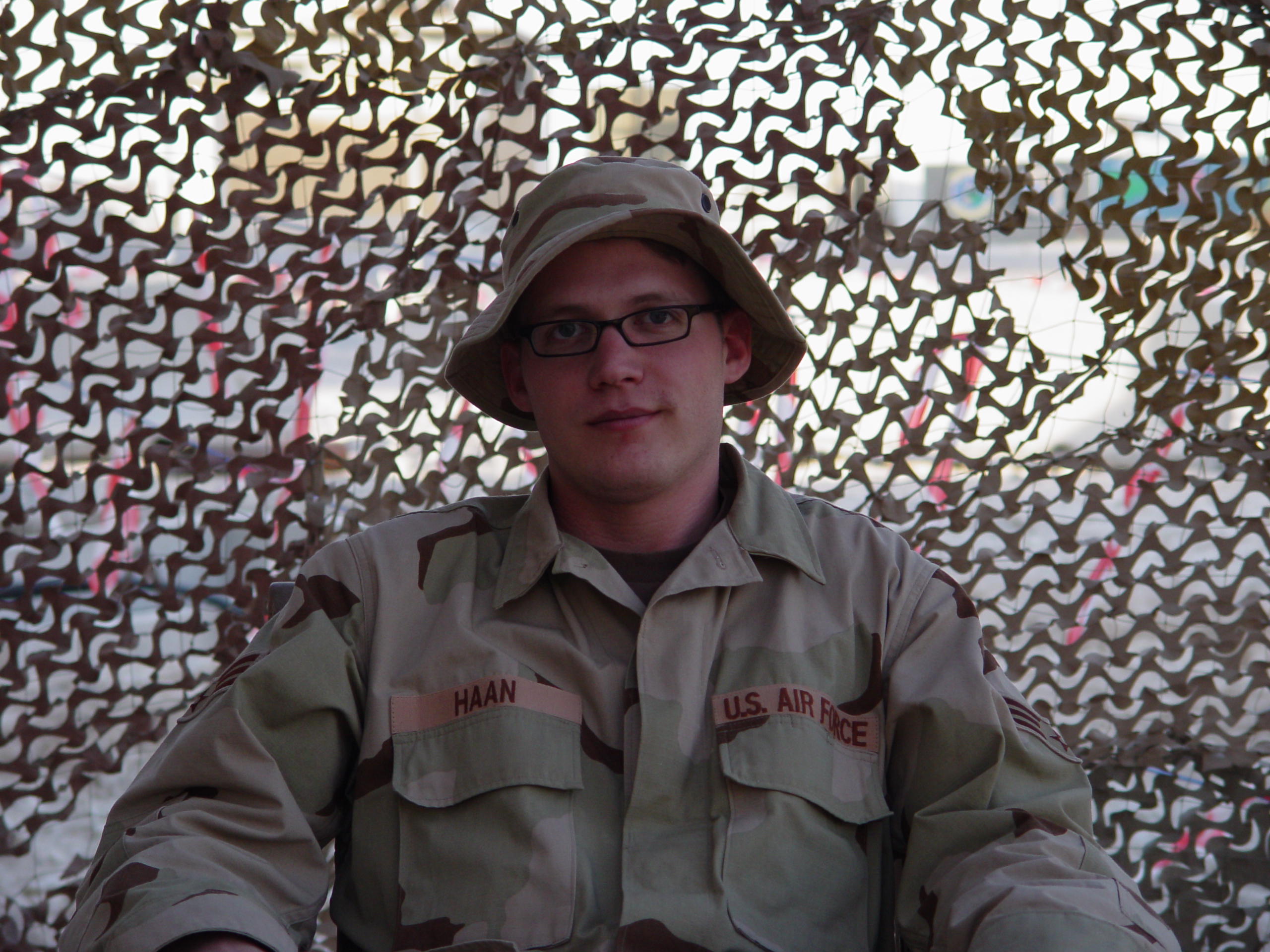
Photo of me in my Air Force uniform taken at Ali Al Salem Air Base in 2004. I'm pale as a ghost.

Ali Al Salem Air Base, Kuwait 2004

The last few years I was in the military I took night classes studying psychology, which led me to the conclusion that the military is a cult. I left the military full of guilt and shame at a time when it was viciously taboo in American culture to criticize the military or the preeminence of America.

Around the time I left the military one of my brothers was building a huge following blogging on MySpace under the screen name, “The Mad Goat.” He looked like he was having fun, and people were listening to the things he had to say, even it was just belligerent, drunken stories with dubious moral lessons at the end. So I started vomiting my drunken, belligerent viewpoints on MySpace as well. I copied the formula for my brother’s screen name, “The” + “adjective” + “animal”  and chose “The Wise Sloth” because I aspire to be wise, and I make an art form out of laziness.

The quality of my writing was awful. I had no business writing or expecting anyone to pay attention to my drivel, but a few people did, and that fueled my desire to keep going. Around 2008, MySpace basically died as everyone migrated to Facebook. At that point, my brother stopped blogging and got on with his real life. I started a WordPress blog and copied over the few decent posts I’d written. Unfortunately, I lost 99% of my readership and had to build a new audience without the advantage of having a social networking platform built right into my blogging platform.

I decided to keep blogging for several reasons. First, my blog is an extension of my journals, where I catalog my own observations about life as I struggle to get it all figured out for myself. The fact that The Wise Sloth is public is an added bonus. I know there are a lot of people asking the same questions as me. If I can help them find answers quicker, I may be able to help make the world a better place for both of us.

Sometimes I choose my blog topics based on what I think my readers would benefit from or what would increase traffic to my site. My essays on sexual positions and techniques accomplish both of those goals.  Blogging also gives me a pulpit to speak about subjects that don’t get enough attention, like the fact that the U.S. Military is a cult, Christianity is mythology, capitalism is the root of most of the world’s problems, and locally sustainable communities are the solution to most of those problems.

As I write enough posts on a subject, I’m compiling them into books. I’ve made a few hundred dollars off The Wise Sloth from book sales and donations, which is a horrible return on investment considering that I’ve put thousands of hours of work into it, but that doesn’t bother me. I would still do it if I won the lottery and never had to worry about money again, and I’d still be writing if I knew for a fact that I’d never make any money off of it.

Having said that, I do want to make money from blogging, but I’m consciously playing the long game here. As long as I never stop blogging, it’s only a matter of time before I write enough books or create enough viral content to raise serious money. When that happens I’ll be able to fulfill my ultimate goal of building a secular, intellectual monastery. In the meantime, I’ll be playing my little humble part in raising awareness of important issues. Whenever I die, I’ll leave something behind that will hopefully in some way justify my existence. Then all the work my doctors (and possibly God) put into keeping me alive when I was a baby won’t have been in vain. Or maybe all of my irreverent, vulgar words will be nothing but a huge disappointment, but at least I’ll have had fun writing them.

Photo of me taken in Colorado in 2015 holding a 40 ounce coffee mug

Denver, Colorado 2014

If you enjoyed this post, you’ll also like these:

Blogging
My Goals
My Life Stories (in chronological order)
My Art

Piancavollos’ Traveling Snail

Sign of the "Piancovollo" city limit sign in the Dolomite mountains of North East Italy.

From 2000-2001, I was stationed at Aviano Air Base in North-Eastern Italy, at the base of the Dolomite Mountains. One day I hiked to the top of a nearby mountain named Piancavollo. From the top, you can see miles and miles of farmland, small towns, and the long runway of Aviano Air Base. They say on a good day you can see Venice, an hour’s drive away. From Piancavollo all of civilization is spread out before you in a panorama. It makes you wonder how many people are milling around down there going on about their lives? How many dramas, how many love affairs, how many tragedies, how many criminals? But then again, you know all about what’s going on down there. You live there, somewhere, and you’ll be back before you know it. But from up here it seems so far away as to be surreal, just like how the top of the mountain does from down there.

Arial photo of the city of Piancavollo, looking down from the mountain of the same name

When I first arrived in Italy and saw that mountaintop commanding the horizon I told myself that I had to climb it to be able to say I did it and chalk up one more experience in the story of my life. When I finally got to the top and started looking down at so many places that I hadn’t been yet I started thinking about all the other places around the world that was craving to visit before I die. I didn’t want to look back on my life and say that I didn’t live a vibrant life because I never went to Hawaii, or Moscow, or London, or Key West, or Alaska.

I’m terrified of living a mundane life. Never mind the fact that in the short 22 years of my life I’ve been to Athens, Jerusalem, Cairo, Paris, Rome, Florence, Pisa, Vienna, New York, LA, and Cancun to name a few. But that’s not good enough. I’ve gotta keep moving,

Anyway. So I was standing on this mountain, eye level with the clouds, adding up all the places I needed to visit when my concentration was broken by the thought that I really had to pee. So I scurried over behind some tall rocks and whip it out to do my business when I realized that there was a large snail lying right where I was aiming. So I took a step to the side, and while I was standing there waiting to finish relieving myself occupied my attention by staring at that black and yellow snail.

Look at this little snail. Its life was a total contradiction to my quest for variety. In its entire life, it would never travel more than 20 feet (or something like that). It may never even see another human. It might not even see me right now. It certainly will never notice the vast panorama that’s embracing a hundred miles of varied landscape behind it or understand what’s going on in any of those towns. But do I have the right to say the snail’s life is a tragedy because it won’t see the Eiffel Tower or touch the Wailing Wall?

I won’t ever get to see what a blade of grass four times my height looks like. Surely that snail is getting to see some pretty amazing things down there. But there’s something more important implied by this snail than appreciating the view from a quarter inch above the ground. How many amazing places do you have to go and how many amazing situations do you have to get yourself into before you can say that you lived an amazing life. What if there were more than 7 wonders of the ancient world ever built? What if there was a structure built in every single city on Earth that was worthy of being called a “wonder of the world”? You couldn’t see all of them in one lifetime. So how many do you have to see before you officially lived a vibrant life? How few can you get away with seeing and still say you didn’t live a mundane life?

Taking this idea one step further let’s ask if you really need to see any of these “wonders” at all. Maybe I’m wasting my time and money traveling, and all these adventures that I’m so proud of having have really been distracting me from focusing on something more important. Maybe visiting amazing places is less important than having an amazing personality. Maybe the quality of your environment is determined by the extent that you appreciate it regardless of what or where it is. Maybe it doesn’t matter how many mountains, rivers, or antique buildings you get to see, especially when there’s an entire universe of complex uniqueness in the mind of everyone you pass on your way to see these inanimate buildings and rocks.

Maybe. Maybe. Maybe. Whatever the answers I at least figured I could lighten up a little about not getting to visit more famous places. By the time I finished thinking about all this, I had been done peeing for about a minute now and had just been standing there on that mountain exposing myself to a snail and staring into oblivion. So I collected myself mentally (and physically) and started off down the mountain back to my busy, little town where I had plans to do nothing for the rest of the day.

If you enjoyed this post, you’ll also like these:

My Goals
My Life Stories (in chronological order)
My Art