Monthly Archives: May 2020

All The Points Americans Are Missing In The George Floyd Case

George Floyd was an African American man from Minneapolis, who was choked to death by a police officer on March 25, 2020 while arresting him for spending a forged $20 bill. His death outraged America, particularly African Americans, who staged protests in Minneapolis, which led to looting and clashes with the police. Meanwhile, social media has been flooded with debates, accusations, apologies, pleas, justifications, and general screams of frustration.

The death of George Floyd was an unnecessary and unsurprising tragedy. Watching America scramble for a call to action, I’ve noticed a typically American lack of nuance in the national dialogue. I’m not going to solve the world’s problems with my hot take on the issue, but I want to be on the right side of the conversation and try to offer the voice of reason when so many people are looking for a one-point solution to a one-point problem.

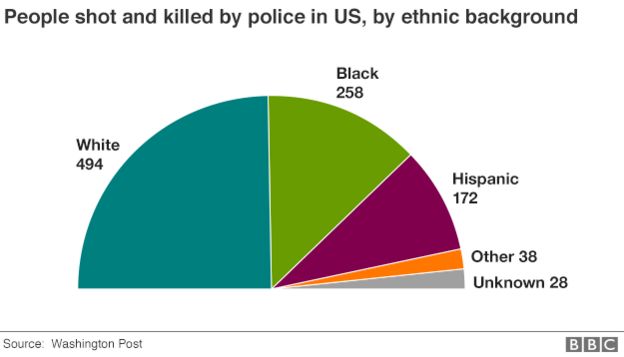
America’s police force kills over 1,000 people per year. Some of these are justified, some of them aren’t. The only time you ever hear any outrage over the subject is when a white cop kills an unarmed African American. The are two reasons for this. One, African Americans feel disproportionately targeted by systemic racism in the police force. This conclusion is drawn from the fact that African Americans make up 12% of the population but account for 26% of police killings. Two, if we’re being honest, 99% of the viral videos of police killings involve African Americans. If you get all your news from social media, you’d think they’re the only victims of police brutality.

Every year, police kill twice as many whites as blacks, almost as many Latinos, and a handful of other people.
Source

Imagine if you were a shepherd, and you had a flock of 1000 sheep. Every year, wolves killed 50 white sheep, 25 black sheep, 24 brown sheep, and 1 spotted sheep. So you sat down and tried to figure out a way to stop the wolves from targeting black sheep. Even if you could bring the percentage of black deaths down to 10%, you’d still be left with a wolf problem.

In regards to police, if you frame the problem as a primarily race-based issue, then the logical solution is race-based sensitivity training, but no amount of cultural awareness Power Point briefings are going to end the systemic abuse of force by the police.

The root of the problem is the militarization and commodification of law enforcement that sweeps up all races in its reign of terror. The strongest evidence for this is the fact that black cops are just as likely to kill blacks as white cops.

If you sat through every training session police officers attend through their career, you’ll never hear a speech about how you’re supposed to target African Americans. You will be trained to view everyone as a threat. You’ll be instructed to “go beyond the ticket” and attempt to escalate every minor traffic stop into an excuse to search for contraband. You’ll be trained to use military grade weapons and fighting techniques. You’ll be brainwashed to uphold the law no matter how frivolous they are, and you’ll punish victimless crimes because your police station relies on funding from tickets, and the prison-industrial complex has bribed politicians to design the law to fill prison beds for the profit of publicly traded prisons.

I’m not saying the police don’t do any good, but they should expand their motto to, “serve, protect, terrorize, and profit.” As long as their mission includes terror and profit, nobody is safe. If you fix that, then you’ll save lives from every race.

Fixing law enforcement’s misguided mission and systemic culture of violence is a necessary step in ending unnecessary police killings, but there are other factors that need to be addressed.

If it’s a moral imperative that we stop black people from being killed, then we’re obligated to ask why 93% of black murder victims are killed by black people and 41% of violent crimes are committed by blacks. I’ve seen Black Lives Matter supporters say it’s racist to point out these statistic, but ignoring the problem can’t help solve it. These numbers are important, because they may help explain why police officers (including black ones) seem to be more afraid of African Americans than other races.

You don’t have to dig deep into African American arts before you find that it has its own culture of violence, which creates a perfect storm when it meets police officers’ culture of violence.

You can call me a racist for pointing out violent crime statistics and the popularity of gang culture You can get me fired from my job and kicked off social media, but tomorrow, Pizza Hut still won’t deliver pizza to the ghetto, and the police will still be vividly aware of the statistics and culture they’re walking into when they enter black neighborhoods.

The African American community is desperate to blame someone for systematically training police to fear them. While there are surely nuanced external historical, sociological, and political factors involved, it’s honestly unfair to act surprised that cops would look at ambassadors for the black community like these and extrapolate assumptions:

I’m not saying African Americans deserve to be stereotyped. I’m saying, if you’re looking for sources of stereotypes and want to protect black people from getting killed, you would accomplish more by lecturing gun-toting gangsters than random white suburbanites on the internet.

But even that won’t fix the root problem that created and sustains gangsta culture: systemic economic oppression. Desperate circumstances lead to desperate actions. If you live in a poor community with few jobs (and mostly low paying ones), then the cost-benefit analysis of committing crimes to survive rises. The more crime there is, the more important it is to protect yourself from criminals, and this equation quickly spirals into a cycle of violence.

Gangstas wouldn’t need a charismatic leader to convince them to choose jobs over crime if good jobs existed in the ghetto and the economy wasn’t designed to bankrupt the poor. Until all poor Americans have immediate access to high paying jobs and an affordable cost of living, no amount of motivational speeches are going to prevent poor people from choosing crime over non-existent opportunities in a system that sets them up for failure.

So how do you bring jobs back to the ghetto? Not by looting and burning down businesses. I’ve seen people online justify rioting by saying peaceful protests haven’t worked. So this is their only recourse. They even compared their actions to the Boston Tea Party… ignoring the fact that the Boston Tea Party led to a civil war.

The Boston Tea Party analogy would be accurate if protesters were stealthily burning police stations and nothing else. That might send a powerful message, but there can only be one response to uncontrolled looting and destruction: the police are obligated to respond with brute force. By their actions, rioters are demanding cops reciprocate violence with violence. The only possible outcome of this course of action is more immediate violence, and in the long run, more militarization of the police and distrust.

I could be wrong. Enough violence might force somebody to do something… but not without tangible, actionable demands. Nobody in power can pass a law that makes cops stop being bad. In order for the Black Lives Matter movement to be successful, it needs a clear leader with a list of actionable demands and a strategy for applying leverage in case their requests aren’t met.

Even then, there’s a word for an organization that threatens governments with lists of demands: “terrorists.” And we all know how America responds to terrorists.

There is another option though. America has a system built in place for charismatic leaders to change laws: elections. The Democratic and Republican party have both proven they only work for their campaign donors and lobbyists. If you’re not funding their careers, they don’t give a fuck about you. So I’m not suggesting voting Democrat will save the poor.

What African Americans can do though is start their own political party and put Black Lives Matter politicians directly into the system where they can literally write the laws without having to beg, coerce, bribe, or wait on anyone else. That could directly change the systemic flaws in the the police force and the economy.

For what it’s worth, that’s what I think the call to action from George Floyd’s death should be.

If you liked this post, you may also like these:

Police Brutality
Racism and Xenophobia
Predatory Capitalism Creates Poverty

How To Reduce America’s Federal Deficit

One of my readers recently asked me to write a blog about reducing America’s deficit. So, here you go.

Right now, America’s total debt is about $18 trillion. That numbers is calculated by adding the government’s promise to pay social security, government pensions, military pensions, health insurance trust funds, savings bonds, and a few other debt vehicles. You could spend a lifetime micromanaging all the details of the national debt. For the sake of simplicity, I’m going to focus on ways to reduce the cost of the biggest programs America is borrowing all this money to pay for.

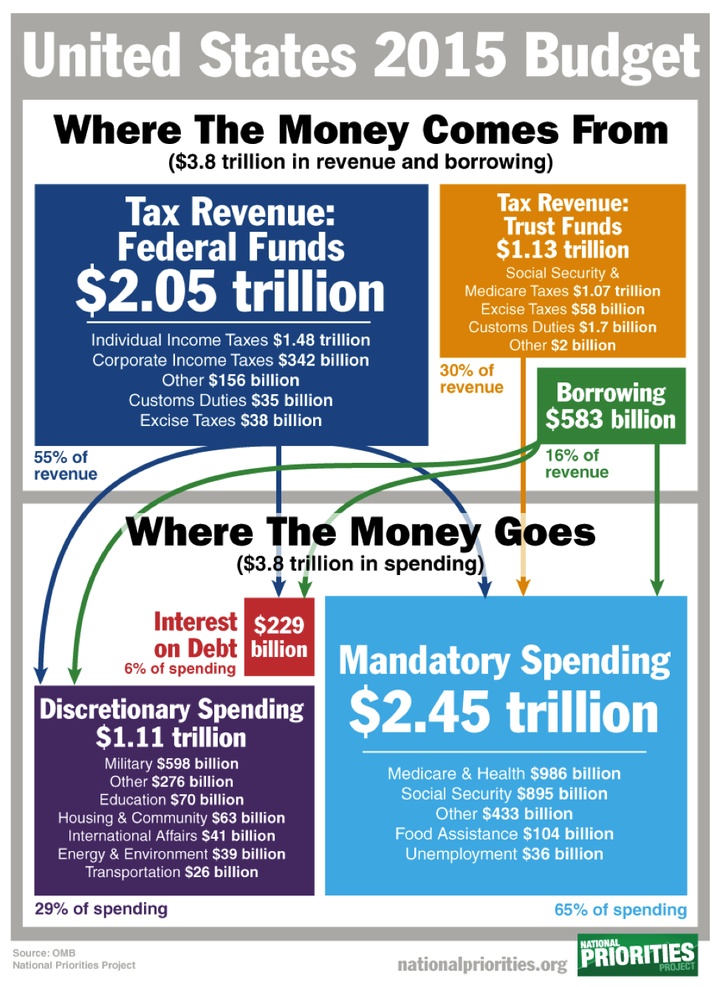
The graph below is a little old, but the percentages haven’t changed much. It paints a clear picture of where the federal government spends the most money:

United states 2015 budget

The Big Five Expenses

Medicare and Health

Healthcare is the biggest expense for the federal government as well as the leading cause of bankruptcy for individuals. I’ve already written a blog about My Theories On How To Fix Healthcare in America. In summary, they are:

  • Make price gouging illegal.
  • Nationalize the healthcare industry.
  • Eliminate or nationalize the health insurance industry.
  • Regulate and Subsidize healthcare.

If hospitals and insurance companies didn’t gouge their customers, there would be no need for the government to pay the difference between what they charge and what customers can afford. You can accomplish this one of four ways: Pass laws telling private companies what they can charge. Make the healthcare industry a branch of the government and set prices for what they charge. Nationalize the health insurance industry so the government can set what they’re willing to pay for medical procedures and put all the profit from insurance into the public coffers.

If you feel those first three options are too oppressive, you could pass laws saying what private companies can charge, and give them a small kickback from the government to make sure they still make enough profit to thrive. It sounds odd, but it would be cheaper than paying unregulated prices and insurance markups. New Zealand has had pretty good results using this system.

Another way to lower medical costs in America without touching the healthcare industry is to raise the quality standards of food and beverages to prevent health problems in the general public. If Americans stopped consuming processed food full of carcinogenic additives, soft drinks full of processed sugar, and factory farmed foods full of pesticides and hormones, then fewer people would spend their golden years in hospitals.

Social Security

For the past 60 years, Baby Boomers have been paying their parents’ and grandparents’ social security. Now, Gen X and the Millennials are paying their parents’ and grandparents’. However, young people’s low wages can’t keep up with the size of the Baby Boomer generation.

Sadly, this means there are only three possible ways to fund the Baby Boomers’ social security:

  1. A pandemic kills enough Boomers to reduce the cost drastically.
  2. The government finds a shady way to not pay the Boomers what they’re owed.
  3. The government borrows trillions of dollars and passes the debt to the next generation.

None of these solutions are good, but one of them has to happen. America has already painted itself into a corner on this issue. Moving forward, there are a few things we can do to ensure we don’t get into this mess again.

First, we would need to lower the amount individuals can pay into the system so the next generation doesn’t have to pay out so much. However, this would require lowering the cost of living to ensure social security checks are enough to survive comfortably on.

The two biggest expenses for the elderly are healthcare and housing. I already discussed a few ways to lower the cost of healthcare, and I wrote another blog entitled, The Housing Market is a Crime Against Humanity.

The cost of housing is artificially inflated by the government and lending institutions through fees, interest, and taxes so that over the course of a thirty-year mortgage, the price of a property is doubled. If we fixed that system, then people could afford to own their own homes.

Another way property prices are artificially increased is by allowing individuals to buy dozens, even hundreds of rental units, creating a false scarcity that leads to housing bubbles. By limiting the amount of property people can own, we can increase the supply to poor people. If we reduce property taxes on top of that, it should be easy to afford to keep a roof over your head when you’re too old to work.

Military Spending

America spends more money on its military than the next eight biggest militaries in the world combined, and all those countries are America’s allies. So, it’s difficult to justify our military budget on the basis of national security.

An easy way to lower military spending is to simply slash its budget and let the D.O.D. figure out how to manage its resources. The first thing they’d have to do is decrease their staff size, which would have the long-term benefit of reducing the number of pensions it has to pay.

One of the main reasons the military budget is so high is because America has so many bases. I’ve had a hard time finding an exact number, but Wikipedia says there are about 5,000 total, with over 600 overseas. That figure is close enough to get the point across. The overall mission of the U.S. military isn’t to protect American land. It’s to maintain global military superiority.

I’m not implying the military is trying to take over the world. They’re just maintaining the status quo. Some would argue this is a good and necessary mission, but it’s bankrupting America, and what good is global supremacy when millions of Americans are living below the poverty line? Many Americans would benefit from changing the military’s mission to just defending against imminent attacks. There’s even a school of thought that argues America would be less likely to get attacked if its military wasn’t all over the world intimidating other countries.

Another logical place to cut military funding inside the U.S. is eliminating V.A. hospitals. I’m not suggesting we should deny veterans healthcare. I’m pointing out that the V.A. is a notoriously inefficient system. I seriously believe most of the veterans who kill themselves, reach that level of hopelessness by fighting with the V.A. in a futile attempt to get the help they need. If America fixed its regular healthcare system, we could just move all the veterans to it and subsidize their treatment cheaper than going through the V.A.

There are countless little ways the military hemorrhages money through internal fraud, waste, and abuse. Those cracks are worth filling, but they pale in comparison to the amount of money the government pays to private contracting companies for supplies and research and development. America spent over $300 billion designing the F-35 fighter jet that can barely do its job. In order to justify these costs, America will have to use its overpriced equipment, which means finding another war to fight even if one doesn’t exist. Ending, or at least, heavily regulating the military-industrial complex is an essential step the government must take to reign in military spending.

Unemployment and Poverty Assistance

According to the graph at the top of this page, poverty assistance programs make up the fourth largest slice of government expenses. I’ve seen other figures that count it as the largest expense. Some people would argue that either way, this is evidence we need to cut funding to the poor.

The best solution to poverty isn’t to let the poor suffer and die. It’s to reduce the cost of living to make assistance less necessary. It’s tragic that people will complain about spending ten cents out of every tax dollar to help the poor, but they’ll give their landlord one third of their paycheck every month without blinking an eye.

Fixing healthcare and the housing market alone will reduce the need for poverty assistance. Reducing unemployment will take more drastic measures, but it is possible. One step that would help is creating a single national job board that every business must post vacancies and hire through. This would eliminate a lot of the excuses people make for not finding work, and it would streamline employment assistance programs.

Finding a job is only part of the problem though. A bigger issue is getting to work and having access to childcare while you’re there. If we hadn’t designed our cities to require driving long distances to get anywhere, then every job would be within everyone’s reach. Fixing this would require redesigning cities, which is almost impossible, but that’s the solution. Don’t shoot the messenger. If city infrastructure were efficiently spaced and accessible, then it would be cheap and easy to transport children to daycare facilities. If those were run by able-bodied retirees, then they could make a little extra income without having to charge nosebleed prices, and everyone could get on with their lives.

All that aside, we wouldn’t have to spend tax money to subsidize workers who live below the poverty line if their employers paid them a living wage and businesses didn’t gouge their customers to maximize profits. But that will never happen as long as the rich write the news that people base their perception of reality on.

Education

Coming in a distant 5th place in the cost of running society, is education. The federal government only spends a fraction of their budget on this cost, but state governments spend ten to twenty percent on it. If we could lower the price of education, then that money could be used to cover other costs of living.

The cheapest way to provide unlimited education to the masses is through online learning. You could theoretically close all brick and mortar schools and home-school every student through self-paced online courses with pre-recorded videos. Then you wouldn’t even need nearly as many teachers or faculty.

I’m not actually arguing we go to that extreme, but I would like to see one free online school that offers every course from kindergarten through college that anyone can attend as an alternative to standardized schools so if you happen to live in an underfunded district where you school is little more than a day care center for gang members run by 23 year old teachers, then you could have access to a reliable source of education.

It’s no secret that the cost of higher education has skyrocketed unjustifiably high in the past thirty years. The reason isn’t because it’s more expensive to run a school. It’s just that colleges have been forcing students to take government grants and student loans solely for the sake of increasing profit. The government could put a stop to this by not giving colleges free money and making it illegal to gouge students. Duh.

Three Other Solutions

Lower the debt ceiling.

If you hate all my ideas on how to lower the deficit, here’s one you might agree with. Lower the amount of money politicians are allowed to borrow and force them to figure out solutions other than passing the problem on to the next generation.

Before we can do that though, we need politicians who are competent and virtuous enough to make rational decisions that are in the best interest of the tax payer. To that end, we’d need to have higher competency standards for politicians and close the cracks in the political system that invite corruption. Specifically, we’d need to stop allowing lobbyists and special interest groups to legally bribe politicians with campaign finance and kick backs.

Raise taxes on the rich and close tax loopholes

We could keep spending at the same rate we’re at if we raise taxes to cover the costs. If we raised taxes on people who already rely on poverty assistance programs, that would force them to rely more heavily on assistance. If we raised taxes on people who can afford to spend a thousand dollars per day for the rest of their lives without ever having to downsize their mansion or yachts, then nobody would have to suffer. And frankly, those rich people wouldn’t lose any money they weren’t ever going to spend anyway.

We don’t even have to raise taxes on the rich. We could just close all the tax loopholes they use to avoid paying their share and collect that.

Nationalize the Banking/Lending Industries

Every time you use a debit or credit card, the company that processes the transaction takes a small fee, just PayPal. That’s why gasoline is often cheaper if you pay with cash. Every time you take out a loan, a bank collects interest. All of those transactions add up to billions, if not trillions, of dollars each year that end up sitting in an account or buying a rich guy his third mega yacht. If the government nationalized the banking/lending industry, then it could set reasonable interest rates and keep all the profit to use for the common good.

If you liked this blog, you’ll probably like these:

Fixing the Economy
The Housing Market
Healthcare in America