Tag Archives: self-improvement

How To Solve A Problem With A Team

My collaborative problem-solving process:

1: Pick a speaker. The first person who volunteers gets to be the speaker. They receive the Speaker badge. They now act like a dungeon master of the group. He has the final say on who gets to speak and how long they get to speak. He is the authority that tells people what to do, when and why. The speaker can give the position to anyone at any time. A 50% vote can remove the speaker. The speaker’s seat cannot be vacant. The speaker draws his authority from the consensual agreement all players made by sitting down at the game and putting their piece on the board. Any member can leave at any time for any reason. The speaker is also the primary point of contact for receiving and conveying information between other groups and the public. But any member can speak to anyone whenever and about whatever they want.

2: Once all the players are the board and have placed their avatar on the board the speaker asks a question.: He says, “What is the question we’re here to ask?”

3: Each player provides an answer. Every player can take broad liberties in how they answer the question, but the question must be clear.

4: When everyone has submitted their final answer the group gets to see everyone’s answer.

5: The group identifies as many patterns in their answers as they can and turns in their answers to the host.

6: Everyone gets to look at everyone’s answers.

7: The process is repeated until an agreement on the answer is achieved.

8: When consensus is achieved the host will refine the answer into a written statement and will seek the turn-based agreement to refine the final answer.

9: When a final answer has been agreed upon and written down one of the team members will design a symbol for the question. One of the team members will make a piece for the symbol and put it on the center of the board. The question’s symbol piece on the board solidifies each member’s resolve to be a part of the problem-solving process and to do their best to work as a team member to accomplish a shared goal.

10: Once the question’s symbol piece has been put on the board and everyone has acknowledged the significance of the event, the host will ask the following question: “What are the variables in the equation.”

11: Each member will make a list of every variable in the equation they can think of.

12: They turn in their final answers to the host.

13: Everyone analyzes everyone else’s answers and looks for patterns and holes in the analysis.

14: The host refines everyone’s answers in a turn-based manner until everyone is in agreement on a final answer.

15: They make pieces symbolizing each of the fundamental aspects of the problem.

16: The host asks, “How do we solve this problem?”

17: Every member writes down answers and hands them to the host.

18: Everyone looks at everyone else’s answers.

19: Everyone looks for patterns and holes in the answers.

20: The host refines everyone’s answers in a turn-based manner until everyone is in agreement on a final answer.

21: The host asks, “What questions aren’t we asking?”

22: Everyone writes down their answers, turns them in and everyone looks at them. This goes around until everyone is in agreement to move forward.

23: They create a symbol and a piece for their call to action to solve the problem.

24: The host asks, “What part will each of you play in solving the problem?”

25: Everyone submits their answer to be analyzed using the turn-based method.

26: The host asks, “What is the first thing you are going to do to solve the problem.

27: Everyone submits their answers to be analyzed using the turn-based method.

28: After everyone has submitted their final answer the team breaks, and each player does not return to the board until they have completed their quest.

29: The process repeats itself until the final goal is accomplished.

Other useful videos on systematic problem-solving:


If you enjoyed this post, you’ll also like these:


The Meaning of Life
How to Think Like a Genius
Knowledge and Learning
Biker Philosophy
My Tweets About Philosophy 

The Relationship Between Sanity, Reality, Truth, Science And Religion

REALITY = that which is true.

SANITY = thoughts and behavior based on true premises.


“Sanity” is defined: “having or showing reason, sound judgment, or good sense.” But how do you know when someone has or shows reason, sound judgment or good sense? The key is, “truth.” The definition of both “truth” and “reality” can be said to be, “that which is.” Once you understand what is true and real you can make accurate assessments of the world and base your decisions and perceptions accordingly.


So in order to be sane, you have to know the truth about what is real. If you hold perceptions or beliefs that aren’t real then you’re insane. This means that psychology alone can’t bring you to full mental health. Psychology can help you understand the motives, developmental factors and other critical aspects of the human psyche, but it doesn’t provide a tool to distinguish reality from fantasy. Therefore, any good psychological treatment will also include training and exercises in critical thinking and science.

Think about it. How do you determine the difference between reality and fantasy, that which truly is and that which truly isn’t? For example, how do you know you exist? How do you know your parents are really your parents? How do you know the universe didn’t begin the day you were born? How can you trust the version of history you’ve been told is real? What makes a fact, a fact?

The determining factor is supporting evidence. Our entire society is based on this principle. You can’t be tried for a crime without supporting evidence because it’s the supporting evidence that establishes fact. You can’t write an article in an academic journal unless your propositions are based on supporting evidence. You can’t make a claim about the nature of the physical universe without supporting evidence. You won’t be considered mentally healthy unless your perceptions and beliefs are based on supporting evidence.

When you start making exceptions and saying, “Oh, I don’t need supporting evidence for this one little thing.” or start cooking your answers to fit your preconceived beliefs or flat-out falsifying information you set off down the path of insanity because your perceptions and beliefs are no longer supported by independently and consistently verifiable evidence.


Scientific thinking = basing conclusions on evidence.

Faith-based thinking = ignoring evidence that disproves your conclusion.


This is the crux of the disconnect between science and religion. Science demands evidence and rejects taboos. It would be an understatement to say that science (as well as proper philosophy) accepts doubt. Science demands doubt because doubt is the wedge that divides truth from fantasy.


Diagram showing how scientific and faith-based thought works. Basically, scientific thought uses a rigorous method to test for truth. Faith ignores evidence to support a preconceived conclusion.


There’s a classic story about a scientist who built his career on a scientific theory he’d come up with. Late in life, his theory was disproven by a young scientist just out of college. When the elder scientist learned he had been proven wrong he thanked the younger scientist for showing him the truth.

To a scientist, there’s no joy in the world greater than being proven wrong because there’s no joy or reward in the world greater than truth, and that’s worth giving up your pride for. You can accuse scientists of a lot of things, but you’d be wrong to deny that the underlying principle behind science is the humble search for truth.

However, physical science doesn’t answer every question there is to ask. It doesn’t answer, “Why are we here?” “Who am I?” “What is love?” or “Why shouldn’t we hurt each other?”

This is where philosophy and the social sciences come in. They acknowledge there are theoretical questions outside the realm of physical matter, and even though these questions don’t have physical supporting evidence, you can still use systematic logic to deduce, infer and extrapolate reasonable answers to these questions. Just like hard science, social science uses doubt to separate truth from fantasy.

Religion is the opposite. Religion starts from a position that isn’t backed up by physical evidence or logical deductions. Often times religion actively contradicts the evidence such as in the case of creation stories and the effectiveness of prayer. Its theoretical answers are based on the subjective cultures that produced each religion, and it reverse engineers warped, illogical explanations to support its conclusions. Often times it will even flat-out falsify information. The study of apologetics is systematic cognitive dissonance.

Religion claims it has a monopoly on truth, but all the real evidence contradicts this claim. Religion employs every tool of deception and delusion. It teaches techniques such as faith, fear, and dogma to undermine truth for its own purposes.

Religion claims to be humble but refuses to admit or even consider if/when it’s wrong. Science, on the other hand, sets the bar for humility. Thus it sets the bar for truth, and in the end, it sets the bar for sanity.


If you enjoyed this post, you’ll also like these:


The Meaning of Life
How to Think Like a Genius
Knowledge and Learning
Biker Philosophy
My Tweets About Philosophy 

What Is Wisdom?

Knowledge is having the right answer to a question. Wisdom is figuring out the right answer to the right question.

The more you know, the wiser you can become, but until you use a piece of knowledge in a question, it’s just inert information in a data set waiting to be queried. You have to ask yourself questions and use the knowledge in your brain as the variables in the equations in order for your knowledge to serve a purpose.

The more important the question, the more valuable it, and the knowledge required to answer it, becomes, but tallying the sum total of your knowledge is futile. The only thing that really matters is you came up with the best answer to the best question to have the most positive effect on your life. If you’re doing that, then you’re moving forward in life and shouldn’t have time to rest on your laurels anyway.

You can appear wise if you happen to know the right answer to a lot of random questions, but if the question is unimportant, then the only people who would praise you for mastering futility are fools. That’s not the definition of genius. That’s the definition of insanity.


Ask the right questions.

Nobody will ever ask you all the most important questions in life. You’re the only one who can do that for you. If you don’t make a habit out of asking yourself, “What is the most important question I can ask?” then you’re a ship lost at sea, not because you can’t sail, but because you don’t.

Wise people appear to be two steps ahead of everyone else because they’ve already asked themselves the most important questions before they came up, and they’re focused and driven because it doesn’t take external motivation to do what’s most important to you. Far from needing a push, you’ll make excuses to justify doing what’s really most important to you. It takes motivation to act against your beliefs. That’s why there are so many backsliding religious people. Religion is hard to do because it requires a lot of cognitive dissonance to believe in something that fails the test of truth.

Since thinkers have already taken it upon themselves to thoroughly question what’s logically most important in life, they’re more likely to be working towards a logical end goal. People who don’t make a habit of asking themselves, “What’s most important in life?” are unlikely to be toiling towards or defending a logical goal. That’s ultimately how you measure the difference between wisdom and foolishness: by the value of the end goal. You can accomplish everything you set out to by being clever as a fox, but if your goals are unimportant, then you’re just the world’s sharpest fool.

So ask yourself, “What’s the most important question I can ask?” Think about that for the rest of your life. While you’re doing it, bear in mind, the only way to answer a question is to ask more questions, and the more skilled you are at asking questions, the better answers you can deduce. So initially, the most important question you can ask yourself is, “How do you ask a question?” Like most questions, there are a lot of answers, and some are more useful than others. If you need a place to start, I wrote a guide which offers one perspective, and there are thousands more on Amazon.


Question your answers.

Our brains trip us up with schemas, biases, logical fallacies, and all sorts of other reasons to be irrational. To make enlightenment more difficult, many of life’s questions have multiple right answers. Some questions have answers that can’t be proven but have to be asked anyway. And the most important question you can ask right now may not be the same as anyone else. Plus, no matter how much we learn about life, our understanding will always be at least 99.9% incomplete.

We’re all lost on our own seemingly futile journey customized to our lives, but we’re also all in the same boat. We’re studying the same data set and sharing the stakes. So a lot of our goals/questions will line up. Sometimes corroborating your answers with someone else is proof you’re on the right track. Other times it’s a sign we’re all making the same mistake.

One thing most of us can agree on is, if a lion is charging at you, then the most important question you can ask yourself is, “How do I not get eaten by this lion?” because if you die, then you’re out of the game. So to the extent that life is valuable, it’s important for you to ask yourself, “Am I about to die?” If the answer is “yes,” then the next most important question you can ask is, “How can I prevent that?” If the answer to the first question was “no,” then the next question you need to ask is, “Are other people about to die, and if so, how can I prevent that without getting myself killed in the process?”

You may be a murderous psychopath who views other humans as soulless piles of atoms, or you may be a sociopath who measures the value of others by how you can use them to get what you want. You may be a religious zealot who measures the value of other people by how many of your favorite prophet’s rules they break, or you may be an abused, broken child in an adult’s body, who hates the world for everything it’s done to you. No matter what you think of anyone else, the bigger picture is that we’re all in this together. It takes a collaborative effort to advance humanity. The more people die, the fewer allies we have to accomplish mankind’s long-term goals. We can’t survive, let alone colonize new planets with utopian village theme parks if we don’t work together, but first, we have to save each other.


We all need to survive, and right now the sky is looming with apocalyptic threats so obvious you can’t take your eyes off them. The answer to the question, “Is something coming to kill us?” is “Yes.”

I’ll save you some time decoding the matrix of problems strangling the world. The lynchpin of the world’s problems is poverty. Understand that and everything else will fall into perspective. Fix it, and all its satellite problems will fall away.

But what happens after we fix all the world’s problems and establish utopian settlements on Mars? What’s the next most important question we should ask ourselves then? We’ll see when we get there, but one question we should be prepared to ask is, “What’s the greatest threat to the perfect world?”

It would be logical to prepare ahead of time for an asteroid or futuristic Hitler, but the root of all evil is ignorance. If you build a perfect city and fill it with fools, the first thing they’d do is tear it all down with sincerely good intentions. We’ll never live in anything resembling utopia until everyone is wise. That doesn’t mean we all agree on the same answers, just that we’re all talented, self-driven question-askers who are asking ourselves the most important questions.

Before we become wise enough to live in utopia though, we have become wise enough to create it. Plus, if we all became as genius as possible, we wouldn’t even need to solve half the world’s problems, because we’d be smart enough to not do those stupid things in the first place. This means the most important thing we can do to create and protect utopia is to learn new things and ask new questions today. The better learning resources we have, the faster and further we can improve ourselves.

This means it’s of paramount importance everyone does something to improve education. There are some free online schools, that could use donations, but every nation in the world should be putting money in a single fund to create one online school with the budget of a small country. If your politician isn’t talking about something like that, you should tell them to start or replace them with someone who does.

With or without the perfect education tool, it’s still up to the individual to decide to teach themselves by any means necessary. It’s a moral imperative everyone asks themselves every day, “What’s the most important thing I can teach myself today?” because you won’t grow until you do, and when you don’t grow, the world doesn’t either. The less you grow, the more the world is full of idiots.


Scumbag Steve Meme with the caption, "Expects us to live in a Utopian society. Doesn't read."


What do you do after solving the big problems?

It’s worth speculating what would you do if you became an uberman and all the world’s problems were solved. What’s the most important question you can ask when there’s no threat to distract you… or when death is unavoidable? You’re here, and you’re going to die eventually. There’s more to life than just surviving and preparing. If you only live for tomorrow, you put off living indefinitely. There’s value in the moment, and there’s value to who you are independent of what you can do for society.

Whoever you become is who you have to live with. Who you are is how you experience reality right now, and for the rest of the fleeting moments in your life regardless of anything going on anywhere outside your skin. There’s no point training to be the perfect problem solver, student, worker, artist, citizen or parent if you’re not becoming the perfect you. I could be wrong, but sooner or later, the most important question you can ask yourself may be, “How do I become more me?”


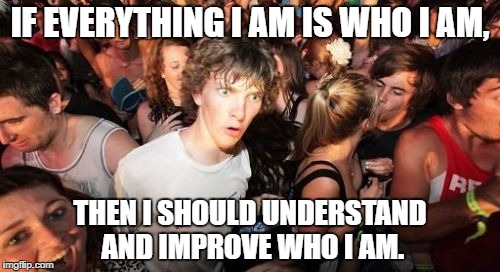
"If everything I am is who I am, then I should understand and improve who I am."


Well, if you can be your favorite you in the present moment, then afterward, you’ll have the perfect past to look back on. Everything I’ve said up to this point may feel more like a guilt trip than an inspirational speech. Nobody can just jump up, become an ubermensch and build an intergalactic empire, but I’m not begging or demanding you to carry a burden. I’m pointing out what an opportunity life is. Every question you ask is a step forward, and the more steps you take, the farther you get. Climbing that mountain yields at least three rewards: the experience of the journey, getting to see above the clouds and being able to say you did it. That’s life, and it doesn’t happen on accident.`


If you enjoyed this post, you’ll also like these:


The Meaning of Life
How to Think Like a Genius
Knowledge and Learning
Biker Philosophy
My Tweets About Philosophy 

How To Become An Expert At Anything

1. State your goals.

The more specifically you identify your goal the more specifically you can focus on it. Saying your goal out loud or writing it down will help you refine your goal and stay focused. However, telling other people your goals can give your brain a false sense of achievement that will deduce your motivation to complete them.


2. Study other people’s research and mistakes, and do it efficiently.

Whatever you’re trying to do has probably already been mastered by someone else. Learn from their research and mistakes. Go read a book about it. Read every book you can find on the subject. Take a class on it. The more external help you can to get the less you have to reinvent the wheel.


3. Practice.

No matter how much you read up on a subject or listen to lectures, that’s only going to help you understand the theory. Take for example the simple skill of rolling a cigarette. I can fully explain everything there is to know about rolling a cigarette in one or two pages, but even if you memorize those instructions word for word you’re not going to be able to roll quality cigarettes quickly and consistently until you’ve rolled at least 200 cigarettes yourself.

Every time you do something the neural pathways your brain responsible for processing that action will grow stronger. The stronger those pathways become the more second-nature the thing you’re doing will become.

Not only that, but throughout your life, you’ve developed a unique and extensive list of good habits, bad habits and different predispositions to ways of thinking and acting. All of these factors influence everything you do. Nobody else knows what all of those factors are. So nobody else’s instructions will be tailor-made for you. The only way for you to understand how your predispositions affect what you’re trying to do is by doing the thing you want to do.

As you practice you’ll come to understand not only your strengths and weaknesses but also the subtle nuances of the task you’re trying to accomplish, and by giving yourself hands-on experience with the task you’ll fully understand why these nuances exist, how to fix/exploit them and eventually how to change them. But those subtleties can only be teased out through hands-on experience.

The point of practicing is to understand the logic of the system better. The more logically and systematically you understand the logic of the system the better you’ll be able to master the system. As you practice, break down the system into its component parts and write a how-to manual for how to do the thing. It doesn’t matter if anyone else will ever read it. It will force you to fully articulate how to do what you’re doing and allow you to take a step back and look at what you know and find the holes in it.

Also, practice all the time. You can’t get good at anything if you only do it once a month. In between practice sessions you’ll forget everything you learned last time and the neural pathways you’ve strengthened in your brain through practice will atrophy. It’s a common misconception that some people are born experts. Mozart and Beethoven are often cited as examples, but in reality, they only appeared to be child prodigies because they devoted their entire childhood to practicing constantly. If you want to master something then practice it every day, preferably several times a day. If you can, devote your whole day to it every day.


4. Learn from your mistakes.

It’s human nature to feel bad when you fail or make mistakes. We tend to beat ourselves up real bad for it, but you never hear about baseball or basketball players beating themselves up for missing swings or throws. That’s because, in their line of work, it’s obvious that the only way to practice is by failing. This is true in any walk of life. It’s simply impossible to master a skill without failing, because failing is practicing, and practicing is the path to success.


5. Constantly ask yourself, “Why am I doing this?”

If you have to force yourself to practice then you’re not doing something you’re passionate about. Oh, you may be passionate about achieving the end goal of becoming rich and famous, but you’re not passionate about the task. So performing the task makes you miserable, and your brain constantly tells you to stop. You can push yourself through that wall for a while, but you’re not going to be able to keep pushing yourself against your will for the decades it’s going to take to master a skill. If you hate practicing them do yourself the biggest favor of your life and quit whatever it is you’re doing, and find something you enjoy doing.

You should want to practice several times a day every day. You should want desperately to cut other time-consuming activities out of your life to give you more time to do what you really want to do: practice. If you’re not like a crack addict going through withdrawals when you can’t practice then you’ve set the wrong goal. Find the thing you can’t live without and practice that, because if you do something you’re not passionate about enough to master it, you’re likely going to grow to hate it and become miserable.

If nothing else, life is short. You’re running out of time to follow your real dream…the dream you would do just for the sake of doing it regardless of whether or not you’ll ever master it.


6. Make crap.

What do you think Leonardo Da Vinci’s first picture looked like? What do you think Mozart’s first song sounded like? I guarantee you it was crap. The road to perfection is paved with crap. Rolling crappy cigarettes is discouraging. Every crappy cigarette you roll is proof that you’ll never be able to roll a perfect cigarette. Even if that’s true, you should keep rolling crappy cigarettes not because your goal is to become a master cigarette roller but because you want to roll cigarettes, and you enjoy the crappy cigarettes you’ve rolled until one day they start coming out perfect, and that day will come quicker than you expected because you weren’t constantly stressing about becoming a master. You were just doing what you want to do and enjoying yourself and learning along the way without measuring success by the end product.


7. Constantly ask yourself, “Should I be doing this?”

Maybe you want to learn how to roll cigarettes perfectly. It’s great that you have a goal, but you picked the wrong goal. All cigarettes do is get you addicted to poison and then kill you slowly and painfully. Life is short (especially if you smoke). Are you making the most of your time? Are the things you’re getting better at really important? Are they worth the time and stress? Are they contributing to your demise or the demise of society at large? Are they a waste of time? If you’re not asking yourself these questions then you might be wasting your life mastering a counter-productive skill.


8. Break the rules and cheat.

Here’s a motto you can live by, “By definition, the quickest and most efficient way to do anything is to cheat.” By “cheat” I mean break the rules. What are the rules anyway? They’re just the standard way of doing things that the people before you established. They’re not written in the fabric of space/time. They’re not like the laws of physics. They’re not even moral imperatives. Rules are just words people said. In order to do something better, you have to do it differently. That means you have to change the rules, and in order to change the rules, you have to break them.


If you enjoyed this post, you’ll also like these:


The Meaning of Life
How to Think Like a Genius
Knowledge and Learning
Biker Philosophy
My Tweets About Philosophy 

10 Steps to Winning An Argument

"Wow, that internet argument completely changed my fundamental belief system," said no one, ever.


Step 1:

When someone tells you something you disagree with, recognize the fact that you’ve been wrong before. Regardless of how absurd their idea is, remember how confidently you once believed the things you now know you were wrong about. The same thing could very well be happening again.

Step 2:

Assume that if this person believes what they’re saying, then they must have a compelling reason to. You might find in the end that it’s not logical, but since it’s strong enough to influence them, there must be something to it. Find out their reasons for believing what they’re saying before you disagree with them. Press them to keep talking. Find out everything there is to know about the topic before criticizing it.

Step 3:

Don’t respond yet. Tell the person, “Give me a few minutes to think about this.” or better yet, “Let me sleep on it. We’ll continue this conversation tomorrow.”

Step 4:

Assume/pretend the other person is right. Block out your beliefs for a time and look at the world through his eyes. Imagine living a life where you walk around believing what you were just told.

Step 5

Consider their arguments objectively. Imagine that you’re a scientist in a laboratory where ideas can be stored in Petri dishes. In one dish is their argument. In another is yours. Take your argument and put it on a shelf. Then take their argument and put it under a microscope. Use logic to dissect it and study it independent of how it relates to your ideas.

Put your initial hypothesis about the outcome out of your mind. This is a clinical study where scientific truth is more important than winning. In fact, the only way to truly win is to arrive at the truth. Furthermore, disregard the source of the idea you’re studying. Just because the idea came from a source you don’t trust, doesn’t mean it can’t be true. The source has nothing to do with the idea. So separate the two for the time being.


Step 6:

Take the results of your scientific dissection and file them away. Then take your own ideas and put them under the microscope. Even if you’ve studied them before, the fact that they’re being challenged means there’s a chance you might have missed something. Consider where your ideas came from. Did you really adopt them because you’d done all the math and arrived at the conclusion this is the correct answer yourself, or did somebody else tell you it was true? Dissect your arguments with the scalpel of logic again. Be brutal about it. Get angry at your ideas. Hate them. Tear them apart with the fury of a lover who just found out your soul mate has been cheating on you.

Step 7:

Compare the results from both of your studies, understanding that the goal of the study isn’t to determine who is right or wrong. Arguments are almost never black and white. You could both be right about some aspects of the topic and wrong about others. The goal of the study is to take the good and bad of both arguments and mix them together to create the real truth. If at the end of the study you accept or reject the opposing idea completely, you probably did your math wrong. If you do find fault on either side, don’t throw the whole petri dish away. If an idea has flaws, then fix them.

Step 8:

If you want, you can present your findings to the person you argued with, but this isn’t necessary. This whole process was never a battle between people. It was really an internal battle in your personal search for truth. Whether or not you can convince the other person of your findings is irrelevant.

Step 9:

If you do decide to continue the argument with the other person, don’t worry about winning. Simply explain your findings to them, and if they don’t like it, then end the conversation. Winning an argument won’t do anything for you except stroke your ego, which is pointless. Only proceed if the other person is willing to learn.

Step 10:

Watch for personal attacks. Once either side throws a personal attack, the conversation is over. Dialogue has broken down, and neither side is listening objectively anymore. So you may as well quit. If you draw first blood, you’re probably the more closed-minded person. If you had logical reasons for your argument you’d be using them instead of calling the other person names. The more you make fun of the other person, the more of a case you build that you either can’t handle the truth or just like to fight.


If you enjoyed this post, you’ll also like these:


The Meaning of Life
How to Think Like a Genius
Knowledge and Learning
Biker Philosophy
My Tweets About Philosophy 

Your Ability To Think Obligates You To

Picture of Dr. House holding a human brain, next to the caption, "If you have one, try to use it please!"


Human beings are biological, sentient, autonomous cosmic supercomputers. You’re smarter and more powerful than the most expensive computer in the world. You’re the rarest and most valuable thing in the universe. Regardless of your personal opinion of yourself, you’re capable of looking at the world around you, identifying problems, solving them intellectually and then enacting your solution. You’re the only being in the universe that we know of that’s capable of doing that. Celebrate that fact, but know that with great power comes great responsibility. It’s your responsibility to think about the world’s problems and then solve them.

That’s an intimidating responsibility, but you shouldn’t have to be guilt tripped into accepting it. You should already be doing it out of selfishness if nothing else. You want to live in a better world, and you have the ability to make it better. You don’t have anything better to do than making the world a better place.

Even if you’re content where you’re at, the future of mankind depends on everyone solving as many problems as possible. The future has to be built brick by brick, and the more people who pitch in, the faster the future gets better. The more people find excuses not to solve problems, the slower humanity progresses and the greater the chance of collapse; there’s a tipping point where if too many people ignore their responsibility to think, then collapse is guaranteed.

We’ve spent our entire lives on the wrong side of the tipping point and don’t even recognize we’re living in a collapsed society. We take gun violence, international wars, sweatshops, invasive, predatory police, corrupt politicians and inefficient bureaucracy for granted. We even celebrate them. What we don’t do though is take responsibility for the world’s problems. We throw up our hands and tell ourselves it’s somebody else’s responsibility to fix all the problems around us. But it’s all of our responsibility to go out of our way and our comfort zone to think and solve problems. The whole reason the world is awash with problems is because most people aren’t thinking. If you’re not thinking then you’re being stupid, and stupid kills.

Evil triumphs when good men do nothing. Doing nothing is evil. It’s the main ingredient in failure. If you want your life to be a success you need to think. If you want the world to become a better place then you need to think. Even if you don’t want to, the rest of humanity needs you to.

Think about this. The matter that makes up your body was present at the Big Bang. You’ve traveled through gas clouds, oceans and atmospheres to get where you are today. You’re a conscious being in a seemingly unconscious universe. You’re wasting your life if you don’t do the most amazing thing you’re designed to do. Think, and let’s build a better world brick by brick, problem by problem.


"What a man can be, he must be." Abraham Maslow

If you enjoyed this post, you’ll also like these:


The Meaning of Life
How to Think Like a Genius
Knowledge and Learning
Biker Philosophy
My Tweets About Philosophy 

The Danger In Telling People Life Has No Meaning

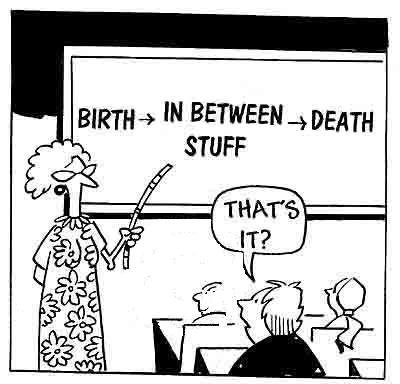
Cartoon of a teacher pointing to a chalk board that says, "BIRTH -> IN BETWEEN STUFF -> DEATH." A student in the classroom is asking, "That's it?"


If there’s no true, pre-set inherent meaning to life then the question, “What did you do with your life?” serves the same practicality as, “What was the purpose of your life?” If there’s no true reason why we’re here then that’s as close as you’re going to get to experiencing and fulfilling any real meaning in your life, and on one level it is real.

Suppose you dedicated your entire life to playing football. Then on your deathbed, someone asks you, “Why were you here?” Well, apparently you were here to play football. It doesn’t matter if that’s what you were supposed to do. That’s what you did. So that’s retroactively why you existed.

Understanding that, if someone asks you what the meaning of life is, and you just smugly tell them, “Life has no meaning…” and leave it at that, then the only influence you’re likely to have on your audience to convince them there’s no point to thinking about the question altogether.

If that happens, they’re still going to end up doing something with their lives. Their life is still going to be guided subconsciously by a primary prerogative…only now they’re not going to be conscious or in control of it. This means they’re just going to let their evolutionary instincts guide them. Their priorities will be to reproduce, conquer and consume, and they’ll fall into the pack or herd mentality and allow the ebb and flow of mainstream culture to define their identity, wants and fears for them. They’ll meander through life as confident as they are blind.

When someone asks you what the meaning of life is, if you say it’s meaningless, you may as well just tell them it’s to mimic your favorite television characters and be a workaholic consumer whore.

P.S. Telling people the meaning of life is 42 accomplishes the same thing.


If you enjoyed this post, you’ll also like these:


The Meaning of Life
How to Think Like a Genius
Knowledge and Learning
Biker Philosophy
My Tweets About Philosophy 

How Do You Find Purpose Without Knowing The Meaning Of Life?

Life is an absurd, existential dilemma because we must go through it without knowing the answers to the most important questions: What caused the Big Bang? Does God exist? Do souls exist? What happens after we die? What’s the difference between right and wrong? What is the meaning and purpose of life?


Our lack of answers to these questions affects our lives every moment of every day. Why do you get out of bed in the morning? Why do you go on living? Is it because you’re working towards a goal that’s meaningful to you or are you just surviving out of habit or because you don’t want to die? Do you even have any personal goals? Are you letting the tides of society determine how you spend your days?

We’re destined to live and die lost, but that doesn’t mean we’re doomed. If you can find a goal that’s important to you personally, and actively work towards fulfilling it, then you won’t feel purposeless and unfulfilled. If you don’t pick a passion and follow it, you’ll feel existentially depressed even if you believe in God and Heaven. So, it’s a moral imperative that you pursue self-actualization.


Nobody is going to cram self-actualization down your throat. You can’t rely on your parents, schools, mentors, bosses, religious leaders or luck to turn you into a fully-realized adult. The social, political and economic systems that run the world aren’t designed to walk you through the steps of growing up and fulfilling your potential. They’re more designed to starve you, grind you down and exploit you. Your life is your responsibility. It’s up to you to study all of humanity’s wisdom and systematically pick out the most useful instructions on how to create yourself.

You’ll find more relevant information on that topic in psychology textbooks than in ancient religious tomes written by warring tribesmen who made human and animal sacrifices to Gods. Parts of your “self” were defined by your biology and the environment you were raised in. So In order to understand yourself, you have to understand how your nature and nurturing molded you into who you are today. Before you can begin working on achieving a goal that brings you personal fulfillment in this absurd, existential vacuum, you have to fully understand yourself: your strengths, weaknesses, aptitudes, tendencies, predispositions, personality type, emotional type, intelligence level, etc. Then you need to use that information to define your wants.


After you define your wants, the rest of your life will be a race with no finish line, as you continue to explore and pursue your passions. Maintaining this level of dedication requires a systematic understanding of motivation and success skills. You don’t need to go to college to find these answers. All the wisdom of history is just a Google or YouTube search away.


If after all that work, the only finish line we’re ever going to cross is death, which erases all our accomplishments, why bother? Well, it’s like climbing a mountain. It’s not the destination that matters, it’s the journey, the pleasure and meaning of which, is determined by how high we climb.


If you enjoyed this post, you’ll also like these:


The Meaning of Life
How to Think Like a Genius
Knowledge and Learning
Biker Philosophy
My Tweets About Philosophy 

Why You Shouldn’t Commit Suicide

Your body is made of start dust that has existed for about fourteen billion years. The history of the universe is the history of how you were born. You’re the universe incarnate. Your body is made of trillions of atoms that form billions of molecules that form millions of cells that form a network of interconnected tissues and organs that all add up to create a walking, talking, seeing, smelling, hearing, feeling, thinking, dreaming, loving, learning, hurting, glowing, reproducing organic machine. The blueprints of your body are incomprehensibly elegant. To say that you’re intelligently designed is an understatement. I don’t know if there’s a God or not, but it looks like a lot of love, attention, and genius went into the design and creation of every living thing in the universe, including you.


Try to imagine what the universe was like before the big bang when the universe was nothing more than something that could have existed. At that first moment, what were the odds that almost fourteen billion years later one small pile of atoms that had been dancing and swimming across the cosmos would coagulate into an inconceivably elegantly designed organic bipedal supercomputer that is self-aware and thinks it’s you? My guess would be the odds of that happening are either one in infinity or zero. I don’t know why we exist or what the meaning of life is, but the rarity and brevity of life sure seem to point to the conclusion that life is inconceivably important… including yours.

If you ever get to doubting your importance, go climb a mountain and watch the sunset and the stars come out. Stand in the cold night air and gape at the oceans of atoms in the night sky swirling through eternity. That’s the universe that gave birth to you, and that’s what you are. You’re a shining, cosmic miracle living in possibly the grandest, most elegant, albeit dangerous, playground that could possibly exist.

Nothing you can ever do or not do will change how important you are. Everyone has their own reasons why they doubt their self-worth, and many of those reasons seem to have merit. We all fall short of our potential, and we all do things we regret. We all hurt people, sometimes very badly. We’ve all done things we’re ashamed of. Even when we think we’re doing everything right, sometimes the world just keeps beating us down until we’ve spent so much time on our belly that we feel like an animal.

The irony of that is, we are all animals. We’re pretty clever monkeys, but we’re more primitive than we tend to admit. Our brains may be cosmic supercomputers, but they don’t have enough storage space to begin to comprehend an iota of the knowledge out there. Since we weren’t born with an instruction book we don’t even know what we’re supposed to be learning anyway. We’re all so lost we don’t even know how lost we are, and that’s how we’ll spend the rest of our lives. The silver lining in the existential despair of existence is that we’re all doing amazingly well under the circumstances. We all deserve a pat on the back for being able to function in society at all. Also, our failures and imperfections were inevitable. You shouldn’t get any madder at yourself or anyone else for screwing up than you would a two-year-old.

Life hurts bad, and it hurts often. Then, at the end of it all, we lose everything. Some of the pain we endure is unjust, but all of the pain we endure is the cost of living. Fortunately for you, even though on one level you’re nothing more than a monkey lost in a storm, you’re also still an intelligent, autonomous, bipedal cosmic supercomputer. You might not be the smartest, fastest, strongest, most beautiful, most successful monkey, but you’re still one of the rarest, most powerful forces in the universe. Your five senses, thumbs, and legs effectively give you superpowers, and the more you learn the more superpowers you can have. As long as you’re breathing, there’s something you can do to find and enact solutions to your problems. You have the power to change your environment. You just need to use your superpowers and never ever, ever quit.


Of course, that’s easier said than done. It’s easy to feel overwhelmed, but help is out there. In fact, you already have more help than you can imagine. It’s important to bear in mind that the universe itself has already spent almost 14 billion years giving birth to you, and it’s still helping the trillions of atoms in your body operate in perfect unison. The gears of the universe are always spinning inside of us, around us and to the farthest corners of the cosmos. The universe is always doing something for you.

Before you were even born, generations of human beings toiled in the mud to keep your bloodline alive. People have fought and died for you. People have devoted their lives to understanding the universe so your generation will be less lost than theirs. You weren’t born in the mud because your generation is being held up by the accomplishments and sacrifices of every generation before you. You’ve been given so many gifts unconditionally by your ancestors that you should feel grateful to the point of feeling indebted.

On the other hand, your ancestors also did a lot of selfish, hurtful things that make life suck. The religious, political and economic systems they handed down to your generation are woefully flawed and cause immeasurable suffering. Even though there are members of your own generation who want to maintain the status quo and keep profiting from the problems in your life, there are millions of people out there willing to be your ally if you just reach out to them. There are some people you’re going to be compatible with, and there are some people you aren’t. If you’re surrounded by people who treat you with indignity and make you feel like a subhuman freak, you need to reach out on the internet and find a tribe you fit into. I guarantee you, it’s out there somewhere.

If your mental health is so low that you’re contemplating suicide, you should reach out to a suicide hotline, an online suicide hotlinesupport group, forum and/or professional therapist. Those resources are out there. Help is out there waiting for you, and seeking help isn’t a sign of weakness. It’s a sign of wisdom.

Sometimes suicide seems like the only solution to your problems, but it’s a permanent solution to a temporary problem, and if you haven’t already sought help then suicide isn’t really your last resort. You still have multiple options before even considering that. If you’re willing to give up everything you have to escape your problems via suicide then there shouldn’t be anything holding you back from sacrificing everything in the pursuit of improving your life via paying for therapy, spending time at support groups, moving to a more peaceful place or traveling the world.


Why make even more sacrifices to stay alive in a world that can be so cold? Because your life is bigger than your pain. Any support group will tell you life gets better, and the harder and smarter you work the better it gets. You might not get everything you want out of life. You may never see Rome or Paris or the Aurora Borealis, but the entire universe is littered with potential awesome experiences. The most rewarding experiences out there are the ones you have with the people you love, and those people are out there either right in front of you or just around the corner. Even if they’re on the other side of the planet, you can still reach them if you’re crafty and tenacious enough.

The more positive opportunities you seize and the more positive experiences you have the more they’ll shape you into a stronger, wiser, more complete person. The better of a person you become the better of a life you’ll experience. As long as you can grow, your life can become more joyful and fulfilling.


Picture of a fortune cookie that says, "The major value in life is not in what you get, but in what you become."


Even if your life turns out to be nothing more than a cosmic accident and your existence is ultimately meaningless, you can still shine in the brief time you have before you die anyway. You don’t have to climb a mountain to find that. You’re already a miracle experiencing a miracle. You can feel that anytime anywhere. All you have to do is let go of your worries and just be.

Yes, there are problems in this world that we can’t just ignore in an oblivious haze of naïve optimism. But if there are problems in your life that you can fix then you should fix them and not worry about them. If there are problems in your life that you can’t fix you should accept them and not worry about them. Either way, there’s no point in enduring life’s problems if we don’t take time to stop and bask in the positive aspects of life as often as possible. That’s what makes life grand. That’s what makes life worth living. That’s why you’re lucky to be alive and why you shouldn’t cut short the priceless, brief opportunity you’ve been given.


If you enjoyed this post, you’ll also like these:


The Meaning of Life
How to Think Like a Genius
Knowledge and Learning
Biker Philosophy
My Tweets About Philosophy 

The Cosmic Perspective (Why It’s Wrong To Hurt People)

Imagine if after you died you had to stand in front of God and/or everyone who has ever died before you and explain why you were so indifferent to (or enthusiastic about) the suffering of your fellow man. Then, after you explained yourself you had to stand with your ancestors and listen to the apologies of everyone else who died after you. What excuses do you think we’d get most tired of hearing? And if we had to apologize for bullying, exploiting and manipulating each other as well, which excuses for those kinds of behaviors do you think we’d get tired of hearing the quickest?

Part of me wants to believe we live in a just universe and that there’s some kind of fairness in death, but it would be entirely fair to force us all to stand around and shake our heads at ourselves until the universe blinks out of existence. So as it stands, the theoretical, unprovable possibility that the universe is fair terrifies me, and even if there isn’t any kind of afterlife at all, the survival of humanity still depends on us not hurting each other. Either way, we should all be asking ourselves what went wrong? What’s going wrong? Why do we keep hurting each other?

If you want to understand why people hurt each other, you can start by listening to everyone’s excuses and looking for common denominators. If you do that, the first thing you’ll notice is that humans are experts at making excuses. Everyone who hurts anyone has a reason why they believe they’re doing the right thing, but no matter how solid our reasons sound, they always overlook one simple detail that trumps our excuses: the value of human life.


If we truly appreciated the value every human being brings to the universe, then we’d never hurt one. We’d go out of our way to make sure everybody had enough of everything without needing to be ordered or guilt tripped. We certainly wouldn’t hold other people down and take what little they’ve got.

Based on the evidence I see around me, I don’t think the disconnect between how valuable life is and how valuable we treat life comes from the fact that we’re too dumb to understand how valuable life is. Based on the evidence I see around me, I think we’re just too dumb to teach it to our children. In fact, we’ve been systematically indoctrinating children (the future hope of humanity) to believe in mythologies in which human sacrifices have to be made to atone for humanity’s innate despicableness. Of course people are going to act crazy when you give them that kind of moral compass.

You don’t need a book or a prophet to tell you how valuable life is. Just go spend a night camping on a safe beach far away from the city lights. Spend a few good hours staring at the stars and soaking up the enormity and beauty of the universe. You won’t find a catchphrase written in your native language up there that describes in bureaucratic detail why life is valuable and how it should be treated. You’ll just see the universe laid bare outside the warped lens of your ancestor’s culture.

As you’re staring up at the sky imagine floating in outer space among the stars looking back down at the earth. From that vantage point, you can easily see that life is a treasure 14.6 billion years in the making, and it doesn’t matter which words you use to describe it. If you can simply look up and see the truth of that then how can go back to work and yell at another living, breathing human being about how the most important thing they can be doing with their life right now is turning in paperwork and if they don’t turn it in on time they’re going to get in so much trouble it’s going to set back their entire future as punishment for being such a criminally substandard human being? How could you rob poor people? How could you inflate half-truths to justify going to war?


If you can’t see why it’s wrong to hurt other people then you’re not spending enough time looking at the stars. When you see other people being mean you can be certain they’re not evaluating the value of life from the cosmic perspective.


If you enjoyed this post, you’ll also like these:


The Meaning of Life
How to Think Like a Genius
Knowledge and Learning
Biker Philosophy
My Tweets About Philosophy