If You Don’t Believe In God, What Do You Do Now?

Cyanide and Happiness comic of two people talking by a tree: Person 1: There is no God. Our existence is without purpose. Person 2: Oh, definitely. We are adrift in an uncaring void indifferent to all our mortal toil. Person 1: Exactly! In the end, nothing we do matters. Person 2: Totally. Person 1: We just... why are you climbing that tree? Person 2: Because the future is an adventure! Come on! Person 1: But... Person 2: Hey! I found squirrels!


Even if there really is some force somewhere out there in the universe that fits some definition of the word “God,” that doesn’t change the fact that all of the religions humans have written into books are mythologies. They’re based solely on ideas human being made up, not divine intervention.

You shouldn’t cling to a belief system that isn’t based in reality. That’s immature. Part of growing up is understanding reality and acting accordingly. The reason being sane is mature is because thoughts and actions based on reality are more meaningful and more productive than thoughts and actions based on fantasy.

Granted, at least mythology is something. It feels safe and secure. It gives your life some kind of structure and purpose even if it’s twisted. Like a drug, once you get used to it, the prospects of living without it can be terrifying. Without it, you can easily feel completely lost, like you’re doomed to walk the earth with no direction, purpose, hope or motivation until you wear out and die… for no reason.

That’s a legitimate concern that everyone who stops believing in mythology has to face. What do you do with your life if you’re not basing your decision on an instruction book? These questions may seem dizzying at first, but there are answers to life’s questions, and a lot of them are basic common sense.


If you’ve left religion and are feeling lost, here are a few things you could be doing to bring structure and meaning to your life outside of religion.


1: Commit to finding your own answers.

If you’ve stopped believing in mythology I would strongly advise against resting on your laurels and spending the rest of your life patting yourself on the shoulder for figuring out that the universe wasn’t created by a bi-polar unicorn as you go about your business simply commuting back and forth to a job you don’t really like and spending your evenings watching television, giving yourself diabetes, and popping out children to make you feel like at least something good and long-term came out of your life. Granted, going with the flow and ticking off all the boxes society tells you to is still preferable to believing in mythology, but there’s more to life than that.

If you’ve stopped believing in mythology, then the first thing you should consider doing is donning the responsibility of figuring out life for yourself. To this, you might reply, “But nobody knows or will ever figure out the meaning of life. I’m certainly no Socrates. So where does that leave me?”

Even if it’s true that you can’t conclusively prove the meaning of life, you’re still here. You still need to figure out some kind of philosophical framework that explains what you should do here despite the fact that you can’t know the ultimate meaning of life. To this, you might reply, “But that’s so vague and really hard.”

To that, I would reply, “Welcome to the universe, life and growing up.” That’s the hand we’ve been dealt. The sooner you stop complaining about it and start addressing it the sooner you can chisel out some meaningful and useful answers.

To this, you might reply, “You still haven’t explained why I should do any of that. What’s the point if we just live in an inanimate universe and that’s it? Why should I bother accepting this supposed responsibility of becoming a philosopher?”

To that I would reply, “Have you ever looked up at the night sky? The universe is a mind-blowingly vast yet intricate place. It’s nothing short of awesome. And the fact that organic life exists at all, let alone organic life capable of contemplating its own existence and deciding its own fate, makes the universe all the more amazing. Life is so surreal and amazing we should all just be sitting around all day staring at our hands in perplexed awe asking ourselves, “How is this even possible?”

Life is the rarest, grandest adventure. It’s not something to be mourned, feared or ignored. It’s there for the taking. Everything good is laying out there before you. It’s up to you to take it. You’re responsible for embracing that responsibility in the same way that if someone gives you a free all-expense-paid trip to the best amusement park in the world, you have a responsibility to not let that opportunity slip through your fingers. It’s not like you have anything better to do.

You can’t make the most out of life if you don’t understand it. So if you’re feeling lost, a great place to start getting your bearings is at school… or anywhere you can learn something new.


2: Define the value of human life.

If the prospect of figuring out life for yourself seems overwhelming, it may just be because you’re making it harder than it has to be. The corner-stone of any overall life philosophy is the value of human life. Once you establish what that is then a lot of things will fall in place. So figure that out. Then write your answer on a piece of paper and stick it to your refrigerator door with a magnet.

To this, you might reply, “Oh, well that’s easy. Life is infinitely valuable.”

To that, I would reply, “See. That wasn’t so hard, was it?”

But make sure you articulate a reason why life is valuable. The more concrete your reasoning is, the more useful it will be. The vaguer it is, the less it will mean anything to you, and the easier it will be to act contrary to that belief.


3: Create a logical system of ethics.

Once you’ve established the value of life, then you can ask yourself what logical implications that has on how you should treat others as well as yourself. The more you explore that question, the more guidance you’ll have in life. You can and should constantly question your answers and update your code of ethics. The more you improve your system of ethics, the more useful it will be. The less you define it, the more haphazard of a life you condemn yourself to.

Some of the ideas you come up with may already be written down in one or more mythological texts. Feel free to take those concepts and ignore the bad ones. Consider every idea you find regardless of the source, but don’t take or reject any of them on faith.

Write your conclusions down. That forces you to articulate them, and if you can look at all of your ideas on paper it will be easier to update them, fill in the gaps, see where they’re going and add to them, consolidate them, share them and get feedback on them.


4: Achieve self-actualization.

Even if we don’t know the meaning of life, we still know we exist. We’re proud of the fact that we’re the only beings in the universe who know we exist, can articulate that fact to ourselves and have unique names and identities. We’re proud to be alive, and we’re proud to own our own identity. Who you are is priceless, and you knew that before you ever learned to read. The thing about that is, if it matters who you are then it matters who you become. You have the potential to become more you, and that’s a big deal.

The more you grow and find/create yourself the easier, more enjoyable and meaningful life will become. Growth is its own reward, and it affects every aspect of your reality. After all, your mind is your reality. Everything you know and experience happens in your mind. When you improve your mind you effectively improve your entire universe. If you want your life to be ten times better than it is now, then learn ten times more knowledge. Reflect on your life ten times more. Ask ten times more questions. Become ten times more self-actualized, and your life will get ten times better. Even if there are external forces like shitty bosses and unmanageable bills that are making your life suck, you’ll be ten times more likely solve those problems once and for all if you become ten times more self-actualized.

If there really is any such thing as a soul that maintains your unique perspective after death, then it must be based on your identity… or at least, that’s what we hope. We hope that the conscious sum of our identity and perspective continues to exist after we die. Well, if you’re so worried about what happens to your soul after you die then you should be putting an equal amount of emotion into cultivating who you are before you die and don’t have any more chances to improve the one thing you expect to take to eternity.


5: Do what you will, harm no one.

What do you do with your life if there are no ultimate answers and we were all born doomed to wander the earth so lost we don’t even know how lost we are until we finally die a meaningless death that is unaffected by our mortal deeds?

Well, have you ever tried swimming? If you’ve never been swimming, it’s pretty fun. You should try it. If you have tried it, and you liked it then you should think about doing it again. Sex is also good. I highly recommend safe sex. And if you ever make it to Italy, try the gelato. It’s to die for.

If you’re still looking for something to do, there are plenty of rewarding hobbies available on earth as well. If you liked swimming you could get into scuba diving. Other things that a lot of people find really rewarding are: hiking, skydiving, drawing, painting, sculpting, making music, theater, construction, teaching, designing… the list goes on.

Life is here to be lived, and there are a lot of fun, rewarding things to do out there. Go do them. That’s living. That’s where happiness comes from. You don’t need to be a prophet or a professional philosopher to know that it’s important to enjoy the world we were given.

More importantly, having new experiences and doing the things you love is half the process of finding/creating yourself. So if you don’t know what else to do in life, go have some fun. You might find yourself along the way.

Just don’t hurt anyone. You may have the might, but you don’t have the right.


6: Make the world a better place.

If you just can’t make heads or tails of life and are completely confused about what to believe or do, the very least you could do is try to make the world a better place. And it’s a safe course of action if you believe there’s any chance that reincarnation, karma or the afterlife are real. If you’re gripped with fear over what happens after you die, you should consider exerting that amount of emotion into making the world a better place. If you think the answers may be out there but we’re just too primitive to grok them, you should consider devoting some of your time and energy to making the world a better place for future generations to set them up to fulfill humanity’s potential. If you value life at all you should devote some of your life to making the world a better place.


If you enjoyed this post, you’ll also like these:


Agnosticism 
Atheism
Secular Living
Islam
The Bible is mythology
Christianity is Harmful to Society
Preaching, witnessing and arguing with Christians
Christian Culture
My Tweets About Religion

Are You A “Meta Atheist” Or A “Pop Atheist?”

I recently wrote a blog lamenting that Atheist subculture is attracting disingenuous members, and I predict that this trend will continue until Atheists are actively trying to disassociate themselves from idiots who do stupid things in the name of Atheism just like how “good” or “true” Christians have to disassociate themselves from child-raping priests, The Westboro Baptist Church and ordinary suburbanites who make no attempt to actually live like Christ.


Admittedly, this whole topic is a bit silly, because Atheism is merely the lack of a belief in God. It’s a non-entity. To say that Atheism is a religion, culture or identity is like saying not collecting stamps is a hobby or that bald is a hair color.  If you can’t lump “not-stamp-collectors” together into a group and talk about what “not-stamp-collectors” are doing, then how can you talk about Atheists as a group and what Atheists are doing? Well, you can because Atheist have chosen to identify as a group, wear Atheist labels, and create Atheist communities with a budding Atheist culture. I didn’t start this fire. I’m just watching it and talking about it.

The fact that human beings have made a subculture out of Atheism is neither good nor bad. It all depends on what human beings do with it.  Some humans will take the Atheist subculture in a productive direction, but there’s a growing number of idiots who identify as Atheists and are going to screw it up for everybody else. I divide these two groups of Atheists into what I call “Meta Atheists” and “Pop Atheists.”

Meta Atheists are people like Sam Harris and Richard Dawkins. They arrived at their Atheism through a rigorous, lifelong quest for truth. Now that they identify as Atheists, they’re still pushing the limits of their own understanding as well as the limits of human understanding. They’re more likely to be quoted by Atheists than to quote other Atheists, but any instance when they identify as Atheists, or quote other Atheists, or do anything Atheist-related, is merely a by-product of their search for truth.


Pop Atheists are not engaged in a rigorous, lifelong quest for truth. After reading a few books and a few internet memes they accepted that the universe wasn’t created by a magical unicorn, but once they embraced that elementary fact they went out and bought a $50 T-shirt that says, “MY HOBBY IS NOT COLLECTING STAMPS!” and have spent their life ever since then insulting Christians on the internet. Their Atheism is not a means to an end. It is the end destination, and they will spend the rest of their lives wallowing in it…or at least until they move onto the next big fad.

Meta Atheist and Pop Atheists aren’t mutually exclusive. They’re opposite ends of a scale. The main difference is that one thinks proactively and objectively. The other thinks reactively and subjectively. This outlook on life leads them to behave differently, but nobody thinks completely proactively/objectively or reactively/subjectively all the time.


Here are a few signs you might be a Meta Atheist:

1: You don’t believe in God. You believe that  Judaism, Christianity, Islam, Buddhism, Hinduism, “Mormonism,” Scientology and Wicca are mythologies entirely invented by humans. In addition to all that….

2: You’re engaged in a lifelong quest for truth and understanding. You may identify as an Atheist, but you identified as a truth-seeker before you arrived at Atheism. Not that you feel the need to back up your claim to be a truth-seeker, but if you had to you could produce a growing list of books you’ve read that are not on the best-seller’s list. You can also explain a pattern of conscious decisions that led you to seek out these books; they weren’t just random books that fell into your lap. You can also produce a stack of notes you’ve taken personally that show how you’ve made a conscious and objective effort to tweeze patterns of truth out of what you’ve learned.

3: You have an articulate philosophy on ethics that you actually use. If a child came up to you and asked you, “What’s the difference between right and wrong?” or “What’s the most important piece of advice you can give me?” You’ll have an answer ready to go since all you’ll have to do is give the answers you live by. You won’t say, “Uh, well, you know? I think we all just…” And you won’t give any answers that are vague to the point of being useless like, “Be good to everyone.”

4: You’re not a dick. You don’t take joy in tearing down other people. You’re not vindictive, and when you argue it’s not to win, it’s to arrive at truth.

5: Your identity isn’t strongly defined by your association with popular subcultures. Sure, you might like Star Trek, but you’re not a Trekkie. You might have been to a football game, but you don’t own a room full of football memorabilia.

6: You don’t watch TV for 7 hours a day and listen to “the hits of the 70’s, 80’s, 90’s and today” every moment you’re in your car. You don’t constantly bombard your brain with pop culture. If you know what “American Idol” is, you hate it for everything it is and everything it isn’t.


Here are a few signs you might be a Pop Atheist:

1: You don’t believe in God. You believe that Judaism, Christianity, Islam, Buddhism, Hinduism, “Mormonism,” Scientology and Wicca are mythologies entirely invented by humans. In addition to all that….

2: Your identity is rooted inseparably to Atheism. Here’s a test you can take (or give). Draw a blank mind map on a piece of paper. In the middle circle write down what you identify most as. Then in the surrounding circles write down what you identify as in a secondary fashion. A pastor might put “Christian” in the center circle. Then in the secondary circles, he might put, “husband, father, citizen.” In a tertiary ring of circles, he might put, “American Idol fan, long-distance runner, traveler.” If you would put Atheism in that center circle you might be a Pop Atheist, because a Meta Atheist would likely put something like “sentient start dust, life form, mammal, human being, or truth-seeker” in the center circle.

3: You’ve spent a shit load of money on Atheist-themed merchandise.

4: You’re a dick. You savor winning arguments and tearing other people down. You will not accept defeat. You must have the last word.

5: You left religion for subjective reasons like you hated your Christian father or you decided God doesn’t exist after watching your grandfather die a painful death from cancer.

6: You can point to a place in a book, movie or song where you learned everything you know. Don’t get me wrong, learning is vital. But if you’ve never figured anything out on your own and the extent of your beliefs is a list of regurgitated footnotes…then you’re not a meta thinker; you’re a product of your environment, and you’ll never break free from that box. The only hope you have of growing is if someone else pushes the limits of human knowledge, writes about it and you stumble upon that book.

7: You gorge yourself on popular culture day in and day out. You’ve seen every episode of every prime-time sitcom as soon as it came out. You love pop music. The best night of your life was at a concert. You’re on top of the latest fashion trends. You identify with pop culture. You think wearing a “Star Trek,” “Star Wars,” “Bieber Fever,” or “Cannibal Corpse” shirt makes you cool.


If you enjoyed this post, you’ll also like these:


Agnosticism 
Atheism
Secular Living
Islam
The Bible is mythology
Christianity is Harmful to Society
Preaching, witnessing and arguing with Christians
Christian Culture
My Tweets About Religion


Predictions On The New Atheist Movement

The only difference between a New Atheist and an Old Atheist is that New Atheists live in a time when it’s socially acceptable to be an Atheist, and Old Atheists lived in a time when it wasn’t. I draw the line in the early 2000’s when authors like Sam Harris and Richard Dawkins made it cool to be an Atheist.


Dates aside though, New and Old Atheist’s have the same core ideology (or lack thereof). They believe there is no God, and religion is mythology. At least, that’s what a linguist would tell you, but New Atheism isn’t just a word in a dictionary. It’s a social movement. It’s a meme, and it’s evolving at the speed of society.

After 100 years of evolution, I believe Sam Harris and Richard Dawkins will be rolling in their graves as New Atheism will come to resemble the the ugly religious movements it takes so much pride in distinguishing itself from now.

Religion is defined:

“1: a set of beliefs concerning the cause, nature, and purpose of the universe, especially (but not exclusively) when considered as the creation of a superhuman agency or agencies, usually involving devotional and ritual observances, and often containing a moral code governing the conduct of human affairs.

2: a specific fundamental set of beliefs and practices generally agreed upon by a number of persons or sects”

I challenge you to go on an Atheist chat board and declare Atheism is a religion and see what happens. Every argument you find on the internet for why Atheism isn’t a religion may be technically true, but outside of the debate chambers something interesting is happening:


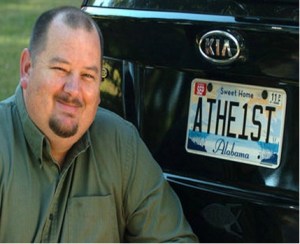
Photo of a man sitting next to his car, which has a license plate that reads, "ATHE1ST."


Photo of a man holding up a fake license plate that says, "Jesus paid it all!"


Picture of a T-shirt that says, "Born again. I didn't turn our right the first time. John 3."
 
 
A few pieces of tongue-in-cheek merchandise do not constitute a religion, but what you see here are the first stones being laid in a path that leads to religion. The individuals buying all this Atheist merchandise today may never go all the way down that path. The individuals wearing Atheist shirts, putting Atheist license plates on their cars, listening to Atheist music as they drive to a convention center to hear an Atheist author speak about the book they’ve written on Atheism may just be doing all that as a form of social protest against the oppression of Atheists at the hands of Christians, and that’s great.
 
I would say, “Long live social progress!” but somewhere out there are legions of idiots who feel lost in this great big, mysterious, lonely, cold universe we live in and are looking for answers and a sense of identity and will gladly latch onto any social movement that will offer them that sense of closure and belonging they’re looking for. Those legions aren’t going to latch onto a social movement or a systemic explanation of the universe because it makes sense. They’re going to latch onto whatever is most popular, and if they see one group of people being smug, condescending assholes to another group of people they’re going to join the smug, condescending assholes because they would rather be the one picking on outsiders than the one being picked on.
 
Look at Christian culture. 99.9% of Christians don’t act at all remotely like Christ in any way whatsoever. The average Christian has no idea what the Bible even says aside from the quotes printed on whatever sweatshop-made Christian merchandise they bought at their nearest Christian megastore.  And yet they’ll defend their beliefs (or rather, their identity) to the death despite the fact that they don’t even know what it is they believe in, and what they actually believe contradicts what they claim to believe. Those idiots didn’t choose to be Christians because they looked at all the belief systems presented to them, studied them and picked one based on objective reasoning. They just jumped on the first bandwagon that rolled by and refused to get off.
 
Well, the Christian bandwagon is finally breaking down, and the Atheist bandwagon is picking up speed. Naturally, it’s picking up idiots at an exponential rate. Those idiots are going to drag down Atheism the same way they did Christianity. Atheism may not be a religion today, and there might not be brick and mortar churches of Atheism with ordained Atheist evangelists, but give it time. That day will come, and it’ll probably come sooner than you think.
 
That might not be a bad thing. In the New Atheist’s scramble to differentiate themselves from old school mythologists few of them have stopped and considered that maybe Atheism should be a religion. Just because old school mythologies committed countless atrocities in the name of God and continue to drive people insane, teach immoral behavior and cripple society that doesn’t necessarily mean Atheism has to end up down the same dead-end road as it evolves into a specific, fundamental set of beliefs and practices generally agreed upon by a number of persons or sects.”
 
But you can always count on idiots to screw up a good thing. I predict that idiots will hijack and screw up the New Atheism movement. In fact, I reckon that process has already started, and it’s not a matter of when the degeneration will begin but how fast it will progress. It’s only a matter of time before an idiot who identifies as an Atheist beats up and/or kills someone for their opposing beliefs… not because Atheism makes people insane and immoral, but because stupidity makes people insane and immoral, and the number of idiots who are taking advantage of calling themselves Atheists is growing every day.
 
Update: Turns out I was right. New Atheists are becoming their own worst advocates.
 

If you enjoyed this post, you’ll also like these:


Agnosticism 
Atheism
Secular Living
Islam
The Bible is mythology
Christianity is Harmful to Society
Preaching, witnessing and arguing with Christians
Christian Culture
My Tweets About Religion


Do Agnostics Believe In Intelligent Design?

There’s a scientific organization known as S.E.T.I whose purpose is the Search for Extra Terrestrial Intelligence. The founders of this organization asked themselves how you would scientifically deduce the existence of intelligent life in the universe if you couldn’t directly shake hands with an intelligent alien. They concluded that if you can find patterns in radio waves coming from deep space that are too orderly to happen randomly in nature, then it would be logical to conclude that those patterns were coded by an intelligent being.


For example, if an alien spaceship flying past Earth picked up a radio transmission of an Elvis song they would know there is (slightly) intelligent life on Earth because that song is too orderly to happen randomly in nature. But what if it wasn’t an Elvis song they heard? What if it was a code describing in detail how to build an android? If aliens heard that coming from earth they would know there was extremely intelligent life in this galaxy. But what if that code wasn’t sent via radio waves? What if they found a box floating through space containing a single solid-state computer chip that held the code? That would still be too orderly to exist randomly in nature.

If the scientists at S.E.T.I. found such a computer chip floating around Earth they would conclude it was intelligently designed. But what if the code wasn’t in a chip? Would it matter where we found the code, as long as we found a logically patterned code somewhere in something?

Well, look at our DNA. It’s a code. The code is a program. The program is for the design of an intelligent being that is capable of self-direction and self-awareness. Its body can process resources to generate its own energy, repair itself and even create new robots.


Now let’s take a step back and look at the rest of the living creatures on planet earth. Each living thing contains similar codes. These codes even overlap between species. Humans, reptiles, fish, and birds (to name a few) all have eyes. Dissimilar species have lungs, feet, skin, reproductive organs, hearts, skeletons, etc. One or two examples would be a coincidence. The extensive number of similarities constitutes a clear pattern. The pattern indicates order. Order indicates these similarities aren’t an accident; the code is designed that way.

Consider also how these patterns came to exists. All of these species didn’t pop into existence 6,000 years ago. They evolved over millions of years. Since evolution has produced patterns, we can conclude that there is an element of order in the process of evolution. Evolution isn’t completely random. Taxonomy isn’t random. Hereditary traits can be predicted because they’re not random. Mutations may be random, but every child born with ten fingers, ten toes and two eyes are the product of order.

When we use the same criteria for identifying intelligent life that S.E.T.I. uses, then evolution is probably the best evidence we have for the existence of an intelligent designer. Having said that, even if God does exist, religion is still mythology.


If you enjoyed this post, you’ll also like these:


Agnosticism 
Atheism
Secular Living
Islam
The Bible is mythology
Christianity is Harmful to Society
Preaching, witnessing and arguing with Christians
Christian Culture
My Tweets About Religion


Do Agnostics Ask, “Why Is God So Cruel?”

Picture of bodies in a pit from the Holocaust


As an agnostic, I find enough evidence in the physical universe to leave a reasonable doubt that some force may exist somewhere out there that fits some definition of the word, God. This leaves me in a position to wonder why a God, even a vaguely defined, theoretical one, would allow so much suffering in the world it created.

I’ve heard high school aged anti-theists say they don’t believe in God because no God would be as cruel as the one in the Bible. This is a logical fallacy. I’m convinced that all the religions invented by our ancestors are mythologies that have stayed on the shelf past their expiration date. Any stories of God murdering “His” chosen people’s enemies are just more evidence religion is mythology.

It could be true that God exists and religion is mythology. It could also be true that God is just cruel. The existence of pain and suffering in the real world doesn’t mean there is no God. Whether or not you like something has no bearing on whether or not it’s true. If God is cruel though, it brings us back to the question, why does God allow child cancer, abject poverty, and war crimes to exist?

Personally, I find it hard to resent the theoretical creator of the universe for all the suffering in the world, because if God is truly omnipotent and omniscient, then that means God knows and experiences everything that happens. If that’s true, then God has experienced every drop of pain that has ever happened: every shooting, every beating, every disease, every tear.

If that’s true, then God hasn’t just experienced every instance of human pain. God has experienced it for every other living thing to ever exist. If God was looking through the eyes of every animal that ever got torn to shreds, then the question, “Why does God let bad things happen?” becomes, “Why would God go through all the pain in the universe to bring us here in the first place?”

The same concept might also be a little bit true even if there is no God. If the universe is all that exists, then life is the universe incarnate. Our blood and tears are the universe’s. So why would the universe sublimate life, if it meant damning itself to every ounce of pain that has or will ever exist?

The thing about questions is, God doesn’t answer them. The only way humans have ever gotten any answers to any questions is by studying the data they have and asking themselves the questions.

I don’t know how or why the universe was created the way it was. All I can do is look at what’s here and try to connect some dots. I know in this universe, there exists elegance in nature, consciousness, pain, and happiness. I know I value my life, and I was born with the ability to hope, love, want, cry, play, create, and above all, be.

So immediately, I have to give credit where credit is due. I couldn’t say any of that without existing in God’s Matrix in the first place. So any whining I do is from an ivory tower. Even though humans have experienced unspeakable misery on this planet, we were given the tools to make life better. We were given hands, eyes, bi-pedal legs, opposable thumbs, and most importantly, brains more powerful than any supercomputer.  We were not left alone to die in the rain. We were given everything we need to create a world where joy eclipses sorrow. We’ve just chosen to use our gifts to hurt each other. So when I see pictures of corpses of children riddled with bullets, I feel ashamed to blame the same higher power that gave us everything we need to end those atrocities.

It doesn’t take a psychologist to figure out joy is relative to pain, or a poet to observe that “the summer would not be so sweet were it not for the winter.” The bigger question is, is the cumulative pain of every living creature in history worth the joy of existence? If the math didn’t add up, I couldn’t imagine life would exist in a universe as mathematical as ours.

There’s nothing illogical about how this universe operates. If things like death, suffering and quantum physics seem illogical to us, it’s just because the universe is smarter than us. We can’t answer the question, “Why would God be so cruel?” because we don’t know shit about shit. One thing we do know about the universe is it operates according to brilliantly logical mathematical equations that create perfectly operating universe’s, planets, atoms and subatomic particles. So, if all that stuff is working so brilliantly, and suffering is part of that design, then maybe suffering is as necessary as gravity.


If you enjoyed this post, you’ll also like these:


Agnosticism 
Atheism
Secular Living
Islam
The Bible is mythology
Christianity is Harmful to Society
Preaching, witnessing and arguing with Christians
Christian Culture
My Tweets About Religion


Do Agnostics Fear Death?

I can’t speak for all agnostics, but I can offer my perspective on death. I don’t know if there’s a God or an afterlife. I don’t know why we’re here or what happens after we die. I don’t know how much our lives matter, or if they even matter at all. But I do know one thing, that the universe is amazing. Its size, complexity and power are unfathomable.  Its design is beyond genius. The more I dwell on what little I know about the elegance of the observable universe, the less I worry about death.


"Everything we call real is made of things that cannot be regarded as real. If quantum mechanics hasn't profoundly shocked you, you haven't understood it yet." Neils Bohr


As scary as death is, I take solace knowing that our life and death were engineered by the same genius that designed the stars. If I had to pick someone to determine my eternal fate, I’d pick whoever or whatever designed the universe. Even if the universe is simply the product of existential probability, I would volunteer to put my fate in the hands of existential probability, because apparently, it’s doing a really good job so far. Conveniently for me, the same force that created the universe is the very force that will determine my fate. So… whew.

For selfish reasons, I would like for my consciousness to continue to exist after the death of my physical body, but I’ve never seen any hard evidence to support that that’s even a possibility… except for the fact that I came into existence once against all probability. If it happened once, there’s a statistical precedent that it could happen again. Surely, the same force that created this universe could create another opportunity for us if it were logical to do so. And it did see fit to give us this opportunity. So why not another?

But even if I just go into an eternal, nonexistent sleep when I die, I’ll preemptively accept my fate graciously. That wouldn’t be my first choice, but everything the universe has done to create and manage life has been “good” so far. So, as much as my survival instincts make me hate the idea of eternal unconsciousness, if the same power that manages the subatomic particles of stars has computed that it’s logical for me to spend eternity in a nonexistent sleep, then who am I to argue?

Even if I’m wrong about most of this, any fool can look at the night sky and see that we’re part of a grand design, and that design is awesome. If death is a part of the majestic work of staggering genius that is the universe, then whatever happens after death will be mathematically logical, if nothing else. But… since we’ve already got the weight of the universe pushing in our favor so far, we’re in as good a position as we can be to hope for the best.


If you enjoyed this post, you’ll also like these:


Agnosticism 
Atheism
Secular Living
Islam
The Bible is mythology
Christianity is Harmful to Society
Preaching, witnessing and arguing with Christians
Christian Culture
My Tweets About Religion


Recommended Intelligent Books And Videos

I’ve had a few people ask me to recommend good, intellectual books to read and videos to watch. So I’m making an ongoing list:

Books

Documentaries

Movies

Pseudo Intellectual Junk

These will not make you smarter. They will make you feel smarter without nourishing your intellect. Avoid them or approach them with brutal skepticism.)

Who’s Afraid of the Big Bad Books?

These books are demonized in the Western World (some of them for good reason). As a result, they’re useful to challenge your conventional upbringing by looking at the world from the point of view of your culture’s enemies. Seeing the world from extreme perspectives will help you center your perspective and will help you understand how other people think. If nothing else, if you’re going to make enemies out of people who think differently than you then you may as well at least be informed about what it is they think.
 

If you enjoyed this post, you’ll also like these:


Knowledge and Learning
How to Think Like a Genius
My Tweets About Philosophy 
The Importance of Public Education
Flaws in the Public Education System
Improving Public Education


How To Read For Truth

The quality of your person is equal to the quality of the information in your brain. This means that if you hope to grow up and make the most of your life, you need to consciously and systematically undertake a lifelong quest to gain and refine the quality of knowledge in your brain.

In a Utopian society, the path of knowledge would be well paved and streamlined. Every level of education would be free for anyone of any age, and every curriculum would be painstakingly edited for objectivity and clarity. Unfortunately, humanity has opted to devote more of its resources to killing each other than raising each other.

The good news is that you live in the information age. Technology allows the average person access to more information than kings in ancient times had. Unfortunately, freedom of information has come with a cost. When production and distribution of information was largely controlled by wealthy publishing houses, information was expensive and had limited distribution channels but did a pretty good job of filtering information for quality. Today anyone can publish anything and put it on the Internet right next to the most professionally crafted literature humanity has ever produced.

As soon as the internet was invented, journalists started warning us that equal access to information distribution would result in a fog of white noise that makes it exceedingly difficult to find the quality information, and I’m sad to say that the situation is even worse than that. The problem isn’t just that there’s too much information written by amateurs who can’t write coherently and don’t do a professional job of fact-checking their data. There are news outlets with biased agendas bending the truth and misleading their consumers for their own benefit. Even the consumers themselves are guilty of mangling the truth by littering social news sites with their insane, or at least misinformed, editorial comments.


This situation isn’t fair, but life isn’t fair, and your life is your responsibility. So it’s up to you to sift through the white noise and misinformation to arrive at truth on your own. You can point fingers all day long at writers for not doing a good job of paving the way to truth, but you’re really the biggest obstacle standing between you and enlightenment.

As a child, your brain soaked up all the knowledge available to you in your environment like a sponge, but your ability to use formal reasoning didn’t develop until after you’d already established your perception of reality. In other words, during childhood, you just assumed that what you learned was true, but a lot of it wasn’t, and all of it was filtered through your subjective culture. This means you were doomed to grow up with a warped perception of reality. We all were, and to make matters worse, there may not be one true perception of reality. So not only were we born so lost we didn’t even know we’re lost, we’re probably doomed to be lost by degrees our entire lives no matter how many of our misconceptions we slay.

This is made all the direr by the fact that we don’t know what we don’t know. So the tendency is to assume that what we know is all we need to know (or close enough). You’ll find conceited people who are totally convinced of their intellectual mastery from every walk of life, from the most inbred redneck to the most ordinary office secretary to the most tenured professor… and they’re all wrong.


Every individual in the world will be guilty of being conceited about being smart at some time/s in their lives, which is bad enough, but when everyone in a society does the same thing, that behavior becomes a part of their culture. This is why every culture in the world tends to assume it’s the best culture in the world. Xenophobia, ethnocentrism, and patriotism aren’t mistakes only the worst humans make. They’re an inevitable product of the human brain. So no matter where you were born, I can guarantee you that your culture tends to celebrate its obsolete past and demonize beliefs and behaviors outside of your ancestors’ experience. Since culture tends to blindly label anything outside of its past experiences as bad, that means popular culture tends to demonize progress because progressive thought is inherently deviant thought.

Ironically, the fact that humans are born with their minds set to auto-reject isn’t a flaw in the design of the brain. Our brains are supercomputers that receive, process, store and recall an astronomical amount of information every moment of our lives. Our brains have to manage all this information while also operating a body that grows, generates its own energy, processes waste, heals itself and reproduces. This necessitates that the brain process information as efficiently as possible, which it does partly by saddling the subconscious mind with the burden of making as many decisions as possible. It does this by assuming that whatever it has done in the past to survive will ensure its survival in the future. This means we’re all born on autopilot. We learn schemas and repeat the same patterns of thoughts and behaviors the rest of our lives while tending to automatically reject any new and unfamiliar information and then reverse engineering reasons why afterward.


You can see the human autopilot function at work on any social news sites or internet forum. Go to any social media site and click on the “Comments” button under any news article. The more comment threads you read, the more you’ll see the auto-pilot/auto-reject phenomenon. The more forward-looking or creative the article is, the more of a backlash you’ll see.

Undoubtedly you’ve seen this behavior in real life. Have you ever met a person who contradicts everything anyone says? They’re probably smug and eloquent, but they don’t really stand for anything other than standing against anything anyone says to them. That’s because their mind isn’t tuned into searching for truth. Their mind is tuned into auto-rejecting everything and confirming their biases. Sadly, they’ll win every argument they ever have, but that won’t bring them any closer to the truth. It’ll just reinforce their belief that they can never be wrong. For all the effort they put into proving they’re right, they’re really building a wall around them that keeps the truth out.

When you’re looking for it, it’s easy to browse through comment threads and see people genuinely celebrating their superior genius by finding the most pointless flaws in the text in question and tearing apart anyone who challenges their irrelevant position. It’s easy to see grammar Nazis do this. It’s harder to catch ourselves doing it, especially when we don’t type out our arguments in a comment thread to look back over and get feedback from others on. More often, we just read or hear something and quietly bury whatever nuggets of truth we could have learned under smug, short-sighted, self-serving complaints.

I’m not saying this to sound smug by putting down stupid people. I’m saying this to warn you that everyone, myself included, has an instinctive drive to do this, and no matter how vigilantly we watch ourselves for this destructive behavior, we all slip, and the consequences are twofold. First, by tearing down other people indiscriminately just so we can win an argument we actually reinforce our opponents’ incorrect perceptions since the only thing we’ll have taught our opponent is that people who think differently than them are jerks.


Not only do we stop other people from perceiving truth, we stop ourselves as well. Here’s a perfect example. I published blog about how borders are inhumane. A self-proclaimed Christian responded in a comment saying opening borders is like taking the hinges off the door to your house; you’re just inviting the scum of the earth to come in. I replied that Jesus would have taken the door off the hinges to his house and let anyone in. He rebutted that Jesus didn’t have a house. So I was wrong. That’s when I stopped responding and deleted the whole conversation; it was obvious he wasn’t interested in arriving at truth. He just wanted to win an argument.

Technically, you could say he did win, because he was right. Jesus, in fact, did not have a house of his own after he started his ministry, but by winning that pointless, irrelevant, distracting argument, my opponent missed any truth he could have gained from the conversation. Sure, I’m at fault for not articulating my point better, but that just goes back to what I said in the beginning of this essay. Life isn’t fair. The world isn’t going to gift wrap truth for you and give it to you with a spoon full of sugar. The water is murky, but your education is your responsibility. It’s up to you to read for truth.

On a societal level, it’s important for every author or speaker to present factual information in a clear and understandable manner for the benefit of the masses. On an individual level though, you’re not going to read many books twice, which means you only have one chance to learn something from them. If you waste the opportunity nit-picking grammatical errors and technical flaws, then you miss the opportunity to learn the more important lessons in the text. Sometimes you could read 100 pages of bullshit with only 10 lines of useful, enriching information. You win the reading game by finding those 10 lines that will make you a better person, not by finding 1000 reasons you’re smarter than the author.

Even if you read 90 pages of garbage, you can still learn something by figuring out what the author didn’t say or should have said. One of the most productive intellectual exercises you may ever perform is to read “The Satanic Bible” and “Mein Kampf” for the express purpose of finding one useful piece of information in each of them. Afterwards, look at everything else you read with the same stoic, purposeful objectivity as you did when you read those two books. When you read anything, always ask yourself what useful truth you can tweeze from the text for the purpose of enriching yourself, and anytime you feel compelled to argue with an author of a blog, book or even another person’s comment on a chat forum, ask yourself what you really have to gain by tearing them down, and ask yourself if you’re really doing it in the honest pursuit of mutually beneficial truth or if you’re just auto-rejecting for the purpose to subconsciously proving your intellectual superiority to yourself.


If you enjoyed this post, you’ll also like these:


The Meaning of Life
How to Think Like a Genius
Knowledge and Learning
Biker Philosophy
My Tweets About Philosophy 

It’s Not Cool To Be Stupid

I was riding on a city bus yesterday when I overheard a kid in the seat behind me brag to his friend proudly, “The only book I read is Facebook.” Those words will haunt me for the rest of my life, but I’m not surprised people think it’s cool to be stupid. Since the invention of television, children have grown up watching shows that portray stupid people as heroes. If you expose children under the age of 10 to stupid role models, they’ll take their icons’ behavior for granted and mimic them. Their brains will soak it up and build neural pathways around it. So it will shape their behavior in ways they don’t understand even if they try everything consciously possible to dis-incorporate the stupidity they’ve witnessed from their perception of reality:

If you told a child they couldn’t watch stupid television programming during the most impressionable age-range of their life because it will warp their minds as surely as watching hardcore pornography and violence, that wise little kid will ask you, “Then why do adults spend so much time and money going out of their way to create stupid television programming and try to stream it onto every screen in the world?” The shortest answer is that adults are stupid and thus unreliable.

Don’t believe the hype. It’s not cool to be stupid. It’s stupid to be stupid. It’s uncool to be stupid, and there’s a very practical reason why. The world is a mind-bogglingly complicated place to live, and it’s unforgiving. You get one shot to build a successful life, and it only takes one stupid mistake to ruin everything. The quality of your life depends on how well you understand the world and how well you solve the waves of problems that wash past you every day. The only tool you have to solve those problems and make the most of your life is your brain. Being stupid is being mentally crippled. Being smart is being mentally healthy and strong. So whatever benefit there is to looking cool by being stupid are far outweighed by the fact that it will ruin the rest of your life in more ways than you could ever comprehend.


I don’t need to pull out philosophical reasons to convince you it’s uncool to be stupid. This isn’t a concept you have to take on faith or work up the strength to live by. This is a warning. Stupidity is what makes life suck. The dumber you are, the less you’ll be able to cope with life, the more you’ll fail and the harder your life will be. The smarter you are, the more effortlessly you’ll waltz through more difficult problems for bigger rewards. Living a confused, helpless life isn’t cool. Living a brilliant, fulfilling life is cool.

But it’s not all about you. The world is a small place, and everyone’s problems rub off on the people around them. Your stupidity makes everyone’s life around you harder. Even when smart people do something stupid, it makes everyone’s lives around them harder. When you’re old enough you’re going to be put in some kind of position of authority over people younger than you. Then your stupidity will have the force of God in those young people’s lives. Stupidity affects everyone, and it’s like litter. When everyone litters a little bit it all adds up to a trashy country. When everyone celebrates littering, the whole country goes to hell in a handbasket. Then we leave a trashy country for the next generation to clean up when they could have been building a better world (on top of the better world we could have created instead of creating mountains of trash.

It’s not cool to be stupid. It’s tragic to be stupid. You’re worth more than that. Your neighbors deserve more from you, and humanity needs more from you. Don’t be stupid, and don’t let your friends be stupid. Stupid hurts everyone, especially stupid people.


If you enjoyed this post, you’ll also like these:


The Meaning of Life
How to Think Like a Genius
Knowledge and Learning
Biker Philosophy
My Tweets About Philosophy 

Why It’s Bad To Be Stupid (The Alphabits Analogy)

Picture of a box of "Alpha-Bits" cereal. On the box is a picture of letters made from compressed whole grain flour


Note: If you don’t know, Alphabits are an American breakfast cereal made of processed grain that’s been shaped to look like letters of the English alphabet.

Your brain is like a cereal bowl. Gaining knowledge is like pouring a little Alphabits cereal into the bowl. The more knowledge you gain, the more Alphabits you pour in. Once you’ve got those Alphabits in your bowl, they just sit there, but if you pick through the letters and look for patterns, you can spell words by stringing letters together. The fewer letters you have, the fewer words you can spell. The less of any certain kind of letter you have, the fewer words you can spell. So it’s not so important that you have any Alphabits of the letter “X,” but if you’re missing a lot of vowels, you won’t be able to make very many words.

The more letters you have, the more complete sentences you can make. If you have enough Alphabits you could write a novel, or a how-to-guide or something profoundly wise and useful. If you’ve only got enough letters to write one page, then you’ll only be able to write relatively simple things.


Picture of letter-blocks from the board game "Scrabble" spelling out the sentence, "Amazing things are about to happen."


In this analogy, the Alphabits represent pieces of knowledge, and the quantity of Alphabits in your bowl represents how much you know. The words you spell by stringing your Alphabits together represent the complex ideas you’ve learned/figured out in your life.

The fewer Alphabits you have in your bowl, the fewer ideas you can understand. This is profoundly important because the sum total of the ideas in your head are what make up your identity and your perspective of reality. What’s in your head is your reality. The less you know the less you are… and the less you can become because you can only string X-number of Alphabits together in so many combinations.

The number of Alphabits in your bowl, or the lack thereof, limits the number of ways you can express yourself as well. If you don’t have many Alphabits, then your interaction with life, the universe, and the world will be through simple grunts and truncated messages, because that’s the extent of your total life-repertoire. The more you fill your bowl and the more you study the pieces the more beautiful and useful words you can string together and write deeper, more meaningful paragraphs. Why grunt when you can sing a ballad?

It’s not a chore to fill your bowl with Alphabits or take the time to sift through them and sort them. Stringing those Alphabits together is how you lay the road to happiness. Every idea you understand and organize into your greater worldview brings you one step closer to having a relatively complete understanding of who, what, where, when and why you are enabling you to understand how to get to where you want to be.


If you don’t pour any Alphabits in your bowl, or take the time to string the letters together into any words other than what you heard on TV, then your life is basically forfeited. You had the chance to make whatever you wanted, and you just let your Alphabits sit there while you complained about the taste all the way through breakfast.

That’s not cool. That’s not honorable or mature. That’s a pathetic tragedy. Stupidity is a pathetic tragedy. And yes, that makes stupid people a pathetic tragedy, but the call to action isn’t to sneer at stupid people. Stupidity is the consequence of stupidity. If you were born and raised with X-number of Alphabits in your bowl, and the people who served you breakfast never gave you more, and discouraged you from asking for more, and taught you it was wrong to “play with your food,” then how could you be anything other than a product of your environment?

If your parents didn’t spell it out for you as a child, someone’s spelling it out for you now. Your Alphabits are your responsibility. Fill your bowl, and study what’s in it, because when you die, what’s left on the table will be the product of your existence. I don’t know if we’ll be judged after death based on what we left on the table. I don’t know if there will be any consequences for anything we succeed or fail at in life, but I do know that while we’re here, what we do is what we experience. It’s what we have to look back on for the rest of our lives and what determines what we’re capable of doing/experiencing for the rest of the time we have left to live. So it matters here and now what you’ve done with your Alphabits. If your life sucks, and you want it to be better, I guarantee you that if there’s a solution to your problems then the way to find it much less use it is to either get more Alphabits in your bowl or study the ones you’ve got closer, and figure out what combination you missed.

So it matters here and now what you’ve done with your Alphabits. If your life sucks, and you want it to be better, I guarantee that if there’s a solution to your problem, then the way to find and use it, is to either get more Alphabits in your bowl or study the ones you’ve got closer and figure out what combination you missed.


If you enjoyed this post, you’ll also like these:


The Meaning of Life
How to Think Like a Genius
Knowledge and Learning
Biker Philosophy
My Tweets About Philosophy