Tag Archives: systemic economic oppression

A Novel Approach To Taxing The Rich

The big argument against raising taxes on the rich is that the fewer taxes the rich pay, the more incentive they’ll have to work hard and create jobs, but if we tax the rich heavily, then they won’t be motivated to grow their businesses. This theory ignores a fundamental truth about capitalist economies: You become a millionaire by working hard, but there isn’t enough time, energy or opportunity in one person’s life to become a billionaire through hard work. The only way is by underpaying your workers and overcharging for your products or owning stock in companies that underpay their workers and overcharge their customers. So the only way to become a billionaire is to steal. The way you do that may be legal, but it’s still stealing.


One way to fix the economy is to put a 100% tax on individual’s income over $1billion. No human being needs more than $1billion, and if you made it impossible to make more than $1billion then you will eliminate the incentive for anyone to try. This won’t stop people from working harder. It will just stop people from exploiting their workers and their customers or cutting jobs to maximize profit.

Plus, you could use those billions of tax dollars you’ve liberated from the greedy to stimulate the economy by creating new businesses. If you want to create jobs and stimulate the economy… then create jobs. The government could sell on of every product. If the government used the money it requisitioned from the rich to start businesses, it could regulate those businesses and make sure its employees got paid a fair percentage of the profit their work generates. The government could guarantee its workers are treated with more dignity than McDonald’s. Plus, it could guarantee the quality and safety of its products, which this would stimulate competition with the rest of the private companies.

Best of all, if the government sold one of every product, then the extra profit those businesses generate could go directly to paying for public programs instead of paying for a CEO’s new yacht. If the government made enough money off the goods and products it sold, we could eliminate the need for many of the taxes and fees we pay. If nothing else, we could subsidize healthcare, give our teachers raises, or invest in free education.

If you believe America is a welfare state, then instead of giving money away to the poor, clear out every other floor of the projects and replace those apartments with offices and pay for it with the money the government takes back from the ultra-wealthy. Give everyone in the projects jobs right there. That will eliminate the excuse of not being able to find a job as well as the need for the poor to buy cars and gas to travel across town to demeaning jobs that pay demeaning wages.

Americans are raised on the idea that working like a slave without complaining and hoarding money are hallmarks of virtue, but some people don’t want to work like slaves nor do they want a lot of money. If the government opened businesses that didn’t set Asian sweatshop work quotas and paid their workers good wages with lifetime job security, a lot of individuals who would have otherwise turned to a life of crime to support their unambitious lifestyle would gravitate to part-time jobs where they would be happy and not bother anyone.

Billionaires could just pay and treat their workers humanely, but they’re not going to. Poverty and crime aren’t their problems. If they won’t treat workers with respect and foresight, then the government needs to step in and do it.


If you enjoyed this post, you’ll also like these:

Predatory Capitalism Creates Poverty
Socialism and Communism
The Life of the Rich
The Life of the Poor
Oppression in the Workplace
Success and Retirement
The Housing Market
Healthcare in America
The Stock Market
Banks
Taxes
Cryptocurrency
Fixing the Economy
My Tweets About Economics

12 Things Wrong With America’s Tax System


1: Americans can’t vote directly on what their taxes are spent on.

Few, if any, of the problems listed below would exist if Americans were able to vote directly on what they want their taxes spent on, but there are only a few minor times and places where Americans are allowed to do that. Despite the fact that Americans have no say in how their taxes are spent, they’ll be sent to jail at gunpoint if they don’t pay whatever amount the government demands of them. This is the definition of extortion, and it’s the opposite of freedom. If your political representatives don’t spend your taxes on what you want them to, then that constitutes taxation without representation.


2: Americans aren’t allowed to know what a lot of their taxes are spent on.

The White House, Pentagon, CIA, NSA, FBI, each branch of the military operate top secret facilities the average American isn’t allowed to know anything about. There are other agencies taxpayers don’t know exist. Taxpayers aren’t even allowed to know how much they’re spending on these programs, but if you don’t pay for them, you’ll go to jail.


3: Billions are spent spying on Americans, controlling them, and destroying their lives.

In 2013 Edward Snowden leaked information detailing how the U.S. government is using the NSA, in cooperation with the military, to spy on American citizens. The government responded to this by labeling him an enemy of the state and reminding the rest of America that whistle-blowing is punishable by death or life in prison.

Since September 11, 2001, the average police department is militarizing, but they’re not using their expensive resources to protect the people who pay them. They’re using their power to hunt civilians and dole out enough fines to fill their quotas to pay for more militarized gear. At the same time, the police are filling private, for-profit prisons with non-violent offenders.

The entire world knows America’s “War on Drugs” is a failure that creates more problems than it solves. Every expert and most laymen agree on this, but America won’t change its laws because there are too many industries with lobbyists that are making too much money off of it.

Americans not only have to put up with this constant intrusion into their lives, but they have to pay for it all, and they have no way to opt out.


4: Billions are spent funding industries that rely on selling their product to the government and are allowed to lobby the government for more funding.

Industries like the prison system, standardized testing companies, weapons manufacturers, military contract staffing agencies and mercenary groups are funded almost completely by taxpayer money. Those industries then take that money and use it to lobby politicians to buy more of their products and services. The healthcare industry’s lobbyists were able to go as far as to strong-arm the government into forcing every taxpayer to buy nearly-useless health insurance and be fined if they don’t, and law enforcement is complicit in fining and jailing anyone who doesn’t obey the insurance companies’ demands. The cost/benefit analysis of funding these industries doesn’t add up to the taxpayer. They’re not getting a positive return on their investment.


5: Billions are lost on subsidies for the rich.

Private businesses that sell their products and services directly to the public can also lobby politicians to give them taxpayer money. When the government gives away subsidies to big businesses, the taxpayer doesn’t get anything in return. In theory, they should get cheaper products, but the rich don’t get rich charging as little as possible. They get rich by selling the cheapest product for the highest price they can get away with.


6: Billions are lost to legal tax evasion.

The law frowns upon people putting their tax dollars in off-shore tax havens, but there are ways to legally do that. You can also legally take advantage of tax loopholes that allow you get out of paying the same rates as everyone else.


7: Billions are lost on pork barrel legislation:

When a government-funded industry becomes big enough to lobby politicians, they’re almost guaranteed to be able to fleece taxpayers indefinitely. For every business that relies solely on the government, there are hundreds more that will successfully lobby politicians to give them one-off payouts that benefit the business owners more than they benefit taxpayers.


8: Other countries can lobby the government to give them taxpayer money and representation in government.

America gives away at least $70 billion to foreign interests annually. Foreign governments and businesses can use this money to lobby American politicians to give them more money or vote on policies that benefit them regardless of whether or not it’s in the best interest of the American public.


9: The tax code is literally impossible to understand.

The federal tax code is so big, the IRS doesn’t even know how big it is, but it estimates it to be about 7,400 pages long. This doesn’t include state and county taxes. It’s so difficult to calculate how much you owe in taxes, people spend $7 billion annually to hire tax experts to calculate how much they owe. Even those experts are only trained in niche sectors of the tax code. Nobody understands it completely.


10: Small businesses are choked by convoluted taxes.

Working class citizens are frustrated by the fact that they don’t know how much taxes they have to pay or why, but as long as they cough up enough money to stay out of jail, their lives can go on as normal. Small business owners’ livelihood depends on their ability to navigate the labyrinth of tax codes that apply to them. If your business is small enough, it’s possible to file your taxes yourself, but if you’re not good at math, you won’t be able to open a lemonade stand. This is a huge part of why half of all small businesses fail. However, if you were born rich, you can pay someone to manage all of that for you.


11: Regressive taxes oppress the poor.

Some people would say America has a progressive tax system, because the more money you make, the more you have to pay in taxes. But consider that if you make $1,000 per month, the government will take a little over $100 out of each paycheck. If you only make $1,000 per month, you almost certainly don’t have any savings. So you’re paying 10% of your total net worth in taxes every month.

Millionaires who pay 40% of their income to taxes annually will complain that they’re taxed too high, but they can still afford to eat steak and lobster dinners, buy their own home and pay for their kids to go to college. The consequence of poor people paying 10% of their net worth to taxes every month is the difference between eating fresh food or boxed food, fixing your car or walking, seeing a dentist or buying Ibuprofen.

The 10% the poor pay in federal taxes don’t include sales taxes, property taxes, auto taxes, county taxes and state taxes. When you add it all up, taxes cripple the poor more than they help them. Once they run out of money, they may be able to qualify for some kind of welfare, but it’s not enough for them to have a decent quality of life. With or without government assistance, the poor still live in constant fear of starvation and homelessness. This regressive tax code amounts to institutionalized economic oppression.


12: Billions are wasted on corrupt, ineffective social programs that treat the symptoms of poverty, not the causes.

Millions of taxpayer dollars are wasted every year on ludicrous bureaucratic expenses like requiring a military veteran who lost his legs to submit forms every year stating he still doesn’t have any legs. It doesn’t take many internet searches to find more examples of government waste.

America spends over $1,066 billion on Medicare, welfare, and other social services each year, but poverty, fear, and misery still exist. Doubling the money spent on these programs wouldn’t solve the problem because this money is spent addressing the symptoms of poverty, not the cause.

No matter what you do, you’ll still have to pay for taxes, food, clothing, utilities, and housing. There is no finish line in the rat race. There’s no point where you can stop working and live your life free from the bill collector. You’ll always be forced to pay landlords, banks, grocers, utility companies and the IRS, and everyone is charging their customers as much as possible. Giving the poor handouts to pay banks and big businesses ultimately amounts to redistributing the nation’s wealth to the rich.


Conclusion

Taxes keep citizens mildly safe from criminals and terrorists. Taxes also build roads, schools and other services that help people fulfill their potential, but we all live in a predatory economy that is designed to bankrupt the poor, and there’s no safety net. Once the rich succeed at taking all your money, you have to sleep on the streets, which is illegal in many cities. Until you reach rock bottom, you have to live in fear of running out of money. That fear drives the poor to work as much as possible without complaining, and they’ll never be free to stop working long enough to join a successful protest. Even if they could, the police will beat them and send them to jail.

Given the choice, no rational person would agree to this social contract. This raises the question, what’s the alternative? The answer to that question is deceptively simple. In order for a person to be secure, free and happy, they need the basic necessities of life: food, water, shelter, and education.

If it costs $86,100 to build an apartment unit, the government could build an apartment for all 318 million taxpayers for $274 billion, which is well within America’s budget. This would eliminate homelessness and the gut-wrenching fear that comes from barely being able to afford rent.

It would only cost $30 billion to feed the entire world. If the American military spent 5.4% of its $664 billion budget, it could feed everyone on the planet. At the very least, it could feed every American very well. Then no American would ever have to live in fear of starvation again.

For another $100-$200 billion, every American could have free utilities and education, especially if the government isn’t paying inflated prices to private utility companies and schools.

For about $500 billion per year, every American could be housed, fed and cared for. This would eliminate the need for social security and welfare, which Americans currently pay more than twice that amount for. It would also eliminate the desperation that drives so many people to use drugs and commit violent crimes.

You don’t need to raise taxes to accomplish this, you just need to stop spending taxes on things that don’t benefit taxpayers. Instead, use the money people already pay to help them directly. If that sounds radical, then that just proves how dystopian America’s tax system has become. We’ve strayed so far from reality that sanity looks crazy.


If you enjoyed this post, you’ll also like these:

Predatory Capitalism Creates Poverty
Socialism and Communism
The Life of the Rich
The Life of the Poor
Oppression in the Workplace
Success and Retirement
The Housing Market
Healthcare in America
The Stock Market
Banks
Taxes
Cryptocurrency
Fixing the Economy
My Tweets About Economics

What America’s Class And Tax Systems Really Look Like

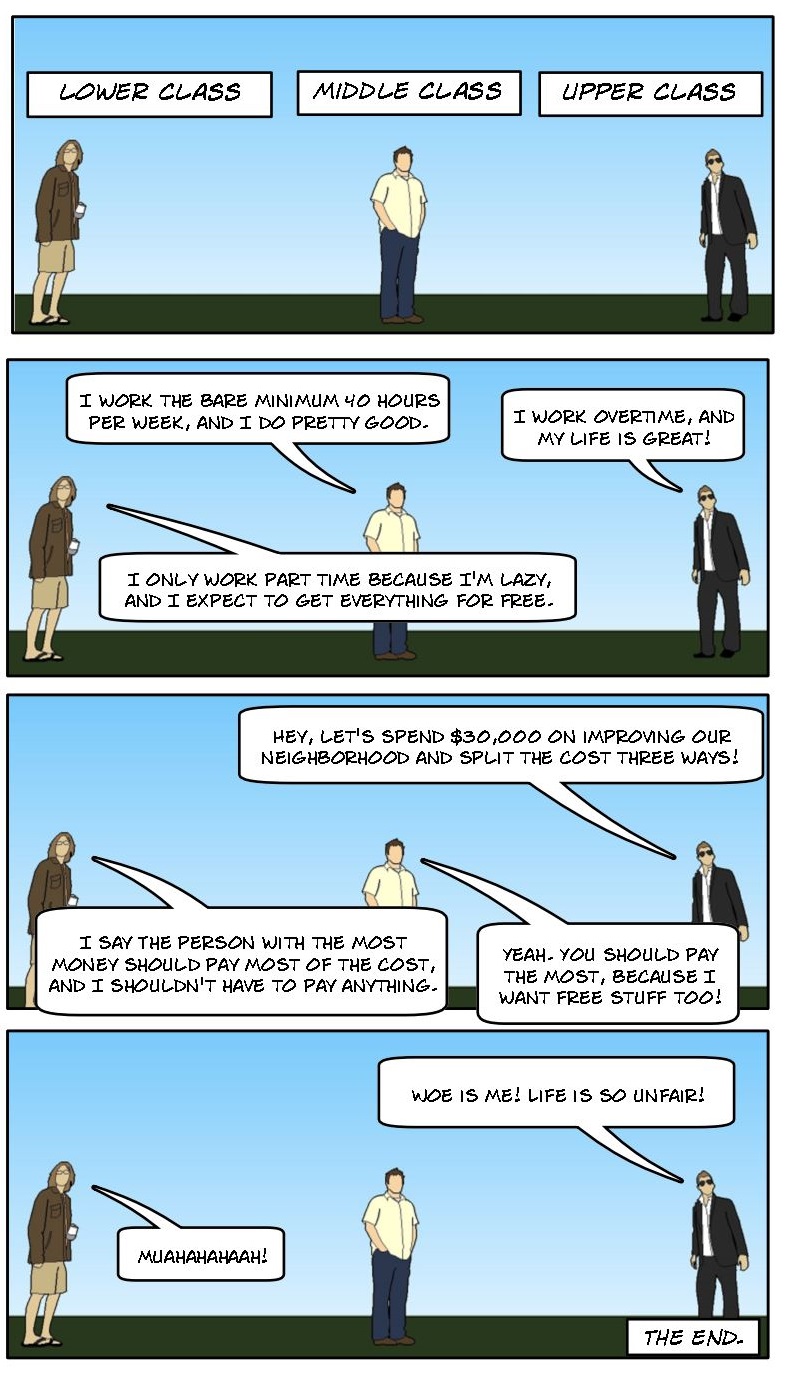
A friend sent me a Youtube video and asked for my opinion on it. I had so much to say about it that I wrote a blog about it. The video argues that America’s progressive tax system rewards the lazy and punishes the rich. If you don’t want to watch the five-minute video, I’ve summarized it in a one-page comic below.


The lowest class is lazy and ungrateful. The Middle class is doing the bare minimum, and the upper class works constantly and is happy.


In case the message in the video isn’t clear, the producers at PragerU.com made at least two more, Do The Rich Pay Their Fair Share? and The War on Work, reiterating the point: Poor people just aren’t trying hard enough, and rich people are hard workers who have to feed the leeches. PragerU probably isn’t run by capitalist conspirators who are knowingly creating misleading propaganda to placate the masses into accepting a life of indignity, fear, and toil. There are millions of other Americans who have the same perception of reality and want to spread the truth as they see it.

Recently a story went viral after a twenty-six-year-old woman lost her job for writing a blog called, “An Open Letter To My CEO” about how little money she made and how hard it was/is to survive. Then a twenty-nine-year-old wrote a response that went viral. She basically told the first girl to suck it up, work harder and stop expecting handouts. She’d probably tell me the same thing if she read the open letter to my CEO I wrote five years ago.

Nobody wants to give handouts to lazy people who don’t want to work. Saying that poor people are just poor because they’re not working hard enough is a warped perception of reality at best and a straw man argument at worst. Below is a comic that more accurately reflects America’s class and tax system:


Comic about the upper class exploiting everyone else


The poor are not America’s enemy, they’re its victims. The ultra-rich aren’t heroes. They’re the creators and sustainers of economic oppression. They’re going to continue to make economic inequality worse as long as they have all the money and thus all the power, and they’re going to hold onto their money and power as long as Americans justify and glorify their own slavery.

The economic revolution America needs has to happen in the minds of Americans. They need to understand how the economy is stacked against them and start pointing fingers at the real source of the problem.


If you enjoyed this post, you’ll also like these:

Predatory Capitalism Creates Poverty
Socialism and Communism
The Life of the Rich
The Life of the Poor
Oppression in the Workplace
Success and Retirement
The Housing Market
Healthcare in America
The Stock Market
Banks
Taxes
Cryptocurrency
Fixing the Economy
My Tweets About Economics

Billionaires Won’t Save You, And Socialism Won’t Kill You

In 2010 I wrote an essay titled, “The fundamental problem with the economy,” in which I argue poverty exists because most business owners pay their employees the lowest wages possible while charging their customers the highest prices for the cheapest-made products, and I suggest that business owners could eradicate poverty by paying equitable wages and fair prices. A few days ago, one of my readers left the following comment and video in response to that blog:


“We can start by having the biggest US companies follow your example; like Apple, Google, Facebook, Amazon, Walmart, Microsoft, Exxon-Mobile, Chase, Wells-Fargo and Berkshire Hathaway. You think they would do it? Most of the giant corporations are run by liberal-leaning CEOs.

Look at Venezuela, they have Socialism and the governments seized too many companies and they’re not producing enough food to feed people. People are going hungry and babies are not getting their milk. What is your analysis on the Venezuelan condition? You should do a blog on it.”


CEOs could end poverty tomorrow if they all collectively agreed to pay their workers a fair share of profits and charge customers fair prices, but small-to-medium-sized business owners can’t do that. As long as most businesses charge extortion prices, they force each other to pass on their operating costs to their workers and customers to keep up with the price of doing business in a cut-throat economy.

Every Fortune 500 company could afford to lower their profit margins, but they don’t, not because it would hurt their business’s chance of survival, but because the owners and investors wouldn’t be able to horde as much money for themselves.

If Microsoft and Berkshire and Hathaway needed every penny of their profits to operate, then Bill Gates and Warren Buffet wouldn’t have been able to pocket billions of dollars in profit. So the price of Microsoft and Berkshire Hathaway’s products and services aren’t based on necessity. They’re based on two factors:

1: How badly Gates and Buffet want to stockpile money they’ll never spend

2: How little Gates and Buffet care about their workers and customers’ quality of life

This makes them either the most evil or delusional people in the world. They may talk progressive and give fractions of their fortunes back to the poor through charities, but they’re still driving the train of economic inequality full speed ahead. Even billionaire, George Soros, who American conservatives hate for sponsoring Democratic politicians, is still raping the lower classes to feed his insatiable bank account. Today’s billionaires are the modern-day version of feudal lords or colonial slave plantation owners. No matter how neat their ideas are, or how many pet charities they support, they’re still the reason poor people’s lives are a living hell.

Take a minute and let the gravity of this sink in. Generations of our ancestors wasted their lives, working themselves to death at jobs that treated and paid them like they’re less than human. They spent their lives working against their will, doing things that had no personal meaning to them and only kept going to work out of fear. Fulfilling their boss’s contrived responsibility robbed them of the time they had to fulfill their potential and give their lives meaning.

This is why economic theories like Socialism and Communism were invented, because business owners have been literally and existentially killing their workers and customers for all of human history, and they still are.

The poor need a new economic system more than the rich need more expensive luxuries, but America is the world’s dominating superpower, and the majority of America’s population identifies as pro-Christian, conservative and Capitalist. Most Americans couldn’t tell you what Communism or Socialism are, but they know they’re evil and, every country that has tried them has failed, which proves (to them) Capitalism is the best economic system.

America can’t change until it can have a sane national dialogue about economics. It can’t do that as long as the majority of Americans believe anything divergent from Capitalism is evil. To that end, they need to learn it doesn’t make any sense to demonize Communism and Socialism for at least four reasons:


1: None of the countries that called themselves Communist or Socialist were what they claimed to be.

Immediately after Lenin seized power in the Soviet Union, his countrymen raised an army and went to civil war with him because he didn’t implement Communism. He implemented a fascist dictatorship with some poorly implemented aspects of Communism. When his followers pointed this out, he justified this by basically saying, “Yeah, I know it’s not really Communism, but that’s a goal we have to work towards, and these are desperate times. So what we’re doing right now is ‘War Communism,” which will be replaced by real Communism when things settle down a bit.” But instead, he reinstated a limited amount of Capitalism and turned a blind eye to black market Capitalism.


https://youtu.be/YHepzTtfnKI


After Lenin died, Stalin took Lenin’s fascist leadership style to the next level, and in less than one hundred years, corruption and greed imploded the U.S.S.R. before anything resembling Marx’s Communism could be implemented.

China’s ruling party calls itself Communist, but the country is run by billionaires and is full of sweatshops. The definition of “Communism” is, “a political theory advocating class war and leading to a society in which all property is publicly owned and each person works and is paid according to their abilities and needs.”

The definition of “sweatshop” is, “a factory or workshop, especially in the clothing industry, where manual workers are employed at very low wages for long hours and under poor conditions.” Billionaires, sweatshops and iron-fisted authority are all antithetical to Communism.

If you were to study any Communist country without knowing it was Communist, and then tried to identify what kind of government it has, you’d probably guess fascism every time. That doesn’t mean Communism is fascist. It means fascist leaders use doublespeak.

I’m not saying Communism is better than Capitalism or that it should be tried again. I’m just pointing out that claiming Capitalism is the best system in the world because Communism failed, is like saying Coke is better than Pepsi because Faygo is disgusting, and Juggalos are crazy.


2: America has made efforts to destabilize every country that has ever called itself Communist or Socialist.


A long quote by Will Blum from "Killing Hope," which says every non-capitalist country has been sabotaged by capitalist ones.


The Vietnam War, the Cold War, and the Cuban Missile Crisis were campaigns in the war between Capitalism and Communism. America orchestrated dozens of coups and bloody revolutions in its war against alternative economic models. So the argument that Capitalism is the best economic model because every Communist and Socialist experiment has failed, is like saying your Nike shoes are better than someone else’s Adidas shoes because you won a race against them after shooting them in the face.


3: Socialism is a blanket term for a wide range of nuanced economic models.

Socialism is defined, “a range of economic and social systems characterized by social ownership and democratic control of the means of production, as well as the political theories, and movements associated with them. Social ownership may refer to forms of public, collective, or cooperative ownership, or to citizen ownership of equity. There are many varieties of socialism and there is no single definition encapsulating all of them. Social ownership is the common element shared by its various forms.”

Ultimately, Socialism means employees share ownership and profits of the company they work for. This means co-op grocery stores are the smallest example of Socialism, but you can scale the concept up and mix and match it with different government styles. Just look at Wikipedia’s list of different flavors of Socialism.


Saying Socialism doesn’t work because Venezuelans are hungry is like saying it’s impossible to raise dogs as pets because you know somebody who tried to raise a wolf and it ate their children. Even if Chavezism is a legitimate example of one type of Socialism, the argument that Socialism doesn’t work because Venezuela is collapsing, would still be tantamount to saying fishing is a failed method to get food because people have been injured fishing with dynamite. Just because dynamite fishing is crazy, that doesn’t prove hunting is the only way to get food.


Technically, those metaphors don’t apply to Venezuela anyway, because Venezuela is arguably no more Socialist than China is Communist. Hugo Chavez nationalized a few industries in Venezuela, but he didn’t nationalize every business. So the economy was still predominantly Capitalist.

In theory, the companies he nationalized became the property of the state, and since the state belongs to the people, therefore those companies belong to the people. However, the people didn’t get an equitable share of the profits. A lot of it was stolen by corrupt politicians, and the rest went to subsidizing prices and giving away free stuff.

Plus, the workers didn’t have any control over the companies, and even though Chavez was democratically elected, the policies he implemented and enforced, were his own creation, not the will of the people. When civilians protested him, he ordered police to shoot them in the streets.

If Socialism equals social ownership of businesses, then what happened in Venezuela wasn’t Socialism. It was just fascism, corruption and inefficient bureaucracy failing to fix the problems of a predominantly Capitalist economy.


4: Communism, Socialism, and Capitalism aren’t the only possible economic models.

Communism is one man’s theory on how to fix a country that doesn’t exist anymore. Socialism and Capitalism are both spectrums of ideas. The flavor of Capitalism used in America can be more accurately described as “Predatory Capitalism” than “Free Market Capitalism.”

Capitalism is defined, “an economic and political system in which a country’s trade and industry are controlled by private owners for profit, rather than by the state.”

Ask anyone who works for a co-op, they’ll attest private ownership of business isn’t inherently evil. Capitalism only becomes predatory when business owners squeeze the life out of the people they’re meant to serve. So claiming Capitalism is evil because America has apocalyptic levels of economic inequality, is like saying nobody should eat cake because your dad owns a poison cake business.

The easiest solution to economic inequality is for business owners to treat their workers and customers as they would want to be treated. Barring that, there are a million other economic models we could design using concepts taken from Communism, Socialism, Capitalism and new ideas we haven’t thought of yet.


If you enjoyed this post, you’ll also like these:

Predatory Capitalism Creates Poverty
Socialism and Communism
The Life of the Rich
The Life of the Poor
Oppression in the Workplace
Success and Retirement
The Housing Market
Healthcare in America
The Stock Market
Banks
Taxes
Cryptocurrency
Fixing the Economy
My Tweets About Economics

Collapse Is The Product Of Unsustainability. Sustainability Is the Product Of Sustainability.

The economy is bad, and every politician running for office these days gets hard pressed to explain how they’re going to create jobs and raise wages. The problem with looking to campaigning politicians for answers to the world’s problems is they’re only going to tell you the answers that win them votes. So you can only expect to get the “Sunday school answers” from them that gloss over the hard, embarrassing roots of economic crises.

They’re never going to tell you the economy is bad because it’s fundamentally broken, and it’s not that the economy just all of a sudden broke after working properly for some time;  it’s designed to eat its own tail. So, technically, it was successful at doing what it was designed to do.

If you don’t know how America’s economy works, here’s a quick introduction. Companies try to sell as much stuff as possible. They try to spend as little money as possible for the things they buy and charge as much money as possible for the things they sell.

On the surface, this formula may seem reasonable. Lots of companies have gone bankrupt because they made products that lasted forever, and once everyone bought one, the business couldn’t sell anymore. So companies have learned not to make things that last. They make products as cheap as possible not only because it guarantees them more sales after those things break, but cheap junk is also cheap to produce. So companies make a higher profit at both ends of their business model. Then they can make even more money if they constantly raise the price of everything for any reason that sounds remotely justifiable.


There’s no giant conspiracy behind this. The state of the economy was probably inevitable. Businesses that minimize expenses and maximize profit make more money than businesses that sell high-quality products at reasonable prices, and once a business has more money than their competitors they can buy all the advantages they need to put their competitors out of business. In a free (or even not so free) market only the most profitable businesses survive, but when the majority of businesses sell the cheapest products at the highest price you cross a tipping point where the economy just eats itself alive.

Mass consumerism is burning through all the world’s natural resources at a mind-boggling rate. This destroys the environment and raises the cost of goods as resources become more scarce. Instead of those resources being used to build a permanent world, they’re used to fill garbage dumps and pollute the eco-system. Then we have to divert more resources to managing these problems we’re creating. All the while the businesses we rely on to sell us the products to manage the problems we’re creating keep raising keep selling us cheaper and cheaper tools while their cost keeps going up for any reason that sounds remotely justifiable. So for every two steps, we take towards a stable economy and a clean environment we take one step back.

But that’s a best-case scenario. In the real world, we’re running as fast as we can towards an economic collapse by making everything as expensive as it can be. The more expensive everything gets, and the more often people have to repair the things they’ve already bought, the less people can buy, which means the less demand there will be for new products, which means unemployment will go up, which means people will have even less money to buy more products to justify more jobs. This is a straight-forward domino effect straight towards collapse.


But the cure sounds as bad as the disease. If everyone made products that lasted and sold them for reasonable prices then many businesses would go bankrupt, and the ones that survived would never make enough capital to expand significantly.  This is a recipe for unemployment and ultimately… starvation.

However, unemployment is only a bad thing if the only reason people need jobs is to make as much money as possible because everything is expensive as possible and everything breaks. If people could survive for free (or next to free), then they wouldn’t need to work 40+ hours a week. We have the technology and skills to allow people to live for free if we would only use them.

Consider what you need to survive. You need a house, food, clothes, water, and electricity. How expensive is it to get those things? As it stands rent costs at least one-third of your wages. Food is grown in foreign countries, covered in toxic preservatives and shipped to foreign supermarkets that charge such high prices they can afford to have regular sales and still make money off of deeply discounted sale items. Your clothes are made in sweatshops in foreign countries and shipped to stores around the globe where their price tag is marked up thousands of times higher than they cost to produce. Utilities are largely run by private companies that charge as much money as they can while their executives live more luxuriously than any medieval king could ever dream of.  When you lay it out like that, there’s obvious room for improvement in this system.

There are ways we can make housing, clothing, food, and utilities drastically cheaper. If we do that, the economy won’t make as much profit, but people won’t need to work for (or save) as much money to survive. Plus, if they don’t have to spend money on housing, food, clothing, and utilities then they’ll have more money to spend on job-creating products.

I’ll make a few suggestions how to lower costs on these expenses, but I’m not trying to convince you those are the right ideas as much as I’m trying to convince you that everyone (especially politicians) should be thinking and talking about lowering the cost of survival to improve our quality of living and our chances of survival.

Here are a few suggestions to stabilize our economy and our lives:


Housing

Taxpayers pay a lot of money to the government through the course of their lives under the assumed condition that their government will use that money to improve their quality of life. Welfare, Medicare, Medicaid, Social Security and similar social services are all swamped by people who are too poor and sick to survive. Half the problems those social services address could be solved if people had free housing, even if that “house” was nothing more than a cramped efficiency apartment. If it was free and guaranteed then everyone will have a better chance of building a secure, healthy life…and career.

Governments can claim eminent domain over property, and we can build extremely cheap, strong, eco-friendly buildings with sandbags. America certainly has enough prisoners to put to work filling sandbags. Once these are built, there’s no need to charge citizens extortionate fees or taxes to live there. If poor people can live there freely and securely then the cost/benefit analysis of doing drugs and committing crime will plummet with their stress level.

This isn’t giving the poor a handout. The poor pay more in taxes in their lifetime than it would cost to build sustainable sandbag houses for every person in the world three times over in sin taxes alone. Even if that’s not precisely true, the point the remains.  Poor people pay taxes with the understanding that the government will use it to raise their quality of life. You can pay for houses for the poor with poor people’s own money if governments would just stop spending poor people’s taxes on such aggressive police and militaries who prey on civilians. And stop having the poor subsidies tax cuts for the ultra-wealthy.

I really want to beat this horse to death, because this is such a simple and obvious concept that it’s easy to take for granted, but it’s profoundly important. Governments exist to help the taxpayers who fund it. Nothing…nothing…nothing…nothing… in the world will help first-world taxpayers more today than having a free house. Setting up a system to provide everyone with a free house should have been one of the first things any government ever did. And with the technology we have today this is more possible than ever.


Food

There’s no need to get rid of super farms altogether or ban international food shipments. They serve a purpose, but there’s no need for the world to rely solely on them for its food supply. You can grow food anywhere. You just need a place to grow it and someone who knows how to make it grow. If you grow it right next to you then you don’t have to ship it anywhere but your kitchen before you consume it. If governments build free housing complexes they could incorporate gardens and small strips of farm/ranch land into the layout. It would be inefficient to try to grow all your food there, but any amount you could grow onsite you don’t have to pay to import. If you can grow 30% of your food onsite then you can reduce your living expenses by 30% while creating local agriculture jobs for skilled and unskilled workers. That’ll also reduce food-shipping-related pollution and resource-consumption by 30%.

But this method wouldn’t work in suburbia because suburbia is so inefficiently designed. That’s not a reason to disregard urban agriculture. That’s a reason to abandon the suburban city model.


Clothing

If we can’t clothe ourselves without forcing children to work in sweatshops then we should just walk around naked. But we don’t have to rely on sweatshops, and we don’t have to pay $90 for a shirt. There should be a global ban on importing sweatshop clothing. That doesn’t mean sweatshop workers should lose their jobs. That means factory workers should get paid a living wage and get to work under inhumane conditions. But that’s not going to happen as long as CEOs reserve the right to exploit their workers and have the incentive of being able to pocket as much of the company’s profits as they want. Cap executive pay and put a limit on how high the cost of products can be marked up. Make profit sharing mandatory. And finally, let an impartial, international health organization set health and safety standards for commercial merchandise.  The only “negative” consequence these changes have to cause is stopping executives from being able to afford to live in utter, shameful luxury. As long as business executives can’t pass their costs off onto their workers or customers then everyone else will enjoy a higher quality of living while still being able to afford clothes, shoes, and all the other products we buy.


Utilities

Technology exists for buildings to collect their own rainwater, process their own waste and generate their own electricity. If building standards required every building to be environmentally sustainable then there would be little need to pay for public utilities or their upkeep. Cities could still keep public utilities in a backup fashion instead of being the single point of failure that they are now. I’m not saying it’ll be easy to convert the world to using sustainable architecture/technology. I’m just saying, as long as we keep doing what we’re doing we should expect the same results.


If you enjoyed this post, you’ll also like these:


Predatory Capitalism Creates Poverty
Socialism and Communism
The Life of the Rich
The Life of the Poor
Oppression in the Workplace
Success and Retirement
The Housing Market
Healthcare in America
The Stock Market
Banks
Taxes
Cryptocurrency
Fixing the Economy
My Tweets About Economics

Politics Won’t Stop Being Evil Until Economics Stops Being Evil

The American populace has become infamous for how divided it is on how it expects its government to operate. However, the country is united almost unanimously on the position that political change is needed. As the country devolves into near civil war over the fringe issues its politicians feed the people to squabble amongst each other over, it’s becoming more and more imperative to understand that practically any political change is unlikely to have any significant long-term effect on the quality of life in America until the standard economic model is revamped.

In order to understand why this is you have to first understand that America’s economic model is more accurately described as “predatory capitalism” as opposed to simply “capitalism.” Predatory capitalism is based on 2 fundamental operating principles:


1. Pay workers as little as possible within the limits of supply and demand.

2. Charge customers as much as possible for goods and services within the limits of supply and demand.


These two simple principles will cause ripple effects that will multiply themselves over time. The first and most obvious effect is the nation’s wealth will trickle upwards, making the rich richer and the poor poorer. Once the rich become rich, they’ll be able to reinvest that wealth making them richer and allowing them to expand their control over the economy. Once the poor become poor, it will take longer for them to work their way out of poverty or compete with the rich to establish competitive businesses. The long-term effect of this is exactly what you see in America: major chains, owned by the rich, worked by the poor. It will be almost impossible for all those minimum wage workers to open their own “mom and pop” business much less competitive retail chains. This problem becomes even worse the more land the wealthy own as the poor will not be able to afford their own land to build their businesses on.


Once the rich become rich enough to have millions or billions of dollars of disposable income they will be able to use that money to influence politics through financing the careers of pro-monopoly politicians either directly, through campaign contributions, bribery, lobbying, campaigning against anti-monopoly politicians and funding anti-monopoly, anti-worker propaganda. Again, this is exactly what has happened in America.

Now that America has passed this tipping point where a few wealthy individuals control the majority of the wealth in America, there is little point in political reform. What if a third political party was elected to office? What if abortion were legalized? What if marijuana prohibition was ended? What if net neutrality was secured? What if stricter environmental protection laws were passed? What if the privatization of education was ended? The reality of life for the average American would remain unchanged. As long as the economic model that robs the poor and gives to the rich stays in place, poor people will still spend their lives working 3 jobs just to stay alive. They’ll still be crippled by mortgage and student loan debt for the majority of their lives and pass debt on to their children. And they’ll still be dependent on the major corporations for most of their food, clothing, shelter, and medicine.

As long as the poor have no wealth to leverage their interests, the rich will still retain the economic power to shape the political landscape according to their predatory agenda. The solution to this problem isn’t legislation guaranteeing profit sharing or fair prices. The rich could still simply purchase legislation to rewind progress.

The only way the poor will have the access to a fair share of the nation’s wealth is for business owners to willingly give their workers profit sharing, fair prices and, preferably, on-site housing at their place of work. Unfortunately, it’s unlikely that this will happen in a predatory economy as business owners will be inclined to try to extort as much money as they can from their workers and customers in order to remain competitive against other ruthless companies.

Existing business owners need to be encouraged to treat the people within their sphere of influence with the dignity and respect due to every human being. Barring that, the poor need to pool their mental and physical resources to open and support businesses that don’t practice predatory capitalism. Barring that, the poor can always exercise the leverage of boycotting and striking, but this is unlikely to happen since the wealthy have already shaped the economic and political landscape so that it’s extremely difficult to unionize or avoid buying from corporations.

So the most productive course of action for the poor at this point is to start and support their own egalitarian businesses. Once they do that, they can begin accumulating their own wealth and thus leverage, reduce dependency on predatory businesses and enjoy a decent quality of life without being treated like slaves.


If you enjoyed this post, you’ll also like these:


Predatory Capitalism Creates Poverty
Socialism and Communism
The Life of the Rich
The Life of the Poor
Oppression in the Workplace
Success and Retirement
The Housing Market
Healthcare in America
The Stock Market
Banks
Taxes
Cryptocurrency
Fixing the Economy
My Tweets About Economics

Why Do So Many Small Businesses Fail?

I keep seeing politicians come on the television and say they’re going to fix the economy, create jobs and raise wages. I’ve been listening to the same promises my entire adulthood while simultaneously staring at a fundamental flaw in the economy that no politician is talking about. If they do talk about it, it’s just long enough to acknowledge a problem exists before changing the conversation back to meaningless talking points.

The problem is that it’s really, really, really, really hard to start a small business. Over half of all small businesses fail within their first year. Politicians have said that much, but they never sink their teeth into why. People don’t fail at businesses because it’s so hard to provide someone else a product or service and then take their money from them. The hardest part about running a small business, the part that trips so many people up, is that the government will send you to jail and fine you into poverty if you can’t flawlessly navigate 10,000 miles of legal bureaucracy.

If you want to succeed in business, you basically need an associate’s degree in economics. If you don’t believe me, go get a tax number, file your small business name, write a business plan, and pick a piece of accounting software to help you organize your taxes. Most people won’t make it that far.

You may be shouting, ” But that’s how business works! If you can’t do that much, then you’re too stupid to be in business!” The thing about that is, it doesn’t have to be so hard to start a business. Our predecessors just went out of their way to make it that hard. I’m sure they had good intentions and reasons that sounded reasonable on paper, but the end result is they’ve created a very narrow bottleneck to owning/operating a small, private business that excludes the poor and uneducated.


I don’t know or care if there’s a conspiracy theory behind this or if it’s just the cumulative effect of millions of stupid decisions. I just care that the deck has been stacked against the poor and uneducated. If all humans are equal then all humans should have an equal chance at an education and owning their own business. Even if a human is stupid…why would we punish them for that? And if all they’re trying to do is sell oranges on the side of the road, why do we need to bring mind-bending bureaucracy into their life at all?

The reason why is because the American tax code assumes every transaction that can possibly be taxed must be tracked and taxed. I believe the I.R.S.’s philosophy does more harm than good, and I base that opinion on the fact that every night the news says the economy is terrible. The reason it’s terrible is because we’re doing something terribly wrong. Obviously, the economy has more problems than just this, but I suspect that as long as we keep assuming that every transaction which could possibly be taxed must be tracked and taxed then the economy will continue to be terrible, especially for the poorest, most uneducated human beings living on earth.

Other than “Tiger Mom,” I’ve never heard of a book on success or leadership that advocates micromanaging. In fact, everything I’ve ever read said it’s the most stifling, soul-destroying approach you can take to accomplish anything. So… if we apply that same principle to the tax code, it points to the conclusion that maybe we should lighten up there.

If people can make money, they’re going to spend it. It’s going to get caught in the tax net somewhere. If people just didn’t have to file anything or pay any taxes for small businesses that make less than $10,000 per year, then people will have the breathing room to establish their small businesses before leaping into the realm of completely retarded bureaucracy. That wouldn’t threaten big businesses’ effective monopolies. It would just give human beings some breathing room.

If the I.R.S. ever wanted to help the nation out a little more they could automatically assign everyone with a business tax id number and generic business license so nobody has to apply for anything when they start operating their small business. They just operate under the codes they were born with.

If the I.R.S. ever wanted to help the nation out a little more they could automate their personal income tax system a little better. Maybe the smart folks at N.A.S.A. can help them. If N.A.S.A. can figure out how to land a cyborg on Mars remotely they can probably figure out a way to automate everyone’s yearly income taxes so we don’t all get sent calculus riddles by snail mail that we have to pay a seasonal accountant $300 to solve just so they can tell us a random amount we have to pay on top of that.


If you enjoyed this post, you’ll also like these:

Predatory Capitalism Creates Poverty
Socialism and Communism
The Life of the Rich
The Life of the Poor
Oppression in the Workplace
Success and Retirement
The Housing Market
Healthcare in America
The Stock Market
Banks
Taxes
Cryptocurrency
Fixing the Economy
My Tweets About Economics

The Letter I’ll Never Send My CEO

Dear Daniel,

You must be very proud of your company. You started it on your own and took it from a garage-sized operation to an award-winning and internationally known brand. Few people in the world ever achieve that much success. Equally impressive is the fact that success doesn’t seem to have gone to your head. The few times anyone has asked me what you’re like I told them you’re a down-to-earth kind of guy, a little shy even. I told them you’re always smiling and friendly and that I can’t even imagine what you’d be like when you’re angry because that would just be so out of character for you. It’s unusual for someone as gentle as you to make it so far in the dog-eat-dog, cut-throat world of business. You should be proud.

I sometimes wonder if you ever imagined your company would grow this large when you first started out. If so, I wonder how you envisioned your company would look. I wonder if you imagined it being a progressive, Utopian(ish) workplace like Google where your employees would almost rather be at work than at home. You certainly seem to be trying to take it in that direction, what with the idealistic company values printed on the giant poster in the front office, the lack of dress code, the free milk and coffee and fruit and the occasional company-sponsored fun-night. Some workers even get a dollar an hour bonus for meeting their “key performance indicators.” I know some of the executives get bonuses for reaching their targets, and their bonuses are so big that nobody ever talks about them. You’ve also set a sales goal, that if we meet, the company will divide up one million dollars between all the employees. We both know you’ve been far more generous with perks than most companies.

I wonder if this is how you envisioned the future of your company when you first started out. I also wonder if sometimes you look down from your corner office and think, “You guys are all suckers. I can’t believe you’re doing this. Thank God I’m not as naive as you.” Let’s be honest for a minute and spell out the math, so to speak. I know this must have crossed your mind before.

You pay your workers as little as possible within the context of the law and supply and demand. Some of us get fifty cents or a dollar fifty over minimum wage, but let’s be honest. If the minimum wage were six dollars you’d be bragging about how you pay some of your workers seven dollars an hour. If the minimum wage were four dollars you’d be bragging about how you pay some of your workers five dollars.

In addition to paying your workers as little as possible to maximize the profits you get to take home you work us as long as the law will allow. You also exploit the loophole that as long as overtime isn’t mandatory you don’t have to pay over time, and despite the fact that we do intense mental and physical work for you, we’re expected to keep up the highest pace humanly possible the entire time, every day. And you guarantee that we’ll exhaust ourselves to that limit by designing the computers we use to monitor, record and report everything we do. So even if our boss doesn’t see us resting the system will show it. If there’s any doubt that we’re pushing ourselves to the limit (which there’s not) you can always play back the video footage from the dozen cameras that keep a constant watchful eye on us.

Even though nobody counts the way you spend every minute of your day and you can take as long of a lunch break as you want and take time off whenever you want I know you’re a busy man. So I’ll get straight to the point. I wonder how fully conscious you are of the fact that your business model is based on exploiting wage slaves, which is just a fancy way of saying, “slavery.” I wonder how fully conscious you are of the fact that every dollar you put in your pocket was earned by us, and every dollar you spend on luxury is a dollar we can’t spend on necessity. I wonder how fully conscious you are of the fact that every day we come to work we’re fighting against your “key performance indicators” for survival. I wonder how fully conscious you are of the fact that the key performance indicators are based on the best worker working at their best speed and doesn’t take into consideration all the little tasks we have to do every day like tidying up, looking for a pen, changing stations, finding a computer that works, waiting for the constant little lags in the system caused by the tragically designed infrastructure, restocking supplies, tying our shoes, going to the bathroom and so on. So in order to reach the ninety-five percent productivity rate that’s expected of us we actually have to work all day at a one hundred to one hundred and ten percent productivity rate.

Granted, all the stress would be worth it to us if we meet that sales target and get that one million dollars… except everyone in the company knows it would take fifty miracles to make that happen. That bar was set low enough to (theoretically) motivate us but high enough that there was never any risk of you having to pay up. So all that “incentive” has accomplished is sending a clear message to everyone who works for you that we’ve made you enough money that you can afford to give away a million dollars but you’re not willing to share that wealth with us. In fact, you’re willing to insult our intelligence and lie to us to try to squeeze as much sweat and irreplaceable time out of our fleeting lives as you can so you can convert it into cash in your pocket to squander on more luxuries for you and your family.

This is why your best workers leave. This is why you have so many immigrants and potheads working for you, because they’re the only ones desperate enough to endure the working conditions you’ve created.

I often wonder if this is how you imagined you’d build your fortune when you started your company. I wonder if you dreamed of wasting the best years of people’s lives slaving away for you for barely enough money to survive. I wonder if you even realize you’re doing it and if you’ve excused it all away by telling yourself things like, “That’s business.” or “If you don’t like it you can get another job.” or “I have to do this to stay competitive.”

I wonder how much thought you’ve put into the value of human life, and by that, I don’t just mean how much one person’s life is worth but how much each minute in a person’s life is worth. Is a minute in one person’s life worth more or less than a minute in another person’s life? If you had to spend five years working in the conditions you’ve created for the pay you allow, would you consider those five years fully lived? If your children had to work in the conditions you’ve created for the pay you allow would you feel like they fully lived their lives? If the answer to either of those questions is “no” then why would you demean and rob other people’s lives that way? Is there really any excuse big enough to justify wasting an equal human being’s potential for money?

Why is it that if you cut a person’s life short it’s called murder but when you cut the best years of their life out in the middle it’s a justified business expense? You might think these questions are overdramatic, but if you play back the video of your workers and you see the dead-eyed, stressed out expressions they wear on their faces all day when your back is turned you’ll realize I’m not exaggerating when I say that the reality is, you’re killing us little by little every day.

I’m positive this isn’t what you envisioned when you started your business, and I’m positive that you’re either completely ignorant of what you’ve become or you’ve made enough short-sighted excuses to justify your actions to yourself, and I’m positive you’ll never realize the true cost your success has come at to the people who run your company. I regret that I’ll never be able to send this letter to you because you’ll fire me, and I need this job because slavery is better than starvation. So I’ll work for you as long as I have to until I’ve saved enough of the crumbs you’ve let fall from your plate and I can start my own business that treats the people I work with as equal human beings fully deserving of equal respect and profits. I, and everyone who has ever worked for you, will always remember you with sadness and regret.


If you enjoyed this post, you’ll also like these:


Predatory Capitalism Creates Poverty
Socialism and Communism
The Life of the Rich
The Life of the Poor
Oppression in the Workplace
Success and Retirement
The Housing Market
Healthcare in America
The Stock Market
Banks
Taxes
Cryptocurrency
Fixing the Economy
My Tweets About Economics

The Legacy Of A Billionaire

Comic in which Steve Jobs goes to Heaven and tells Saint Peter he's a Buddhist who believe in reincarnation. So Steve Jobs is sent to be a sweatshop worker in an Apple factory.


Steve Jobs, founder and CEO of Apple, died recently, and the internet has been flooded with eulogies and praises about him. If he had been a member of the Catholic Church, I swear they would have awarded him posthumous sainthood, and I’m not surprised by this at all. When Bill Gates, Richard Branson and Warren Buffet die they’ll get the same treatment. Even Rupert Murdoch and the Koch brothers will get some kind of glowing recommendation letter to Heaven from someone.

I’m not saying all this praise is completely undeserved. Every billionaire puts a lot of mental and physical effort into building companies that provide useful products to humanity. I respect that, but I also recognize it’s only half the truth. It’s misleading and unethical to only acknowledge the high points of any billionaire’s career, and the fact that we praise billionaires so eagerly and consistently, is a sign of a deeper flaw in society which desperately needs to be addressed and rectified.

You can become a millionaire by working hard, but there isn’t enough time, energy or opportunity in one person’s life to become a billionaire through hard work. The only way you become a billionaire is by underpaying your workers and over-charging your customers… or by owning stock in companies that underpay their workers and overcharge their customers.

So the only way to become a billionaire is to steal. The way you do that may be legal, but it’s still stealing. Steve Jobs may have been a technological visionary, but the cold, hard fact of the matter is he was a thief. I can respect the work he did, but I can’t respect him for the unreasonable, unnecessary mountains of cash he skimmed off the sweatshop slaves who built and sold Apple products.

Why did Steve Jobs deserve eight billion dollars, no limit on his lunch breaks and thousands of heartfelt eulogies, while the people who build iPods apparently don’t even deserve to be treated like human beings? You could ask the same question about any billionaire, but almost nobody ever does. So we keep rewarding robber barons while punishing hard working poor people.


Nobody ever talks about how much money Steve Jobs deserved for each iPod sold. He wouldn’t have died with eight billion dollars if the cost of an iPod reflected its production value. I’m not saying Steve Jobs should have sold his products at-cost. I’m raising the question, how high you can mark up the cost of goods and services before it becomes unethical? If you mark it up high enough to accumulate eight billion dollars without being guilty of price gouging, then how much money do you have to horde before your ethics become questionable? How about sixty-eight billion dollars?


As it stands, the generally accepted answer to this question is that there is no limit; the more money you horde, the bigger of a hero you are. Furthermore, the blame doesn’t lay on the CEO for overcharging for products. The blame lies with the customer for agreeing to pay the advertised price. There is some truth to that, but again, it’s only half the truth.

Steve Jobs knew there was no logical reason for his customers to pay the price he wanted to charge for iPods. So he created one of the most successful advertising campaigns in history to frame the iPod as a status symbol first, and an electronic gadget second. In other words, Steve Jobs went down in history as a visionary business leader for orchestrating a propaganda campaign that exploited his customers’ mental weakness to swindle them out of more money. That’s not admirable. That’s dishonest and cruel, but he gets praise for it from so many people because the entire economy operates under the assumption that if you can be swindled, then you should be.

This isn’t how a utopia operates. This philosophy creates poverty, which in turn creates misery and crime. This is part of Steve Job’s legacy, and whatever good things he did, don’t change the fact.

It’s worth noting that Steve Jobs did give some money to charity, but every old granny in the world who puts a dollar in a collection plate at church gives a higher percentage of their income to charity than he did. I don’t want to sound ungrateful or discourage billionaires from giving to charity, but at the same time, I can’t give them too much street credit when they’re giving away money they were never going to spend anyway. They didn’t lose anything by giving to charity, but they got a lot out of it in the form of lucrative tax breaks and a reputation for being generous. At any rate, if you have billions of dollars to give away, why not just cut out the middle man and leave that money with either your workers, customers or both? Does it justify burning your workers and customers if you’re nice to other people?

I haven’t heard any news about Steve Jobs leaving all of his money to charity after his death, but other billionaires have contrived a reputation as saints for making that claim. I don’t believe billionaires deserve praise for this either, because it’s tantamount to cruising down the street in a stretch Hummer limousine drinking a glass of $10,000 wine and shouting at homeless people through the sunroof, “You’ll get my money when you pry it from my cold, dead hands!” I fail to see the honor in that sacrifice, not that Steve Jobs was even that generous.


If you enjoyed this post, you’ll also like these:


Predatory Capitalism Creates Poverty
Socialism and Communism
The Life of the Rich
The Life of the Poor
Oppression in the Workplace
Success and Retirement
The Housing Market
Healthcare in America
The Stock Market
Banks
Taxes
Cryptocurrency
Fixing the Economy
My Tweets About Economics

The Poor Aren’t Taking All Your Money. The Rich Are.

It’s not uncommon in any country to hear people blame the miserable state of their economy on welfare recipients freeloading off the hard work of the middle and upper classes. While it’s true that welfare queens do exist, they’re not the fundamental problem with the economy. The fundamental problem with the economy is that business owners underpay their workers and overcharge their customers.

That one-two punch is enough to force middle-class workers to have to count their pennies to survive, and it bleeds blue-collar workers straight into nearly inescapable poverty. Surviving, much less saving, is made even more difficult by the fact that landlords have to overcharge for rent because banks (and government taxes) extort everyone who takes out a 30-year mortgage. The only way to get a job that pays enough to afford all the meaningless fees you have to pay to buy a house is to buy a degree from a university, but the cost of a degree is inflated so high that poor people can’t afford it. So they’re stuck working degrading, underpaying jobs for the rest of their lives. Those who can afford a degree are crippled with debt for half a lifetime.

These two factors are enough to force middle-class workers have to count their pennies to survive, and it bleeds the lowest class into nearly inescapable poverty. Surviving, much less saving, is made even more difficult by the fact that landlords have to overcharge for rent because banks and government taxes extort everyone who takes out a 30-year mortgage. The only way to get a job that pays enough to afford all the meaningless fees you have to pay to buy a house, is to buy a degree from a university, but the cost of a degree is inflated so high that poor people can’t afford it. So they’re stuck working degrading, underpaying jobs for the rest of their lives. Those who can afford a degree are crippled with debt for half a lifetime.

The only reason wages are so low and the cost of goods, loans, and education are so high is because the rich get rich by taking as much of everyone else’s money as they can while giving as little back as possible.  This hurts everyone, but it hurts the poor the worst. The reason poverty exists in the first place isn’t because poor people are lazy. They’re poor because business owners took all their money.

"So that's why I work so many hours, so you can collect welfar, wear pajamas in public and have an iphone." "False. You have to work so many hours so your boss can get rich."

It is true that a small minority of poor people scam the taxpayers and don’t want to work, but look at the alternative. Their only option in life is to work themselves to death in degrading jobs that don’t pay a living wage to begin with. Why wouldn’t they scam the system? Because it’s irresponsible? They can’t get ahead in life because the rich are scamming them out of all their money. They’re just doing to the system what the system did to them. I’m not saying that’s right, just that it’s inevitable.

Slashing welfare isn’t going to make the middle class richer or help the economy. It’s just going to create more misery and poverty. Increasing welfare isn’t going to help anyone either because business owners are just going to take the poor’s money anyway, and the poor still won’t be able to afford an education. Business owners and investors are going to continue getting richer, and everyone else is going to continue getting poorer (or at least working themselves to death treading water) as long as business owners and investors refuse to share their profits with their employees or charge reasonable prices for their goods and services. Raging against poor people for being lazy, greedy scum bags adds insult their injury and makes undeserving scapegoats out of them while the real robbers continue business as usual.


If you enjoyed this post, you’ll also like these:

Predatory Capitalism Creates Poverty
Socialism and Communism
The Life of the Rich
The Life of the Poor
Oppression in the Workplace
Success and Retirement
The Housing Market
Healthcare in America
The Stock Market
Banks
Taxes
Cryptocurrency
Fixing the Economy
My Tweets About Economics