Tag Archives: economic reform

My 1-Point Plan On How To Save The World

There are rogue politicians and institutions who want to change the world for the better, but their voices are drowned out by countless other greedy and powerful politicians and institutions. Since there are so many problems of such great magnitude that need to be fixed, and there are so many people working so hard to keep them from being fixed from within the system, it’s extremely unlikely those problems can or will be fixed from within the system. Even if the system could be fixed, it would take years, possibly lifetimes for that to happen, and in the meantime, countless people will needlessly suffer and die.

The fastest, most effective way to make the fundamental changes the system needs is to build a new one from scratch. That solution might sound more difficult than fixing the old system, but I believe it’s not only realistic, but also relatively easy. You don’t even need to overthrow any existing government or ask permission to implement this solution. You just need to build a sustainable, organized village and expand it to support more and more people. This process can be started with less than one hundred thousand dollars.

One of the reasons why fixing the current system is borderline futile is because unsustainable cities are economically dependent on outside assistance to survive. Any Pacific islander can attest that dependence on outside assistance makes you the servant of those you’re dependent on. True freedom requires true independence, and that requires internal ecological and economic sustainability.

It doesn’t take much to build an economically sustainable village. All you need to get started is farmland, water and housing. If you construct your buildings with sand bags, you can make durable, well-insulated structures relatively inexpensively. Once you have a fully functioning farm that produces enough food to meet all your inhabitants’ dietary needs, then your farm will be able to support non-agricultural workers who can do anything from metallurgy to computer programming.

The farm should provide work space and living quarters to people who create vital products like clothing, household goods, medicine, and transportation. This will make the farm more sustainable and thus less dependent on outside assistance, which will make the hybrid office/farm village more independent. However, there’s no need to completely cut one’s self off from the rest of society. You still can and should trade with the outside world. The key is that a self-sufficient village doesn’t trade in order to survive. It trades in order to profit, and the more profitable it becomes, the more it can expand and build more farms and more work spaces. The more diverse types of businesses the farm supports, the more sustainable it will be.

A legally operating business that grows its own food, houses its workers on-site and produces a wide variety of goods and services will be able to provide a high quality of life for its members, and that quality of life won’t be threatened by boom and bust cycles of predatory capitalism… unless the farm exploits its work force by selling them goods and services at the highest price possible while paying them as little as possible.

This doesn’t mean the farm has to be Communist, Marxist, Leninist or Maoist though. Profits should be shared among workers. Common sense and common decency says that’s fair. Common sense and common decency also say the executives shouldn’t get to keep the majority of the company’s profits. One fair way to divide profits in this kind of environment is for the company to keep half the profits it produces. It reinvests that money into expanding the business and upgrading its living facilities. The workers don’t need to own their land they live on or the rooms they sleep in. As long as the company allows its members to live in its facilities for free and eat its food for free, then the workers can save their money for a rainy day or a retirement home somewhere else.

The rest of the company’s profits could be divided evenly between all the workers. That will upset some people who will find excuses why they should get paid more, but if everybody’s basic needs are already fulfilled, people will just be bickering about who gets paid more to buy more toys with. Personally, I believe every part in an engine is equally important to make a vehicle drive-able, and a business is like an engine. Everyone is equally important and deserves equal compensation. If you disagree with that philosophy, you can still compromise and pay your workers similar to the military, where everyone is basically paid the same, but workers are compensated for time in service, hazardous duty and other factors. You could also allocate percentages of profits to high earning departments and let the departments split their profits themselves. As long as profit sharing isn’t too unequal, everyone should be able to reasonably accommodated.

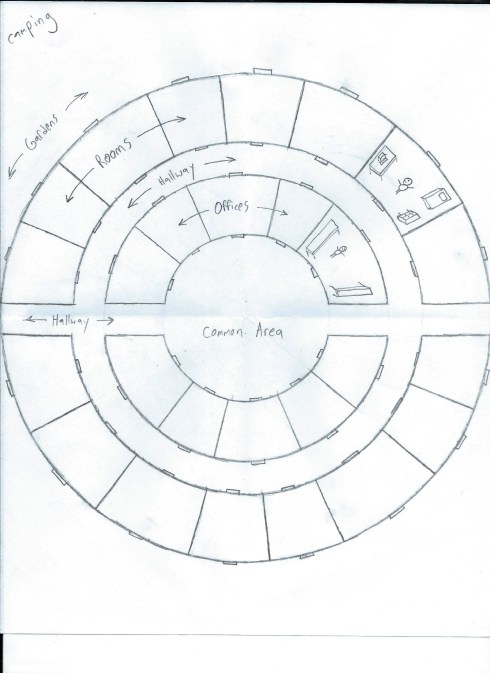
Once your city is sustainable, your workers basic needs are met, and your company is making a profit, you can expand the city indefinitely. If your city is built in the shape of a ring, you can connect every office by a single road, rail or walking path. If you build concentric rings as you expand, you can leave a certain percentage of the wilderness between the rings untouched as a nature preserve.

As long as you don’t go out of your way to control your workers with unreasonable, inhumane rules and regulations, the population will be free and happy. The rest of the world can be as brutal as an American prison, but the inhabitants of the sustainable eco-city won’t have to worry about unjust policies of world governments. The more sustainable eco-cities there are in the world, the less governments will be able to bully and exploit their citizens. Eventually those governments may simply become obsolete and crumble on their own, leaving behind fully functioning, sustainable, humane cities that can operate without excessive bureaucracies and laws.

If the entire city is effectively living in the same building with the same computer network, your entire population will be organized and accessible through the city’s intranet. This will allow the company to keep as detailed records on its employees as the military keeps on its members. This can be used for evil, but if the leaders of the city are meticulously screened, trained and controlled, then this system could be used for good. Your people could live like the crew of the Star Trek Enterprise. They would have a cradle-to-grave tracking method that maintains their medical, mental health, education and career details. With that tool, students could be steered towards their ideal career path. Employees could easily vote on policies or leaders. You could even use this information to create the world’s most efficient dating site. The potential use for good this system possesses is limitless.

Building a city is ambitious and expensive, but this whole process can be started with a small farm employing as few as twenty people. It can be expanded over time without subverting or challenging any existing power structure. It represents as social evolution, not a revolution. It doesn’t require any creepy ideologies or charismatic leaders. It’s just a smart way to do things.

These circular cities can be built from sand bags within the legal boundaries of existing nations, or they can be built on/in giant floating disks that can be launched and connected on the open ocean to create floating islands. We’ve had the technology to do this for ages, and it’s more feasible now than ever. If enough floating sustainable free island states are built, they can disgrace the old nations by offering a higher quality of life with less rules, less inequality, less stress and less violence. If everyone had a realistic chance at abandoning the country of their birth then politicians will have to do a better job at governing in order to keep tax payers in. If a country is too corrupt, inefficient and inhumane to retain enough tax payers, then their government will simply crumble without the need for a violent revolution or a charismatic revolutionary leader to rally behind.

That’s how I’d save the world if I had the money. I’d build a better system from the ground up logically and sustainably.

3-D architectural drawnings showing the stages of building and expanding circular, sustainable monasteries

If you enjoyed this post, you’ll also like these:

Talk About Saving the World
Be Better People
 Build a Better World
Buy a Better World
Fixing the Economy
Predatory Capitalism Creates Poverty

Stop Guilt-Tripping Poor People Into Saving The Environment

97% of climate scientists agree that humans are causing global warming and threatening the extinction of life on the planet as we know it. Even if that’s not true, as some believe, there’s no doubt pollution and urban sprawl are killing off thousands of species. On a long enough timescale, this will tip the eco-system into catastrophic failure. So there’s definitely a call to action here. It’s vital that humans change their behavior, and millions of dollars have been spent on propaganda and movies trying to convince us to do so.

This is a message we all need to hear because we’re all complicit in the destruction of the environment. Wildlife habitats were bulldozed over to make room for the cities we live in. Pollution is created from manufacturing the products we fill our houses with, and the leftover trash goes right back into the land we’re not occupying.

Even if we all reduce our consumption and only buy eco-friendly products, that will only slow the damage we’re doing to the planet. It’s still an inevitability if we keep doing what we’ve been doing, but the problem isn’t that the average person needs to be more responsible. Guilt-tripping the average person is blaming the victim.

It’s pretty much illegal to live anywhere except in a modern house. The only place you can find enough food to survive is at a grocery store where every product is mass produced, pumped full of poisonous chemicals and packaged in disposable containers. In order to make a living, you almost have to own a car that you have to keep dumping toxic chemicals into. In order to pay for all of this, you’ll have to work for a business that makes and/or uses mass-produced consumer products.

While it’s great that we’re not all living in caves and hunting wild animals, modern life is more of a grueling, soul-crushing rat race than a futuristic utopia. The only way to escape the daily grind is to make enough money to buy land and build off the grid. Even then, you’ll still be hounded by taxes. So you need a permanent source of income to keep feeding the beast, or the police will take everything you own and throw you in jail.

If you’re one of the 3 billion people who live on less than $3 per day there’s no chance of you being able to afford to move off the grid. Even if you live in a first world country, you’ll have to make at least $28k annually just to cover the cost of living, and you’ll still be eating eat cheap processed food, living in the ghetto, driving an old, unreliable car, and never seeing a doctor or dentist.

It’s no accident it’s so expensive to live or that so many people have so few options. All of these worker/consumer/taxpayers aren’t lazy. Almost all of them work full time. They’re stuck in a never-ending cycle of working just to make enough money to be broke after they’ve paid their bills because that’s how the system is designed. Everyone except the ultra-wealthy are trapped in an endless cycle of debt. We would love to escape the rat race, but all the exits have been systematically blocked. So we have no choice but to keep working, shopping and helping destroy the planet.

Money is power, and the owners of the businesses that are strip-mining the planet’s resources have taken all the money. They’re the only people who have the ability to break the cycle by investing their fortunes into building self-sufficient cities and an economy that doesn’t require the mass production/consumption of junk. They’re not taking any steps in that direction because that would mean scrapping the system that made them wealthy in the first place.  It should come as no surprise that they’re using their fortunes to make the economy even more unsustainable for the poor. The harder it is for the poor to live self-sufficiently, the more secure the revenue streams of big business are.

If you’re going to make propaganda urging people to save the environment, then you need to target the people who are most responsible for the destruction of the environment: wealthy business owners and investors. Any effort spent guilt-tripping the poor only accomplishes two things: making poor people feel bad about themselves and distracting them from the source of all the world’s problems: our unsustainable economic model.

If you enjoyed this post, you’ll also like these:

Talk About Saving the World
Be Better People
 Build a Better World
Buy a Better World

My Vision for A Secular, Intellectual Monastery

On my “About” page I state that my long-term goal is to build an intellectual monastery. I’ve written a few blogs and comics explaining why I believe we can cure a lot of major world problems by using the monastic community model on a large scale.  You may be wondering why someone would spend so much time thinking about monasteries. This is the story of how and why I did.

I was born an introvert, which predisposes me to want to be left alone in a quiet place, and I’ve come to believe that the events of the first few months of my life predisposed me to the solitary life even more. I spent that time in an incubator in a hospital preparing for, receiving and recovering from heart surgery resulting from the premature birth of me and my identical twin brother. During that time, pretty much the only human contact I received was from a sweet, elderly nurse hovering above me. So my brain adapted to isolation and minimal sensory stimulation.

I showed up to life late and didn’t want to come out of my shell. So I let my identical twin brother speak for me until our parents caught on and made me go to speech therapy. I knew how to speak. The twin studies my brother and I went through showed we had above-average language comprehension. I just didn’t want to get involved with the drama of life. On the first day of kindergarten, I froze in the doorway to my classroom while all the other students stared at me.

As an adult, I’m a completely well-adjusted, functioning member of society. I spend as much time in crowds as anybody else. I can be the life of the party if I need to. I’ve competed in public speaking competitions and managed a computer help desk in a war zone. I’m good at being social. I just need to get away from the crowds and be alone to recharge my batteries more than the average introvert, and I still can’t watch Imax movies or go to theme parks, because all the commotion and sensory overload gives me a splitting headache and wears me out.

People are born all over the introversion/extroversion scale, and there’s no wrong place to be. That diversity is one of humanity’s greatest strengths. We need to understand our personal nature so we can adapt to it. I enjoy being introverted, and I take advantage of the perks it gives me, like the patience to write books and draw intricate pictures.

Back in elementary school, before I was old enough to articulate all of that, I’d daydream about escaping the daily commotion and living in a tree house in the woods. I wanted an orchard of different trees, and I’d build walkways between them and just never leave the canopy.

When I learned about monasteries in middle school history class, I was hooked immediately. I filled notebooks with floor sketches of monasteries and castles, plotted on grid paper.

But living in a castle wasn’t an option in South Texas. I was stuck in suburbia, which is a never-ending cycle of duties, rules, and drama. In high school, I romanticized about living in an insane asylum. As long as I wasn’t forced to take pills that turned me into a zombie, I could walk around in my pajamas, work on my hobbies and have three hot meals a day. It would be the perfect life.

Unfortunately, I’m too mentally healthy to qualify for a free meal. So in my early twenties, I enlisted in the U.S. Air Force and spent four years stationed in Europe… to my surprise. While I was there I did as much traveling as I could afford and got to see a lot of ancient communal living quarters, which inspired me to study up on the places I couldn’t go.

The history of Europe’s monasteries is set to the backdrop of the history of Europe itself, which is an almost never-ending saga of wars, famines, diseases and economic oppression. Monasteries weren’t immune to these forces, but they were insulated from the worst of it because they were self-sufficient. The monks had everything they needed and barely had to work part-time. Meanwhile, the peasants outside the walls were being used as slave labor and not earning enough to survive. Everyone should be as lucky as the monks, and if everybody had lived like the monks to begin with, most of Europe’s bloodshed and misery never would have happened.

I left Europe and the Air Force in my mid-twenties convinced that a monastery would be the best place in the world for me. So I scoured the internet to see what was available and was unsurprised to find they were almost all religious. This is a deal breaker for me because I believe religions are mythologies, and I don’t want to spend my life dancing around a mythology.

Even if I could play nice, most religious monasteries don’t accept heretics. The ones that do still tend to have schedules and rituals that are an unacceptable waste of time to me. The ones that give you the most freedom cost the most money. There are still a few that will let you stay for free, but you can’t stay long term.

As the internet grew I found more monasteries, but never one that was feasible for me. So I got on with my normal life, commuting back and forth between a house I didn’t own and a job I didn’t like. The longer I lived and worked in suburbia, the more fed up I got with the rat race, and the more time I spent escaping to my ideal monastery in my imagination.

After years of fretting, one day I got fed up and decided that if I could create a monastery in my head, then I could create it in the world. After all, I have opposable thumbs, bipedal legs, and a brain. There’s nothing I can’t do if I work on it long enough. So I threw down the gauntlet and said to myself, “That’s where I want to be. If nobody else has built it yet, then I’ll just build it myself.”So I researched how much it would cost to build a monastery, and I found that it would be at least $500,000 if I hired contractors to do it using standard construction methods. Since I didn’t have any money at all, I researched alternative building materials and floor plans to lower costs. I filled notebooks with sketches and notes until I settled on a circular design using sandbag walls.

Design for modular, pyramid shaped monastery rooms that minimize building materials needed Design for an underground monastery consisting of camper trailers with connected rooms Design for a crescent shaped monastery with a ring of underground camper trailersDrawing of a glass greenhouse shaped like a cathedral Drawing of an Airstream trailer in a hollow, man-made hobbit hill

Circular monastery design

Using the circular floor plan, I only need to build half for it to be functional. I could build that for $250,000 and finish the rest later.

That’s the plan. Now I just need the money. There are a lot of ways I could earn $250,000, and I’ve considered them all. In the end, I chose to meet my goal by writing. Some people would say that’s risky, but it’s what I enjoy doing, and it’s what I’d be doing if I lived in a monastery. This way, if I never get my dream home, at least I’ll have done the other thing I wanted to do.

While I’m writing towards my goal, I’m always thinking about new designs and business plans. Monasteries can be easily modified to suit different purposes, and with enough money, I would build multiple versions, but my ideal monastery, the one I’m going to build first, would operate like a long-stay working hostel for the gifted.

Tenants stay for three months to a year. They work part-time for the monastery, and that covers 100% of their room and board. There are no other schedules or rules, but each tenant has to be actively working on a creative project that has significant value to humanity. The monastery will also host retreats and workshops, and there will be a pay-by-donation campground at the edge of the property to generate passive income.

That’s what I’m working towards and why you can always expect new content on The Wise Sloth. If you want to see some random guy on the internet build an intellectual monastery, here’s how you can help.

  • If you’re an eccentric millionaire who can afford to give an eccentric pauper $250,000 just to see what happens, click the Donate button below.
  • If you know an eccentric millionaire who would give a guy like me $250,000 just to see what happens, then send them the link to this blog.
  • If you want to donate a few thousand dollars, I would invest that money in editing my E-books and putting them into print so I can earn $250,000.

Click to donate via PayPal

I’m not going to nickel and dime my way to building this. I’m very grateful to anyone who wants to throw me tip money to show your support, but I would encourage you to give that to The Khan Academy instead. I may never get my monastery, but they’re providing free online education to the world. The world won’t change until it’s educated.  Every nickel and dime they get makes the world less stupid, and that can’t come quick enough.

Khan Academy logo (Click to donate to the Khan Academy)

In lieu of a donation, you can tell your friends about the Wise Sloth and share your favorite Wise Sloth blog on social media. If you’ve read this far, thank you for spending your time with me. You can look forward to seeing more thought-provoking posts on The Wise Sloth, and eventually, you’ll get to watch me build my monastery.

If you enjoyed this post, you’ll also like these:

My Goals
My Life Stories (in chronological order)
My Art

The Economy Needs A Love Stimuls


There’s an old saying among investors that goes something along the lines of, “Invest in the companies you buy products from.” You don’t need to have a Ph.D. in economics to understand that if you’re buying a company’s products then other people are too, and their stock is likely to go up and stay up.

There’s actually quite a bit you can understand about the economy without having a Ph.D. just by looking around you and using common sense. The economy is laid out at your feet. Every time you go to work you set foot in the economy. Every time you pay your bills, go to the bank, go to the grocery store, go on vacation, etc. you’re getting a first-hand look at the fundamental gears of the economy.

Now I’m not trying to imply that it’s a waste of time to study economics in an academic setting. I just want to talk about the concrete things we can see in front of us and compare it to what the talking heads on television are telling us. What I see in front of me is that every year everything is getting more expensive. Part of this is because of inflation, which the government could eliminate by printing less money, but they’ve decided a little inflation is good because it encourages investment. Whether or not that’s good or bad or right or wrong is another argument altogether. What’s important is that the main reason products and services are getting more expensive is because business can get away with charging more. And of course they’re going to bump up the price every chance they can. It’s in their best interest because it makes them money.

I also see business finding more and more sneaky was to rob the consumer by exploiting legal loopholes. Contracts, terms of service, warranties, service agreements, service plans, unnecessary upgrades, fines, recurring charges, etc. If you have a bank account, cell phone, cable TV, credit card, loan, mortgage, insurance, retirement fund, or have had to sign your name on any piece of paper for a business then you know what I’m talking about. And all these nickels and dimes not only hurt the poorest of the poor the hardest, but they actively target the poorest of the poor.

Speaking of targeting the poorest of the poor, fines for breaking one of the millions of useless laws we have in this country hurt the poor disproportionately more than the rich as well. I read an article on the Internet today that said Congress was actually hoping to pass a law to fine people who are too poor to afford health insurance just like they fine people who are too poor to afford car insurance. I don’t see that happening, but it horrifies me that it was ever even brought up. That tells me a lot about the kind of country I live in.

And while all of this is going on minimum wage lags far behind inflation. It’s becoming more common to hire people as contractors and fire them before they can earn benefits. Most of the people I know in real life have horror stories about themselves or their friends/family getting laid off because the company they worked for wanted to hire a young person out of college who could do the job cheaper. If you want a new job, your professional references are quickly becoming useless as employers refuse to give meaningful recommendations out of fear of being sued for slander.

And probably most importantly, let’s talk about the education bubble. The cost of an education is skyrocketing. It can double in a single year. Why? Profit. Period. And nobody gives a shit if you can’t afford it or if you have to spend the rest of your life paying off loans with interest for an overpriced piece of paper that doesn’t even reflect your professional potential. A degree is by and large a lie, but without that lie, you can’t get ahead in business. And that speaks volumes of America’s business model. It’s based on a stack of lies….lies that everyone knows are lies but do nothing about because we don’t have the courage to stand up to bullshit no matter how many Disney movies we watch and spend the rest of the night feeling like Hercules or Mulan in our crippled little heads.

But do you ever hear the talking heads on television discussing the fact that our economy is built on the blood and sweat of the poor, and that more than anything else the driving force of our market is exploiting and manipulating the consumer and the worker, particularly the poorest of them? No. They talk about stimulus, recessions, market forces, foreign debt, wall street reform, bonuses for CEO’s, etc. And while all of these topics have their place in the economy they’re ignoring the fundamentals, the salt of the earth shit. They’re ignoring the fact that the poor who are holding up the economy are being bled dry, and the signs around town say it’s only going to get worse. You can reform as many bullshit stacks of paper on Capitol Hill that nobody except a few Congressional assistants and a few eccentric professors are going to read. It’s not going to change the fact that business in America is run like shit.

The only stimulus that is going to change America around is love. Give the poor the wages they deserve, charge them what’s fair, and quit trying to fuck them out of every extra cent they have through predatory legal loopholes. That is the only reform package that’s going to fix our economy. I know the rich, sadistic mother fuckers who designed our system don’t want to hear much less do that, because it means they’re only going to get filthy rich instead of stupid, ridiculously, filthy rich, but if they continue business as usual they’re going to suck the poor dry until the poor have nothing left to give and nothing left to lose. When we run out of purchasing power the economy stops. Then the rich won’t be able to make any more money anyway, but that’ll be the least of their problems because the poor will have nothing left to lose. Have you ever met someone who has nothing to lose? They’re scary. It’s like they have a superpower. They don’t give a fuck. They will eat your face off.

That’s the choice every CEO needs to make: treat people with equal respect and love or lose all of your customers and your family’s fucking faces eaten off by a horde of starving peasants you drove to desperation because you failed to reign in your ignorant, shortsighted, wasteful, merciless greed but instead prolonged the exploitation of your fellow man by hiring well dressed bobbleheads to get on television and confuse the population with bullshit talk about macroeconomics you knew they wouldn’t understand or question and thus would just defer authority to you like good little dogs and go on eating your shit while you feasted on more stake than you could even finish.


If you enjoyed this post, you’ll also like these:


Predatory Capitalism Creates Poverty
Socialism and Communism
The Life of the Rich
The Life of the Poor
Oppression in the Workplace
Success and Retirement
The Housing Market
Healthcare in America
The Stock Market
Banks
Taxes
Cryptocurrency
Fixing the Economy
My Tweets About Economics

Suburbia Is A Sensory Deprivation Chamber

Rows and rows of identical suburban houses


Suburbia has a glass ceiling of happiness. Psychologists have pretty well documented the aesthetic effect of your surroundings on your mental state. McDondalds is painted bright colors to make you move faster. Prisons are painted dull colors to make you apathetic. Suburbia is drab. Its architecture is mediocre and repetitive. You don’t get the sense of wonder and awe as at the top of a mountain or in a cathedral. There’s a limit to the amount of joy you’re going to receive from the aesthetics of suburbia.

Spending too long in sensory deprivation makes you withdrawn and catatonic. In suburbia, where we sit in our climate controlled houses, drive the same route over and over to our climate controlled offices, where we sit in climate controlled cubicles… we’re basically living in a sensory deprivation chamber, and it has a noticeably dulling effect on our minds.

Unless you work really hard to break up your routine, every day of the week is likely to be indistinguishable from any other day of the week any year of your life. You can actually live on autopilot and never think and still get through your life. Spend enough time in suburbia, and stop noticing your drive to work. You’ll just show up to your job and realize, “I don’t remember driving here.” Suburbia numbs you that profoundly.

Life in suburbia offers luxuries and comforts unheard of to royalty in the Middle Ages, but when life becomes so rote, with so little variation, you’re eventually left with no frame of reference to judge the highs and lows. You lose your orientation of happiness and experience happiness vertigo. Then minor inconveniences in your life can seem like the end of the world, and small pleasures can seem euphoric. But the latter statement is no justification for happiness vertigo because that lifestyle is chaotic, unreliable, and ultimately stressful.

Being happy requires fulfilling your wants, because if you don’t, your mind gets stuck in a perpetual state of fight or flight as it yearns to fulfill its perceived needs. Suburbia kills your opportunity to fulfill your wants in two ways. First, the fact that your basic survival needs are fulfilled misleads you into thinking you have everything you should want. You feel guilty if you ask for more, which dissuades you from expecting more out of life. Even if you do have ambition, suburbia will stifle it. You’ll have to drive long distances to reach businesses. You’ll have to sit through stressful traffic to reach any place you might express yourself or grow. Given that you’re a slave to your job and family, you won’t have much time to do that anyway.

If you ever reach a place where you can express yourself or grow, you’ll have to pay for it, but utilities, rent, mortgages, insurance, car payments, credit card bills, cable, internet, cell phones, etc. will keep you perpetually buried in debt. Suburbia is designed to drain your wealth, which limits your options, and cancels out the sense of security that is suburbia’s greatest advantage.

Everything about suburbia is designed to normalize life as unbroken, numbing, lukewarm blandness. Sure, you’ll be insulated from the atrocities of the ghetto or third world countries, but it’ll be nearly impossible to experience self-actualization and fulfill any meaningful purpose.


If you enjoyed this post, you’ll also like these:

Predatory Capitalism Creates Poverty
Socialism and Communism
The Life of the Rich
The Life of the Poor
Oppression in the Workplace
Success and Retirement
The Housing Market
Healthcare in America
The Stock Market
Banks
Taxes
Cryptocurrency
Fixing the Economy
My Tweets About Economics