Tag Archives: how to save the world

Society Won’t Improve Until You Do

"I told about the whole being greater than the sum of its parts. It's that way with people too, he said, only with people it's sometimes that the whole is less than the sum of the parts." Wendelin Van Draanen

If a society is nothing more than a large group of individuals, then the key to creating a Utopian society is to create a large group of Utopian individuals…

but if you can’t help an individual improve him/herself who doesn’t want to improve him/herself, then there’s no chance of helping a society of people who don’t want to improve themselves….

and if a person who does want to improve himself will do so with or without outside help, then a society of people who want to improve themselves will do so with or without outside help…

then if you don’t live in a Utopian society already, there’s a strong possibility it’s because the majority of people in your society don’t want to improve themselves. In which case, there’s little hope of your generation living to see Utopia…

and any chance your society has of improving its wants will be minimized as long as the majority of people in your society spend 3-6 hours per day watching and listening to commercials designed to make them crave fulfillment of the pettiest, self-serving, immediate desires humanity is capable of.

If you enjoyed this post, you’ll also like these:

Talk About Saving the World
Be Better People
 Build a Better World
Buy a Better World

3 Reasons We’re Not Trying To Make The World A Better Place

Our species has spent the majority of its existence and its evolution as ignorant beasts ruled by our instincts. Even today it’s still possible to get all the way through life using about as much logic as a bird uses to successfully navigate a complicated flight path. You can easily let your instincts guide you through all of your life decisions.

It would be a mistake to assume only the most misguided, weak, cowardly members of society give up and surrender themselves to their instincts. We’re all born set on autopilot, and our instincts don’t turn off after they’ve led us to our mother’s milk. By default, we stay on autopilot our entire lives. Logic is a relatively unnatural ability that has to be consciously and deliberately chosen and refined over time in order to override our instincts.

Everyone assumes they’re the exception to the rule, and they’ve taken control of their lives, but if everyone was as independent-minded as they believe they are, we would live in a peaceful, equitable, and logical world. The world is the way it is because we’re still a society of animals who consciously use the logical part of our brains as little as possible.
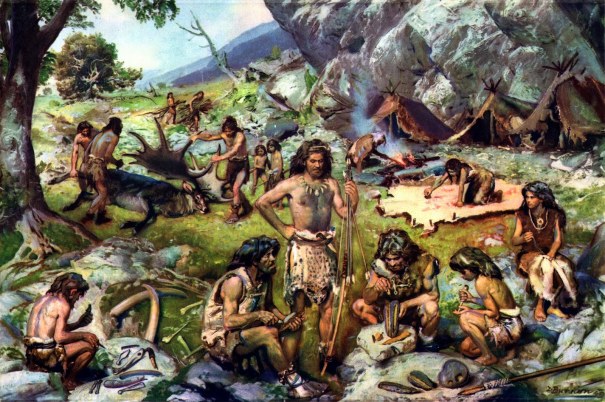
 

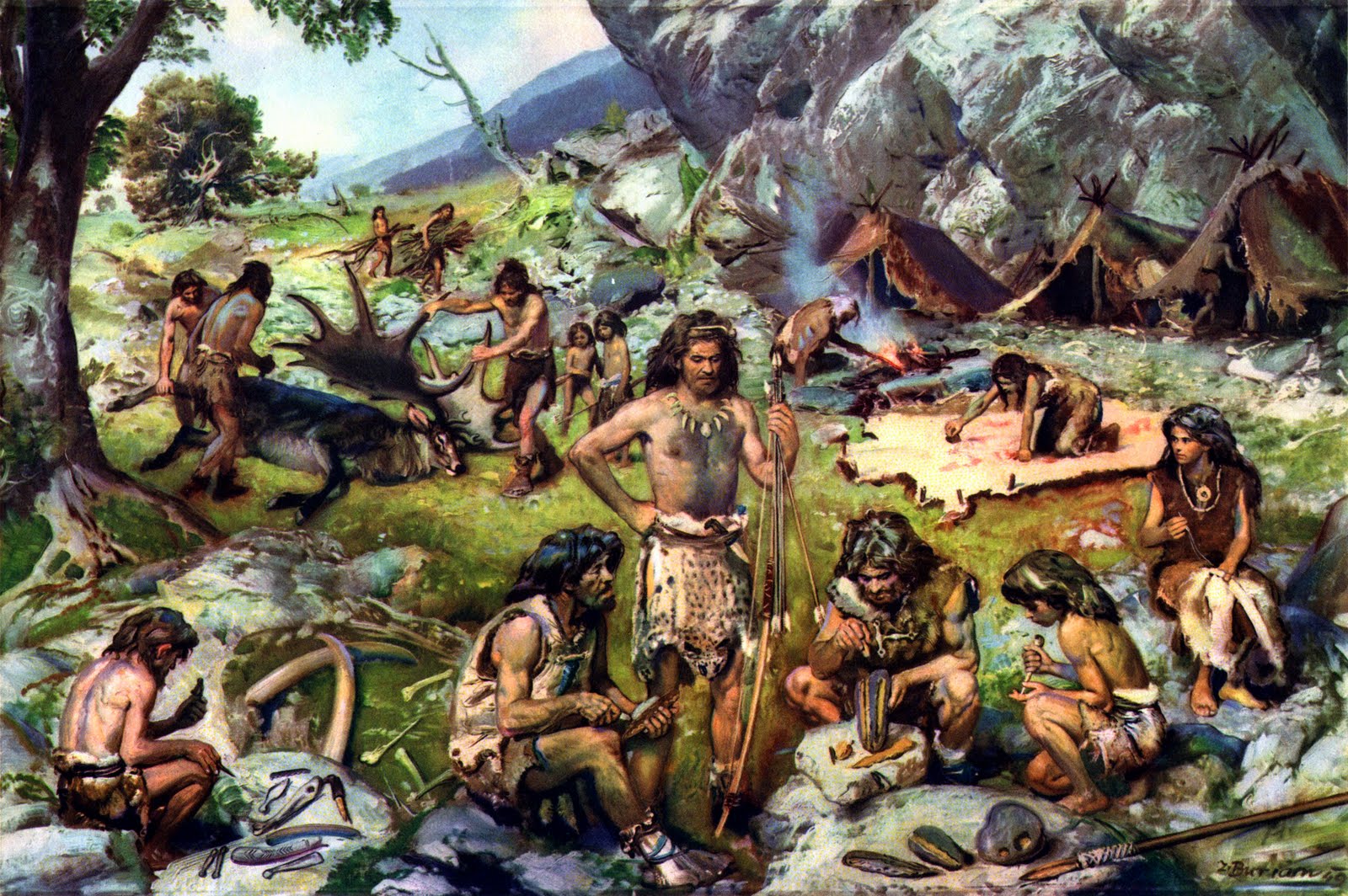
Painting of a group of primitive cave men sitting around their camp working at various tasks like skinning a deer and grinding plants


Consider our nature.

All of our emotions are animal instincts: joy, trust, fear, surprise, sadness, disgust, anger, anticipation… even love… especially love. Parents tend to automatically love their children for obvious evolutionary reasons. Men are attracted to beautiful women because they appear to be healthy mates. Females are attracted wealthy and strong males because they appear to be good providers and strong mates. Guys want to sleep with as many girls as possible to spread their genes. They’ll even rape women despite all logic. Girls want to hold onto one guy to help them raise their offspring, and both men and women will remain in abusive relationships despite all logic. We tell ourselves falling in love is one of the “highest” intellectual activities we do. In reality, it’s as primitive as taking a dump.

Masculinity reflects the hunter/protector role male animals traditionally filled for the past 2 million years. Femininity reflects the camp-tending/child-rearing role female animals traditionally filled for the past 2 million years. Today we look to leaders to run society for us because we’re pack animals, and that’s how we‘ve done it for millions of years. Tall people get promoted at work more because we see them as more “alpha” pack members. Feeble kids get picked on at school because even as children we feel compelled to establish our dominance in the pack hierarchy. The same instinct motivates bosses at work to bully their subordinates. Our brains go on to undermine our ability to use logic by providing us with mental shortcuts like schemas, confirmation bias, the fundamental attribution error, fear of the unknown, etc.

This sounds sinister, but the fact that our species has survived this long is evidence that these instincts are helping us. They tell us what to do when life is too complicated to think all the way through. They guide us towards the path of least resistance and help us navigate our way through life with minimal need to think for ourselves. In other words, we’re not supposed to use our brains because we can’t be trusted to.


Consider our nurturing.

Infants can’t think objectively much less distrust the people they view as gods: their parents. So as infants, it’s only logical for us to trust our parents and assume that the way they teach us to live was the way to live. And since we assume that that’s the way it never occurs to us to question it. And when someone tells us we’re wrong it’s only logical for us not to believe them. Even if we do ever decide to look at our beliefs objectively we can only change the beliefs we have, not the ones we don’t have, and we don’t how much we don’t know. So we’re inclined to believe that we know as much as there is to know (or at least as much as we need to know). From that point of view, it’s logical (or at least inevitable) to have a closed mind (initially). To make matters worse, the more we know the more we tend to believe we’ve reached the apex of human knowledge. So ironically, the more we know the more close-minded we tend to become. Even when we admit that we don’t know everything we tend to think that admitting our ignorance makes us wise, which again closes our mind.

It’s human nature to have a closed mind, and that’s why it was inevitable that the religions we created would say that blind faith in the answers you’ve been given will earn you a place in paradise while questioning the answers is a crime so terrible that those who do it deserve to be punished for eternity. It was inevitable that the governments we’ve created would say that to be a good citizen you have to be a patriot and support your government no matter what and anyone who doubts their country is a traitor or a terrorist or at least a cry baby. It was inevitable that our parents and school officials would say to respect them and that to question them is insolent, disrespectful, stepping out of our place, rude, etc. It was inevitable that society would tell us to be optimistic and grateful for what we have and that to question your position in life or your society’s social model is pessimistic and ungrateful. It was inevitable that our business model would reward those who don’t rock the boat (even if it’s sinking) and labels people who criticize the system as insolent, troublemakers, lazy, or not tough enough to handle “it.”

Businesses love to talk about thinking inside and outside of the box, but these terms are misleading. There’s no inside or outside the box thinking. There’s being guided by your instinct while repeating the patterns you’ve learned from society and then there’s thinking, period. And for those who define their reality by repeating the processes they already know, anything and everything outside of their experiences appear radical. To them, the world is black and white, and they tend to view anybody who thinks at all as an extremist and a heretic. We say we value thinking, but nobody takes it upon themselves to practice thinking as an art form. We don’t think on our own time, and even when someone barges into our lives and pushes ideas into our hands that don’t fit into our preconceived schemas, we tend to automatically naysay it and label it stupid…and the more we label everything outside our box stupid the smarter it makes us feel and the more it cements us into our box.


Look at our group behavior.

Just like our individual brains, society seeks the path of least resistance. Society is set to autopilot. It embraces beliefs that are familiar, vague, and shallow. It embraces behavior that is routine, immediately gratifying, and physical. It shies away from beliefs that are too unusual, self-critical, complicated, or far-sighted. While society will accept superficial forms of deviance such as wearing slightly unusual clothing and using slightly unusual slang, it opposes behavior or beliefs that contradict or undermine society’s fundamental values, which again, are vague and shallow. After generations of this modus operandi, cultures naturally sift out a functional level of equilibrium that it calls maturity, responsibility, being grown up, sane, normal, moral, acceptable, natural, etc.

Children usually don’t have all of these standards explicitly spelled out for them,  but society will give them hints when they step off the path and will guide them to normality and mediocrity. When they get there, they’ll be rewarded with acceptance, praise, and the internal peace that comes with having your mind completely whitewashed. All of this sounds sinister, but again, these tendencies have evolved because they help us survive. However, our instincts are blind, and when left unchecked they can actually drive us to our deaths through over-consumption, overpopulation, and over-competition.

Unfortunately, despite possessing the ability to reason, our individual instincts and our societal tendencies oppose the development of logic, the fail-safe that could save us from our instincts. The more you question yourself and take yourself off of autopilot the more you have to come face to face with your own inadequacies, and the truth hurts. The more you confront these difficult truths the less simple your world will become, the more responsibility you’ll have to take for your welfare and the harder life becomes for you. The more you question society and see the world more clearly the more society will reject, ridicule, fear, hate and persecute you. So we’re classically conditioned to become safe, unthinking, self-congratulatory automatons who are going to over consume, overpopulate, and over compete ourselves into extinction.

History provides plenty of examples of individuals who pursued the art of thinking despite the immediate, negative consequences, and while they did find answers that lay outside the accepted model of human understanding and improved life for future generations…many of these individuals were killed for their trouble. Make no mistake, society is not a docile herd of sheep following a sly pied piper. They’re a ravenous pack of wolves kowtowing to the fiercest wolves, and the only thing worse than being at the bottom of the hierarchy is to be outside the group because that makes you a common enemy, and pretty much the only thing they’ll all put their differences aside for is to kill an outsider who threatens to upset the status quo of the pack.

Yeah, we all want society to improve, but all we really need to do to improve society is become better individuals. We don’t become better individuals though because anytime anyone tries, they’re descended upon by the wolves (who are usually their friends and family). We all want the system to improve, but anytime someone tries, the same thing happens. Theoretically, we all want change, but in practice, it’s the one thing we fear and hate most.

The point of all this isn’t to say change isn’t possible. Obviously, society has changed a great deal throughout the history of civilization. It’s just worth knowing why you’re unlikely to see all the changes you want in your lifetime. Don’t get me wrong. You’ll see some change in your lifetime, but most of the change will be unimportant (like fashion). You’ll see some baby steps on the important issues even though people will fight that progress kicking and screaming and then spend the rest of their lives bitching about how these advances in society are proof of the crumbling of society and the end of the world. Then you’ll see the children of this generation grow up accepting those baby steps as true, but most of our children won’t think any farther past that. Only a few of our children will grow up to be sinful, heretical, preposterous, ungrateful nerds who will push the envelope of human understanding. They’ll be persecuted by those of our children who grow up to be good, normal, decent people. Then our children’s generation will die off, and their children will grow up accepting some of the advances that the deviants of the previous generation made, and the cycle will continue improving at a snail’s pace…

Unless we start rigorously, systematically teaching children to think. If we can raise just one generation of children with legitimately curious, logical, objective minds we can break the cycle of ignorance. But in order to do that we’re going to have to teach them to be sinful, heretical, preposterous, ungrateful nerds, and most parents will fight that tooth and nail. That’s why society won’t change…much… unless you can think of a way to undermine the system.


If you enjoyed this post, you’ll also like these:


Talk About Saving the World
Be Better People
 Build a Better World
Buy a Better World



The Economy Needs A Love Stimuls


There’s an old saying among investors that goes something along the lines of, “Invest in the companies you buy products from.” You don’t need to have a Ph.D. in economics to understand that if you’re buying a company’s products then other people are too, and their stock is likely to go up and stay up.

There’s actually quite a bit you can understand about the economy without having a Ph.D. just by looking around you and using common sense. The economy is laid out at your feet. Every time you go to work you set foot in the economy. Every time you pay your bills, go to the bank, go to the grocery store, go on vacation, etc. you’re getting a first-hand look at the fundamental gears of the economy.

Now I’m not trying to imply that it’s a waste of time to study economics in an academic setting. I just want to talk about the concrete things we can see in front of us and compare it to what the talking heads on television are telling us. What I see in front of me is that every year everything is getting more expensive. Part of this is because of inflation, which the government could eliminate by printing less money, but they’ve decided a little inflation is good because it encourages investment. Whether or not that’s good or bad or right or wrong is another argument altogether. What’s important is that the main reason products and services are getting more expensive is because business can get away with charging more. And of course they’re going to bump up the price every chance they can. It’s in their best interest because it makes them money.

I also see business finding more and more sneaky was to rob the consumer by exploiting legal loopholes. Contracts, terms of service, warranties, service agreements, service plans, unnecessary upgrades, fines, recurring charges, etc. If you have a bank account, cell phone, cable TV, credit card, loan, mortgage, insurance, retirement fund, or have had to sign your name on any piece of paper for a business then you know what I’m talking about. And all these nickels and dimes not only hurt the poorest of the poor the hardest, but they actively target the poorest of the poor.

Speaking of targeting the poorest of the poor, fines for breaking one of the millions of useless laws we have in this country hurt the poor disproportionately more than the rich as well. I read an article on the Internet today that said Congress was actually hoping to pass a law to fine people who are too poor to afford health insurance just like they fine people who are too poor to afford car insurance. I don’t see that happening, but it horrifies me that it was ever even brought up. That tells me a lot about the kind of country I live in.

And while all of this is going on minimum wage lags far behind inflation. It’s becoming more common to hire people as contractors and fire them before they can earn benefits. Most of the people I know in real life have horror stories about themselves or their friends/family getting laid off because the company they worked for wanted to hire a young person out of college who could do the job cheaper. If you want a new job, your professional references are quickly becoming useless as employers refuse to give meaningful recommendations out of fear of being sued for slander.

And probably most importantly, let’s talk about the education bubble. The cost of an education is skyrocketing. It can double in a single year. Why? Profit. Period. And nobody gives a shit if you can’t afford it or if you have to spend the rest of your life paying off loans with interest for an overpriced piece of paper that doesn’t even reflect your professional potential. A degree is by and large a lie, but without that lie, you can’t get ahead in business. And that speaks volumes of America’s business model. It’s based on a stack of lies….lies that everyone knows are lies but do nothing about because we don’t have the courage to stand up to bullshit no matter how many Disney movies we watch and spend the rest of the night feeling like Hercules or Mulan in our crippled little heads.

But do you ever hear the talking heads on television discussing the fact that our economy is built on the blood and sweat of the poor, and that more than anything else the driving force of our market is exploiting and manipulating the consumer and the worker, particularly the poorest of them? No. They talk about stimulus, recessions, market forces, foreign debt, wall street reform, bonuses for CEO’s, etc. And while all of these topics have their place in the economy they’re ignoring the fundamentals, the salt of the earth shit. They’re ignoring the fact that the poor who are holding up the economy are being bled dry, and the signs around town say it’s only going to get worse. You can reform as many bullshit stacks of paper on Capitol Hill that nobody except a few Congressional assistants and a few eccentric professors are going to read. It’s not going to change the fact that business in America is run like shit.

The only stimulus that is going to change America around is love. Give the poor the wages they deserve, charge them what’s fair, and quit trying to fuck them out of every extra cent they have through predatory legal loopholes. That is the only reform package that’s going to fix our economy. I know the rich, sadistic mother fuckers who designed our system don’t want to hear much less do that, because it means they’re only going to get filthy rich instead of stupid, ridiculously, filthy rich, but if they continue business as usual they’re going to suck the poor dry until the poor have nothing left to give and nothing left to lose. When we run out of purchasing power the economy stops. Then the rich won’t be able to make any more money anyway, but that’ll be the least of their problems because the poor will have nothing left to lose. Have you ever met someone who has nothing to lose? They’re scary. It’s like they have a superpower. They don’t give a fuck. They will eat your face off.

That’s the choice every CEO needs to make: treat people with equal respect and love or lose all of your customers and your family’s fucking faces eaten off by a horde of starving peasants you drove to desperation because you failed to reign in your ignorant, shortsighted, wasteful, merciless greed but instead prolonged the exploitation of your fellow man by hiring well dressed bobbleheads to get on television and confuse the population with bullshit talk about macroeconomics you knew they wouldn’t understand or question and thus would just defer authority to you like good little dogs and go on eating your shit while you feasted on more stake than you could even finish.


If you enjoyed this post, you’ll also like these:


Predatory Capitalism Creates Poverty
Socialism and Communism
The Life of the Rich
The Life of the Poor
Oppression in the Workplace
Success and Retirement
The Housing Market
Healthcare in America
The Stock Market
Banks
Taxes
Cryptocurrency
Fixing the Economy
My Tweets About Economics

Buy A Better World By Donating Dividends

Graphic of a small plant growing money symbols out of its branches

Many people give away a percentage of their income to charities each year. The more of a percentage of your income you give away, the more I believe this idea would help create the effect you’re looking to accomplish, which is to make the world a better place.

Instead of just outright giving away your money, find a company on the stock market engaged in doing something you feel is worthwhile. This could be companies that make products and services that help the poorest of the poor directly, like desalinization technology, or ones that help indirectly, like cell phone manufacturers. Find one that pays dividends, and invest in that company. Then donate your dividends to charity to help those who can’t wait for technology or the economy to catch up to their plight.

Going this route, your initial investment will grow and allow you to give away more money in the long run in addition to helping a needed business grow. When you’re ready to cash out and retire, you can sell off all your stocks so you don’t become destitute yourself.


If you enjoyed this post, you’ll also like these:


Predatory Capitalism Creates Poverty
Fixing the Economy
Build a Better World
Buy a Better World

One Dollar Equals One Vote In The Economy

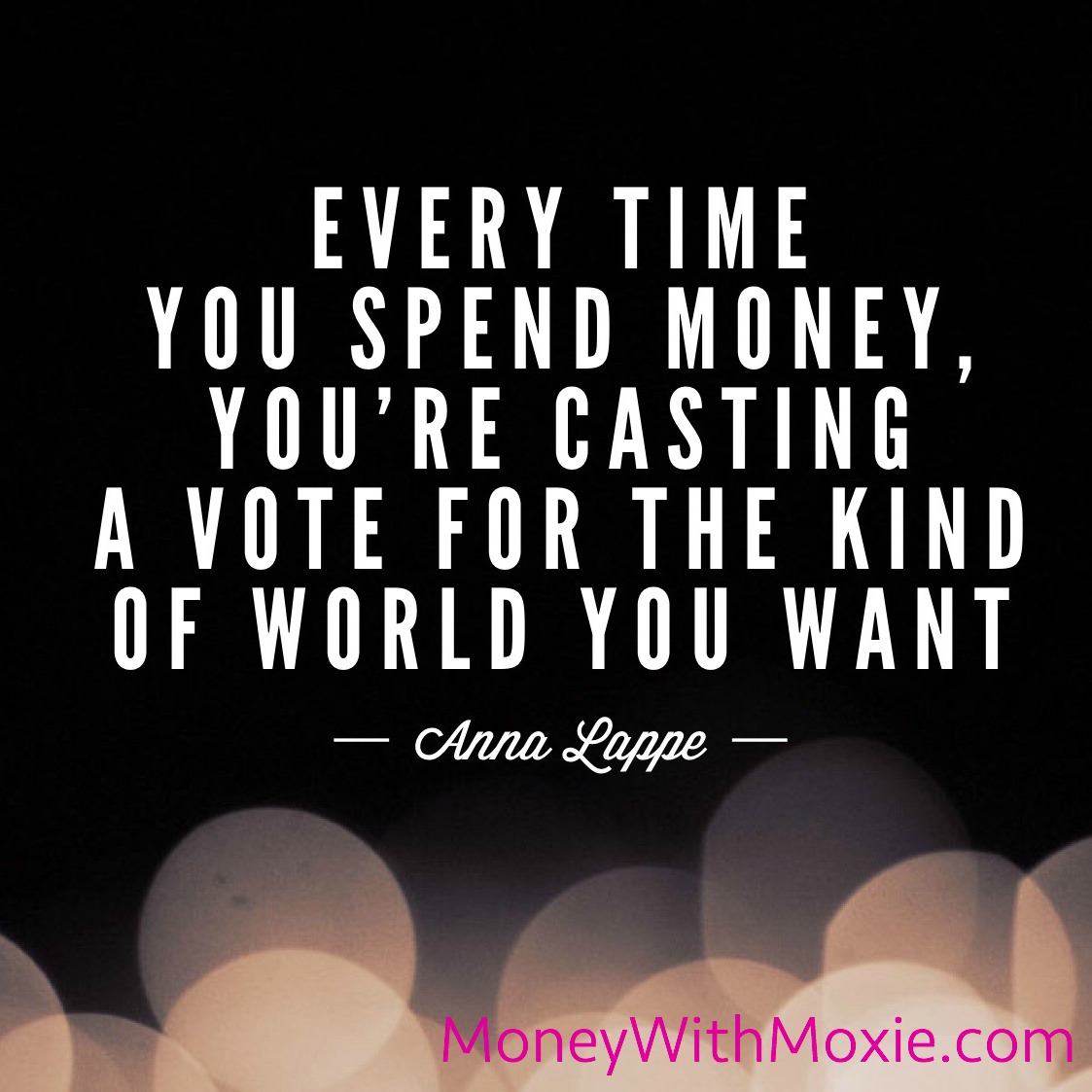
"Every time you spend money, you're casting a vote for the kind of world you want." Anna Lappe

The term, “free market” is defined as, “an economic system in which prices and wages are determined by unrestricted competition between businesses, without government regulation or fear of monopolies.” The American economy is not strictly a free market. There’s a lot of regulation that goes on, but by and large, the general population determines what’s sold and how much it’s sold for via supply and demand. If we don’t want something that’s offered, we won’t buy it, and then business offering it will cease to exist. If we want something, we’ll buy it, and the more we want it, the more we’ll pay for it.

The more money we spend on a certain product or service, the more money that business will make. Thus, the more money that business will have to reinvest into making that product or service better. As investors see us spending our money in certain places they’ll start more business to fill that need. That drives up competition and forces each business in that field to make even better products for potentially lower, more competitive prices.

There’s no ballot box where we deposit our voting slips and determine what we want businesses to sell us, but there are cash registers and dollars. A free market is a democracy where we vote with our dollars, and we suck at voting. If we took all the money we spent on sports over the past 30 years and invested all of that money into energy we’d all be riding around in flying cars right now. If we took all the money we spent on designer clothes in the past 30 years and invested it in public transportation there’d be no traffic. If we took all the money we spent on movies and invested it in housing there’d be no homelessness. We’ve done a good job of voting on computers at least. For every other bad decision, there’s Master Card.

As we watch banks collapse and the economy lag, we hear a lot of talk about the role regulation and deregulation of business practices has played, and it’s all very confusing. We’re all looking for someone to point the finger at. We need a scapegoat, and I have no doubt that one will be found for us. It won’t solve our problems, but it’ll make us feel better because we won’t have to point the fingers at ourselves. We won’t have to admit that gas prices are so high because we voted for it by buying Hummers. We won’t have to admit that the reason so many mortgages have defaulted is because we voted on mass-produced houses we couldn’t afford in unsustainable suburbs. The reason we’re worrying about whether or not we’ll have the basic necessities of life when we retire is because we didn’t vote on them. We voted on Pepsi, Prada, Persian rugs, iPods, Hollywood, Harley Davidson, Marlboro, Ikea, and Viagra.

There are a lot of corporate villains and incompetent politicians out there who have done a lot of unethical things to bankrupt the economy, but we shouldn’t forget we voted in all of these mistakes with our dollars, and we should take responsibility for it and feel ashamed. However, that won’t do us any good unless we use that shame to vote wiser in the future. Don’t waste your money. Spend responsibly on the things that matter, and the things that matter will improve. Not wasting your money on things you don’t need will also allow you to save money to give you a cushion when things go bad. Then, the shit will never hit the fan.

If you enjoyed this post, you’ll also like these:

 Build a Better World
Buy a Better World
Predatory Capitalism Creates Poverty
Fixing the Economy

Where Do Heroes Come From?

Outline of Superman. The crest on his shirt has a question mark instead of an "S."

I have this theory about where heroes come from. Look throughout American history, and you can find some incredible heroes who fought in the name of social justice. There are no great leaders today. America is so starved for real heroes that it’s resorted to looking up to sports players and TV characters as substitutes. Why don’t we have any heroes, and why were there so many in the past? What was different?

As cliché as it is to pull the “Fight Club” card, I think Chuck Palahniuk touched on it when he wrote that we have no great war to fight. If you look back through history at any hero anywhere you’ll notice that they all had great wars to fight. Think about Winston Churchill. He was a great orator, a capable leader, and a massive alcoholic. Ask yourself this, if it weren’t for Hitler, would many American know Winston Churchill’s name?

There are rarely heroes without a war to respond to because human nature is to sit around docilely as long as nothing is bothering you. The more something bothers you the more you respond to it. However, depending on how house-broken you are, you’ll put up with degrading levels of abuse before you stand up for yourself. Some people are so housebroken they’d let themselves get poked to death with a stick. Some people are so housebroken they’d kill to keep getting poked by that familiar stick.

Some people get fed up with getting poked by the stick and stand up and take the stick away. From an evolutionary standpoint, it sort of makes sense. If there’s no need for heroes then nobody would be motivated to become a hero. Unfortunately, heroes don’t seem to stand up until the poking has turned into bloody beatings.

So you have to ask yourself, how much are you getting poked? Have you ever seen anyone getting hurt or killed from the poking around you? And at what level would you actually stand up and be a hero? Or would you take your beatings to the grave?

If you enjoyed this post, you’ll also like these:

Talk About Saving the World
Be Better People
 Build a Better World
Buy a Better World