Tag Archives: maturity

The Relationship Between Sanity, Reality, Truth, Science And Religion

REALITY = that which is true.

SANITY = thoughts and behavior based on true premises.


“Sanity” is defined: “having or showing reason, sound judgment, or good sense.” But how do you know when someone has or shows reason, sound judgment or good sense? The key is, “truth.” The definition of both “truth” and “reality” can be said to be, “that which is.” Once you understand what is true and real you can make accurate assessments of the world and base your decisions and perceptions accordingly.


https://youtu.be/TBOiDfdzueo


So in order to be sane, you have to know the truth about what is real. If you hold perceptions or beliefs that aren’t real then you’re insane. This means that psychology alone can’t bring you to full mental health. Psychology can help you understand the motives, developmental factors and other critical aspects of the human psyche, but it doesn’t provide a tool to distinguish reality from fantasy. Therefore, any good psychological treatment will also include training and exercises in critical thinking and science.

Think about it. How do you determine the difference between reality and fantasy, that which truly is and that which truly isn’t? For example, how do you know you exist? How do you know your parents are really your parents? How do you know the universe didn’t begin the day you were born? How can you trust the version of history you’ve been told is real? What makes a fact, a fact?

The determining factor is supporting evidence. Our entire society is based on this principle. You can’t be tried for a crime without supporting evidence because it’s the supporting evidence that establishes fact. You can’t write an article in an academic journal unless your propositions are based on supporting evidence. You can’t make a claim about the nature of the physical universe without supporting evidence. You won’t be considered mentally healthy unless your perceptions and beliefs are based on supporting evidence.

When you start making exceptions and saying, “Oh, I don’t need supporting evidence for this one little thing.” or start cooking your answers to fit your preconceived beliefs or flat-out falsifying information you set off down the path of insanity because your perceptions and beliefs are no longer supported by independently and consistently verifiable evidence.


Scientific thinking = basing conclusions on evidence.

Faith-based thinking = ignoring evidence that disproves your conclusion.


This is the crux of the disconnect between science and religion. Science demands evidence and rejects taboos. It would be an understatement to say that science (as well as proper philosophy) accepts doubt. Science demands doubt because doubt is the wedge that divides truth from fantasy.


Diagram showing how scientific and faith-based thought works. Basically, scientific thought uses a rigorous method to test for truth. Faith ignores evidence to support a preconceived conclusion.


There’s a classic story about a scientist who built his career on a scientific theory he’d come up with. Late in life, his theory was disproven by a young scientist just out of college. When the elder scientist learned he had been proven wrong he thanked the younger scientist for showing him the truth.

To a scientist, there’s no joy in the world greater than being proven wrong because there’s no joy or reward in the world greater than truth, and that’s worth giving up your pride for. You can accuse scientists of a lot of things, but you’d be wrong to deny that the underlying principle behind science is the humble search for truth.

However, physical science doesn’t answer every question there is to ask. It doesn’t answer, “Why are we here?” “Who am I?” “What is love?” or “Why shouldn’t we hurt each other?”

This is where philosophy and the social sciences come in. They acknowledge there are theoretical questions outside the realm of physical matter, and even though these questions don’t have physical supporting evidence, you can still use systematic logic to deduce, infer and extrapolate reasonable answers to these questions. Just like hard science, social science uses doubt to separate truth from fantasy.

Religion is the opposite. Religion starts from a position that isn’t backed up by physical evidence or logical deductions. Often times religion actively contradicts the evidence such as in the case of creation stories and the effectiveness of prayer. Its theoretical answers are based on the subjective cultures that produced each religion, and it reverse engineers warped, illogical explanations to support its conclusions. Often times it will even flat-out falsify information. The study of apologetics is systematic cognitive dissonance.

Religion claims it has a monopoly on truth, but all the real evidence contradicts this claim. Religion employs every tool of deception and delusion. It teaches techniques such as faith, fear, and dogma to undermine truth for its own purposes.

Religion claims to be humble but refuses to admit or even consider if/when it’s wrong. Science, on the other hand, sets the bar for humility. Thus it sets the bar for truth, and in the end, it sets the bar for sanity.


If you enjoyed this post, you’ll also like these:


The Meaning of Life
How to Think Like a Genius
Knowledge and Learning
Biker Philosophy
My Tweets About Philosophy 

What Is Wisdom?

Knowledge is having the right answer to a question. Wisdom is figuring out the right answer to the right question.

The more you know, the wiser you can become, but until you use a piece of knowledge in a question, it’s just inert information in a data set waiting to be queried. You have to ask yourself questions and use the knowledge in your brain as the variables in the equations in order for your knowledge to serve a purpose.

The more important the question, the more valuable it, and the knowledge required to answer it, becomes, but tallying the sum total of your knowledge is futile. The only thing that really matters is you came up with the best answer to the best question to have the most positive effect on your life. If you’re doing that, then you’re moving forward in life and shouldn’t have time to rest on your laurels anyway.

You can appear wise if you happen to know the right answer to a lot of random questions, but if the question is unimportant, then the only people who would praise you for mastering futility are fools. That’s not the definition of genius. That’s the definition of insanity.


Ask the right questions.

Nobody will ever ask you all the most important questions in life. You’re the only one who can do that for you. If you don’t make a habit out of asking yourself, “What is the most important question I can ask?” then you’re a ship lost at sea, not because you can’t sail, but because you don’t.

Wise people appear to be two steps ahead of everyone else because they’ve already asked themselves the most important questions before they came up, and they’re focused and driven because it doesn’t take external motivation to do what’s most important to you. Far from needing a push, you’ll make excuses to justify doing what’s really most important to you. It takes motivation to act against your beliefs. That’s why there are so many backsliding religious people. Religion is hard to do because it requires a lot of cognitive dissonance to believe in something that fails the test of truth.

Since thinkers have already taken it upon themselves to thoroughly question what’s logically most important in life, they’re more likely to be working towards a logical end goal. People who don’t make a habit of asking themselves, “What’s most important in life?” are unlikely to be toiling towards or defending a logical goal. That’s ultimately how you measure the difference between wisdom and foolishness: by the value of the end goal. You can accomplish everything you set out to by being clever as a fox, but if your goals are unimportant, then you’re just the world’s sharpest fool.

So ask yourself, “What’s the most important question I can ask?” Think about that for the rest of your life. While you’re doing it, bear in mind, the only way to answer a question is to ask more questions, and the more skilled you are at asking questions, the better answers you can deduce. So initially, the most important question you can ask yourself is, “How do you ask a question?” Like most questions, there are a lot of answers, and some are more useful than others. If you need a place to start, I wrote a guide which offers one perspective, and there are thousands more on Amazon.


Question your answers.

Our brains trip us up with schemas, biases, logical fallacies, and all sorts of other reasons to be irrational. To make enlightenment more difficult, many of life’s questions have multiple right answers. Some questions have answers that can’t be proven but have to be asked anyway. And the most important question you can ask right now may not be the same as anyone else. Plus, no matter how much we learn about life, our understanding will always be at least 99.9% incomplete.

We’re all lost on our own seemingly futile journey customized to our lives, but we’re also all in the same boat. We’re studying the same data set and sharing the stakes. So a lot of our goals/questions will line up. Sometimes corroborating your answers with someone else is proof you’re on the right track. Other times it’s a sign we’re all making the same mistake.

One thing most of us can agree on is, if a lion is charging at you, then the most important question you can ask yourself is, “How do I not get eaten by this lion?” because if you die, then you’re out of the game. So to the extent that life is valuable, it’s important for you to ask yourself, “Am I about to die?” If the answer is “yes,” then the next most important question you can ask is, “How can I prevent that?” If the answer to the first question was “no,” then the next question you need to ask is, “Are other people about to die, and if so, how can I prevent that without getting myself killed in the process?”

You may be a murderous psychopath who views other humans as soulless piles of atoms, or you may be a sociopath who measures the value of others by how you can use them to get what you want. You may be a religious zealot who measures the value of other people by how many of your favorite prophet’s rules they break, or you may be an abused, broken child in an adult’s body, who hates the world for everything it’s done to you. No matter what you think of anyone else, the bigger picture is that we’re all in this together. It takes a collaborative effort to advance humanity. The more people die, the fewer allies we have to accomplish mankind’s long-term goals. We can’t survive, let alone colonize new planets with utopian village theme parks if we don’t work together, but first, we have to save each other.


We all need to survive, and right now the sky is looming with apocalyptic threats so obvious you can’t take your eyes off them. The answer to the question, “Is something coming to kill us?” is “Yes.”

I’ll save you some time decoding the matrix of problems strangling the world. The lynchpin of the world’s problems is poverty. Understand that and everything else will fall into perspective. Fix it, and all its satellite problems will fall away.

But what happens after we fix all the world’s problems and establish utopian settlements on Mars? What’s the next most important question we should ask ourselves then? We’ll see when we get there, but one question we should be prepared to ask is, “What’s the greatest threat to the perfect world?”

It would be logical to prepare ahead of time for an asteroid or futuristic Hitler, but the root of all evil is ignorance. If you build a perfect city and fill it with fools, the first thing they’d do is tear it all down with sincerely good intentions. We’ll never live in anything resembling utopia until everyone is wise. That doesn’t mean we all agree on the same answers, just that we’re all talented, self-driven question-askers who are asking ourselves the most important questions.

Before we become wise enough to live in utopia though, we have become wise enough to create it. Plus, if we all became as genius as possible, we wouldn’t even need to solve half the world’s problems, because we’d be smart enough to not do those stupid things in the first place. This means the most important thing we can do to create and protect utopia is to learn new things and ask new questions today. The better learning resources we have, the faster and further we can improve ourselves.

This means it’s of paramount importance everyone does something to improve education. There are some free online schools, that could use donations, but every nation in the world should be putting money in a single fund to create one online school with the budget of a small country. If your politician isn’t talking about something like that, you should tell them to start or replace them with someone who does.

With or without the perfect education tool, it’s still up to the individual to decide to teach themselves by any means necessary. It’s a moral imperative everyone asks themselves every day, “What’s the most important thing I can teach myself today?” because you won’t grow until you do, and when you don’t grow, the world doesn’t either. The less you grow, the more the world is full of idiots.


Scumbag Steve Meme with the caption, "Expects us to live in a Utopian society. Doesn't read."


What do you do after solving the big problems?

It’s worth speculating what would you do if you became an uberman and all the world’s problems were solved. What’s the most important question you can ask when there’s no threat to distract you… or when death is unavoidable? You’re here, and you’re going to die eventually. There’s more to life than just surviving and preparing. If you only live for tomorrow, you put off living indefinitely. There’s value in the moment, and there’s value to who you are independent of what you can do for society.

Whoever you become is who you have to live with. Who you are is how you experience reality right now, and for the rest of the fleeting moments in your life regardless of anything going on anywhere outside your skin. There’s no point training to be the perfect problem solver, student, worker, artist, citizen or parent if you’re not becoming the perfect you. I could be wrong, but sooner or later, the most important question you can ask yourself may be, “How do I become more me?”


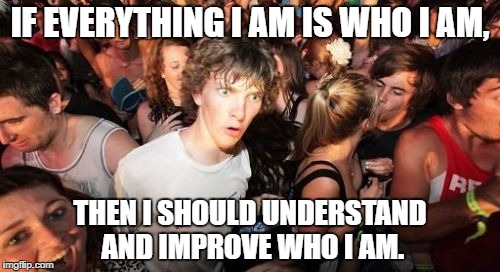
"If everything I am is who I am, then I should understand and improve who I am."


Well, if you can be your favorite you in the present moment, then afterward, you’ll have the perfect past to look back on. Everything I’ve said up to this point may feel more like a guilt trip than an inspirational speech. Nobody can just jump up, become an ubermensch and build an intergalactic empire, but I’m not begging or demanding you to carry a burden. I’m pointing out what an opportunity life is. Every question you ask is a step forward, and the more steps you take, the farther you get. Climbing that mountain yields at least three rewards: the experience of the journey, getting to see above the clouds and being able to say you did it. That’s life, and it doesn’t happen on accident.`


If you enjoyed this post, you’ll also like these:


The Meaning of Life
How to Think Like a Genius
Knowledge and Learning
Biker Philosophy
My Tweets About Philosophy 

How To Become An Expert At Anything

1. State your goals.

The more specifically you identify your goal the more specifically you can focus on it. Saying your goal out loud or writing it down will help you refine your goal and stay focused. However, telling other people your goals can give your brain a false sense of achievement that will deduce your motivation to complete them.


2. Study other people’s research and mistakes, and do it efficiently.

Whatever you’re trying to do has probably already been mastered by someone else. Learn from their research and mistakes. Go read a book about it. Read every book you can find on the subject. Take a class on it. The more external help you can to get the less you have to reinvent the wheel.


3. Practice.

No matter how much you read up on a subject or listen to lectures, that’s only going to help you understand the theory. Take for example the simple skill of rolling a cigarette. I can fully explain everything there is to know about rolling a cigarette in one or two pages, but even if you memorize those instructions word for word you’re not going to be able to roll quality cigarettes quickly and consistently until you’ve rolled at least 200 cigarettes yourself.

Every time you do something the neural pathways your brain responsible for processing that action will grow stronger. The stronger those pathways become the more second-nature the thing you’re doing will become.

Not only that, but throughout your life, you’ve developed a unique and extensive list of good habits, bad habits and different predispositions to ways of thinking and acting. All of these factors influence everything you do. Nobody else knows what all of those factors are. So nobody else’s instructions will be tailor-made for you. The only way for you to understand how your predispositions affect what you’re trying to do is by doing the thing you want to do.

As you practice you’ll come to understand not only your strengths and weaknesses but also the subtle nuances of the task you’re trying to accomplish, and by giving yourself hands-on experience with the task you’ll fully understand why these nuances exist, how to fix/exploit them and eventually how to change them. But those subtleties can only be teased out through hands-on experience.

The point of practicing is to understand the logic of the system better. The more logically and systematically you understand the logic of the system the better you’ll be able to master the system. As you practice, break down the system into its component parts and write a how-to manual for how to do the thing. It doesn’t matter if anyone else will ever read it. It will force you to fully articulate how to do what you’re doing and allow you to take a step back and look at what you know and find the holes in it.

Also, practice all the time. You can’t get good at anything if you only do it once a month. In between practice sessions you’ll forget everything you learned last time and the neural pathways you’ve strengthened in your brain through practice will atrophy. It’s a common misconception that some people are born experts. Mozart and Beethoven are often cited as examples, but in reality, they only appeared to be child prodigies because they devoted their entire childhood to practicing constantly. If you want to master something then practice it every day, preferably several times a day. If you can, devote your whole day to it every day.


4. Learn from your mistakes.

It’s human nature to feel bad when you fail or make mistakes. We tend to beat ourselves up real bad for it, but you never hear about baseball or basketball players beating themselves up for missing swings or throws. That’s because, in their line of work, it’s obvious that the only way to practice is by failing. This is true in any walk of life. It’s simply impossible to master a skill without failing, because failing is practicing, and practicing is the path to success.


5. Constantly ask yourself, “Why am I doing this?”

If you have to force yourself to practice then you’re not doing something you’re passionate about. Oh, you may be passionate about achieving the end goal of becoming rich and famous, but you’re not passionate about the task. So performing the task makes you miserable, and your brain constantly tells you to stop. You can push yourself through that wall for a while, but you’re not going to be able to keep pushing yourself against your will for the decades it’s going to take to master a skill. If you hate practicing them do yourself the biggest favor of your life and quit whatever it is you’re doing, and find something you enjoy doing.

You should want to practice several times a day every day. You should want desperately to cut other time-consuming activities out of your life to give you more time to do what you really want to do: practice. If you’re not like a crack addict going through withdrawals when you can’t practice then you’ve set the wrong goal. Find the thing you can’t live without and practice that, because if you do something you’re not passionate about enough to master it, you’re likely going to grow to hate it and become miserable.

If nothing else, life is short. You’re running out of time to follow your real dream…the dream you would do just for the sake of doing it regardless of whether or not you’ll ever master it.


https://youtu.be/oIrT1eHs1b0


6. Make crap.

What do you think Leonardo Da Vinci’s first picture looked like? What do you think Mozart’s first song sounded like? I guarantee you it was crap. The road to perfection is paved with crap. Rolling crappy cigarettes is discouraging. Every crappy cigarette you roll is proof that you’ll never be able to roll a perfect cigarette. Even if that’s true, you should keep rolling crappy cigarettes not because your goal is to become a master cigarette roller but because you want to roll cigarettes, and you enjoy the crappy cigarettes you’ve rolled until one day they start coming out perfect, and that day will come quicker than you expected because you weren’t constantly stressing about becoming a master. You were just doing what you want to do and enjoying yourself and learning along the way without measuring success by the end product.


7. Constantly ask yourself, “Should I be doing this?”

Maybe you want to learn how to roll cigarettes perfectly. It’s great that you have a goal, but you picked the wrong goal. All cigarettes do is get you addicted to poison and then kill you slowly and painfully. Life is short (especially if you smoke). Are you making the most of your time? Are the things you’re getting better at really important? Are they worth the time and stress? Are they contributing to your demise or the demise of society at large? Are they a waste of time? If you’re not asking yourself these questions then you might be wasting your life mastering a counter-productive skill.


8. Break the rules and cheat.

Here’s a motto you can live by, “By definition, the quickest and most efficient way to do anything is to cheat.” By “cheat” I mean break the rules. What are the rules anyway? They’re just the standard way of doing things that the people before you established. They’re not written in the fabric of space/time. They’re not like the laws of physics. They’re not even moral imperatives. Rules are just words people said. In order to do something better, you have to do it differently. That means you have to change the rules, and in order to change the rules, you have to break them.


If you enjoyed this post, you’ll also like these:


The Meaning of Life
How to Think Like a Genius
Knowledge and Learning
Biker Philosophy
My Tweets About Philosophy 

10 Steps to Winning An Argument

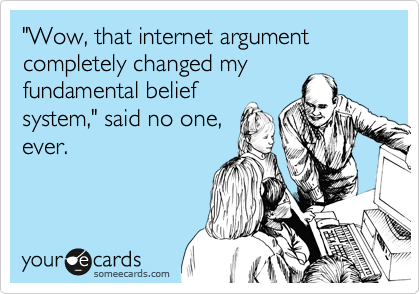
"Wow, that internet argument completely changed my fundamental belief system," said no one, ever.


Step 1:

When someone tells you something you disagree with, recognize the fact that you’ve been wrong before. Regardless of how absurd their idea is, remember how confidently you once believed the things you now know you were wrong about. The same thing could very well be happening again.

Step 2:

Assume that if this person believes what they’re saying, then they must have a compelling reason to. You might find in the end that it’s not logical, but since it’s strong enough to influence them, there must be something to it. Find out their reasons for believing what they’re saying before you disagree with them. Press them to keep talking. Find out everything there is to know about the topic before criticizing it.

Step 3:

Don’t respond yet. Tell the person, “Give me a few minutes to think about this.” or better yet, “Let me sleep on it. We’ll continue this conversation tomorrow.”

Step 4:

Assume/pretend the other person is right. Block out your beliefs for a time and look at the world through his eyes. Imagine living a life where you walk around believing what you were just told.

Step 5

Consider their arguments objectively. Imagine that you’re a scientist in a laboratory where ideas can be stored in Petri dishes. In one dish is their argument. In another is yours. Take your argument and put it on a shelf. Then take their argument and put it under a microscope. Use logic to dissect it and study it independent of how it relates to your ideas.

Put your initial hypothesis about the outcome out of your mind. This is a clinical study where scientific truth is more important than winning. In fact, the only way to truly win is to arrive at the truth. Furthermore, disregard the source of the idea you’re studying. Just because the idea came from a source you don’t trust, doesn’t mean it can’t be true. The source has nothing to do with the idea. So separate the two for the time being.


Step 6:

Take the results of your scientific dissection and file them away. Then take your own ideas and put them under the microscope. Even if you’ve studied them before, the fact that they’re being challenged means there’s a chance you might have missed something. Consider where your ideas came from. Did you really adopt them because you’d done all the math and arrived at the conclusion this is the correct answer yourself, or did somebody else tell you it was true? Dissect your arguments with the scalpel of logic again. Be brutal about it. Get angry at your ideas. Hate them. Tear them apart with the fury of a lover who just found out your soul mate has been cheating on you.

Step 7:

Compare the results from both of your studies, understanding that the goal of the study isn’t to determine who is right or wrong. Arguments are almost never black and white. You could both be right about some aspects of the topic and wrong about others. The goal of the study is to take the good and bad of both arguments and mix them together to create the real truth. If at the end of the study you accept or reject the opposing idea completely, you probably did your math wrong. If you do find fault on either side, don’t throw the whole petri dish away. If an idea has flaws, then fix them.

Step 8:

If you want, you can present your findings to the person you argued with, but this isn’t necessary. This whole process was never a battle between people. It was really an internal battle in your personal search for truth. Whether or not you can convince the other person of your findings is irrelevant.

Step 9:

If you do decide to continue the argument with the other person, don’t worry about winning. Simply explain your findings to them, and if they don’t like it, then end the conversation. Winning an argument won’t do anything for you except stroke your ego, which is pointless. Only proceed if the other person is willing to learn.

Step 10:

Watch for personal attacks. Once either side throws a personal attack, the conversation is over. Dialogue has broken down, and neither side is listening objectively anymore. So you may as well quit. If you draw first blood, you’re probably the more closed-minded person. If you had logical reasons for your argument you’d be using them instead of calling the other person names. The more you make fun of the other person, the more of a case you build that you either can’t handle the truth or just like to fight.


If you enjoyed this post, you’ll also like these:


The Meaning of Life
How to Think Like a Genius
Knowledge and Learning
Biker Philosophy
My Tweets About Philosophy 

Your Ability To Think Obligates You To

Picture of Dr. House holding a human brain, next to the caption, "If you have one, try to use it please!"


Human beings are biological, sentient, autonomous cosmic supercomputers. You’re smarter and more powerful than the most expensive computer in the world. You’re the rarest and most valuable thing in the universe. Regardless of your personal opinion of yourself, you’re capable of looking at the world around you, identifying problems, solving them intellectually and then enacting your solution. You’re the only being in the universe that we know of that’s capable of doing that. Celebrate that fact, but know that with great power comes great responsibility. It’s your responsibility to think about the world’s problems and then solve them.

That’s an intimidating responsibility, but you shouldn’t have to be guilt tripped into accepting it. You should already be doing it out of selfishness if nothing else. You want to live in a better world, and you have the ability to make it better. You don’t have anything better to do than making the world a better place.

Even if you’re content where you’re at, the future of mankind depends on everyone solving as many problems as possible. The future has to be built brick by brick, and the more people who pitch in, the faster the future gets better. The more people find excuses not to solve problems, the slower humanity progresses and the greater the chance of collapse; there’s a tipping point where if too many people ignore their responsibility to think, then collapse is guaranteed.

We’ve spent our entire lives on the wrong side of the tipping point and don’t even recognize we’re living in a collapsed society. We take gun violence, international wars, sweatshops, invasive, predatory police, corrupt politicians and inefficient bureaucracy for granted. We even celebrate them. What we don’t do though is take responsibility for the world’s problems. We throw up our hands and tell ourselves it’s somebody else’s responsibility to fix all the problems around us. But it’s all of our responsibility to go out of our way and our comfort zone to think and solve problems. The whole reason the world is awash with problems is because most people aren’t thinking. If you’re not thinking then you’re being stupid, and stupid kills.

Evil triumphs when good men do nothing. Doing nothing is evil. It’s the main ingredient in failure. If you want your life to be a success you need to think. If you want the world to become a better place then you need to think. Even if you don’t want to, the rest of humanity needs you to.

Think about this. The matter that makes up your body was present at the Big Bang. You’ve traveled through gas clouds, oceans and atmospheres to get where you are today. You’re a conscious being in a seemingly unconscious universe. You’re wasting your life if you don’t do the most amazing thing you’re designed to do. Think, and let’s build a better world brick by brick, problem by problem.


"What a man can be, he must be." Abraham Maslow

If you enjoyed this post, you’ll also like these:


The Meaning of Life
How to Think Like a Genius
Knowledge and Learning
Biker Philosophy
My Tweets About Philosophy 

10 Things You Need To Know About Yourself

1. Your personality type

Personality tests aren’t 100% perfect, but understanding your personality type will give you a whole new level of self-awareness. The first thing it will do for you is give you permission to have all the quirks that make you different from everyone else. It will also help you identify your innate strengths and weaknesses, which will help you understand how to navigate life using your unique mental toolkit. There are companies that offer full spectrum personality and aptitude tests that will tell you more about yourself than you ever thought there was to know. If you’ve never taken one of these I strongly recommend it. Unfortunately, they can cost hundreds of dollars, but it’s worth it. If you don’t have that kind of money you can take free tests online and then research your personality type online. Below are a couple of links to free tests.

Human Metrics

Free Personality Test

2. Your mission statement

If you’ve never summed up the purpose of your life in a brief statement then you can’t prove that you know what you’re doing with your life. Even if you have a vague idea, if you’ve never stated it then you don’t have a solid compass to guide your actions when life gets complicated. I’m not saying you have to know the definitive answer to the question of the meaning of life. I’m just saying that you need some kind of direction, and the better you articulate it the better you can follow it and improve it.

3. Your top 5 goals in life 

Having an overarching theoretical purpose in life is nice, but there’s not much point unless you have a plan on how to achieve that goal. If you’ve never articulated what exactly you want to accomplish in life then you’re just going to waffle through life like a lost explorer slashing through the jungle with no direction hoping to randomly stumble upon the promised land.

4. Your 5, 10, 20 and 30-year plan

Life takes a long time, and you can accomplish a lot in one year, but some goals take decades to achieve. The more completely you have your life plan mapped out the more likely you are to achieve your goals. This doesn’t mean you can’t be spontaneous or change your plans repeatedly. In fact, as you grow your plans should change, but you should still have a plan. It will help give your life and actions meaning, and having a clear plan will mitigate the hopelessness of floundering through life haphazardly.

5. Your 5 greatest strengths and 5 greatest weaknesses

Taking a professional personality/aptitude test will pretty much answer this question for you. Regardless of whether or not you take one you’re still going to change as you grow. Thus your strengths and weaknesses will change. The better you understand your evolving mental skill sets the better you can adapt your approach to life to them.

6. The 5 biggest turning points in your life

Who you are today and where you’re going in life was shaped by who you were previously and what happened to you in your past. The better you understand your past the better you can make sense of the present and the future. The best way to understand your past is to tell your life story to a professional therapist and get their feedback. If you can’t afford that though, you at least need to understand that your life is like a billiard’s ball. It moves in a set direction until an equal or greater force acts against it and changes its direction. Studying the turning points in your life will help you understand how you got to where you are today. That knowledge will empower you to take control of your destiny instead of getting knocked around by external forces until you fall into a hole.

7. Your 5 worst and 5 best memories

Something relatively traumatic has happened to everyone, and you carry the memory of those events with you to this day. If you never identify those experiences and confront them they will haunt you and cripple you for the rest of your life. Part of growing up and making the most of life is dealing with past traumas. I strongly recommend exploring those experiences with a professional therapist, but if you can’t afford help you’re still responsible for making the most of your life. You can’t fix yourself if you don’t identify what broke you.

On the other side of the coin, life is more majestic than it is tragic. Despite the bad things that have happened to you there is immeasurable beauty in life. Pinpoint the best parts of your life and carry those in your pocket so you can pull them out and bask in their warmth on the bad days.

8. Your top 10 moral guides (5 good and 5 bad)

Most of the human population claims to believe in one of the mythologies invented by our primitive ancestors. So when you ask them what their moral code is they just point to a religious book and say, “That.” But most people don’t follow even half of their religion’s moral code. They cherry pick the rules that conform to their modern cultural values. Even then they still break those whenever it serves their purposes. Effectively, most people don’t live their lives according to a concrete moral code. They just waffle through life fulfilling their base desires and reverse engineering excuses for their actions along the way. This approach yields chaotic results. This doesn’t mean that everyone should write their own religion or double down and make a more concentrated effort to live according to the primitive values of our blood-thirsty, chauvinistic, uneducated ancestors. But you will find it incredibly useful to articulate (and improve upon) a list of the top rules that define the difference between right and wrong.

9. The 5 pieces of advice you would pass onto the world

When I was 18 I asked every adult I knew what single piece of advice they would pass on to a young person just striking out into the real world. None of them had a coherent, premeditated answer. None. That’s when I first realized the majority of the adult world has no idea what they’re doing and are just making it all up as they go along. That’s no way to go through life, and it’s not fair to the younger generation. Boil down the lessons you’ve learned in life into at least five pieces of useful advice for yourself and the rest of society so that we can all live wiser, happier lives.

10. 5 things you’re going to teach yourself

Knowledge is like a superpower. After you graduate from school nobody is going to be cramming superpowers down your throat; it’s up to you to seek out and consume knowledge yourself. If you haven’t identified what you want to learn you’re not going to seek that information out. So put a lot of thought into that and articulate what you want to know. You may want to start by asking yourself what the most important information a human being can know is.

If you enjoyed this post, you’ll also like these:

Growing up and Becoming You
Happiness and Peace
Self-Esteem
Health
Drugs and Addiction
Achieving a Healthy Work/Life Balance
Leadership and Authority
My Tweets About Self-Help

Creativity Is Logic, Not Magic

Thoughts follow the same rules of science as chemistry and physics. You can’t get a new thought from nothing. In order to have new ideas you either have to learn them from a source outside yourself or combine existing thoughts in new ways. Your thoughts will continue on the same trajectory until acted upon by a new thought.


Ultimately, thoughts are nothing more than mathematical equations. Every event that happens to you is a new variable for your brain to calculate and find a solution to, and there are so many variables involved in doing something as simple as crossing the street that if you gave your full attention to everything you did you’d never make it out of the house in the morning, but that’s okay because your brain is a cosmically powerful computer and can take simple tasks such as crossing the street and calculate them practically subconsciously, and it can do other tasks, like beating your heart, completely subconsciously.

Look at how these simple concepts make complete sense of the mysterious concepts of emotions, creativity, and inspiration. Our emotions are the product of our brain subconsciously calculating all the variables in our life. Falling in love seems so mysterious, but when you take a step back and tally all the variables it makes logical sense. The logic might not add up to a responsible decision, but when people make bad decisions it’s because they don’t have enough knowledge in their brain to calculate their decisions correctly. However, to them, it appears logical because they’ve come to the most logical conclusion based on the variables they have.

This is why psychologists have a bad reputation for asking people questions and never giving answers. If the patient knew all the variables in the first place, they wouldn’t have a problem because they could find the solution on their own. If the psychologist were to give them the answer, then the ‘patient’ would reject it because the correct answer doesn’t add up using the limited amount of variables they’re working with. So the only way for the psychologist to get the patient to see the correct answer is to walk them through the problem and let them solve it for themselves. The only way they can arrive at the idea is by someone walking them through the process of combining the ideas already in their head.

If you need more evidence that emotions are subconscious logic, then look at your own dreams. Psychologists are sometimes able to interpret dreams because they’re a logical representation of the variables in our lives even though they’re almost entirely the product of our subconscious. Sometimes the logic is obvious such as when a soldier has nightmares about war. Sometimes they’re mysterious, but even when they’re mysterious we know it’s not because they’re magical. It’s only because we don’t fully, consciously understand the variables in the equation.


https://youtu.be/h6CL2Y4yS0I


Creativity is just a matter of combining variables in innovative ways. Sometimes the logic is obvious such as in the case of artists like M.C. Escher. While Norman Rockwell and H.R. Geiger may seem whimsically creative, if you walked through their childhoods you could identify all the variables that led them to develop the styles they chose. And neither of those two artists could have possibly arrived at the other’s style because the variables in their lives didn’t add up to the other’s conclusions.

Inspiration is the simplest of all. Whenever we all of a sudden have a brilliant flash of insight it’s because something caused us to combine the exact two thoughts in the exact way to come to a logical conclusion that we were previously missing a vital variable to arrive at.


Now let’s take this a step further. The sum of all your knowledge (aka variables) and thinking skills (aka formulas) yield your identity and your philosophy on life. The more variables you understand, and the better your thinking skills are, the more of a true individual you’ll be and the more successful your philosophy on life will be. The less you know, the less you can think. The less you’ve thought about the equation of life, the more incomplete of a person you’ll be and the worse your life skills will be.


If you enjoyed this post, you’ll also like these:


The Meaning of Life
How to Think Like a Genius
Knowledge and Learning
Biker Philosophy
My Tweets About Philosophy 

Ten Ways People Get Dumber As They Get Older

Renaissance painting of a fool or jester sitting in a chair looking forlorn.


1. We stop going to school.

While in school you have knowledge crammed into your head for 4-8 hours per day. After graduation, most people just stop reading altogether because they have no motivation to teach themselves new information. Most people resented and resisted the knowledge were taught when they were in school. So after graduation, they’re more than happy to plop down in front of the TV for the next 60 years and let their mind turn to mush and forget everything they did learn in school.


2. Even if every adult wanted to learn, a lot of them are too busy.

Between working 8-12 hours a day, cultivating (or enduring) a marriage, raising children and doing household chores most people don’t have the spare time or energy to learn new things.  There’s not much you can do about this, but even though there’s a good excuse for it the fact remains…most people don’t learn much after graduation.


3. We assume the education we did receive proves we know everything (or at least as much as we need to know).

In theory, this shouldn’t be true. You’d think that people who went to 4-8 years of college would have a lifelong passion for learning, but the more people with higher education degrees you meet the more you’ll find out this generally isn’t the case. Instead, the higher of a degree they’ve earned the more conceited they are about how much they know. The more conceited they are the less motivation they have to learn more. So they spend the rest of their lives congratulating themselves for their past educational accomplishments and cease achieving new educational accomplishments while forgetting most of what they had learned that they’re so proud of.


4. We give up.

When we’re young we tend to be enthusiastic, hungry idealists. The world is a big, open sky to us. Every adult felt like that when they were younger, but then they got out into the real world and found out nobody gives a crap about you. You’re not a snowflake. You’re a number, and you’re expendable. Nobody really wants you to think outside the box. They want you to shut up and follow their orders.

Someday you may come to the realization that idealism is cute in cartoons, but in the real world the responsible thing to do, the adult thing to do, is to get a job you don’t necessarily take any joy from and work hard day-in and day-out for 60 years without a single complaint.

When the light goes out in your eyes and your life downshifts into autopilot you don’t think of brilliant things. You lose the motivation to explore. You just fade out. You call it “responsibility,” but your willful celebration of slavery defeats the purpose of existing in the first place, and it makes the world a duller place.


5. We come to believe that the rank makes the man.

The purest example of this is military officers. Aside from politicians, no group of people in the world are more delusional about their self-worth than military officers. Why do they think they’re so great? Because they have an arbitrary, man-made rank that tells them they’re God. And once you’re God you believe you can do no wrong. So you don’t listen to anything you don’t want to hear, and you have no motivation to improve yourself since there’s nowhere to go once you’ve reached the top. This is as true in the civilian sector as it is in the military. Give people an important title and tell them they’re important and they’ll become delusional idiots.


6. We assume the mere fact that we’re older makes us wiser.

Adults think kids are dumb shits. Adults don’t try to talk sense to kids because they know every kid is so naive they’re practically, certifiably insane. Being an adult surrounded by children is like being a one-eyed man in the land of the blind. You have more clarity and hindsight than them. True as that may be, it tends to go to adults’ heads. Even if adults are smarter than children that doesn’t make them a higher form of life. And the only reason adults are smarter than children is because they were born first. Whoopdy doo. You don’t get an award for that. If you think being born before someone else makes you better than them then you’re not as smart as you think.


7. Similar to #6 is that we tend to assume that getting married, having kids, and working at a job makes us wiser.

Again, yes, you do learn a lot about life by experiencing these trials. But those lessons are on par for what you should learn in life. Great. You can do what you’re supposed to. That’s not going above and beyond the limits. Assuming doing the bare minimum in life makes you an expert on life is foolish and shows how little you know about life. More importantly, it causes you to stop pushing yourself to learn more than the bare minimum.


8. We’ve had more time to convince ourselves of our beliefs.

Childhood is defined by our quest to understand ourselves, the world around us, why we’re here and what we’re supposed to do now that we’re here. By the end of childhood, we’ve amassed a head full of answers and explanations, and a lot of those answers are wrong. Even if they were all right, our understanding of life would still be incomplete. But people get the answers they’re comfortable with and repeat those answers to themselves over and over again until they can’t see anything else outside their tiny misshapen reality. Then they spend the rest of their life defending their answers and becoming more close-minded. After we’ve spent 50 years telling ourselves the same thing over and over again, we would have to erase part of our identity to admit that we’re wrong about our cherished beliefs. There’s a reason we have the saying, “You can’t teach an old dog new tricks.”


9. Similar to #8 is that we’ve had more time to surround ourselves with sources that confirm our biases.

We make friends who believe the same things we do. We watch television shows that are slanted to our point of view. We read news sources that cater to the spin we want to hear. The few nonfiction books that the average person reads are written by authors who just tell their audience what they want to hear. After a lifetime of confirmation bias we inevitably convince ourselves with concrete certainty we’re the good guys and anyone who disagrees with us are the bad guys.


10. We’ve invested our pride and our very identity in our tiny reality.

Growth requires change, but in order for adults to change they have to admit that their tiny worldview is either wrong or incomplete. Pride alone won’t let them do this, and even if they were willing to lay their pride aside- their identity is their reality, and their reality is their identity. Changing would be tantamount to suicide, and even though it would benefit them more in the long run, most people are too afraid to walk through the darkness to reach the light. They would rather live with a comfortable lie.


If you enjoyed this post, you’ll also like these:


The Meaning of Life
How to Think Like a Genius
Knowledge and Learning
Biker Philosophy
My Tweets About Philosophy 

My Two Rules About Rules

Picture of a military helicoptor hovering next to a sign that says, "Speed limit enforced by aircraft." Underneath the photo it says, "THE RULES: They may be stupid, arbitrary and irritating, but god help you if you break them."

Rule #1: Rules were written by people, and most people are idiots.

If there were one lesson to be learned throughout all of human history, it’s Rule #1. Amazingly though, there are billions of people who haven’t learned that lesson. Oh, sure they’ve learned not to kill 6 million Jews, but they haven’t learned to question their employer’s rules today. As a result, they get locked into enforcing outdated or illogical rules that make people’s lives worse.

The rules they enforce might not kill 6 million Jews, but they’ll waste the short and infinitely valuable time being bogged down with needless work. This will prevent them from accomplishing their highest level goals, ironically, in the name of doing what’s right.


Rule #2: A rule’s only true authority comes from its ability to help people.

Rules were created to serve people. People weren’t created to serve rules. When a rule ceases to help people, it negates its purpose for existence and thus negates its authority. For example, nobody would argue against the rule “don’t kill people.” However, rules have to be judged on a case by case basis according to whether or not they’ll help or hurt people each time they’re enforced. If a situation arises where it will help people more by not enforcing the rule, then it should not be enforced. For example, if you lived next to a Nazi concentration camp, you might decide it’s moral to break the “don’t kill people” rule if it were the only way to save the lives of the victims in the concentration camp.


If you enjoyed this post, you’ll also like these:


The Meaning of Life
How to Think Like a Genius
Knowledge and Learning
Biker Philosophy
My Tweets About Philosophy 

Wisdom I Learned Working In I.T. : Answers Come From Questions

Picture of a woman smiling and talking on a phone in front of a computer. Below the picture are the words, "TECH SUPPORT: We can fix anything... except stupid."


Fixing computers for a living means you spend your whole day problem-solving. It’s insanely frustrating because you’re expected to be able to answer any question about any hardware or software problem there could ever be. Even if you went to school to study computers, all of your knowledge and experience is constantly becoming obsolete. So you have to constantly relearn your trade, but no matter how much you teach your self, you’ll never be able to memorize every error code, every symptom, and every solution to every problem that could possibly happen with every operating system.

However, you don’t have to. You’d be surprised how much you don’t have to know about computers and still be able to make a living fixing them… as long as you know how to think logically… which most people don’t. If they did, then most computer technicians, therapists, and police would be out of work. The following rules apply as much to fixing computers as they do to life:


Rule #1: If you want an exact answer, you need to ask an exact question.

When a user’s monitor goes blank they freak out and ask questions like, “Why is this happening to me?” “Why now?” “What the hell is wrong with this piece of shit?” etc. None of these questions are going to provide useful answers. So they call a computer tech who asks questions that cut to the heart of the issue such as, “What’s broken? What was the last thing you did before it broke? Does it have power? Are the connections loose? If we replace this piece will the problem go away or is the problem originating somewhere else?”

Life is the same way. When I’m sad, I don’t just mope around feeling miserable. I ask myself, “What is the problem? Why am I sad? What triggered it? How often does the occur and why? This keeps me from wallowing in hopelessness and ultimately leads to solutions.


 Rule #2: Use a logical, systematic problem-solving process

When I first started fixing computers I’d freak out every time I got a call about a problem I didn’t know how to fix. I’d ask myself questions like, “What am I gonna do? What am I gonna do?” Eventually, I stopped freaking out and learned to look at a computer with the cool air of a mysterious, wandering gunslinger. I’d take my time and break down the problem systematically starting by gathering all the facts, eliminating variables, and testing solutions one at a time until the problem was solved. And throughout the whole process, I’d keep in mind that if you’re not asking exact questions, you won’t get exact answers.

Eventually, I found my method of problem-solving worked equally well in real life. I could see it in my friends as well. The ones who had the most problems in their lives were the ones who sat around asking themselves, “Why is this happening to me?” “Why is life unfair?” These are the people who when you try to offer them solutions to their problems they argue with you and bark excuses at you for why nothing will work. The people who have the least problems in life are the ones who size up their problems logically.


 Rule #3: The quality and quantity of answers you get are proportional to the quality and quantity of questions you ask.

Lucid people know that the causes and the solutions of any problem can be deduced by analyzing the variables in the problem. The degree of success you have deducing the causes and the solutions depends on how specific and articulate the questions you ask are. Using that mindset, they don’t wast any time freaking out or getting emotional about the problems in their lives. They simply go into analytical mode and start asking questions.

When I would get stumped fixing a difficult computer problem, I would stop, take a deep breath, and ask myself, “What questions have I been asking, and why am I asking myself these questions? Which questions haven’t I asked, and why not?” If I couldn’t solve the problem, I would ask for help from someone with more experience for help, but I wouldn’t just ask them for the answer. I would ask them to explain the series of questions they asked themselves to correctly deduce the variables in the equation so I would understand the system and know the right questions to ask next time and why.

So if you find yourself getting emotional about a problem, or one of your friends comes complaining to you about theirs, the first question you need to ask is, “What questions have you asked?”


 Rule #4: Knowing where to find the right answer is just as good as knowing it from memory.

When I first started working at a computer help desk, most of my coworkers were equally inexperienced. We only had one guy on our team who could answer any question. I only used him as a last resort, because if I bothered him every time I got stumped, his entire job would consist of mentoring me. So one day I asked him, “How do you know so much? Why can you solve more problems than anyone else here?”

He looked at me like I was stupid and said, “I don’t know the answers to all the questions you guys bring to me, but I don’t have to if I know where to find them.” Then he pointed to his computer and said,” We’ve all got Google on your computer. There’s a wealth of information on the internet. If I don’t know something, I ask the internet.”

So now, when I run into a problem I’m having even a little difficulty with, I don’t ask myself, “What am I doing wrong!?” I ask myself, “Where can I find the answer without having to make every mistake myself first?”


If you enjoyed this post, you’ll also like these:


The Meaning of Life
How to Think Like a Genius
Knowledge and Learning
Biker Philosophy
My Tweets About Philosophy