I prefer watching educational videos on YouTube more than watching television, but it’s tedious digging for good content, and I’ve already seen most of the good stuff while searching for videos to put in my blogs. In case anyone else is looking for entertaining educational videos on YouTube, I made a series of posts with all the ones I’ve used on The Wise Sloth, organized by topic, with links to the posts they appear in. You’re bound to be enlightentained, and if you need help exploring the 600+ essays on The Wise Sloth, these video lists offer a quick overview that practically summarize my philosophies.
I prefer watching educational videos on YouTube more than watching television, but it’s tedious digging for good content, and I’ve already seen most of the good stuff while searching for videos to put in my blogs. In case anyone else is looking for entertaining educational videos on YouTube, I made a series of posts with all the ones I’ve used on The Wise Sloth, organized by topic, with links to the posts they appear in. You’re bound to be enlightentained, and if you need help exploring the 600+ essays on The Wise Sloth, these video lists offer a quick overview that practically summarize my philosophies.
I prefer watching educational videos on YouTube more than watching television, but it’s tedious digging for good content, and I’ve already seen most of the good stuff while searching for videos to put in my blogs. In case anyone else is looking for entertaining educational videos on YouTube, I made a series of posts with all the ones I’ve used on The Wise Sloth, organized by topic, with links to the posts they appear in. You’re bound to be enlightentained, and if you need help exploring the 600+ essays on The Wise Sloth, these video lists offer a quick overview that practically summarize my philosophies.
I prefer watching educational videos on YouTube more than watching television, but it’s tedious digging for good content, and I’ve already seen most of the good stuff while searching for videos to put in my blogs. In case anyone else is looking for entertaining educational videos on YouTube, I made a series of posts with all the ones I’ve used on The Wise Sloth, organized by topic, with links to the posts they appear in. You’re bound to be enlightentained, and if you need help exploring the 600+ essays on The Wise Sloth, these video lists offer a quick overview that practically summarize my philosophies.
This list comes from my essays on saving the world.
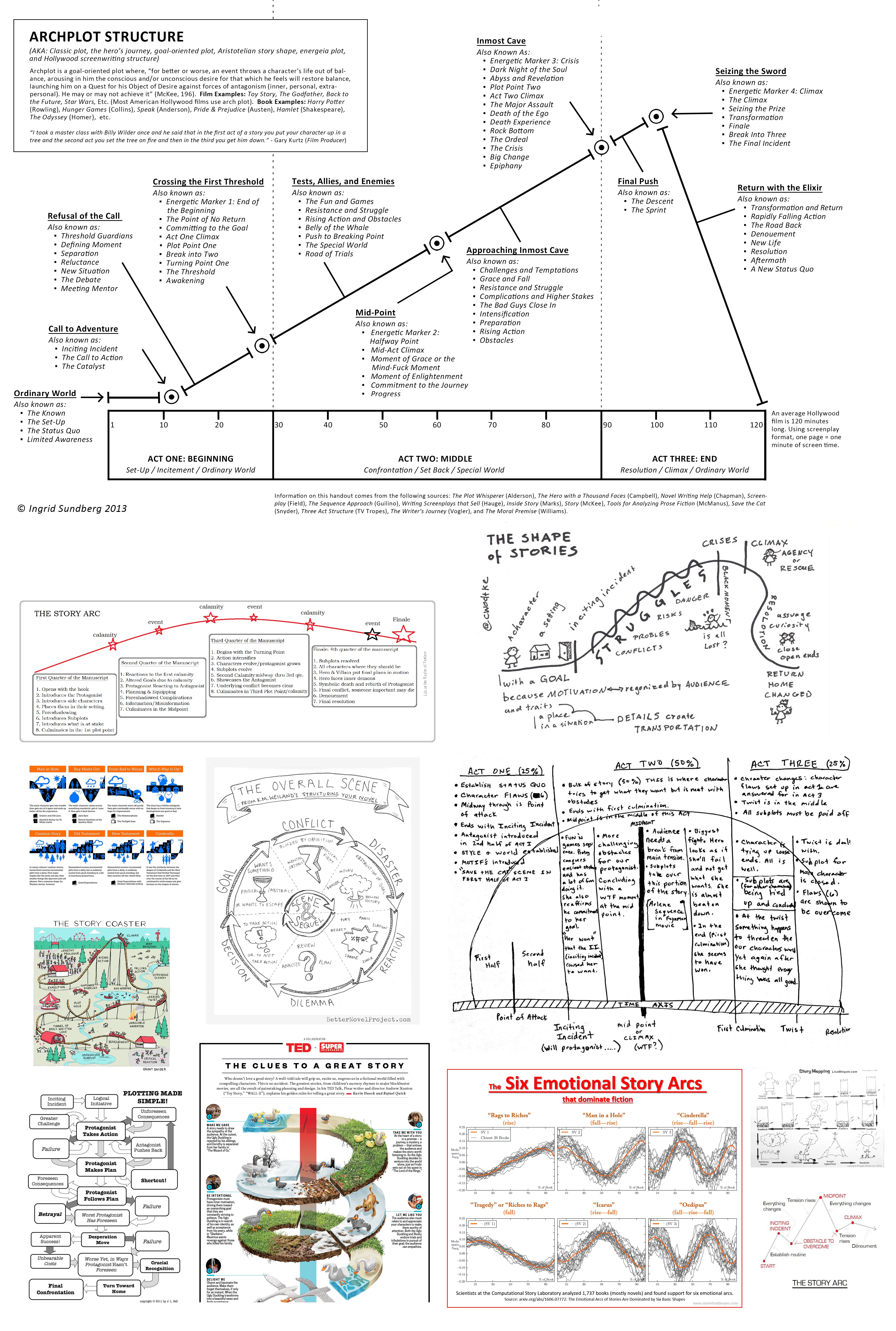
I haven’t been posting much lately because I’ve been working relentlessly on creating the ultimate story plot structure outline tool. In the process, I’ve looked at almost every article, video, and image related to plot structure on the internet. It has been a slow, painful process slogging through the slush pile of advice out there. So, to save other aspiring plotters time researching, I’ve compiled all the most useful content I’ve found into the list below.
46+ Popular Story Structure Graphs In 3 jpgs:
Videos Of The Hero’s Journey and Dan Harmon’s Adaptation:
I prefer watching educational videos on YouTube more than watching television, but it’s tedious digging for good content, and I’ve already seen most of the good stuff while searching for videos to put in my blogs. In case anyone else is looking for entertaining educational videos on YouTube, I made a series of posts with all the ones I’ve used on The Wise Sloth, organized by topic, with links to the posts they appear in. You’re bound to be enlightentained, and if you need help exploring the 600+ essays on The Wise Sloth, these video lists offer a quick overview that practically summarize my philosophies.
This list comes from my essays on economics and focuses on the housing market, taxes, and crypto currency.
I prefer watching educational videos on YouTube more than watching television, but it’s tedious digging for good content, and I’ve already seen most of the good stuff while searching for videos to put in my blogs. In case anyone else is looking for entertaining educational videos on YouTube, I made a series of posts with all the ones I’ve used on The Wise Sloth, organized by topic, with links to the posts they appear in. You’re bound to be enlightentained, and if you need help exploring the 600+ essays on The Wise Sloth, these video lists offer a quick overview that practically summarize my philosophies.
This list comes from my essays on economics and focuses on fixing the economy.
It’s self-evident that the majority of human beings aren’t geniuses. If you’ve ever worked in the food service or retail industries, you probably feel surrounded by idiots who lack basic common sense. On the micro level, this can make one’s personal life infuriatingly stressful. On the macro level, if humanity doesn’t raise its intellectual bar across the board, it’s only a matter of time before we exterminate ourselves. So what is common sense, and how does one achieve the first step in the path to enlightenment? To begin answering these questions, we need to go down the Wikipedia rabbit hole of definitions.
“Common sense refers to plain, self-evident truths or conventional wisdom that one needs no sophistication to grasp and no proof to accept precisely because they accorded so well with the basic (common sense) intellectual capacities and experiences of the whole social body”
In other words, common sense is having a basic understanding of reality, and analyzing it logically to draw accurate conclusions. This is similar to “intuition:”
“Intuition is the ability to (seemingly) acquire knowledge without proof, evidence, or conscious reasoning, or without understanding how the knowledge was acquired. Different writers give the word “intuition” a great variety of different meanings, ranging from direct access to unconscious knowledge, unconscious cognition, inner sensing, inner insight to unconscious pattern-recognition and the ability to understand something instinctively, without the need for conscious reasoning.
I added the word “seemingly,” because knowledge and reasoning don’t come from a magic hole in your head. Your brain is a cosmic supercomputer capable of putting two and two together without your full conscious attention. You don’t have to ponder if it’s safe to walk in front of moving traffic. Your brain can use common sense to solve that problem instantly and give you the answer.
The two common denominators between “common sense” and “intuition” are that they’re both dependent on an accurate perception of reality and rational thinking.
“Reality is the state of things as they actually exist, as opposed to an idealistic or notional idea of them. Reality includes everything that is and has been, whether or not it is observable or comprehensible.”
“Rationality is the quality or state of being rational – that is, being based on or agreeable to reason. Rationality implies the conformity of one’s beliefs with one’s reasons to believe, and of one’s actions with one’s reasons for action. To determine what behavior is the most rational, one needs to make several key assumptions, and also needs a quantifiable formulation of the problem. When the goal or problem involves making a decision, rationality factors in all information that is available (e.g. complete or incomplete knowledge). Collectively, the formulation and background assumptions are the model within which rationality applies.”
Notice that “reality” + “rationality” = “sanity.”
“Sanity refers to the soundness, rationality and healthiness of the human mind, as opposed to insanity.
Psychologist Erich Fromm proposed that, not just individuals, but entire societies “may be lacking in sanity”. Fromm argued that one of the most deceptive features of social life involves ‘consensual validation’: ‘It is naively assumed that the fact that the majority of people share certain ideas or feelings proves the validity of these ideas and feelings. Nothing is further from the truth… Just as there is a folie à deux there is a folie à millions. The fact that millions of people share the same vices does not make these vices virtues, the fact that they share so many errors does not make the errors to be truths, and the fact that millions of people share the same form of mental pathology does not make these people sane.'”
If you know what is true, and you combine factual premises logically, you can calculate true conclusions. When you do this subconsciously, you’re using common sense. This means the opposite of common sense lies somewhere between “irrationality,” “superstition,” and “delusion,” all of which fit the definition of “thought disorders…” or, in other words, insanity.
“Irrationality is cognition, thinking, talking, or acting without inclusion of rationality. It is more specifically described as an action or opinion given through inadequate use of reason, or through emotional distress or cognitive deficiency. The term is used, usually pejoratively, to describe thinking and actions that are, or appear to be, less useful, or more illogical than other more rational alternatives.
“Superstition is a pejorative term for any belief or practice that is irrational – i.e., it arises from ignorance, a misunderstanding of science or causality, a positive belief in fate or magic, or fear of that which is unknown. ‘Superstition’ also refers to religious beliefs or actions arising from irrationality.”
“A delusion is a mistaken belief that is held with strong conviction even when presented with superior evidence to the contrary. As a pathology, it is distinct from a belief based on false or incomplete information, confabulation, dogma, illusion, or some other misleading effects of perception. Although non-specific concepts of madness have been around for several thousand years, the psychiatrist and philosopher Karl Jaspers was the first to define the three main criteria for a belief to be considered delusional in his 1913 book General Psychopathology. These criteria are:
1: certainty (held with absolute conviction) 2: incorrigibility (not changeable by compelling counterargument or proof to the contrary) 3: impossibility or falsity of content (implausible, bizarre, or patently untrue)”
“Thought disorder refers to disorganized thinking as evidenced by disorganized speech. Specific thought disorders include derailment, poverty of speech, tangentiality, illogicality, perseveration, and thought blocking.
When you put all these definitions together, “common sense” equates to the most basic level of cognitive requirements necessary to constitute sanity. People who lack common sense haven’t put in the minimum effort to developing a healthy, rational mind.
If these statements are true, then the steps to achieving the highest level of sanity are the same for achieving genius. I’ve already covered those steps in my post, “10 Steps To Becoming A Genius,” but I’ll summarize the basics into seven steps.
1: Be curious, and learn as much as you can.
The less you know, the less information you can draw on to make logical conclusions. The amount of knowledge you’ll horde by the end of your life will be proportional to your desire to learn. If you don’t thirst for knowledge and wisdom, you simply won’t pick it up. You’ll fill your time making irrational decisions, defending delusional beliefs, and suffering the consequences.
2: Assume you’re ignorant and illogical.
Before you start patting yourself on the back for being genius enough to stay out of traffic, understand that nobody is omnipotent or perfectly rational. Even if you could memorize every Wikipedia article, our brains are hardwired to take subconscious mental shortcuts based on generalizations. These often lead to conclusions and actions that seem logical in the short-term, but are counterproductive in the grander scheme. We can resist these inclinations, but first you need the humility to admit your ignorance.
Click the picture below to enlarge it.
3: Value objective truth over subjective desire.
Some truths are subjective, but most are objective and can be confirmed by evidence and logic. Even religion isn’t a mere matter of personal choice. When put to the test, most, if not all, religions fit the definition of mythology. Ignoring the evidence is delusional. The more emotionally you deny the evidence, the more you exhibit symptoms of insanity.
You can’t complete the process of arriving at objective truth if you value your subjective desires more than objective evidence. This makes respect for the scientific method a prerequisite to sanity and common sense.
4: Use rules to think rationally.
The Scientific Method wasn’t invented by evil Atheists who were tricked by the Devil into misleading humanity from truth. It was invented by people (including religious and non-religious ones) looking for a way to determine, verify, and refine truth. Over the centuries, humans have discovered a slew of logic and critical thinking skills you can must use to separate truth from falsity.
5: Always ask, “why?”
The one simple trick to mastering sanity is: THOUSANDS OF HOURS OF HARD WORK. If that seems like a lot to wrap your brain around, the least you can do is make a habit of asking, “why?” When you experience something you don’t understand, ask why it happened. If someone tells you something, ask why it’s true. Ask why it’s false. If you never stop asking, “why?” then you will never stop finding answers and moving closer to truth.
6: Always question your sources.
In my opinion, the biggest reason the world is so full of irrational, delusional people isn’t because they lack access to information or the tools necessary to make sense of it all. The problem lies in the popularity of the belief that faith in authority is more valuable than skepticism and evidence. If you believe what you’re told, you’ll end up defending beliefs that serve the people who fed you their doctrine. If you don’t question everyone, you’ll believe anyone, and that will not lead you to truth or sanity.
7: Always question your answers.
As finite as our minds are, it’s inevitable that you’ll be led astray by good-sounding arguments that are ultimately false. Even if you don’t catch them coming in, you can still correct them by questioning your assumptions, thinking processes, and conclusions.
I prefer watching educational videos on YouTube more than watching television, but it’s tedious digging for good content, and I’ve already seen most of the good stuff while searching for videos to put in my blogs. In case anyone else is looking for entertaining educational videos on YouTube, I made a series of posts with all the ones I’ve used on The Wise Sloth, organized by topic, with links to the posts they appear in. You’re bound to be enlightentained, and if you need help exploring the 600+ essays on The Wise Sloth, these video lists offer a quick overview that practically summarize my philosophies.
This list comes from my essays on philosophy and focuses on the meaning of life.
Note 1: I wrote this guide on January 7, 2018. At that time, most of what I had to say about cryptocurrency was pessimistic, but I believed at least one of them would last forever, but we had to wait for the market to decide which one it wanted. I’m no longer have any confidence in the cryptocurrency market at all, but I’m leaving this post up for posterity. Look, 99% of of cryptocurrencies are scams, and I believe the 1% that aren’t will be replaced by some kind of new block chain that will solve all the old cryptocurrencies’ problems and make them obsolete. I don’t know what this hypothetical “Bitcoin 3.0” will be or who will make it, but in order for it to be accepted by mainstream businesses, it must have a stable price. So it will just be a medium of exchange, not an investment vehicle. Anyone holding old crypto coins when “Bitcoin 3.0” is invented and released, will be holding a wallet full of digital beanie babies. That’s my opinion. I could be wrong, but at this point I wouldn’t advise “investing” in cryptocurrency because I believe every existing coin will be worthless in a few years.
Note 2: There are about 115 cryptocurrencies listed on this page. These are all the coins that have sold over $1 million dollars as of January 7, 2018. It doesn’t include tokens. Any coin not listed on this page isn’t strong enough to raise $1 million. So betting on them to become the next Bitcoin is like betting on an ant to eat an elephant.
These sites specialize in trading cryptocurrencies. So if you want to access the newest, cheapest coins, you’ll need to buy some Bitcoin, Etherium, or Litecoin from one of the sites above and transfer them to one of the sites below.
These are more sites where you can sell cryptocurrency for cash. Regardless of where you bought or traded your cryptocurrency, you can transfer it between any of the sites listed on this page in a few clicks.
If you plan on holding onto your cryptocurrency for a long time without daytrading, you should keep it in a wallet instead of letting it sit in your account on one of the trading sites because if the government ever shuts those sites down or they get hacked, you’ll lose all your assets.
These sites allow you to look up prices in real time, find information on coins, and set up portfolios that show the current price of the coins you own.
You can “print” your own cryptocurrency coins by dowloading software from the links below and running it on your computer. It will take a long time to make a significant amount, but you won’t lose any money other than the electricity it takes to keep your computer on.
The only factor that gives a cryptocurrency real value is merchants accepting it as payment for real-world goods and services. The most widely used currency, and the only one accepted by major businesses, is Bitcoin. So Bitcoin is the only cryptocurrency that truly deserves to be called a legitimate currency… for now.
Bitcoin became the leading cryptocurrency because it was the first, and still is, the most widely used cryptocurrency on the darknet, which if you don’t know, is a collection of encrypted websites where you can buy illegal products like guns, drugs, child pornography, and much more. The stores on the darknet were the first businesses to accept Bitcoin as payment for real-world goods and services, which is how Bitcoin proved itself as a real-world currency. As long as the darknet exists, there will always be a need for cryptocurrency. So the first rule of investing in cryptocurrency is, you’re gambling with your money if you buy coins that can’t be traded for child porn.
After Bitcoin, the only other cryptocurrencies you can spend on the darknet are ZCash, Dash, Monero, and Ethereum. The reason blackmarket merchants adopted these in addition to Bitcoin, is because Bitcoin leaves a digital trail that can be traced. There are ways to cover your tracks, but the whole reason the darknet started using Bitcoin in the first place, is because it was more anonymous than a bank transfer. ZCash, Dash, and Monero were designed specifically to be anonymous and untraceable. Ethereum wasn’t, but it has smartcontract technology that allows you to use digital wallets that can cover your tracks.
Merchants on the darknet probably still accept Bitcoin even though Monero fits their need better because Bitcoin is accepted by the most legitimate businesses. There’s no point selling heroin for money that can only be spent on more heroin. If Amazon starts accepting Monero or Ethereum, there would be no reason for black market merchants to risk accepting Bitcoin anymore. If they stop accepting it, then Bitcoin will lose its safety net. But if Amazon accepts Bitcoin, it won’t need the darknet to survive.
Monero is the most secure cryptocurrency, which means it’s in the best position to become the next king of the darknet, but legal companies like Amazon don’t need to hide the identity of their customers. Ethereum’s versatility fits the needs of legal businesses much better. If a nerd can use Ethereum’s smart contracts to build the ultimate anonymous digital wallet, it would make Monero obsolete.
Below is a list of other cryptocurrencies that claim to be designed with security in mind. They would be a solid investment if the black market merchants started accepting them, but that need has already been filled. If these coins’ home pages are any indication of the quality of their product, they’ll never be accepted by anyone. The only coins on this list I find remotely interesting are Komodo, Storj, and Maidsafe due to their versatility, but why bet on a latecomer that hasn’t proven itself yet if you already know you can win by betting on one of the big 5?
Below is a list of other currency-centric coins that aren’t security-based. To the best of my knowledge, none of these do anything better than the big 5 established cryptocurrencies. Even if they did, they’re still missing the only factor that really matters. No major businesses accept them as payment or are even talking about considering them. If they’re not on big business’s radar, then they shouldn’t be on yours.
Before you buy any of the cryptocurrencies listed above, be aware that they all share a fundamental flaw. The only thing that gives a currency value is that it’s accepted by merchants as payment. However, consumers are motivated to not spend their cryptocurrency in the hopes it will increase in value 200,000% in two years. If consumers don’t spend their money, then merchants will stop accepting it. If the currency can’t be spent, it loses all its value.
There is definitely a need for a decentralized cryptocurrency, but in order for it to be useful for merchants, its price must be stable, which means “The Next Bitcoin” can’t be an investment vehicle. It’ll just be the medium of exchange. When the need for that kind of cryptocurrency is filled, then all the currencies that behave like stocks will become obsolete… and anyone who invested in those currencies will lose their money. Think about that.
There are currently a few cryptocurrencies that are designed to be pegged to the U.S. dollar, U.S. penny. I’m sure every month, more cryptocurrencies will come out that are pegged to other paper currencies. The more stable currencies there are, the more demand there will be for one standardized coin. It may be the best coin standing, or the American government may create and enforce its own official coin.
The point is, the world is changing fast, and we don’t know where it’s going. Nothing is predictable. Bitcoin might not be worth a penny five years from now, and Dogecoin could be accepted on Mars. Frankly, it might be more secure to gamble your money on a marijuana mutual fund than cryptocurrency.
The other 3 most popular cryptocurrencies:
Litecoin (LTC) is sold everywhere Bitcoin is, and it does everything Bitcoin does a little bit better. It also costs a fraction of the price, but almost nobody accepts it as payment. Until they do, it will be effectively worthless. There are a few niche shops that take Litecoins, but none that are big enough to count, and I haven’t heard any of those express any interest in adding Litecoin as a payment method. If you simply have to bet on an underdog, this is the only one running with the big dogs.
Dogecoin (DOGE) is one of the oldest, most recognizable coins. Despite the fact that it freely admits it serves no purpose, its value is still going up. There are even a few gaming and gambling sites that accept it as payment, which makes it more usable than 99% of cryptocurrencies. I wouldn’t be surprised if Dogecoin hits $1 by 2019. Feel free to gamble on that prediction, but don’t bet more than you can afford to lose, because Dogecoin will never truly be worth a penny.
The problem with Dogecoin is that there are already almost 1 trillion coins in circulation, and its blockchain will continue to produce 5 billion more every year forever. The whole premise of a currency is it has a finite supply, and Dogecoin is infinite. Demand can never outpace supply, and all of its value will be lost to inflation eventually. So the only way to make money off Dogecoin is to buy a ton, wait for idiots to drive up the price, and sell before the bubble pops.
Ripple (XRP) has been getting a lot of media attention lately, and a lot of people are buying into it, pushing the price up. I even bought some and sold it at a profit. I didn’t hold onto it for three reasons. First, it’s not decentralized. It’s servers are all owned and operated by a private business in San Francisco. If the government decides to shut it down or the owner decides to run off to the Bahamas, Ripple will disappear. Nobody can shut down Bitcoin because its technology is spread all around the world on private individual’s computers and mining rigs.
Ripple’s second red flag is it’s designed to destroy a fraction of itself every time it’s spent. This makes it look good on paper because scarcity raises value, but it will just eat itself from the other direction. When there’s not enough left to spend, nobody can or will buy it. This could take a thousand years, but it’s still a scammy feature I’m not comfortable investing in.
My third problem with Ripple also applies to every other coin listed below. Ripple isn’t just a currency. It’s also a business platform. A lot of other coins also have a business baked into them like digital wallets, cloud storage, web hosting, virtual real estate, or insurance document management. So basically, these are businesses that are unofficially selling stocks in their company and calling it “cryptocurrency,” but it may be more accurate to call them “fraudulent stocks.”
This is even more true for the ones that had an initial coin offering (ICO). They’re raising investment capital and selling shares on a cryptocurrency exchange, sidestepping the laws they would have to follow to launch an initial public offering (IPO) to sell shares on a stock exchange. Technically they’re not breaking the law, but the government could reinterpret, rewrite, or ignore those laws and shut down these fraudulent stock issuers at any time. This is my biggest fear about investing in Ethereum, becuase they had an ICO, but some major banks, including JP Morgan Chase, have endorsed Ethereum, and banks always get what they want, even if it’s illegal.
Cryptocurrencies that have sold over $1 million in coins, and may have exciting products, but act like companies issuing fraudulent stock:
Some of these fake-stock coins might survive, and they might have really cool products, but before you buy their coins, ask yourself honestly, can you see Walmart ever accepting it as payment? If not, consider investing in one you can.
Sooner rather than later, the American government is going to shut down all the weakest cryptocurrencies and make it much more difficult to create new ones. There are already almost 1,400 coins, and more are on the way. Right now, the best way to get rich quick from cryptocurrency isn’t by investing in the next Bitcoin, but by creating and selling the next shit coin like Bitbean (BITB). Look at the screenshot of Bitbean’s home page below. There’s nothing behind this “currency” except a couple of guys on cocaine… who are getting rich.
Bitbean isn’t even the worst or most useless. SmurfCoin (SMF) uses a copyrighted image for its logo. I’ve found shit coins that don’t have home pages or their home page is broken. One of them said they were mentioned in several major newspapers, but when you click the links, it just takes you to the newspaper’s home page. Half the shit coins’ home pages are just boiler rooms that use flashing numbers, bright letters, and frantic language to excite or scare you into buying their coin now. Half the companies that offer a new and exciting product or improvement to blockchain technology don’t have a working product yet. It’s “coming soon” or “in development.” If they do have a product, like a groundbreaking crypto wallet, it looks and works just like a hundred other wallets that were probably made from the same code they all downloaded off of Github. There are at least 300 shit coins with home pages that look so similar, I’m convinced they were made by the same person cycling through six templates. Some of these ultra scammy sites have sold over $100 million in coins. So, don’t assume a cryptocurrency’s market cap is always evidence of strength, and always look at its home page before buying.
If the crypto community won’t self-impose new standards to prevent me from creating and selling Dickpickcoin (DCK), then governments will have to step in. When either of those things happen, all the shit coins will become worthless, and all the coins that include products and services, will have their heads on the chopping block. I don’t know when this will come, but I know it’ll be when the cryptomarket gets out of control, and it already jumped the shark with Trumpcoin (TRUMP).
If you simply must gamble on coins that have a market cap of less than $1 million, it doesn’t matter which one you choose. Their value is only based on how many other people are buying it. You may as well buy Dogecoin or the newest, cheapest shitcoin and wait for more idiots to do the exact same thing. Since it’s completely random which will attract the most fools, your safest bet is to buy 50 knowing enough will skyrocket to mitigate your losses.
…Or you could just give your money to me instead of a Russian hacker.
If you enjoyed this post, you may also like these:






 The Wise Sloth