Tag Archives: self-improvement

My Advice To The Younger Generation

My senior year of high school I asked as many adults as I could for the single, best piece of advice they could give to a young man just about to enter the real world. I probably asked around 30 or 40 adults this question, and I never met one who had an answer ready. They all had to stop and think about it. Most of them acted like that was the first time anyone ever asked them to sum up what they’d learned in life.

I don’t specifically remember any of the advice they gave me because most of it was generic and watered down to the point of being useless like, “Do your best.” “Don’t have any regrets.” or “Love everybody.” What I did learn from them and what did stick with me was that not having an explanation for who you are, where you’re going, where you’ve been and what you’ve learned is no way to go through life.

Grown ups are stupid. You have no idea.

Since I don’t want to be that guy I’m going to give my speech to the younger generation right now. The most important thing I can tell young people is that your life is your responsibility. Life isn’t a bowl of cherries. Life is hard, and it’s going to knock you down. You can blame the whole world for all your problems, but even if you’re right, your life is still your responsibility and nobody else’s. Once you’re dead all excuses are moot. Death doesn’t ask you how the world treated you. Death asks you how you lived your life.

If you want to make the most of out of your life you need to plot a goal, lay out a plan in writing and focus the rest of your life on it. In order to know what you want out of life you have to do two things. First, you need to define yourself.

Everyone can tell you their name and where they’re from, but most people don’t spend enough time reflecting on who they are, take time to meditate and feel what it’s like to be them or express themselves through the things they create with their hands. They let the world tell them who and what they are. They associate their identity with the institutions around them. They let the world burn its image onto them instead of burning their image onto the world.

This causes them to spend their entire lives chasing circles trying to find happiness but never truly getting what they want… because they never truly defined what they wanted. They just drifted where the currents took them and then simultaneously cursed and defended where the undertow took them.

Don’t be that guy. Find yourself. Do that by writing your life story. Analyze your past. Map out your journey so far and analyze the patterns. Use that to figure out what made you who you are.  Then once you’ve taken control of your growth, create yourself into who you want to be.

Keep pounding away at finding/creating yourself. Take personality tests and start studying psychology as early as possible. You are your mind. If you don’t know how your mind works then you don’t know how you work. Not only will studying psychology help you understand and take control of yourself, but it’ll help you understand other people, and that will be the most important job skill you’ll ever learn no matter what you do for a living.

The second thing you need to do before you can say where your life is going is to learn to think. Thinking is asking questions. Everything you’ll ever do will be done because of a question you asked yourself in your head. The quality of your answers and thus your actions will be determined by your ability to ask the most important questions, analyze the variables logically, perform cost/benefit analysis and formulate answers.

Nobody else can answer all your questions for you, and for the most part, nobody will even try to help you figure out life. People will (intentionally and unintentionally) give you bad advice, and there’s no way to check to make sure your answers are correct. People will use fear and bribery to coerce you into living your life based on mythology and contrived doctrines. If you choose to follow that path, question it like your life depends on it. If it’s true it’ll stand the most objective test for factual accuracy possible. If it fails the test then you’ll be free.

But don’t think freedom from delusion will set you on the one true path; you’ll never find the one true path because you’ll never be able to prove you’re on the right path, but if you keep questioning life and improving your ability to ask/answer questions, then at least you can live your life for yourself. And if there’s any hope of anyone ever figuring out the universe, the only way any progress towards that goal is going to happen is if someone, preferably you, questions what the hell is going on around here.

If you enjoyed this post, you’ll also like these:

Growing up and Becoming You
Happiness and Peace
Self-Esteem
Health
Drugs and Addiction
Achieving a Healthy Work/Life Balance
Leadership and Authority
My Tweets About Self-Help

The Prime Prerogative

"If it is important to you, you will find a way. If not, you'll find an excuse."

There’s more information in the world than your brain can possibly store or process. Not only are there obscure factoids about South American tree frogs you’ll never know (and don’t care to know), but there are libraries of very important, very pertinent information that you really, really should know but simply don’t have the capacity to learn. Even in our daily lives, we have to ration out what we apply our brain to. We’d all love to learn 10 foreign languages and all of our friends’ phone numbers, but we don’t have the mental capacity. Our brains are already overclocked, and the fact that we live in the digital age, where information fights for our attention in a world already over-saturated with information, makes it all the harder to manage the clutter accumulating in our brains.

Luckily our brains are smarter than we are, and our brains have done an exemplary job of streamlining the process of collecting, storing, processing and retrieving data. But again, it can only do so much. When you’ve got too much to do and not enough resources to do it all, you prioritize. Consciously and subconsciously we break life down into a kaleidoscope of shifting priority schemes. We’ve got long-term priorities, mid-term goals, short-term desires, side projects, and fantasies. We prioritize our friends, our lovers, our sins, our strengths. We construct our perception of reality on all of these imagined lists and hierarchies. Our understanding of these lists becomes who we are.

That process is extremely tumultuous, especially for people who live in inhuman environments. It’s pretty simple to knock a person’s priorities out of whack. Just don’t teach them anything. Don’t let them do anything they want, and scare them all the time. Everyone you’ll ever meet (yourself included) is arguably a little broken, but broken minds still operate using the same operating system as nurtured minds. Everybody’s minds still have to break life down into a hierarchy of priorities in order to manage processing all the data required to propel a semi-autonomous, bi-pedal, organic supercomputer.

This means that everyone you will ever meet will have their own unique, pyramid-shaped daydream in their head about who, where, what, when and why they are. Those pyramids are built from the unique amalgamation of information their minds happened to get cluttered with. So everyone has their own imperfect perception of reality, and each of our universes are ultimately built around a center point, which I call the “Prime Prerogative.”

https://youtu.be/DnPpY0fpKUw

Your life is a question that your brain is trying to solve. Your prime prerogative is the answer it has come up with based on the information it has been able to gather. It’s you doing what you think is most important in life based on your values. It’s the direction that the boundaries you set for yourself are taking your life in…. and that direction may or may not have any resemblance to what you say you believe the meaning of life is.

Uneducated people raised on processed, homogenized consumer culture don’t tend to take the time to meditate on the meaning of life, and if/when they don’t exercise their ability to think for themselves for long enough then their brains default to auto-pilot. Then their prime prerogative defaults to seducing a mate and fighting their way as far up the social hierarchy as their monkey claws will take them. A worst-case scenario would be someone who has been so stonewalled and crippled by their environment that they’ve given up all hope of ever achieving any of their own personal priorities. When prisoners in P.O.W. or concentration camps lose their prime prerogative they just lie down and die. Or if you work in a sweatshop for long enough you just die inside and sleepwalk until your body stops moving, but if you ever meet a person who is still alive and breathing, you can predict they have a prime prerogative.

A person’s prime prerogative is typically set by the time they’re in their mid-twenties, but it can change, especially if the environment changes since that upsets the equation of life the brain is trying to solve and forces it to recalculate its priorities. People’s priorities also tend to change when a hot piece of ass walks by or someone offers them a lot of money. So even if you think you’ve figured out someone’s primary prerogative, you might be basing your answer on information the person gave you when they were pursuing a side goal, but if you spend enough time with a person then their prime prerogative will shine through even if they try to hide it (or because they try to hide it). You still won’t be able to see it through people’s facades if you’re not looking, and to make matters more confusing, our own prerogatives often blind us from seeing other people for who they are and understanding what they want.

If nothing else, understanding other people’s prime prerogatives is useful because it allows you to spot douche bags, con men and psychopaths from a mile away. It’s also useful, because if you ever need something from someone and you know what they want most in life then you can make it in their best interest to help you remove an obstacle between you and your prime prerogative by helping them achieve their prime prerogative.

Of course, there’s a dark side to all of this too. If you work for a marketing firm you can use this understanding of basic human motivation to mind fuck consumers into buying products they don’t need with money they don’t have. If your prime prerogative is to have sex then you can appeal to your sexual prey’s prime prerogative to seduce them. You can even design a cult that uses traumatic brainwashing techniques to reprogram unsuspecting recruits’ prime prerogative so that they’ll want to be your doting, suicidal slave.

But as Isaac Asimov said, “If knowledge is dangerous, the solution is not ignorance.” (paraphrased) The fact of the matter is that anyone who doesn’t understand the principle of the prime prerogative is navigating their way through society half blind.

How do you figure out other people’s prime prerogative? You just start with the assumption that no action is an island, and then you watch people to find patterns in their behavior. Once you start spotting patterns you simply extrapolate them. When multiple behavior patterns all lead to the same conclusion then you can be fairly sure you’ve found their prime prerogative.

"Action expresses priorities." Mohandas Gandhi

If you enjoyed this post, you’ll also like these:

Growing up and Becoming You
Happiness and Peace
Self-Esteem
Health
Drugs and Addiction
Achieving a Healthy Work/Life Balance
Leadership and Authority
My Tweets About Self-Help

Advice On Life

1: Know/create yourself.

You can’t not be you, but if you choose not to understand yourself, identify areas you want to grow in and follow through with a plan to constantly reinvent/upgrade yourself then you’re just going to go with the flow your whole life on autopilot. You’re going to get stuck in an unfulfilling job. You’re going to fall in love with the first person who touches your genitals. You’re going to have children to try to fill the void in your life, and you’re going to be a terrible parent because your own life lacks purpose. You’re going to look back on life in old age and wonder what the point of it all was. But if you’d known who you were and actively set personalized goals then you would have lived with purpose.

2: Be curious and pay attention.

All of the answers to all of your problems are out there in the universe. Problems aside, there are more wonders in this cosmic playground than you could possibly experience or understand, but in order to solve any problem or get the most out of your play time, you need to look at the world around you and study it.

Every time you see something new you should wonder why it is the way it is. Finding out why will empower you. Not knowing will cripple you. Not finding things out is like choosing not to have any superpowers. So find out as much as you can about as much as you can, and never lose your passion for learning, because the moment you stop learning is the moment you start regressing back to a thirsty, hungry, horny monkey on autopilot.

3: Never trust authority.

There will always be someone with authority over you. At any given point in your life, you’ll be subject to multiple authority structures simultaneously: your parents, teachers, bosses, police, politicians. They can all give a good reason why they should have authority over your free will, and most of them will have a fancy looking piece of paper that says they’re more alpha than you.

While these authority figures may deserve a pat on the back or two for something they did, all men were created equal. Everyone will always be equally valuable, and no matter how much knowledge, experience or age someone has, they still don’t know the meaning of life. Ultimately we’re all just bullshitting our way through life and mimicking random cultural norms we take for granted. And no matter how much anyone knows, our knowledge is dwarfed by what we don’t know.

Since we’re all equal and we’re all idiots that means you would be a fool to have faith in anything anyone says. I’m not saying not to listen to people. Listen to everyone. Learn from everyone. Just doubt everything. And when someone tells you that you have to obey them, recognize that they’re bullying you into submission. That’s all that’s happening there.

Your life is your responsibility. Your authority leaders aren’t going to live it for you. They’re not going to do your work or suffer the consequences of your mistakes. Your life is in your hands. I’m not saying you should disobey everyone. I’m just saying, authority isn’t ordained by God. It’s invented by men. The only authority anyone has over you is the authority you give them.  Don’t give it away carelessly.

4: Get a skill and a certification.

The world is a cut-throat place these days, and since the poor are the most defenseless they get their throats cut more than anybody. You can’t live a good life on minimum wage because you can’t afford the basic necessities of life. If you can’t afford the basic necessities of life then you certainly can’t afford to take years off of work to go to school much less pay the extortionate fees every adult education institution charges. But if you don’t have a skill and a piece of paper that says you graduated from somewhere then it will be almost impossible for you to get a job that pays a living wage. Thus poverty becomes inescapable real quick, and the older you get the harder it is to get out of. Seriously, life is hell without a skill and a certificate. Get a forklift license if nothing else. Just get something, because if you don’t then you’ll most likely end up a beaten down wage slave for the rest of your degrading, exhausted existence.

5: The world doesn’t owe you anything, and life isn’t fair.

You can scream at the heavens until your lungs blow out and pray on your knees until they bleed, but it won’t change anything. Throughout your life, you’ll suffer repeated injustices. You’ll get the short end of the stick time and time again. That’s going to happen. Crying about it isn’t going to change anything. The only way to change anything is to do something. The sooner you accept that the world doesn’t owe you anything and life isn’t fair the sooner you can dry your face and start getting your hands dirty doing something about the problem.

6: Don’t be a consumer whore.

Just because you can afford to be stupid doesn’t mean you should. Paying too much for things you don’t need is ignorant. It’s immature. The cost/benefit analysis doesn’t add up. You earn money by spending time working. Money comes from time. Time is fleeting and irreplaceable. The time in your life is the most valuable thing in the universe. Trading it for a $150 shirt that cost $8 to make is giving your life away for nothing, and it makes you a chump. It also means you’re going to have a lot less money in old age, and less money means less security. Less security means more anxiety. More anxiety means more problems. If every consumer whore had done something useful with their money such as donating it to a free online school that covers every topic in academia then the world would be one giant leap closer to Utopia. But as it stands we’ve chosen sports cars, name brand shirts and blood diamonds over Utopia.

7: Have high intellectual standards.

The quality of your life is determined by the quality of your mind. Life sucks for stupid people, and life is limitless for smart people. Being smart isn’t just about memorizing all the keywords in every university textbook. Books just tell you about what’s going on around you. Once you understand what’s going on around you the next step is to engage with the world, study it and try to navigate and operate it. Since you’re going to die someday relatively soon you don’t have any time to lose. If you can choose what kind of environment and stimulation you expose yourself to, you should choose to expose yourself to intelligent, edifying things. Celebrating stupidity by acting brainless and watching brainless television and listening to brainless music and talking about brainless things is a waste of time. You’re letting the mysteries of the universe slip through your fingers. To make matters worse, the more you do it the more you reinforce your own brainless behavior  and since all your brainless friends don’t study the world around them and they just mimic whatever the people around them are doing they’re going to see your brainlessness and assume that being brainless is what we’re all supposed to be doing. Then, as a group, you’re going to be an intellectual drag on society. You’ll become the brainless consumer whore sheeple who politicians and marketers can manipulate into squandering society’s potential for the benefit of a few sociopaths.

8: People are important.

You’re an animate, sentient, bipedal, autonomous cosmic supercomputer. You’re stranded in an elegantly designed universe for a relatively short time, and even if you could find a logical explanation for the absurd, existential question of life you probably couldn’t empirically prove your answer. That sucks and is made worse by the fact that we’re stranded in a cold, harsh universe that isn’t fair and doesn’t owe us anything. Life is hard, but there’s one warm light in the darkness. That light is the other people in the world you’re surrounded by. Each one of us is an existential question, and we have a universe in our minds. We’re the only thing in the universe we can connect with. We make life worth living. We’re the most important thing in the universe. There’s nothing more important we can do than taking care of each other. Hurting, killing, exploiting, bullying, manipulating and abandoning each other is the worst thing we can do.

9: Today is what it’s all been leading up to.

About 14.7 billion years ago an infinitely dense point of energy expanded inexplicably creating time and space as we know it in the process. Since then the atoms in your body have been flying through space. After traveling through gas clouds, stars and oceans they’ve finally come to rest in your body. The atoms inside you have been a cloud, a meteor, a fish, a plant, a cough. The matter in your body has been amazing places and done amazing things. It’s been an incredible journey, and it has all been leading up to one final step. The last step is the step you choose. At the very least it warrants raising your hands to the sky and shouting, “I’m here!”

The time to celebrate life is now, not after you graduate, get promoted or retire. Life isn’t around the corner. It’s here. Now. Today.

https://youtu.be/dTBbRkZi0B4

If you enjoyed this post, you’ll also like these:

Growing up and Becoming You
Happiness and Peace
Self-Esteem
Health
Drugs and Addiction
Achieving a Healthy Work/Life Balance
Leadership and Authority
My Tweets About Self-Help

6 Stages Of Friendship

1: Strangers

Everyone in the world starts out as a stranger (and potential friend) to you.


2: Loose Acquaintance

The first time you meet a person they’re just a random face in the crowd. Unless you meet this person at your arranged marriage, there’s little to no guarantee you’ll ever see them again. It takes time to learn enough about a person to know whether you like them or not. It also takes time to build shared experiences together with which you’ll come to base your friendship on. So even if you really hit it off with someone the first time you meet them, they’ll only be a potential friend until you see them again… and again… and again…and again.

There are over 6 billion people in the world. You only have enough time in your short life to become best friends with a few of them. Your brain understands this. So even if you don’t your mind will subconsciously size up every person you meet and come to a conclusion about whether or not this person is compatible enough with you to be worth pursuing a deeper relationship with. 99.9% of the people you meet in your life will fail the Loose Acquaintance Test. The first time they leave your sight, you won’t ever think about them again. Even if you do remember them, the thought will never occur to you to regret their absence in your life, because they were just some unimportant, random person.

That’s fine. We can’t all spend our lives obsessing over everyone we meet. In fact, we should be conscious of the fact that we should be sizing people up to assess who we can/can’t build meaningful relationships with. If we don’t pay attention we risk passing up the right people and attaching ourselves to the wrong people.


3: Regular Acquaintance

If you keep running into the same person over and over again you’ll learn things about each other and build shared experiences. In no time at all, they’ll stand out of the crowd. When you see their face it will mean something to you, and when you talk to them you can continue your previous dialogues. These interactions will evolve your relationship with each other. Instead of just being a random person they’ll become the person you met there who does this for a living and goes to the place you’re at to get… whatever.

Spending time with a person doesn’t guarantee you’re going to be friends. You’ll meet just as many people who, the more you meet them the more you despise them. However, some will pass the Regular Acquaintance Test, and some will pass it faster than others. You could buy coffee from the same barista for ten years before they become anything other than a friendly barista to you. On the other hand, sometimes you run into people who you just click with and end up spending the next two weeks together every day. Not only do you need to spend time with a person to get promoted in their friend book, but you have to spend meaningful time talking, opening up, overcoming challenges, learning and having fun together before your relationship has significant meaning.


4: Allies

Eventually, you’re going to work with people for so long that you’ll know their whole life story, their idiosyncrasies, and secrets. You’ll know them well enough to accurately predict their future. But they’ll still just be a regular acquaintance who you know at work. Intimate knowledge is a prerequisite for friendship, but it’s only one component.

Feeling affection for each other is another prerequisite for friendship. When you experience affection towards another person emotionally, you get those feelings from your brain. Consciously and subconsciously your brain has been calculating how valuable that person is in your life. If the results of that calculation are negative then you’ll dislike them. If the results of that calculation are positive then you’re like them. The higher they score, the more you’ll like them. The lower they score, the less you’ll like them.

Friendships are warm and fuzzy, but they’re also based on a cold calculation. Life is beautiful, but life is also war. Everyone and every living thing is competing with each other to survive in a dog-eat-dog world where only the strong survive, and only the alpha thrive. Every stranger is a potential threat to you. They could rob you, bully you, steal your lover, get your job, rip you off, betray you or kill you. You might not walk around all day grimly sizing everyone up, but if a stranger asks to borrow $1000 from you, you’re probably going to say “no” without even having to think about it.

The test that regular acquaintances have to pass before they can get promoted to an ally is the test of trust. When you put your trust in someone else by (for example) lending them money, you risk losing ground in your battle against nature to survive. That’s a profound thing to do because you’re choosing to bet or give a tiny piece of your life. That’s sharing life.

As you and another person reciprocate trustworthiness you cease to be regular acquaintances, and you become allies. Effectively you’ve signed an unwritten truce not to fight each other and to back each other up in their time of need even if it’s inconvenient.

There are different kinds of allies you make in life, and each truce is different. Some friends would only let you borrow $10. Some would let you borrow $100, but they wouldn’t pick you up from jail or give you a ride to work. You can open up to some of your friends, and some friends prefer to keep your relationship more formal or professional. Some friendships involve lust, and some don’t. Your expectations of each of your friends is different, but that doesn’t mean your contracts between them are unequal. Variety is the spice of life. We should be conscious of the different kinds of friendships we have and celebrate their idiosyncrasies.


5: Official Friend

When you make a truce with an ally, you agree not to take what the other person has. You can borrow from each other in your time of need, but you’ll be expected to pay your ally back. There’s also a limit to how much your ally will risk on you. An official friend will give you what you need for free without expecting you to pay them back. In fact, they’ll insist that you don’t pay them back. That act goes above and beyond the conditions of a contract. It’s not a bet. It’s a gift, and that’s profound. You’re sacrificing a bit of your life to make another conscious being’s reality better.

Ultimately, friendship is a choice. That choice is yours. Rocks and trees can’t make choices. Only living, sentient beings can. When you choose a friend you express the existence of consciousness in an otherwise inert universe. It also establishes a bond between you and another individual consciousness. The emotions and ideas you share will be unique in all the universe. All of this is valuable enough to justify the existence of life.

But I digress.  Sacrifice is the cost to become an official friend, and it’s not enough to just be willing to make that sacrifice. As admirable as that is, you’ll never be as good of friends with an untested ally than say war veterans are with the people they fought alongside. When you build a history of shared sacrifice with another person you build a history of proven character.


6: Best Friend

Every alliance and friendship is different, and while there’s no need to stress over which friendship is “better” than the others, one will inevitably rise to the top. You win that prize by getting the highest score on the Best Friend Test, which is one question long and looks something like this:

Best Friend = (how well you know a person + how many experiences you’ve had with them + how much you care about them + how well you treat them) – (how many conditions you place on each other’s trust)*(mutual sacrifice).

Put your allies to the test and figure out who your true friends are. And put yourself to the test as well. Consider how high your friends would score you. If hardly anybody would give you a good score you’d be wise to consider the hard possibility that you’re an asshole and need to seriously rethink your life. If your friends score horribly low you may consider the hard possibility that they’re not really friends and it might be better for both of you to step out of each other’s lives.

When you do find a best friend, cherish them. When your life flashes before your eyes you’re going to see all the best friends you’ve made through the years. They were your life. As important as that is, it’s also a simple fact of life that you can’t spend your entire life with just one best friend. Things change. People change. You can’t write a song by only playing one note. As beautiful as that note may be, you have to let go when the time is right and move onto the next note, and the next one, and the next one, celebrating all of them for their uniqueness. (That last bit about music notes was paraphrased from “The Lazy Man’s Guide to Enlightenment”).


If you enjoyed this post, you’ll also like these:


Sex positions and techniques
General Sex Advice
Dating Advice
Relationship Advice
Philosophy of Sexuality
Friendship
My Tweets About Romance

Creativity Is Logic, Not Magic

Thoughts follow the same rules of science as chemistry and physics. You can’t get a new thought from nothing. In order to have new ideas you either have to learn them from a source outside yourself or combine existing thoughts in new ways. Your thoughts will continue on the same trajectory until acted upon by a new thought.


Ultimately, thoughts are nothing more than mathematical equations. Every event that happens to you is a new variable for your brain to calculate and find a solution to, and there are so many variables involved in doing something as simple as crossing the street that if you gave your full attention to everything you did you’d never make it out of the house in the morning, but that’s okay because your brain is a cosmically powerful computer and can take simple tasks such as crossing the street and calculate them practically subconsciously, and it can do other tasks, like beating your heart, completely subconsciously.

Look at how these simple concepts make complete sense of the mysterious concepts of emotions, creativity, and inspiration. Our emotions are the product of our brain subconsciously calculating all the variables in our life. Falling in love seems so mysterious, but when you take a step back and tally all the variables it makes logical sense. The logic might not add up to a responsible decision, but when people make bad decisions it’s because they don’t have enough knowledge in their brain to calculate their decisions correctly. However, to them, it appears logical because they’ve come to the most logical conclusion based on the variables they have.

This is why psychologists have a bad reputation for asking people questions and never giving answers. If the patient knew all the variables in the first place, they wouldn’t have a problem because they could find the solution on their own. If the psychologist were to give them the answer, then the ‘patient’ would reject it because the correct answer doesn’t add up using the limited amount of variables they’re working with. So the only way for the psychologist to get the patient to see the correct answer is to walk them through the problem and let them solve it for themselves. The only way they can arrive at the idea is by someone walking them through the process of combining the ideas already in their head.

If you need more evidence that emotions are subconscious logic, then look at your own dreams. Psychologists are sometimes able to interpret dreams because they’re a logical representation of the variables in our lives even though they’re almost entirely the product of our subconscious. Sometimes the logic is obvious such as when a soldier has nightmares about war. Sometimes they’re mysterious, but even when they’re mysterious we know it’s not because they’re magical. It’s only because we don’t fully, consciously understand the variables in the equation.


https://youtu.be/h6CL2Y4yS0I


Creativity is just a matter of combining variables in innovative ways. Sometimes the logic is obvious such as in the case of artists like M.C. Escher. While Norman Rockwell and H.R. Geiger may seem whimsically creative, if you walked through their childhoods you could identify all the variables that led them to develop the styles they chose. And neither of those two artists could have possibly arrived at the other’s style because the variables in their lives didn’t add up to the other’s conclusions.

Inspiration is the simplest of all. Whenever we all of a sudden have a brilliant flash of insight it’s because something caused us to combine the exact two thoughts in the exact way to come to a logical conclusion that we were previously missing a vital variable to arrive at.


Now let’s take this a step further. The sum of all your knowledge (aka variables) and thinking skills (aka formulas) yield your identity and your philosophy on life. The more variables you understand, and the better your thinking skills are, the more of a true individual you’ll be and the more successful your philosophy on life will be. The less you know, the less you can think. The less you’ve thought about the equation of life, the more incomplete of a person you’ll be and the worse your life skills will be.


If you enjoyed this post, you’ll also like these:


The Meaning of Life
How to Think Like a Genius
Knowledge and Learning
Biker Philosophy
My Tweets About Philosophy 

Society Won’t Improve Until You Do

"I told about the whole being greater than the sum of its parts. It's that way with people too, he said, only with people it's sometimes that the whole is less than the sum of the parts." Wendelin Van Draanen

If a society is nothing more than a large group of individuals, then the key to creating a Utopian society is to create a large group of Utopian individuals…

but if you can’t help an individual improve him/herself who doesn’t want to improve him/herself, then there’s no chance of helping a society of people who don’t want to improve themselves….

and if a person who does want to improve himself will do so with or without outside help, then a society of people who want to improve themselves will do so with or without outside help…

then if you don’t live in a Utopian society already, there’s a strong possibility it’s because the majority of people in your society don’t want to improve themselves. In which case, there’s little hope of your generation living to see Utopia…

and any chance your society has of improving its wants will be minimized as long as the majority of people in your society spend 3-6 hours per day watching and listening to commercials designed to make them crave fulfillment of the pettiest, self-serving, immediate desires humanity is capable of.

If you enjoyed this post, you’ll also like these:

Talk About Saving the World
Be Better People
 Build a Better World
Buy a Better World

Demotivational Inspiration For Work

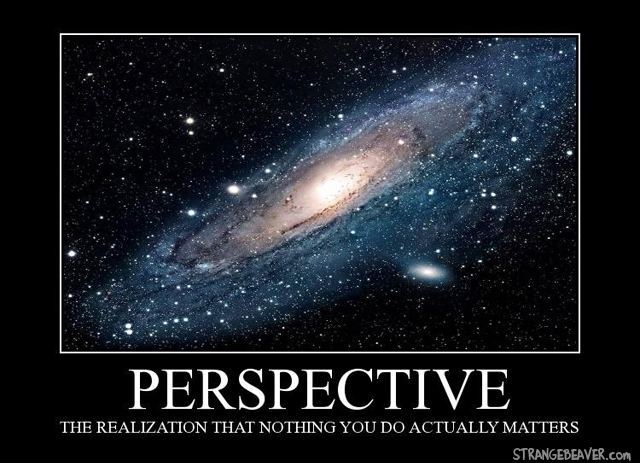
Picture of a beautiful galaxy in space. Below it are the words, "PERSPECTIVE: The realization that nothing you do actually matters"

Everybody has a dream, that big thing you want to accomplish in your short life. Unfortunately, the bigger your dream is the more work it’ll take to achieve it. Thus, the farther away it’ll be and the harder it’ll be to achieve. To make matters even worse, since the size of your dream is relative to your ambition, the bigger your dream is the stronger you’ll burn with desire to accomplish it. Thus the more miserable you’ll be in the present because you’ll be weighed down by all the work you have ahead of you, and you’ll be weighed down by the shame of not having fulfilled your potential yet.

If your unfulfilled ambitions weigh heavy on your soul, take solace in the fact that it doesn’t matter if you accomplish your dreams anyway.

Think about it. Let’s suppose you write the next great American novel, get promoted to CEO, become a rock star, buy that house by the ocean with the rickety dock leading out over crystal blue waters, have sex with a supermodel… whatever.

You know what happens after that? You die. Your fans die. Your lovers die. Your house collapses and gets paved over to make way for someone else’s dream house that’s going to collapse after they die.

In the long run, on the cosmic scale of things, it doesn’t really matter if you accomplish any of your dreams because they’re all just castles made of the sands of time that are going to get blown away, kicked over by the next snot-nosed kid who comes along or dissolved by the indifferent cosmic sea when the celestial tide comes in again.

So what does that mean? That dreams are futile and we shouldn’t have them? No. You need to have dreams because your tomorrow will only be as vibrant as your dreams tonight. If you don’t have a dream then where’s your life going to go? Nowhere. And that would be a waste of a life. But you do need to keep those dreams in perspective.

When you start to stress out over your dream, ask yourself this question. So what if you achieve your dreams? So what if you get a gold-rimmed hot tub and a trophy spouse; is that really going to fundamentally change the experience of existing for you? No.

You’re still going to be you. Your reality is still going to be defined by how you perceive what you experience in the immediate present. All you’re going to do after you fulfill your dreams is continue being you and experiencing the moment.

Life is made up of “todays,” not “tomorrows.” Stressing out about a tomorrow that hasn’t happened ruins your “todays” that are actually happening. So even if you finally do achieve your dreams and tomorrow is everything you ever hoped for, your “yesterdays” will be miserable if you’re always stressing out today.

You don’t need to own a Bentley to enjoy yourself and savor the moment. You can do that right now sitting on the mini lawn chair in your empty one bedroom apartment while typing on a laptop that’s sitting on the upturned luggage you’re using as a table because you don’t own a real one…or whatever the case may be.

If you enjoyed this post, you’ll also like these:

Growing up and Becoming You
Happiness and Peace
Self-Esteem
Health
Drugs and Addiction
Achieving a Healthy Work/Life Balance
Leadership and Authority
My Tweets About Self-Help

My Two Rules About Rules

Picture of a military helicoptor hovering next to a sign that says, "Speed limit enforced by aircraft." Underneath the photo it says, "THE RULES: They may be stupid, arbitrary and irritating, but god help you if you break them."

Rule #1: Rules were written by people, and most people are idiots.

If there were one lesson to be learned throughout all of human history, it’s Rule #1. Amazingly though, there are billions of people who haven’t learned that lesson. Oh, sure they’ve learned not to kill 6 million Jews, but they haven’t learned to question their employer’s rules today. As a result, they get locked into enforcing outdated or illogical rules that make people’s lives worse.

The rules they enforce might not kill 6 million Jews, but they’ll waste the short and infinitely valuable time being bogged down with needless work. This will prevent them from accomplishing their highest level goals, ironically, in the name of doing what’s right.


Rule #2: A rule’s only true authority comes from its ability to help people.

Rules were created to serve people. People weren’t created to serve rules. When a rule ceases to help people, it negates its purpose for existence and thus negates its authority. For example, nobody would argue against the rule “don’t kill people.” However, rules have to be judged on a case by case basis according to whether or not they’ll help or hurt people each time they’re enforced. If a situation arises where it will help people more by not enforcing the rule, then it should not be enforced. For example, if you lived next to a Nazi concentration camp, you might decide it’s moral to break the “don’t kill people” rule if it were the only way to save the lives of the victims in the concentration camp.


If you enjoyed this post, you’ll also like these:


The Meaning of Life
How to Think Like a Genius
Knowledge and Learning
Biker Philosophy
My Tweets About Philosophy 

Wisdom I Learned Working In I.T. : Answers Come From Questions

Picture of a woman smiling and talking on a phone in front of a computer. Below the picture are the words, "TECH SUPPORT: We can fix anything... except stupid."


Fixing computers for a living means you spend your whole day problem-solving. It’s insanely frustrating because you’re expected to be able to answer any question about any hardware or software problem there could ever be. Even if you went to school to study computers, all of your knowledge and experience is constantly becoming obsolete. So you have to constantly relearn your trade, but no matter how much you teach your self, you’ll never be able to memorize every error code, every symptom, and every solution to every problem that could possibly happen with every operating system.

However, you don’t have to. You’d be surprised how much you don’t have to know about computers and still be able to make a living fixing them… as long as you know how to think logically… which most people don’t. If they did, then most computer technicians, therapists, and police would be out of work. The following rules apply as much to fixing computers as they do to life:


Rule #1: If you want an exact answer, you need to ask an exact question.

When a user’s monitor goes blank they freak out and ask questions like, “Why is this happening to me?” “Why now?” “What the hell is wrong with this piece of shit?” etc. None of these questions are going to provide useful answers. So they call a computer tech who asks questions that cut to the heart of the issue such as, “What’s broken? What was the last thing you did before it broke? Does it have power? Are the connections loose? If we replace this piece will the problem go away or is the problem originating somewhere else?”

Life is the same way. When I’m sad, I don’t just mope around feeling miserable. I ask myself, “What is the problem? Why am I sad? What triggered it? How often does the occur and why? This keeps me from wallowing in hopelessness and ultimately leads to solutions.


 Rule #2: Use a logical, systematic problem-solving process

When I first started fixing computers I’d freak out every time I got a call about a problem I didn’t know how to fix. I’d ask myself questions like, “What am I gonna do? What am I gonna do?” Eventually, I stopped freaking out and learned to look at a computer with the cool air of a mysterious, wandering gunslinger. I’d take my time and break down the problem systematically starting by gathering all the facts, eliminating variables, and testing solutions one at a time until the problem was solved. And throughout the whole process, I’d keep in mind that if you’re not asking exact questions, you won’t get exact answers.

Eventually, I found my method of problem-solving worked equally well in real life. I could see it in my friends as well. The ones who had the most problems in their lives were the ones who sat around asking themselves, “Why is this happening to me?” “Why is life unfair?” These are the people who when you try to offer them solutions to their problems they argue with you and bark excuses at you for why nothing will work. The people who have the least problems in life are the ones who size up their problems logically.


 Rule #3: The quality and quantity of answers you get are proportional to the quality and quantity of questions you ask.

Lucid people know that the causes and the solutions of any problem can be deduced by analyzing the variables in the problem. The degree of success you have deducing the causes and the solutions depends on how specific and articulate the questions you ask are. Using that mindset, they don’t wast any time freaking out or getting emotional about the problems in their lives. They simply go into analytical mode and start asking questions.

When I would get stumped fixing a difficult computer problem, I would stop, take a deep breath, and ask myself, “What questions have I been asking, and why am I asking myself these questions? Which questions haven’t I asked, and why not?” If I couldn’t solve the problem, I would ask for help from someone with more experience for help, but I wouldn’t just ask them for the answer. I would ask them to explain the series of questions they asked themselves to correctly deduce the variables in the equation so I would understand the system and know the right questions to ask next time and why.

So if you find yourself getting emotional about a problem, or one of your friends comes complaining to you about theirs, the first question you need to ask is, “What questions have you asked?”


 Rule #4: Knowing where to find the right answer is just as good as knowing it from memory.

When I first started working at a computer help desk, most of my coworkers were equally inexperienced. We only had one guy on our team who could answer any question. I only used him as a last resort, because if I bothered him every time I got stumped, his entire job would consist of mentoring me. So one day I asked him, “How do you know so much? Why can you solve more problems than anyone else here?”

He looked at me like I was stupid and said, “I don’t know the answers to all the questions you guys bring to me, but I don’t have to if I know where to find them.” Then he pointed to his computer and said,” We’ve all got Google on your computer. There’s a wealth of information on the internet. If I don’t know something, I ask the internet.”

So now, when I run into a problem I’m having even a little difficulty with, I don’t ask myself, “What am I doing wrong!?” I ask myself, “Where can I find the answer without having to make every mistake myself first?”


If you enjoyed this post, you’ll also like these:


The Meaning of Life
How to Think Like a Genius
Knowledge and Learning
Biker Philosophy
My Tweets About Philosophy 

Wisdom I Learned Working In IT: Nothing is Magical

I worked in the IT field for nine years, most of it as a help desk technician. It would be an understatement to say my job hasn’t been easy. Anyone who works on computers is part detective, part engineer, part psychologist, part interior designer, part whipping boy, and a shit load of other things that require you to push your mind to its limit in multiple directions every day. When you’re surrounded by intimidatingly mysterious problems every day, you think with your nose to the ground.

Computers aren’t mysterious, magical or spiritual. When you have a computer problem, you don’t pray. You call the helpdesk because deep down, you understand how reality works. Nothing happens because of magic, divine intervention or fate. Absolutely nothing ever happens for no reason at all. Every event in this universe is the product of a cause and effect chain of events. I’m not saying God isn’t real, just that if God is real, it doesn’t break the rules the natural laws the universe operates on.


When your car or computer breaks down, you don’t wonder if someone put a curse on it. Common sense tells you it happened for a cut and dry, logical, scientific reason. You can always confirm this by looking at the evidence and follow the chain of events backward logically to find the secular source of the problem. Yet, people pick and choose times to suspend sanity and slip back into magical thinking.

I once got a call from a user who said something was wrong with her computer. At the time I had a program that let me connect to other computers remotely and take control of the mouse and keyboard. I took control of her computer and started controlling her mouse remotely to check various settings on her computer. I made the mistake of not warning her that I was going to take control of her computer. When she saw her mouse start opening folders, she screamed into the phone, “MY COMPUTER IS POSSESSED!” That really happened. When I got off the phone with her I thought, “If this lady thinks ghosts haunt computers, how much else does she not understand about the universe? Her reality must be a scary place to live.”

A lot of people don’t like to accept that we live in a scientific universe because it’s easier to absolve yourself of ignorance by saying the universe is unknowable and to excuse yourself from responsibility because everything is part of God’s plan, and He’s going to clean up all our messes. It has been my experience, both a computer technician and a human being, that this is a destructive way of looking at life. It never solves anything, and it paralyzes us from taking realistic cause and effect measures to fix our problems. If you don’t believe me, then pray to God to fix your computer the next time your hard drive burns out and see what happens.

Or, when anything goes wrong in your life, don’t panic. Remind yourself, there’s a logical reason why it’s not working. If it seems mysterious, it’s just because you haven’t followed the cause and effect trail to the source of the problem using salt-of-the-earth deductive and/or inductive reasoning.


If you enjoyed this post, you’ll also like these:


The Meaning of Life
How to Think Like a Genius
Knowledge and Learning
Biker Philosophy
My Tweets About Philosophy