Author Archives: wise sloth

The Military Rank Structure Is An Inhumane Caste System

Note: I served in the U.S. Air Force from 2000-2007. My AFSC was 3C0X1 (Communications computer systems operator). My highest rank was E-5 (Staff Sergeant), and I received an honorable discharge.

The American military caste system, particularly its officer corps is an obsolete institution that is incompatible with modern, enlightened values. In order to understand why, you have to look at where it came from.

In the past, the upper class was extremely well-educated, and the poor were mostly illiterate. The job of designing and implementing military strategy naturally fell to the educated upper class, and the job of dying in the mud naturally fell to the illiterate lower class. This division of labor also served as a way to further institutionalize the caste system that separated the upper class from the lower class.

By putting a pin on one human being’s shoulder and a stripe on another human being’s shoulder it gave one human being a visible “right” to order the other like a dog, beat them like a dog and kill them like a dog if they disobeyed their master’s orders. As long as these symbols existed, everyone understood their place in the social hierarchy and accepted it as natural and just.

The industrial revolution and the information age eventually created a middle class to bridge the income gap between the rich and the poor. The higher education system still keeps a glass ceiling over the heads of the poorest of the poor who can’t afford a college degree to open the door to professional work. However, free K-12 public schools, equal access to libraries and all the information on the internet has almost completely bridged the intellectual gap between the rich and the poor.

The constitution of the United States, the Bill of Rights and the Universal Declaration of the Human Rights have whittled the institutionalized caste system down to a thread. Senior ranking soldiers can no longer legally beat lower-ranking soldiers. All soldiers are guaranteed protection from discrimination based on race, sex or religion under equal opportunity laws. Technically, a soldier can still be executed for disobeying a direct order, but that involves a lengthy legal process, and in order to avoid the bad press, disobedient soldiers are almost guaranteed to just do some jail time followed by a dishonorable discharge.

But the military has side-stepped social progress by inventing the Uniform Code of Military Justice (UCMJ). This document exists to provide the military with a legal loophole around the basic human rights guaranteed to all of humanity. One of the greatest insults to humanity perpetrated by the UCMJ is the existence of the officer corps.

The injustice of the officer corps is most clearly exemplified in the act of saluting. When an enlisted troop sees an officer (or a general’s staff car) they must put their hand on their head until the officer returns the salute, which gives the enlisted troop permission to take their hand down. On the surface this is innocuous. Officers will even tell you that the reason enlisted troops salute them is out of respect. However, the true purpose of saluting is betrayed by what will happen if an enlisted troop refuses to salute an officer.

If an enlisted troop refuses to salute an officer they’ll get a letter of counseling. If they still refuse to salute an officer they’ll get a letter of reprimand. Then an Article 15. Then a court-martial. Then they’ll lose rank, pay, privilege and ultimately their freedom when they’re sent to jail. When they’re released from military prison they’ll be given a dishonorable discharge that will prevent them from getting a good job for the rest of their life.

Enlisted troops are taught to salute officers out of respect, but failing that, they’re forced to salute officers out of fear. While the rest of the population is guaranteed that their punishment must fit their crime, enlisted troops and lower-ranking officers are denied this right and are forced to symbolically subjugate themselves to any stranger wearing a pin on their shoulder. So make no mistake, the salute isn’t designed to exchange gestures of respect. It’s designed to systematically indoctrinate lower ranking troops to accept their place in the lower social caste that robs them of the dignity supposedly guaranteed to all men.

And the issue goes deeper than dignity. An officer can order enlisted troops to do anything within the limits of the Geneva Convention, and if the enlisted troop refuses they’ll go to jail. For example, if the higher caste orders the lower caste to do jumping jacks and the lower caste refuses they’ll go to jail. On the surface, this might seem innocuous again, but look at what’s really going on here. What do you call someone who has to do whatever another person says upon fear of jail time and destitution? That’s a slave, and even if you think “slave” is too strong a word to describe someone with no freedom, it’s still close enough to the truth to be immoral and unenlightened.

Definition of slave: "1. a person held in servitude as the chattel of another 2. one that is completely subservient to a dominating influence."

If you’re going to justify the manipulation, exploitation, degradation, and subjugation of another human being, much less an entire group of human beings, you have the responsibility to provide extensive, articulate, air-tight justifications. You can’t wipe away thousands of years of social evolution and human rights with a vague sentence or two such as, “Well, they took an oath.” “They volunteered.”  “Good soldiers follow orders.” “You’re an idiot.” or “You have to follow orders to accomplish the mission.”

This is especially true when we’re talking about soldiers who will be ordered to kill other human beings and be killed themselves in the process. This isn’t a game. This isn’t a joke. This is a human’s life we’re putting on trial, and in the case of a military with nuclear weapons, this is the fate of the entire human race we’re talking about. When we’re talking about tangible, perishable human lives, we can’t afford to be lackadaisical in our arguments. If you truly believe that the lower military castes are selflessly sacrificing their lives for the greater good then they, of all people, deserve serious consideration and not just flippant, condescending, reactionary excuses and arguments about semantics.

Honestly, ask yourself if the officer corps and the human rights abuses that come along with it are truly necessary. In the past, the officer corps’ power and their pay was justified by the degree to which their education level and thus their contribution to the mission exceeded that of the enlisted troop. This arrangement held some merit when the average officer held the equivalent of a doctorate degree and the average enlisted troop held the equivalent of a 3rd-grade education, but that justification is obsolete.

Many enlisted troops have a higher level of education than many officers even if they don’t have the certified credentials to prove it, though some do. Even in the cases where officers do have a higher level of education, that fact doesn’t supersede the fact that all humans were created equal. An officer may have gone to 1-4 more years of school and a few months of officer training school, but to presume that gives one human being the inherent right to treat another human being as anything remotely resembling a slave and force them to degrade themselves is absurd.

Civilian doctors can’t treat uneducated patients like that. Public school teachers can’t treat students like that. Politicians can’t treat voters like that. Prison guards can’t even treat rapists like that. Nobody in the world is allowed to treat anyone else with the level of disrespect that officers are allowed and expected to treat enlisted troops with.

After all, why should they be able to? Do a few years of partying in college really fundamentally change the worth of a human being? If so, shouldn’t all of society adopt this practice? If this system is indeed justifiable then shouldn’t we force it on the rest of society? No! It would be inconceivable to force 100% of society to live under an institutionalized caste system that degrades the lower class. It would inconceivable to force even 50% or 30% of the population to live that way. So why is it okay for 1% of the population to live under a dystopian social contract?

What would happen if troops were as free as civilians? What if they could give a two-week notice and quit their job legally? What if they could challenge and disobey their “superiors?” The existing power structure would have you believe the entire military would dissolve into anarchy. Is that really logical though? The United States has an all-volunteer military. Why would people who willingly volunteered to join the military and support its mission turn around at their first base and abandon their jobs? If you think they would, then you’re saying all the troops are cowards. Even civilians who work for the military don’t turn tail and run at the first sign of danger.

The only other exception is if the mission were unjust. If there were a valid reason to conscientiously object to the mission, then any troop with foresight and a sense of justice would leave their military service. This raises the question, what are the chances the government would ever engage in an unjust war or send its troops on unjust missions?


Cartoon of two elderly Germans watching Nazi troops march down the street. One person is saying, "Well, I don't agree with Hitler's policies, but I still believe that we should support our troops."


If you’re 100% positive the government would never, ever do that, then why lock the troops into anything remotely resembling slavery? If you believe the government has ever engaged in unjust wars, ordered its troops to do unjust things or will ever do so then you would want the troops to have the freedom to think and act on their own conscience. Preventing them from doing so by brainwashing them and holding a gun to their heads would only guarantee corrupt and/or misguided politicians the ability to call on the world’s most lethal fighting force to serve their corrupted purposes. When you justify the enslavement of the military, you need to understand lucidly that you’re giving a monkey a gun on blind faith.

And understand the irony of saying, “Yes, we must brainwash troops, lock them into a caste system and take away their freedom.” What you’re saying is that we absolutely must mislead, mentally and physically enslave and degrade our fellow human beings into submission…for the sake of protecting our fellow human beings from slavery, abuse, and exploitation. The United States Military failed its mission of protecting people’s freedoms the moment it threw out the Universal Declaration of Human Rights out the window in favor of the Uniform Code of Military Justice.

Honestly, what are we doing here? What kind of a world are we creating where we’ve justified an oppressive caste system at the taxpayers’ expense to act as unquestioning mercenaries for the rich and powerful? How can we honestly say to ourselves that we “support the troops” when we’ve allowed our brothers and sisters to be swindled out of their basic human rights?

Are we even worth defending when we would so proudly throw our fellow man under the bus like that? What kind of a world are we creating? You can see with your own eyes what kind of a world we’re creating. Go to any American military base in the world and tour the officer’s barracks and clubs. Then tour the enlisted barracks and clubs. You should be horrified by the Soviet-era disparity between the quality of life between the two castes. The officers gorge themselves on luxury in gold-encrusted rooms (paid for by impoverished taxpayers) while the enlisted people shiver in condemned buildings. You will see a world that has existed right under your nose for your entire life that makes “1984” look like a children’s story.

Don’t accept the American military’s actions on blind faith alone. If the military’s actions have truly been just, then go to the all the countries America has exported war to this century. Talk to the people and look at the physical results of the war. Oh, you’ll find people who celebrate the American military, but for every one of those you find you’ll find 1000 corpses, 1000 broken families, 1000 babies with birth defects from discarded military ordinance, 1000 destroyed buildings, 10 sweatshops where American goods are produced and more often than not, a few active American military bases.

Suppose everything I’ve said here is wrong. Suppose the military caste system is excusable despite its indignity. We still need to question its efficiency. We’ve already asked ourselves if we should have absolute faith in the politicians who wield unquestionable control over the military and acknowledged the inherent danger in that.

Now consider this. Think of all the civilians you know with a bachelor’s degree. What if they had absolute, unquestionable authority over the subordinates in their cubicles. How responsibly would they wield their power to silence all opposition to their will by saying, “Shut up and color or I’ll send you to jail.”? Would totalitarian authority improve innovation and efficiency in public or private organizations? Is there any precedent whatsoever to suggest that totalitarian authority has a tendency to inculcate close-minded thinking, abuse of power and impunity from accountability? Yes. Civilian progress would grind to a halt if they adopted the same caste system the United States military uses.

The military is made up of human beings, just like the civilian sector, and the caste system has had predictably detrimental effects in the military. The military sets the standard for fraud, waste, and abuse because it’s run by the officer corps, which is fraud, waste and abuse incarnate.


Funny explanation of how officers of each military rank behave. They get progressively more egotistical for doing less real work


There’s one final cost to the officer corps itself that we have to acknowledge and accept if we’re to continue to condone its existence much less its celebrity status. Look at the psychological damage it does to officers when they’re allowed to exercise totalitarian authority over other human beings they call their subordinates.

Consider the psychological impact it has on a human being when they’re treated like a god day in and day out for years. This lifestyle will take its toll. The constant reinforcement will indoctrinate the officer himself to truly believe there is something superior about his person, and when this belief is indoctrinated deeply enough he’ll eventually reach a point where this illusion becomes a permanent reality in their own mind.

Then they’ll go through the rest of their life wearing rose-colored glasses. They’ll live in an inescapable false reality in which they play a divine figure walking amongst unclean, incomplete sub-humans, and while this will be enjoyable to the officer, it’s simply not true. That’s literally insanity. The officer corps is institutionalized insanity. I don’t say that to shame officers, I say that to shame the ttaxpayerswho fund the indoctrination of officers and strip them of their sanity.


If you enjoyed this post, you’ll also like these:


Military Mind Control
Military Philosophy
Police Brutality
America is not the good guy

Similarities Between Military Tech School And The Stanford Prison Experiment

Note: I served in the U.S. Air Force from 2000-2007. My AFSC was 3C0X1 (Communications computer systems operator). My highest rank was E-5 (Staff Sergeant), and I received an honorable discharge.

The Stanford prison experiment was a study of the psychological effects of becoming a prisoner or prison guard. The experiment was conducted from August 14th to 20th, 1971 by a team of researchers led by psychology professor Philip Zimbardo at Stanford University. It was funded by a grant from the U.S. Office of Naval Research and was of interest to both the US Navy and Marine Corps in order to determine the causes of conflict between military guards and prisoners.

Twenty-four students were selected out of 75 to play the prisoners and live in a mock prison in the basement of the Stanford psychology building. Roles were assigned randomly. The participants adapted to their roles well beyond what even Zimbardo himself expected, leading the “officers” to display authoritarian measures and ultimately to subject some of the prisoners to torture. In turn, many of the prisoners developed passive attitudes and accepted physical abuse, and, at the request of the guards, readily inflicted punishment on other prisoners who attempted to stop it. The experiment even affected Zimbardo himself, who, in his capacity as “Prison Superintendent,” lost sight of his role as psychologist and permitted the abuse to continue as though it were a real prison. Five of the prisoners were upset enough by the process to quit the experiment early, and the entire experiment was abruptly stopped after only six days. The experimental process and the results remain controversial. The entire experiment was filmed, with excerpts made publicly available.”


The Stanford Prison Experiment was shut down because it violated the ethical standards of professional psychology resulting in psychological and physical harm to the subjects in the experiment. However, the exact same scenario has been repeated every day since before the 1970s on every military tech school in America with full immunity from the law and a deliberate disregard for the ethical treatment of humans.

Here’s how tech school works. Once a recruit graduates basic training, they’re sent to a “tech school” to learn the job skill they’ll perform for the rest of their military career. While life in tech school isn’t as rigorous as basic training, it is the last chance for the military to conform its troops’ thoughts and behavior to its standards before releasing them into “the real military” to succeed or fail at supporting real world missions.  So the environment is designed to indoctrinate the students to embrace willful obedience and let go of their pre-military identity.

Troops live in barracks and are granted small freedoms (such as the right to wear civilian clothing and leave the base) in stages to decompress them from the totalitarian internment they experienced in basic training. Troops march to and from classes in uniform and are assigned some additional duties after school. Many aspects of life for the students are highly regulated in ways that serve no functional purpose other than to get them used to following rules without question. You can’t walk on the grass. You have to carry a flashlight at night. Your uniform must be immaculate. Your room must be cleaner than Martha Stewart’s dream home, etc.

So far, the standard operating procedure of military tech school exactly mirrors the standard operating procedures of a cult, because that’s what it’s based on, which is unethical in itself and would be shut down by the government if any other professional organization other than the government attempted to do the exact same thing.


The parallels between the Stanford Prison Experiment are found in the use of student leaders or “ropes.”  The student leaders are responsible for policing their fellow students.  On paper, these duties can be made to sound innocuous and clinical to the point of boredom. In reality, what happens is the student leaders have a tendency to mimic the intensity and righteous fury of the training instructors and drill sergeant they’ve been getting yelled at by for the past 6-9 weeks. The student leaders tend to feel and express genuine disappointment and anger over the smallest infraction regardless of how arbitrary the rule being violated is. They’ll scream at their subordinates for walking on the grass and accuse them in all seriousness, and with no sense of irony, for having no integrity.

This behavior isn’t an anomaly, and it doesn’t happen behind the backs of the senior military leader’s running the school. It’s actively encouraged and built into the tech school’s official operating procedures. In order for a student leader to advance to the highest level of student leadership, they must “host” “remedial military training.” When a student has violated enough arbitrary rules they’re assigned a day of remedial military training over the weekend. During that time they’ll be forced to exercise beyond the point of exhaustion and submit themselves to a full day of verbal degradation. The emotional abuse is overseen by senior ranking sergeants, but the details are run by the student leaders.

The military justifies this behavior by saying it’s necessary to instill discipline, but that’s just an Orwellian way to say, “brainwashing.” To be fair, it’s not like they’re taping troops’ eyes open, feeding them gunpowder and forcing them to watch snuff films. However, the end result of the brainwashing techniques used in tech school is that the followers of the military cult will someday kill another human being without question.

The “training” methods used by the military are literally in direct violation of professional standards of the ethical treatment of human beings. This exact same behavior has already been shut down by the government in the Stanford Prison Experiment. This isn’t an opinion. This isn’t said out of spite or ridicule. This is a cut and dried fact. If a professional civilian psychologist recreated the exact same environment that exists on military tech schools, much less basic training, their simulation would be shut down by the government for ethics violations. Period.


This raises a very serious point that deserves to be considered seriously and objectively. Soldiers, airmen, seaman, and marines are human beings. However, the government has written the Uniform Code of Military Justice to provide a loophole around the Universal Declaration of Human Rights and exempt military personnel from the same ethical protection guaranteed to everyone else.

Some say it’s necessary to subject troops to inhumane treatment in order to protect civilians’ rights and freedoms, but that argument is self-defeating. It says we have to strip the rights of one portion of society, legalize their systematic emotional, psychological and physical abuse, and literally enslave them, in order to prevent the rest of society from suffering the exact same fate.

I don’t support the unethical treatment of the human beings we’ve labeled “troops.” I don’t support the fact that they’ve lost their freedom. I don’t support the military caste system.  I don’t support slaves being led to get slaughtered in wars their leaders can’t give proper justifications for. I don’t support the UCMJ that allows all of this to happen.

I do support ending the UCMJ. I support freeing the human beings we call troops. I support equal rights for all people, even those who have been coerced and misled into signing away their rights “voluntarily.” And I don’t believe the only way we can achieve peace and harmony on earth is to enslave one portion of society, strip them of their identity and reprogram them into unthinking killers. I believe the standard operating procedures of the United States military are in direct conflict with creating a peaceful and harmonious world. I believe that if you truly “support the troops” then you cannot support the UCMJ that allows the unethical treatment of your fellow human beings, especially those you claim to support and call heroes.


If you enjoyed this post, you’ll also like these:


Military Mind Control
Military Philosophy
Police Brutality
America is not the good guy

4 Reasons Soldiers Are As Much Victims As Heroes

Note: I served in the U.S. Air Force from 2000-2007. My AFSC was 3C0X1 (Communications computer systems operator). My highest rank was E-5 (Staff Sergeant), and I received an honorable discharge.


1. Many soldiers are victims of economic oppression. 

Many soldiers didn’t join the military out of patriotism or the selfless desire to defend other people’s freedoms. Many soldiers joined the military for a job; they choose to lock themselves into a nearly unbreakable contract doing an extremely stressful and potentially fatal job because they were poor. They did a cost/benefit analysis of their options in life and came to the conclusion that the risk of dying outweighed the cost of trying to scrape through life in an economic system that shamelessly exploits the poor and limits upward mobility to those who can afford prohibitively expensive college degrees.  Any honest military recruiter can corroborate this…though any drill instructor will tell you that there are no honest recruiters.

A military recruiter will likely try to spin this sad fact of life by saying it just proves how great the military is because it saves poor people from a life of destitution, but the only reason the poor are running from a life of destitution is because the political leaders that the military defends are too corrupt and unqualified to create a system where everyone has an equal chance at success.


Comic of a soldier in uniform and a college student in graduation robes. The soldier is saying, "I figured it's easier to find a war than a job these days."

"College is so expensive that most poor people can't go unless they join the military. Then, if they make it through alive, they get to come home and earn a degree. It's like 'The Hunger Games," except instead of winning fame and wealth, you end up with a shitty office job." Cate Gary


2.  The sole purpose of basic training is brainwashing. 

Military personnel have heard that basic training is brainwashing, but they tend to dismiss this accusation as subjective liberal propaganda. It’s neither subjective nor propaganda. It’s a verifiable fact.

Professor Margaret Singer summed up the definition of brainwashing this way, “Coercive psychological systems are behavioral change programs which use psychological force in a coercive way to cause the learning and adoption of an ideology or designated set of beliefs, ideas, attitudes, or behaviors. The essential strategy used by the operators of these programs is to systematically select, sequence and coordinate many different types of coercive influence, anxiety and stress-producing tactics over continuous periods of time. The techniques fall into seven main categories:


1. Techniques such as: Extended audio, visual, verbal, or tactile fixation drills, excessive exact repetition of routine activities, sleep restriction and/or nutritional restriction.

2. Social isolation is promoted. Contact with family and friends are abridged, as is contact with persons who do not share group-approved attitudes. Economic and other dependence on the group is fostered.

3. Prohibit disconfirming information and non-supporting opinions in group communication. Rules exist about permissible topics to discuss with outsiders. Communication is highly controlled. An “in-group” language is usually constructed.

4. Make the person re-evaluate the most central aspects of his or her experience of self and prior conduct in negative ways. Efforts are designed to destabilize and undermine the subject’s basic consciousness, reality awareness, world view, emotional control and defense mechanisms. The subject is guided to reinterpret his or her life’s history and adopt a new version of causality.

5. Create a sense of powerlessness by subjecting the person to intense and frequent actions and situations which undermine the person’s confidence in himself and his judgment.

6. Create strong aversive emotional arousals in the subject by use of nonphysical punishments such as intense humiliation, loss of privilege, social isolation, social status changes, intense guilt, anxiety, and manipulation.

7. Intimidate the person with the force of group-sanctioned secular psychological threats.


These tactics of psychological force are applied to such a severe degree that the individual’s capacity to make informed or free choices becomes inhibited. The victims become unable to make the normal, wise or balanced decisions which they most likely or normally would have made, had they not been unknowingly manipulated by these coordinated technical processes.” Source

Every single statement about brainwashing made here is systematically incorporated into military basic training. Military basic training isn’t sort of like brainwashing; it’s the deliberate perfection of brainwashing, and anyone who is brainwashed is a victim.


3. Soldiers are slaves.

When civilians sign up for the military they sign away most of the civil liberties guaranteed to everyone in the universal declaration of human rights. Many of those soon-to-be-soldiers weren’t aware of all the rights they were giving up until after they locked themselves into a legally binding contract. No military recruiter will tell you that you have to read the Uniform Code of Military Justice before enlisting.

Once you sign your rights away, you literally became the property of and wholly subject to the domination and influence of the U.S. government. That’s literally the definition of slavery. That’s not speaking metaphorically or bending words in any way. Soldiers are slaves. Period. Slavery is still legal in the “land of the free” because soldiers are slaves, and if living in bondage wasn’t unethical enough, the systematic brainwashing soldiers are subjected to manipulates them into loving and celebrating their slave-hood. So soldiers are mental slaves as well as legal slaves.

The fact that the military pays its slaves relatively well and are only subject to slavery for a few years doesn’t change the fact that they’re still slaves. Even if you disagree with the use of the term “slave,” the point remains that they still lose an inhumane, unjust and undignified amount of freedom when they join the military. Granted, some people actually enjoy this way of life, but even if they love and embrace it, that still doesn’t change the fact that they’re slaves and have lost civil rights that were supposed to be guaranteed to all human beings.


4. Soldiers don’t fight for the poor and oppressed. They fight for the rich and powerful.

Many soldiers sleep well at night believing they’re liberating the oppressed and protecting civilian’s freedoms even if they were once civilians who have now had their freedoms taken away from them and are now being oppressed.

To add to their peace of mind, the U.S. military has been involved in a number of humanitarian missions and will undoubtedly be involved in future humanitarian missions. So from a certain perspective, soldiers are at least inadvertent heroes…or they would be except for the fact that the U.S. military’s primary mission isn’t to liberate the oppressed, protect civilian’s freedoms or provide humanitarian aid.

Let’s assume for the sake of argument that the U.S. military is officially number one in serving mankind in airlift operations to flood victims, food supply, and rebuilding communities around the world. True as that may be, the U.S. military is currently number one in exporting war, destabilizing regions and killing civilians. A few token presents don’t make up for that fact.

It’s also arguable how much soldiers serve the American people. Every dollar spent on the military is a tax dollar not spent on education or social services. What do the American people get in return for spending all their taxes on fighting phantom enemies around the globe? They get crumbling schools and potholes in their roads.

This would be justified if it kept Americans safe and secure at home, but look at Osama Bin Laden. He said himself that the September 11th terrorist attacks were in response to America meddling in Middle Eastern affairs. America’s response was to jump into the Middle East with both feet and grow roots. I’m not going to argue whether or not that was the right thing to do, but I will argue that the more bases the American military opens on foreign soil and the more people they kill the more it will piss off the rest of the world and make terrorist attacks more likely.

And since the military is bleeding the American taxpayers out of vital civil services the military is creating ripe conditions for poverty back home, and with poverty comes crime and bloodshed. So even if the U.S. military kills every terrorist in the world it will come home to find a collapsed system where more and more houses have bars on the windows and the police are stretched thin dealing with violent crimes. Every soldier needs to seriously ask themselves if they’re really giving or taking more from the American taxpayers.


Conclusion:

Look past all the military propaganda about military patriotism, freedom, and liberation. Analyze the events leading up to every major military action taken by the United States of America. Analyze the outcome of every major U.S.  military action and you’ll find very little evidence to back up the claim that the U.S. military’s primary mission is to protect freedom or anything else universally idealistic. What you will find is a consistent theme of war profiteering. Every time America goes to war the rich get richer and the poor get poorer…assuming the poor survive the collateral damage; there are millions who haven’t, and there are millions more who won’t if business continues as usual. If you’re skeptical about this claim (and you should be) then do your research. If you study the facts and not the propaganda you’ll find that everything said here is true.

So the question all of this leads up to is: If someone orders you to kill someone else and tells you it’s for a very, very, very good reason and you do it with the best of intentions but it turns out that you were lied to and actually killed an innocent person then does that make you a hero, a murderer or a victim? I know it doesn’t make you a hero. I don’t know if it makes you a murderer, but I do know that it makes you a victim.


If you enjoyed this post, you’ll also like these:


Military Mind Control
Military Philosophy
Police Brutality
America is not the good guy

Every Civilian Owes Every Troop A War Debt

Note: I served in the U.S. Air Force from 2000-2007. My AFSC was 3C0X1 (Communications computer systems operator). My highest rank was E-5 (Staff Sergeant), and I received an honorable discharge.


Hopefully, you’ve never been to war. Hopefully, the closest you’ve come to war is watching movies about ones that happened before you were born, but you probably aren’t that isolated. You probably know a few service members, and if you don’t, you know someone who does.

If you’ve spent half your life sitting on the couch watching television and the other half surfing the internet, then you’ve seen some really realistic war movies. You’ve watched fifty documentaries on the Holocaust, and you’ve seen a billion news segments on the wars in the Middle East. So even if you’ve never been to war, you still understand the concept. You deserve a good amount of credit for understanding what war is, why it happens, and what it costs.

You’ve probably seen “Saving Private Ryan,” “The Pacific,” “Band of Brothers,”  “Hurt Locker,” and maybe even “Generation Kill.” You’ve seen the sacrifice. You were moved by the orchestra music, and you’re not stupid. You understand that you owe a debt to all the soldiers throughout history who have died in vain or successfully so you could have a better life. The thought has got to have crossed your mind at some point in your life, and if it hasn’t, I’m telling you now. You owe a debt to every soldier, living and dead.


Here’s the thing about that. Those soldiers didn’t die just so you could be comfortable. Each generation has to give something to the next in order for humanity to survive, much less fulfill its greatest potential. Fallen soldiers took a bullet for the team. What have you done for the team? Without being accusatory, it’s a legitimate question every human being needs to ask themselves.

Only you can answer that question, and if you haven’t thought about it, then you’ve let your fallen brethren down. They thought about it, and they put their money where their mouth was. If you haven’t even thought about it, and you aren’t going to do anything about it as long as you’re not actively being guilt-tripped, then those soldiers died for nothing. If you’re going to let the world devolve into “Jersey Shore” then it might have been better if the Nazis had won. I’m being sarcastic and raising a valid point. The civilian sector shouldn’t be spending their hard-won years of freedom resigned to their couches, learning how to act stupid. The civilian sector was supposed to pick up where the soldiers left off and go on to build paradise.

That’s how it works. You don’t just sit there and be thankful. You repay the debt. You owe it to your ancestors and descendants. You’re not the tip of the spear. You’re a link in a chain. You owe it to everybody to devote your life to helping humanity achieve its potential. If you don’t know how to do that, then you need to ask as many people as it takes until someone explains it to you or you figure out for yourself, because you can’t weasel out of the debt by claiming ignorance. You’re not ignorant, and it wouldn’t make the debt go away even if you were.

Soldiers don’t get to make excuses. They don’t get to say no. If they can’t do something they figure out a workaround. If they don’t know how to do something they teach themselves. They don’t sit around cursing their uselessness and using it to justify future uselessness. They accomplish the mission and/or die trying.

That’s the bar soldiers set for humanity. The civilian sector is capable of the exact same level of accountability, and it’s not like this is a terrible, burden that’s going to cost civilians everything they hold dear. Civilians don’t even need to bother setting out POW tables or sticking “Fallen but not forgotten” bumper stickers on their trucks. All they need to do is try to figure out how they can make the world a better place for themselves and everyone else to live in…and then do that. Coincidentally, we were all supposed to be doing that for a bunch of reasons anyway.

And yet we live in Idiocracy. Someone’s not paying their war debt.


If you enjoyed this post, you’ll also like these:


Military Mind Control
Military Philosophy
Police Brutality
America is not the good guy

Self-Subjugation Is Not A Virtue

Respect is for those who deserve it, not for those who demand it."

Every culture on earth teaches its young that it’s virtuous to place certain people above them. We’re supposed to call our parents, elders, the police, teachers and bosses “sir” and “ma’am.” We’re supposed to address judges and politicians as “your honorable” or “the honorable.” We’re supposed to address anyone with a doctorate degree as “doctor.” We’re even supposed to call priests “father.” Aside from using titles to distinguish these people as being superior to us, we were taught not to talk back to them and obey them without question. Some languages even have formal speech patterns lower ranking members of society are supposed to use when talking to higher ranking members.

We’re told we’re supposed to subjugate ourselves to our superiors out of respect, but that justification ignores several profound truths. Firstly, we were all created equal. We have equal value and deserve equal respect because the value of a human life isn’t determined by social status; it’s determined entirely by the fact that we’re alive. We can believe in equality, but that belief is meaningless if we’re not all treated equally.

Even if higher ranking members of society have accomplished something in their lives worth bragging about, that doesn’t mean that everyone else has done something wrong by being born later, poorer, or less academically inclined. One person’s success in life isn’t someone else’s failure and doesn’t indebt others to them.

The people who enjoy the privilege of titles will insist there’s nothing sinister about expecting others to treat them with respect, but that claim is proven false by what happens if you don’t subjugate yourself to them: you get punished.

The best example of this is the power dynamic between military officers and enlisted troops. Enlisted troops are told to salute officers out of respect, but if they don’t then they get punished. They’ll keep getting punished until they conform to the rules or get kicked out of the military with a bad conduct discharge that will keep them from getting a good job for the rest of their lives. So enlisted troops can salute officers out of respect if they want, but they have to salute them out of fear.

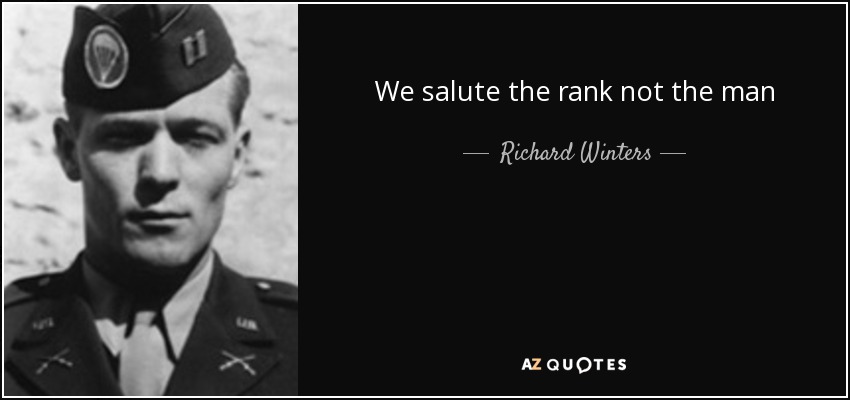
"We salute the rank, not the man." Richard Winters

Anyone who threatens to punish you for not massaging their ego is placing you beneath them, which is disrespectful to you and disregards your equal status to them in the eyes of God and the cosmic perspective.

Military and civilian leaders alike will defend their actions and expectations by asserting that forced respect is necessary to instill discipline, maturity and good order in society. Every cult leader and dictator in history will agree that it’s necessary to convince the lower ranking majority of society that blind respect for their superiors is necessary to ensure good order, but their idea of good order is being worshipped and served like gods forever by the toiling masses who will never have any real hope of upward mobility.

No honest psychologist would argue that wilful self-subjugation is a vital step towards self-actualization. It is a long-established fact that forced respect is a step towards battered person syndrome though.

Enthusiastically subjugating yourself to anyone isn’t a sign of maturity. It’s a sign of captivity. It doesn’t make you into a better person. It makes you into a servile person, and the more you practice it the more you normalize subservience in your mind until you take it for granted. Then, at the end of your life, you won’t be able to turn around and realize it was never preparing you for your turn at being a leader. It was just indoctrinating you into spending your life serving others. And an entire society that thinks this way isn’t progressing towards an enlightened utopia; it’s regressing into a stratified dystopian society where the powerful and privileged exploit everyone else.

If you enjoyed this post, you’ll also like these:

Growing up and Becoming You
Happiness and Peace
Self-Esteem
Health
Drugs and Addiction
Achieving a Healthy Work/Life Balance
Leadership and Authority
My Tweets About Self-Help

Deep Thoughts By The Wise Janitor

Cleaning up after other people day in and day out is an exercise in futility and patience. Every day you vacuum the floor, wipe down the tables, wash the windows, change the toilet paper and whatever else. You take a building that looks like it’s been through the apocalypse and you make it look brand new. Then, by the time the sun sets it looks exactly like it did before you sacrificed an infinitely valuable, irreplaceable day in your life cleaning it. So the next day you clean it again only to have your masterpiece reduced to kipple again. Then you clean it again, and again, and again, but no matter how many times you clean it you never get ahead. You never reach a plateau where you can sit back and relax and bask in the fruits of your labor. You just watch in constant horror as all the work you’ve done the previous day becomes undone.

Not that the janitor is complaining. Everyone else’s inability to clean up after themselves means the janitor has as good of job security as the undertaker. Like the undertaker, the janitor’s job places him at the fringe of society. He’s someone nobody notices until they have to. But unlike the undertaker, the janitor doesn’t have fancy credentials to impress people with and earn their respect. So the janitor stands on the fringe even when he’s in the middle of a crowd. He watches all the respectable, credentialized folk run past him on their way to important places where they’re going to do very important things…or so they believe.

Looking up the social ladder from the perspective of a janitor you see that the more credentials a person has the more important they believe they and their work are. And sure, they make wheels turn, but on a long enough timescale, there’s no difference between what they do and what their janitor does. No matter what job you have the end result is making someone else’s life better in exchange for money. The thing about that is, within 100 years everyone who benefited from your work will be dead. Even if you do something that affects people for generations, a day will come when the ripple effects of your labor come to an end. In a few trillion years the universe will cool and expand until there’s not enough heat left to keep any atoms vibrating. Then, when every atom in the universe has cooled to absolute zero the history of the universe as we know it will end. So everyone’s job is just as futile as the janitor’s. We’re all just rearranging kipple until our time runs out.

The janitor stands in the middle of a crowd obscured by his social status watching all the people around him swarm past him in fast forward with their faces glued to their phones and watches stressing over the tasks lined up in front of them. Compared to a janitor, their burdens are heavy….usually too heavy. The average worker is crushed under stress and anxiety, and no quality of suit or necktie or pantyhose or lipstick can hide stress lines on their faces. The janitor would have sympathy for those marathon workers…if they didn’t make messes everywhere they went and didn’t pay him less than a living wage to clean up after them.

But the point isn’t to get into a dick waving competition. In a trillion years it won’t matter who’s right about what or who is better than who. The point is that no matter what we do it’s all just dust in the wind. If you can do something better for humanity than sweeping up after it then…good. But no matter what you do, if you’re stressing out over it to the point of anxiety then you’re defeating the purpose. Life isn’t what happens tomorrow. Life isn’t a place you arrive at. Life is what happens today. Life is here and now. If you’re stressing yourself out in the name of work then you’re failing at life. You might be better off just emptying garbage cans and replacing toilet paper at a leisurely pace…except of course that being a janitor doesn’t pay a living wage because civilized, credentialized society doesn’t care about the human beings who clean up after them. Of course, on a long enough time scale that little oversight won’t matter, but if it’s important to do those big jobs that make life better for everyone then why undermine the virtue of your work by neglecting the needs of the people who clean up after you? If you won’t take care of the people who take care of you then how much do you really deserve to pat yourself on the back for the work you do?

If you enjoyed this post, you’ll also like these:

Growing up and Becoming You
Happiness and Peace
Self-Esteem
Health
Drugs and Addiction
Achieving a Healthy Work/Life Balance
Leadership and Authority
My Tweets About Self-Help

You Can And Should Live Somewhere Awesome

Picture of a garden gnome sitting on a beach looking at the waves with the caption, "Wish you were here"

Life is infinitely valuable yet agonizingly short. Every fleeting second of your life is worth as much as life itself, and you only have once chance to make the most of each moment. Life is never going to be perfect. The universe isn’t going to hand peace and fulfillment to you on a silver platter. It’s up to you to make the changes in your life that will bring you happiness. You’ll never have complete control of your environment. So you’ll never be able to create the perfect life for yourself as you imagine it, and even if you could, it wouldn’t last forever. So being happy depends more on your ability to enjoy life right now, as it is, than your ability to control the world.

Having said that, there are situations where this philosophy doesn’t apply. Being dogmatically optimistic when there are legitimate external problems in your life isn’t a virtue. That’s insanity. You’re not helping yourself by deluding yourself into believing everything is okay when it’s not.

If you live in the ghetto or suburbia, your life isn’t as good as it could be. Ghettos and suburbs are designed so that you’re far away from work, shopping and leisure. You may have a micro park near you, but that’s about it. You’ll be forced to spend time and money driving anywhere, and wherever you go, everything you do will cost as much money as possible. So you’ll likely spend most of your free time at home where your rent, mortgage, utilities, food and home furnishings will be as expensive as possible. This will limit your options and force you to buy low quality goods and services, which will provide you a lackluster quality of life. If you live in a community that has cultural values that you disagree with, you’ll probably enjoy life even less.

If none of that applies to you, then congratulations, you’re the exception. The rest of society lives in a sensory deprivation pressure cooker. If you’re one of the unlucky people who live in a ghetto or suburb, I have good news. You can live somewhere awesome, and if you haven’t proven it already, you will eventually. At some point in your life you’re going to move houses and change jobs. If you can do that in one city, you can do it across cities. Moving to another country isn’t even that complicated. If you’re in good health, have a bachelor’s degree and are under 30 years old, you can emigrate. All you have to do is file some paperwork and then move your body from one place to another. It’s not as easy as baking a cake, but it’s within your capabilities.

The only thing holding you back from living in a beautiful town with lakes, forests, rivers, ocean waters, nice people, clean air, good food, beautiful culture and freedom is your excuses. You can make all the excuses in the world for why you’re stuck in a dead end town working at a dead end job surrounded by dead end people, and your reasons might sound inarguable on paper, but all of those perfect excuses aren’t going to do you any good 30 years from now when all you have to look back on is a lifetime spent waiting for your real life to begin.

Your only shot at life is happening right now. This is the only chance you’re ever going to have to spend today somewhere you love. This is the only chance you’re going to have to build the memories of today that you’re going to carry with you for the rest of your life. There’s nothing more important going on in your life than making the most out of your life. If you can’t afford to move, then you’re doing something wrong, and you need to read “Think and Grow Rich” by Napoleon Hill. There’s nothing you can’t accomplish if you put your mind to it and never give up. You can and should live somewhere awesome, because the cost/benefit analysis of spending your life in an oppressive, stifling environment just doesn’t add up.

Photo of a disgruntled office worker sitting at a computer pretending to hang himself by his telephone cord

If you enjoyed this post, you’ll also like these:

Growing up and Becoming You
Happiness and Peace
Self-Esteem
Health
Drugs and Addiction
Achieving a Healthy Work/Life Balance
Leadership and Authority
My Tweets About Self-Help

Where Does Hedonism Fit In The Meaning Of Life?

Hedonism is defined by Dictionary.com as:

1: the doctrine that pleasure or happiness is the highest good.

2: devotion to pleasure as a way of life

Renaissance painting of a Greco-Roman party with excessive eating, drinking and sensual behavior

There’s a lot humans don’t understand about life. We don’t know why or how the Big Bang occurred. We don’t know why or how DNA exists in the physical universe. We don’t know why or how we exist or what happens to our consciousness after we die. All we know for sure is that we’re here now, and honestly, the all the evidence we’ve found so far points to the conclusion that after we die our consciousness will simply cease to exist as surely and completely as our consciousness didn’t exist before we were born.

Based on what little we currently know about the universe, the evidence points to the conclusion that once we die our consciousness will simply cease to exist and our bodies will simply become food for other smaller life forms, and eventually our bodies will be broken back down to inert matter. In other words, we were born of dirt, and we’ll return to dirt. On many levels, this is subjectively tragic, but how we feel about the situation is irrelevant to the reality of the situation. What is, is, and what will be, will be.  And you’re born and will die not knowing what it is or what it will be. It’s tough, but that’s life.

When you take all of this into consideration, it creates a powerful argument for the conclusion that the best we can hope for in this short, difficult life is to enjoy ourselves as much as possible. And while some people cling to faith to give themselves the illusion of certainty in life, pleasure is an immediate certainty. This raises the question, Why not have as much physically rewarding fun as possible while you’re here?

"Eat, drink, and be merry, for tomorrow we die." Kurt vonnegut

I can’t empirically prove why we shouldn’t devote our lives to the pursuit of pleasure. All I can do is raise more questions, and the question every hedonist must constantly wrestle with is, “What if there’s something more rewarding I could be doing with my life?” which leads to the next question, “What could possibly be more rewarding than physical pleasure?” And even if there were solid answers to either of those questions we’ll always be left with the question, “So what? What if I personally choose to devote my life to hedonism instead of some other unprovable philosophical ideal? If that’s my choice then what’s wrong with that?” I don’t have an answer to that.

As I said earlier, my current theory on life is that the best we can hope to do is fulfill our potential. This theory doesn’t offer much in the way of guidance though because humans are capable of doing and becoming so much. We’re also capable of not doing and not becoming even more. So if anyone asks you what your potential is, you wouldn’t be wrong to reply, “Whatever I choose.” But if you answer that then you would be wise to ask yourself, “What should I choose to do or become?” Well, there’s no sign painted in the stars telling you what you should do. If you don’t know what you should do then you can at least ask yourself, “What do I want to do or become?”

Your wants are defined by your personality, your identity, your uniqueness. By identifying and fulfilling your wants you’re expressing yourself, you’re exercising your individual existence. Regardless of whether or not your wants turn out to be “right” or “wrong” by some cosmic standard, by identifying and fulfilling your wants you still exercised your existence, and on some level, that’s more admirable than enslaving yourself to doing what someone else once said was right. Of course, you could also argue that The Good Guy’s slaves chose to be mental slaves; they even made considerable personal sacrifices doing what they believed was right and should be rewarded accordingly. And sure, there’s logic behind that point of view that gives it credence…

But let’s take a step back for a moment. Consider the age-old argument of nature v.s. nurture. Do humans behave the way they do because that’s how they were born to behave or because that’s how they were taught to behave? When a child growing up in Saudi Arabia “chooses” to become Muslim, was that really their choice or was that the result of indoctrination? If a middle-class white boy in Texas becomes a pseudo-Christian who acknowledges the divinity of Christ but doesn’t put much more effort into their religion other than that and voting against gay rights, was that truly their choice or was it the result of indoctrination? When a child from a broken home turns to alcohol and drugs to numb the pain of a lifetime spent receiving discouraging feedback, is that a choice or the result of indoctrination? I don’t have the final answers to those questions, especially since those issues aren’t black and white. They’re as complicated and gray as life itself.

One thing I suspect is true is that the better you understand the universe, challenge your beliefs, define yourself, and achieve self-actualization, the more truly your actions will be your own. The more your actions are your own the more you will express and exercise your existence by everything you do. I don’t know how much work that takes or where the finish line is. I don’t know what a self-actualized person would or should do with themselves after defining themselves. I don’t know how much fun they’ll have. I don’t know how much hedonism they’ll embrace or avoid, and I don’t know if there are eternal consequences for either path. What I do know is that life is short. We only get so many minutes, days and years to do so many things. If you spend all that time having fun, then you won’t have much time left to tweeze your identity apart from the environment you were raised in or to refine your wants outside of how you were indoctrinated by society. And if you don’t do that then I don’t know how much of “you” is really “you.” I don’t know what you could accomplish in this world without being yourself, but I would strongly question the the immediate personal value of any choices you make regardless of how fun, socially acceptable, or productive they may be. Regardless of how much fun you had or how much of a difference you made in the world, I would strongly question whether or not you ever truly lived because there was never truly a “you” to live. There was no expression of yourself, there was merely an expression of an existing society.

So should you devote your life to hedonism? I can’t answer that question, but at this point, my personal recommendation is to use the time you have here to defining yourself. How you do that is up to you, it’s your life after all, and it’s nobody’s responsibility but your own.

"Alcohol is not the answer. It just makes you forget the question."

If you enjoyed this post, you’ll also like these:

Growing up and Becoming You
Happiness and Peace
Self-Esteem
Health
Drugs and Addiction
Achieving a Healthy Work/Life Balance
Leadership and Authority
My Tweets About Self-Help

Is It Lazy To Not Want To Work?

There’s a common attitude in American culture that anyone who doesn’t want to work at least forty hours per week is lazy, spoiled, entitled and weak. Baby Boomers are famous for vilifying the younger generations for not apathetically accepting a lifetime of toil.

To be fair, when our elders warn us of the importance of work, they speak from experience. Those who lived through the Great Depression had to adapt to a brutal environment. The beliefs and life-skills that helped them survive became staples of their culture, which they passed down to their children. Now, when Baby Boomers see young adults ignoring survival-based customs, they interpret that as being irresponsible. On the surface, these feelings are reasonable, but in the grand scheme of things, they’re disastrously short-sighted.

During the Great Depression, America had enough resources to feed and house every citizen. The only reason everyone didn’t have at least the bare minimum to survive already distributed to them, was because the premise of the economy was to pay the lowest pages and charge the highest prices possible so that the nation’s wealth flows upward, leaving the poorest workers stuck in perpetual wage slavery, and President Hoover’s solutions to these problems only made this worse.

America’s economy has evolved in a lot of ways, but the premise is still the same. Every business in America is still paying and treating its workers as close to slaves as they can get. The wealth still flows up, and the average worker still lives under constant control and fear.

For most Americans, life is pushing a boulder uphill. The situation has been hard and hopeless for Americans for so many generations, we teach our children it’s immature to follow your passion, and real adults suck it up and pick the smallest boulder within reach and get pushing. Coping with poverty has been a part of American culture for so long, we’re so used to it that most of us don’t even realize we’re doing it. We even celebrate it.

The Millennial generation realizes the game is rigged against them. They know even if they do everything right, they’ll still spend the best years of their lives working their asses off at jobs that pay and treat them like second-class citizens. No matter how much they save, even if they get to live like a first class citizen for a brief time, eventually one of the ever-circling bill collectors is going to rip the last dollar they have out of their hand.

Morbidly, the thing most likely to bankrupt them and take away all hope in their life is the hospital they’ll eventually have to go visit to stay alive. Life for the Millennials is so fucked, hospitals are an existential riddle, and the government’s latest solution to the unaffordability of healthcare was to force everyone to buy unaffordable health insurance that doesn’t cover the cost of health care. So there’s every reason for Millennials to assume life is only going to get more unfair. Parents, politicians, and employers shouldn’t be surprised when Millennials aren’t enthusiastic about their career because working isn’t an opportunity. It’s government-sanctioned slavery.

Millennials are working. They have to, because they can’t survive if they don’t, but if nothing they do matters, then why should they do more than the bare minimum? Why go the extra mile for an employer who treats them like profits are worth more than their lives? If Millennials should reciprocate the respect their bosses show them, then they shouldn’t show their bosses any respect. It’s insulting and unethical to ask Millennials to be excited about the company they work for, because if they’re excited to be in an abusive relationship, then they either have battered person or Stockholm syndrome.

Human beings weren’t put on this Earth to work, especially not at strip malls and office buildings. Spending your life working your ass off in a Polo shirt isn’t “just the way life is.” That’s the way life shouldn’t be. This isn’t the world our ancestors scraped their way out of the mud tooth and nail to create. Philosophically, our economy defeats the purpose of existence. It forces people to devote their lives to surviving, and just because survival is the most immediately important need in life, that doesn’t mean it’s the only need in life. There’s a whole hierarchy of them, leading up to self-actualization at the top.

Maslow's Hierarchy of Needs: Physiological, Safety, Love/belonging, Esteem, Self-Actualization

Our minds are compelled by our DNA to grow to our full potential. When we get stuck at a lower level, our brains act like a nicotine addict urging us to go seek out the thing it’s missing. If we ignore the craving, we get anxious and desperate. Capitalism keeps people stuck at the survival level almost their entire lives. It should be obvious that human aren’t lazy for not wanting to sit in a cubicle for 60 years worrying about bills. They’re monkeys trapped in a cage, raging to get out.

Since immigration laws are so strict, and every country has the same business model anyway, there’s no escaping jobs that pay too little and bills that cost too much. The most common way people cope with living in a Skinner Box is by accepting the apocalyptic nature of their existence and trying to find whatever happiness and motivation they can between shocks.

If you devote your life to surviving, you neglect the rest of your psychological needs. If you don’t fulfill the rest of your potential, then there was no point being here in the first place. Since we’re all going to die eventually anyway, the cost/benefit analysis of risking a slightly earlier death in order to fulfill higher needs in the immediate present adds up.

In America, it’s financially irresponsible to work less than forty hours per week, but it’s cosmically irresponsible to be financially responsible. Granted, if you don’t work so you can sit around all day smoking weed and playing video games, then yes, you’re lazy and irresponsible. But if you work part-time so you can live your dream, you’re efficient and wise.

If we didn’t live in a financially oppressive economy, we wouldn’t need to philosophize about how responsible it is to work 40 hours per week. If we were living in the kind of world our ancestors hoped humanity would build, everyone’s basic needs would be guaranteed. Everyone still needs to pull their weight, but the world could function if we all worked 10-20 hours per week. Whatever conveniences that cost us would be outweighed by the benefit of getting our lives back.

The debate the world should be having isn’t, is it lazy to not want to work? We should be debating why we still put up with a system that works us so long it deprives us of the meaning of life. And instead of bickering about the pros/cons of capitalism, socialism and communism, we need to look at the ground and ask ourselves what we really need, and what we’re willing to give for it.

If you enjoyed this post, you’ll also like these:

Growing up and Becoming You
Happiness and Peace
Self-Esteem
Health
Drugs and Addiction
Achieving a Healthy Work/Life Balance
Leadership and Authority
My Tweets About Self-Help

Have A Healthy Balance Of Passion And Duty

At some point in your childhood, someone probably told you that you can be whatever you want when you grow up and that you should believe in yourself and follow your dreams. If you grew up watching Nickelodeon and Disney movies, then this idea was pounded into your brain. You may have left high school full of great expectations only to discover that good jobs, let alone dream jobs, are hard to find. Not only that, but life is as expensive as possible, and employers pay as little as possible. So the reality of the world we live in is that most people don’t get to be too picky about what they do for a living.

If you ever complained to your elders about how hard it is to follow your passion, the same people who raised you on dreams, probably told you to suck it up and deal with it. That’s life. You’re not special. You’re not entitled to anything, and in order to be a mature, responsible adult you need to put your wants aside and perform your duties without complaint. They might have even gone on to say that self-sacrifice is a virtue that should be practiced daily.

Things being as they are, part of growing up is discovering that your elders lied to you, coming to terms with the real world and then deciding whether or not you should follow your passion or devote your life to being responsible. There’s no quick, easy answer to that question. Everyone is different, and the world isn’t black and white. No one can tell you what’s right for you, but common sense should tell you it’s probably a bad idea to take either option to their extreme.

It’s obvious that throwing caution completely to the wind to pursue a hobby that might never amount to anything is risky to the point of suicide. However, abandoning all your passion in the name of responsibility reduces you to a machine and arguably defeats the purpose of life. You’re here to be you. If you sacrifice everything you want and everything you are just so you can survive, there was no point in being here. In your obsession with survival, you committed existential suicide.

"for me, life is continuously being hungry. The meaning of life is not simply to exist, to survive, but to move ahead, to go up, to achieve, to conquer." Arnold Schwarzenegger

There’s nothing morally wrong with being selfish enough to give your own life meaning and try to enjoy your brief, precious existence. Passion is important. Style is important. You’re not just entitled to know what you want out of life, you have a responsibility to fulfill your unique potential, which is greater than that of a self-subjugating automaton.

Sure, survival is vital, but if you think your only options in life are to either be a painter, singer, dancer or worker, then the problem is that your understanding of the world and your own soul are too narrow. In order to understand how you can fit into the world, the first thing you need to do is take a personality test, but understand that that test isn’t perfect. Take as many personality/aptitude tests as you can until you have a good idea of what your strengths, weaknesses, and dispositions are.

People aren’t born with one skill inside of them that they’re destined and obligated to find and nurture. Within your personality type, there are hundreds, if not thousands of occupations that would bring you deep personal satisfaction. Even if the oppressive nature of our economy prevents you from spending all day every day playing, you should still get as close to your goal as possible. Then, in your free time, you should work as relentlessly as possible to overcome the obstacles between you and your chosen destiny.

Cowards never start. The weak never finish. Winners never quit.

Giving up on your dreams isn’t mature. That’s quitting. It’s self-imposed failure. The fact that life is tough isn’t a good reason to give up your dignity and accept a life of meaningless toil. You’re going to have to make sacrifices in life. That’s a given. You’re going to have to make some kind of compromise between passion and duty, but the important thing is to only compromise as much as you absolutely have to and make your sacrifices/compromises count.

If there’s anyone out there who believes that’s too much for the younger generation to expect out of life, then the problem isn’t that the younger generation is spoiled. The problem is that we’re so used to living in a wage slave-based economy we can’t imagine any other way, and our definition of maturity is inextricably ingrained in that world view. The solution to the existential despair that comes from living in an economy that prioritizes money over people isn’t for young workers to hurry up and die inside. The solution is to build a more humanitarian economy.

If you enjoyed this post, you’ll also like these:

Growing up and Becoming You
Happiness and Peace
Self-Esteem
Health
Drugs and Addiction
Achieving a Healthy Work/Life Balance
Leadership and Authority
My Tweets About Self-Help