Most people can agree that children’s television programming should be mentally healthy. Very few people would be happy if children’s television programming contained footage of cannibalistic DVDA cosplay snuff action. Very few people want the paperback versions of “Ichi the Killer” or “Old Boy” in middle school libraries.
If we’re so serious about protecting children from things that are potentially unhealthy for their tiny, fragile minds then why did “Full House” or “Saved by the Bell” ever exist at all? Both of those programs depicted a straight edge version of reality that doesn’t actually exist and shouldn’t. And all of the main characters in those programs were depicted as role models to be emulated. They even demanded to be emulated.
Even if the producers didn’t know they were creating role models, psychologists have known for decades that children mimic adults and anyone else they perceive as an authority figure. So if you set a kid down and make them watch the same television show every day for 10 years they’ll incorporate that show into their perception of reality.
Neglected children who watch a lot of television may see more adults on television than in real life. They could easily get the impression that every adult is supposed to behave and think sort of like Danny Tanner. They might not have anyone in their life to look up to but Zack Morris. But Danny Tanner and Zack Morris aren’t characters one should emulate.
Pretending you live in a straight edge world isn’t optimistic and responsible. It’s naive and unhealthy. Lying to children so they’ll believe they live in a straight edge world run by straight edge adults isn’t mature or responsible. It’s counterproductive and unhealthy. It misleads impressionable viewers the same way internet pornography misleads pubescent boys into thinking casual sex always ends with the guy cumming on the girl’s face.
I’m not saying there’s anything morally wrong with sex as long as you’re safe and exercise reasonable moderation, but the adults in Full House would never even admit to ever being naked. Married couples don’t even sleep in the same beds in Hollywood G-rated sitcoms. They’re plastic wrapped angels: boring, lifeless and fake. They don’t teach kids to be responsible. They teach kids to be boring, lifeless and fake, which sets them up for failure and stress.
Striving to be that lifelessly, joyously “good” doesn’t help people become or accomplish anything. It doesn’t impress deities. It’s just something to stress out over and feel guilty about. The alternative is to just get on with your life.
Why expose your children to detrimental role models? If you’re going to do that then at least expose them to fun, detrimental role models…like Bernard Black. Come on Hollywood. Create some intelligent, morally introspective characters like Dr. House who aren’t self-destructive drug addicts.
And come on parents. If your kids grow up watching Nickelodeon and Disney then don’t be surprised when they act like monsters… and don’t say you did your best to raise your children. You set them up to base their perception of reality on distorted information. In other words, by letting your children watch unrealistically straight edge television programming, you lied to them and drove insane.
No character flaw is more dangerous than stupidity, and when kids are raised on stupidity, they become stupid. Then they become a danger to themselves and others.
“Tommorowland” is a movie produced by the Disney corporation. The premise is that in the 1950’s a group of scientists create a portal to another dimension where they create a Utopian society with futuristic technology called, Tomorrowland. The greatest invention this new society produces is a machine that can see into the future, and it reveals that humanity back on Earth will destroy itself along with the rest of the planet very soon. The leaders of Tomorrowland decide not to intervene because they believe Earthlings aren’t worth saving. More about that later.
Just like “The Pirates o the Caribbean,” the movie, “Tomorrowland” is based on a theme park attraction at Disney World in Florida. Walt Disney originally intended the Tommorowland attraction to be a planned community where people could live, work and grow in a city that takes full advantage of all the technological advancements of the 20th century. In fact, Disney’s famous Epcot Center stands for “Experimental Prototype Community of Tomorrow.” However, Walt Disney died before his dream could be realized, and his would-be city of the future simply became an overpriced resort that embodies the worst aspects of consumerism.
The working conditions in Disney Land Paris are so dystopian that the workers there famously came to nickname the resort, “Mousewitz.” When management discovered what their workers had nicknamed “the happiest place on earth” they threatened to fire any employee caught using the term, “Mousewitz.” So everyone started calling it “Duckau.” Apparently, Disney World in Florida isn’t any better.
Keep that in mind when you watch the movie, “Tomorrowland,” particularly at the climax of the plot, when the villain and leader of Tomorrowland (played by Hugh Laurie), gives the following speech:
“Let’s imagine, if you glimpsed the future and were frightened by what you saw, what would you do with that information? You would go to politicians, captains of industry? And how would you convince them? With data, facts? Good luck. The only facts they won’t challenge are the ones that keep the wheels greased and the dollars rolling in. But what if there was a way of skipping the middleman and putting the critical news directly into everyone’s head?
The probability of widespread annihilation kept going up. The only way to stop it was to show it, to scare people straight, because what reasonable human being wouldn’t be galvanized by the potential destruction of everything they’ve ever known or loved? To save civilization I would show its collapse, but how do you think this information was received? How do you think people responded to the prospect of imminent doom?
They gobbled it up like a chocolate éclair. They didn’t fear their demise. They repackaged it to be enjoyed as video games, as TV shows, books, movies. The entire world wholeheartedly embraced the apocalypse and sprinted towards it with gleeful abandon. Meanwhile, your Earth was crumbling all around you. You’ve got simultaneous epidemics of obesity and starvation. Explain that one. Bees and butterflies start to disappear, the glaciers melt, algae blooms.
All around you, the coal mine canaries are dropping dead, and you won’t take the hint. In every moment there is the possibility of a better future, but you people won’t believe it, and because you won’t believe it you won’t do what is necessary to make it a reality. So you dwell on this terrible future, and you resign yourselves to it for one reason, because that future does not ask anything of you today. So yes, I saw the iceberg and warned the Titanic, but you steered towards it anyway, because you want to sink. You gave up. That’s nobody’s fault but your own.”
I literally double facepalmed when I heard this speech because the dystopian working conditions at Disney ‘s theme parks is a microcosm of the United States. America claims to be the greatest country in the world, the happiest place on Earth. It claims that everyone has the power to make their dreams come true, but nearly half of all Americans have less than $500 in savings, and that’s not because they’re all irresponsible. The way the economy is designed, everything is as expensive as possible, and jobs pay as little as possible. You can’t afford rent on a minimum wage salary in any state in America. American workers get the least time off of any first world country, and healthcare in America is more expensive than anywhere else. At least America has cheap food, but that’s only because the food is unhealthy processed crap, and the agriculture industry is built on slave labor from third world countries (which is why there are simultaneous epidemics of obesity and starvation). Life in America may be dire, but people in third world countries have been living in the apocalypse their entire lives.
The world didn’t get this way on accident. Corporations, like Disney, made the world this way so that workers wouldn’t have any leverage or freedom to stand up for themselves or demand higher wages. And that’s why people love apocalypse stories because they hate the system they live under. They can’t wait to see the gates of Mouswitz fall. They’d rather spend the rest of their lives fighting zombies than running the rat race to nowhere in corporate hell.
When Hugh Laurie gives that speech in Tomorrowland, he’s speaking to a global audience of powerless wage slaves who are living in fear and struggling just to survive. Most people can’t afford their own home or education much less to build a Utopian city. Telling the average person that it’s their fault the world is burning is blaming the victim.
What makes the speech even more absurd is the fact that Hugh Laurie is a millionaire, and in the movie, he’s talking to George Clooney, who is also a millionaire. Granted, George Clooney has done some humanitarian things with some of his money, but he’s still sitting on enough money to build a small sustainable city where people can live and work free from fear and indignity.
It cost $190 million to make the movie, Tomorrowland. That’s more than enough to build an experimental prototype community of tomorrow. Much like the fictional leaders of Tomorrowland, Disney has the resources to begin saving the world, but it won’t use it for the public good. Instead, it uses that money to mass produce cheap junk destined to pollute the earth and idiotic media that is dumbing down the population and placating them while they sit in their suburban prisons waiting for the rich to stop running the world like a consumer concentration camp and devote their resources to building sustainable infrastructure.
I never had any intention of watching the movie, “Brave.” It’s a kid’s movie about a princess. I’m not the target audience, but I ended up watching it because 99% of the other movies and TV shows that have come out this year have been crap. So I was scraping the bottom of the barrel.
I didn’t expect “Brave” to be an intellectual feast, but someone told me it got good reviews, and I read somewhere else it “challenged the traditional portrayal of women in children’s films as cripplingly codependent ditzy gold diggers” or something like that. So my expectations for “Brave” were a little higher than they would have normally been for a simple children’s movies. Unfortunately, just like when I watched “The Avengers,” I quickly realized I’d set my already low expectations too high for Hollywood.
“Brave” didn’t break the mold. It just polished the crust on top. Here’s how. The protagonist is a princess, but unlike every other princess in children’s television history, she’s not a Barbie doll. In fact, she’s a ginger, which is almost as daring as an African American princess.
Not only is the princess in “Brave” an unattractive ginger, but she also acts like a boy. If you can’t imagine a girl acting like a boy then watch “Mulan.” If you don’t know what “Mulan” is about, it’s a movie that breaks the traditional stereotype of women being cripplingly codependent ditzy gold diggers. On a few levels, “Brave” was just a remake of Mulan, which is nice, but it means “Brave” doesn’t add much if any, diversity to Hollywood’s credits. Plus, if we keep remaking Mulan, then the effect is that young girls still only have two role models to choose from: Barbie and a bulldyke. No disrespect to bulldykes, but that’s not as much an option as a trick to get you to choose Barbie, and it divides the world into a false dichotomy. There are more kinds of women in the world than bulldykes and Barbies. You’d never know that watching children’s television though, and that can make normal girls feel abnormal. If you don’t think this is a big deal then you underestimate how stupid human beings are. Adults are more likely to believe an untrue statement if you show them a picture while telling them something that they know isn’t true.
If we grow up hearing the exact same message over and over again our entire lives then we’ll believe it’s true on some level even if we know it’s not. Children’s television depicts grotesquely distorted, dichotomous and oversimplified gender roles. Even if children could discern reality from fantasy and weren’t basing their understanding of reality on what they watched on television, why would you barrage children’s minds with messages that aren’t true and then leave it up to them to figure out when it’s smart to mimic their heroes and when it’s not? You’re going out of your way to put a stumbling block in front of your child that doesn’t need to be there at all. Even if oversimplified princess movies don’t warp girls’ identities, they’re still just white noise. If girls learn the same lesson over and over again then they never learn anything new. Then, when they enter adulthood they don’t know anything, which is just as counterproductive as indoctrinating them to become Barbies. You could argue that I’m making the issue bigger and more complicated than it is, but the entire problem could be avoided if Hollywood just didn’t go out of its way to remake the same shitty princess story a hundred times a year.
If Hollywood doesn’t change anything else about the traditional princess story, please, please, please stop preaching that arranged marriages are immoral. Even if arranged marriages are immoral, there are already enough stories in existence that cover that topic. If it’s important to you that Indians feel guilty about their culture then they can watch Alladin. Meanwhile, most Western audiences grew up watching movies telling them that arranged marriages are bad, and modern mainstream Western culture practically revolves around dating and promiscuity.
So don’t worry. American girls are not going to let their parents force them to marry someone they don’t want to. You can stop warning us about the importance of using mutual attraction as a basis for a relationship. If “Brave” really wanted to break ground it could have shown a princess in any other stage of a relationship of a relationship after the initial commitment or at least acknowledge that sex exists.
Hollywood, what’s going on? There are a thousand reasons why you should stop selling us this same pig over and over again. If you hadn’t noticed, culture evolves at the pace of television. If you had the balls to finance enlightening entertainment instead of pandering to the lowest common denominator then society would reflect the art it’s raised on and act rationally and sanely.
Several generations have been raised on white noise. Look where it’s gotten us. How bad does it have to get before you decide to use the resources available to you to help cure people of stupidity instead of infecting them with it?
I guess what I”m trying to say is, Hollywood, I’m disappointed in you. You can do better than this. We both know you can.
The quality of the world is determined by the quality of people in it. A perfect world would be full of educated, self-actualized people. In a society like that, we wouldn’t even need the perfect government because people would behave rationally and empathetically without having to be micromanaged. In a world full of idiots, it wouldn’t matter if we had a perfect government because people would still behave irrationally, selfishly and mercilessly, and we would destroy the systems we put in place to make life better.
The world we live in is far from perfect because we are far from perfect. Even if it’s impossible to define or create the perfect person or perfect government, we can still do a lot better than we’re doing. Even if we can’t save everyone else in the world, it behooves us to become better individuals ourselves. Truly, the only way society will improve is by each individual improving themselves, because each individual’s life is their own responsibility, and nobody can live it for them.
In order to fulfill your obligation to improve yourself, you need to proactively educate yourself, analyze yourself and the world around you, and stop spending 34 hours per week watching television.
Watching TV isn’t a sinister act in and of itself. The problem is that the content we’re currently broadcasting is designed to appeal to the lowest mental common denominator. It’s vapid, unedifying brain candy.
Sitcoms, reality TV, and cartoons revolve around petty characters who spend their lives stressing over petty conflicts. They rarely, if ever, teach us valuable life lessons or set positive examples to live by. Even the “mature” characters such as the adults on children’s shows act like unrealistic, goofy, neutered youth pastors.
Emulating these characters will cripple your ability to cope with the realities of life more than they will prepare you. Since these characters are presented as role models and children have a hard time separating fantasy from reality they skew children’s perception of reality for the worse. And those are the “good” characters. Television is full of glamorized characters who are flat-out bad role models.
Only a handful of shows such as Star Trek the Next Generation feature protagonists who are intelligent, proactive thinkers who value knowledge and reason, but more often than not, if a television show features a protagonist with an above-average intelligence he/she will be monstrously flawed in some other way. The rest of the protagonists on television simply celebrate their stupidity. In big ways and little ways watching television skews your perception of reality by presenting you with a warped reality, and the less you get off your couch and experience the real world the more susceptible you’ll be to accepting, mimicking and defending that dumbed down perception of reality.
Millions, if not billions, of people are able to watch television without mimicking the worse behavior they see, but they still worship the actors who play those characters since they’re presented as larger than life. Since these actors appear as authority figures on television we tend to hold them as authority figures in real life even if we know they’re not. Worshipping celebrities is a complete waste of time and distracts you from real intellectual authorities who actually have useful knowledge to impart and can back up their statements with research.
Celebrity-studded sitcoms, reality game shows, and children’s cartoons aren’t the only intellectually toxic programming on television. There are over 100 channels devoted entirely to sports. I understand that professional sports are near and dear to a lot of people’s hearts, but we all need to understand that the only reason that is, is because of the billions of dollars the sports industry has dumped into manipulating people into thinking that sports matter. If all the professional sports in the world disappeared tomorrow the consequence would be that we would not be wasting our time glued to the television watching people move a ball from point A to point B. Then we would have to find edifying and productive things to do with the short, irreplaceable time we have on this planet.
You might reply to my these criticisms of professional sports by saying, “Sports teaches you about teamwork and exercise.” To that I would reply, little league and intramural sports teach you about teamwork and involve exercise. Watching professional sports builds rivalries as senseless as street gangs who hate each other because one gang wears red and the other gang wears blue. And sitting in front of your television watching sports while your body atrophies, is the opposite of exercising.
Probably the best reason not to watch television is the commercials. The word “commercial” is misleading. It would be more accurate to call commercials what they really are, propaganda. Commercials are designed to manipulate the viewers into buying things they don’t need with money they don’t have. They redesign your values so that you believe there’s something wrong with your life that can only be corrected by buying consumer goods. They turn you into a consumer whore who is more interested in the accumulation of objects than solving the world’s problems, and when you adopt that lifestyle you become part of the problem.
You may respond to all of this by saying, “Yeah, the world has its problems. It’s a tough place, but that’s why it’s so important to have a little distraction every once and a while.” There’s truth to that statement, but watching 34 hours of television per week isn’t a little distraction. It’s a full-time job. Think of how much work you get done each week at your real full-time job. You could accomplish that much work making you a better person and solving the real world problems that make life hard by cutting television out of your life. But when you spend a major portion of your free time aging in front of the television, ignoring all the problems crushing civilization, when you could be fixing them, then your complacency makes you as responsible for those problems as if you were an active participant in creating them.
Today we have video phones just like all the 1980s sci-fi movies predicted. We sent robots to Mars. Laser weapons are being actively tested in live fire exercises. We don’t quite have the flying car or the hoverboard yet, but we did get mind-blowing video games that are connected through a global computer network. We might not have interstellar spaceships, but the future is now.
So what’s the deal with the pants? Why are we still wearing chaffing farm labor pants that require hard, constrictive belts to hold up? Soldiers don’t even wear blue jeans or khakis to battle because they’re completely impractical. So suburbanites surely don’t need them. Most of us just sit around in offices all day. Why are we all not wearing Star Treck onesies, pajamas, robes or maybe a jersey knit version of BDUs? Why are we not even wearing the really comfortable stuff we already invented?
How do people dress when their company has a, “wear whatever you want to work” day? They show up in pajamas and track pants. That’s what our instinct tells us to do. That’s what our heart tells us to do. Why don’t we let the spirit run free?
Come on. Shouldn’t we have taken care of this pants situation by now?
13. I will not call a small cup of coffee a “tall” cup of coffee.
The reason Starbucks uses Orwellian doublespeak for its coffee sizes is because some marketing executives held a meeting to figure out how to manipulate people into paying $5+ for 10 cents of liquid, and they decided it would help to change the names of the sizes to sound hipper. Not that I would buy coffee at Starbucks anyway, but if I did I would refuse to act like a mindless consumer whore and give into their hollow marketing ploy. I certainly wouldn’t celebrate it.
12. I will not call a medium sized cup of coffee a “vente.”
11. Unless I’m in Italy or a Spanish speaking country, I will not call a large cup of coffee a “grande.”
10. I will not say “bless you” when you sneeze.
That custom started because the Romans thought your soul escaped your body when you sneezed. At some point, the phrase was stolen by the mythology-worshiping Christians who replaced the mythology-worshiping Romans and everyone started saying it because it just seemed nice. In reality, it’s ultimately pointless. As polite a gesture as it may be, it still reveals one’s unquestioning complicity in holding onto obsolete customs. So if you tell me “bless you” when I sneeze I have to wonder what other dumb (and possibly sinister) customs you’re wasting your life with because your actions are defined by mimicking other unquestioning automatons. You may argue to your death that it’s not a big deal, but point in fact, the world would be a smarter place if we stopped saying, “bless you” when people sneeze.
9. I will not address someone with a Ph.D. as “Doctor so and so.”
People with a Ph.D. will respond to this by saying, “I didn’t go to school for 8 years for nothing.” Don’t get me wrong, I think it’s cool that you went to school for 8 years, and you probably know a few things that I don’t, but that doesn’t obligate me to you in any way. I will not give you a mental hand job, and if you were really so smart you wouldn’t ask me to….since there’s no logical reason to.
8. I will not address a judge as “your honor.”
I don’t care what job you have. That doesn’t automatically make you more honorable than me. For all I know, you may be a terrible person, and even if I do respect you because I know you personally, I still find no logical reason to place you above me.
7. I will not address anyone as “sir or ma’am” in a way that signifies their authority over me.
I won’t address my elders, my boss, a military officer, a police officer, a judge, a politician or anyone else with a “higher” title than me as “sir” or “ma’am,” because we were born equals. We’ll spend our lives as equals, and we’ll die as equals. If reason were a religion it would be sacrilegious to address my equals with a higher title than me. I understand that many people say (and believe) that we call our equals “sir and ma’am” out of respect…but it’s funny how the people who tell us to subjugate ourselves “out of respect” are usually in the business of controlling us.
6. I will not address or refer to a priest as “father.”
Even when I was a Christian in high school I understood that Jesus called himself “the son of man” as a sign of humility and taught that “the lowest among you is the greatest.” He praised a girl who washed his feet with her hair and condemned the religious leaders of the day for putting on airs. So a Christian calling another Christian (who is not their biological father) “father” is sacrilegious. Now that I’ve grown up and understand Christianity is mythology and everyone is equal, the idea of calling a priest “father” is even more repulsive.
5. I will not call or refer to the Dali Lama “His Holiness.”
He’s not holy. He’s a pissing, shitting, aging, ordinary human like the rest of us. The only things extraordinary about him are how flabby his arms are from never having to lift his silver spoon to his mouth himself in his life and what an unconscionable liar and/or megalomaniac he is for pretending to be a reincarnated ubber man. I don’t care how polite he is or how resolutely he stands for peace and freedom (as if nobody else in the world felt that way). If anyone else expected to be called “His Holiness” for that, we would be calling a mental institute to take them to a padded room.
4. I will not call America a democracy.
It’s not. It’s a republic. This isn’t stretching the truth. It’s not meant to be disrespectful. Look it up. Would you call Communist China a democracy? No. You wouldn’t because it’s not. So why would you call America a democracy when it’s a republic? If you argue democracies and republics aren’t mutually exclusive, and America contains democratic elements, I would say those elements are so broken they don’t work like a functional democracy. The election system is rigged to concentrate power in the hands of the people who control the RNC and DNC, and those people work for their corporate donors. So America is more like an oligarchy or a corporatocracy than a democracy.
3. I will not say or type “LOL” in conversation.
If you can’t see how using “LOL” in conversation makes you look dumb, then you’re probably too dumb to understand the reasons even if they were spelled out for you.
2. I will not pledge allegiance to any flag.
Flags aren’t more important than humans, and any virtuous ideals flags supposedly represent are virtuous because they empower people. When people subjugate themselves to a flag they undermine those values. Not pledging allegiance to a flag does more to promote truth, justice, freedom, and equality than bending the knee to an inanimate object that was pushed on you by the leaders of the country you were arbitrarily born into. I will not disrespect my brothers and sisters in other countries by letting a flag or the manipulative practices of politicians divide us.
1. I will not refer to September 11th, 2001 as “9/11.”
“9/11” is a hip media catchphrase. It’s a pop culture buzz word. September 11th, 2001 wasn’t hip. It wasn’t cool. It was a tragedy, and reducing that tragedy to the same level of vocabulary as “LOL” is a disgraceful insult to those who died.
Every time I turn on the news I hear more bad news. It might be hyperbolic to say humanity is sliding towards an apocalypse, but there are plenty of statistics and examples to build a case the world is not as it should be. Divorce rates are hovering around 50%. Shooting sprees and terrorist attacks are fashionable. Depression, unemployment, homelessness, drop-out rates, road rage, domestic violence, excessive consumer consumption and drug abuse are epidemic, and all of these problems are happening in first world countries.
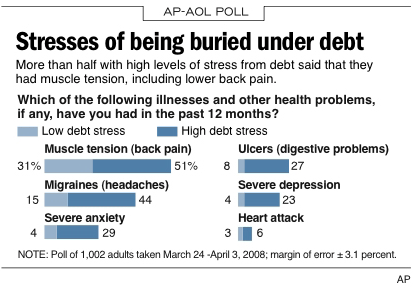
Every day I hear more excuses for why these social ills are happening, and at this point I’ve heard it all: violent video games, angry music, the waning of religion, insanity, laziness and personal irresponsibility, etc. If you made a list of society’s problems, and then made a list of all the causes of those problems, and then tried to find common denominators across all of them, one of the most common factors you’ll find is stress. You don’t need a psychology degree to see this. Look at any individual who snapped and caused some terrible catastrophe in society, and I guarantee you’ll find that person was crushed with stress. The root of most stress in America is money problems.
The biggest cause of domestic strife is money problems. People in debt are more worried and stressed out about the future than people with savings. Debtors have less disposable income to alleviate stress, and they have to work longer hours. Plus, they have less time and disposable income to spend on the schooling/training they need to get a better job that pays more and will allow them to get out of debt.
Families who are in debt are constantly walking a tightrope, and every time they fail at anything, the consequences are catastrophic. Even if you can walk that tightrope, you can only go through life with a gun held to your head for so long before the stress wears you down and makes you impatient and grumpy. If you stay impatient and grumpy for too long, you forget life was ever any other way, and after you’ve accumulated a lifetime of memories of being impatient and grumpy, then your memories shape how you see reality for the rest of your life.
Go to any super-max prison and you’ll find that the majority of prisoners there had the most mind-shatteringly abusive childhoods possible. Most of the adults in regular prisons, and the teens in juvenile detention, all have life stories of being abused and abandoned. The most dangerous members of society are always those who have experienced the most stress.
In some ways, the prospect of succeeding in life is more stressful than the prospect of failing. At least if you die or go to jail, it relieves the fear of knowing you’re going to spend sixty years working at a job that treats you like a commodity by paying you as little as possible, working you as long as possible and giving you as few breaks or benefits the entire time, and in the end, you won’t have a pension or any savings. The smaller the light at the end of the tunnel, the bigger risks you’ll take to get off that train.
College graduates might be able to eventually get promoted into a position with a pension, but the only reason they get that perk is because they have leverage. Entry-level workers without a degree have no leverage. So they’re completely disposable. Employers can work them to the breaking point, throw them away and hire a new, unbroken kid to replace them every few months.
Employers expect employees to celebrate being treated like second-class citizens. When you tell someone they deserve to be treated like a disposable punching bag, and then treat them like one, and then they realize they’ll always be a disposable punching bag… they get really stressed out because they know their lives have value; it’s just irresponsible for them to expect to be treated like it. So they’re forced to use cognitive dissonance to justify their own mistreatment to themselves, which is psychologically traumatic.
When you stress-out and beat down dumb people, they find dumb solutions to cope with the abuse and hopelessness you’re heaping on them. So when you punish dumb people for being dumb, then you create a downward spiral.
That’s the world we live in. Most of the problems going on around you are caused by the stress of how inhumanely smart people have designed the social institutions we’ve created to help us fulfill our potential. As long as those institutions remain unchanged, society will continue on the downward spiral of stress.
It’s no secret that elderly Americans are disappointed at the way the younger generations turned out. Ironically, they should be disappointed in themselves, because they groomed their children to become exactly like them. If parents can’t accept responsibility for their actions, it’s no wonder their kids can’t either.
1: Parents promised their children the American Dream.
Apparently, adults forgot they crammed the idea of the American Dream down their kids’ throats so thoroughly they effectively brainwashed it into them. American history classes, political speeches, holidays, pop music and television all repeat the mantra of American exceptionalism and entitlement to the point of nausea. Adults shouldn’t be mad when children expect to collect on the promise their parents made them.
2: Parents spoiled their children.
Adults like to rant about the good old days when students were punished instead of coddled. Adults also like to rant about how nobody can tell them how to raise their children or lay a finger on their precious snowflake. Who ranted at school PTA meetings and took away principle’s ability to discipline students? Who lavished children with birthday and Christmas presents every year? Who gave children everything they wanted every time they threw a temper tantrum? Who let children sit on the couch all summer? Who left their kids unsupervised? Who failed to teach children right from wrong? It was the same people who told their children they’re special and all their dreams will come true simply because God blessed them by creating them in the land of the free.
3: Parents let television raise their children.
Many adults may cross their arms and stamp their feet and insist they didn’t put these ideas in their kids head, but those same adults sat their offspring in front of the television for 3-7 hours per day for years. When you let your daughters watch 10,000 hours of Disney princess movies and dress them in princess dresses and tiaras, you shouldn’t be surprised when they act like princesses.
4: Parents let commercials raise their children.
Television commercials are designed to do two things: make you insecure and convince your buying a product will solve all your problems. Adults made those commercials. Adults bought the televisions children watched 100,000 hours of commercials on, and adults sat their children in front of those televisions to get them out of their way. If you didn’t want your kids to be petty, materialistic consumer whores, you shouldn’t have let corporations brainwash them.
5: Parents discouraged their children from thinking.
Children might have been able to think their way to sanity, but when they asked their parents hard questions, they got answers like, “Because I said so.” “Because the Bible says so.” “Because I’m the adult.” “Because that’s the way life is.” “Because you’ll get a spanking if you don’t.” “The rules are the rules.” “You’ll understand when you’re older.” “Don’t question my authority.” “Don’t talk back.”
If you punish your child when they try to understand things, they’ll stop trying. If they can’t teach themselves, they won’t grow. They’ll stagnate in the same puerile stage of moral development they were in when you trained them not to think for themselves.
6: Parents let clergymen raise their children.
70% of Americans claim to be Christian, but no American acts anything like Christ. Americans don’t follow 90% of the rules in the Bible because those rules were designed by a primitive tribal theocracy that wrote its culture into law. Half the rules in the Bible couldn’t be made into law today because they violate the Declaration of Human Rights. Some of its laws are useful, but many more are irrelevant and useless.
But the Baby Boomers took their children to church to instill morals into them anyway. The first thing the church taught them was not to think for themselves or believe evidence when it contradicts doctrine. Since they never learned a relevant, useful moral code at church, they went out into the world half-conscious, basing their decisions on a half-formed, volatile combination of modern and archaic values. This is a recipe for insane and immoral behavior. If adults don’t like the taste of that cake, they shouldn’t have baked it in Hellfire.
7: Parents abused their children.
One Bible quote every American has heard is, “Spare the rod, spoil the child.” Before politicians invented child protection laws that contradict the Bible, it was culturally and legally acceptable for a father/husband to beat the women and children living under his roof. The Baby Boomers grew up expecting to become the lords of their house like their parents were. They weren’t allowed to, but they still had a lifetime of bottled-up pain that needed an outlet. It should come as no surprise they took it out on their children.
Not every parent beat their children, but seriously, most of them did at least a little. This didn’t create hardened warriors out of Generation X though, because beating children into obedience only works if you have total control over their lives. Even if total annihilation teaches children to control themselves, it still breaks them inside. Since child protection laws limited how much control Baby Boomers had over their kids, they just beat their kids as far as the law allowed and then kicked them out of the house broken and undisciplined.
8: Parents molested and raped their children.
A study found that as many as one in four women surveyed at two college campuses had been molested or raped as a minor. This study isn’t representative of the entire country, but it matches what the women I know have told me about their childhoods. Other studies put the number closer to one in sixteen. Either way, I believe it’s fair to say that enough children have been sexually assaulted in America to constitute an epidemic. Not every Baby Boomer is guilty, but enough are to make history, and sadly, I don’t think Generation X is far behind. It’s too bad sex-ed classes in America never taught students about the psychological consequences of sexual assault. If they did, we wouldn’t be so surprised when our kids can’t seem to “get it together.”
9: Parents raised their children in suburbia.
Old people brag about how they had to walk five miles to school each day, uphill in the snow both ways. They’re famous for reminiscing about the good old days, when kids worked at farms and they didn’t have fancy technological luxuries. Young people find it hard to relate to those stories since they were raised in suburbia, which is the world’s largest open-air zoo. If you stick a monkey in a room for 20 hours per day, they’re going to start pacing and losing their minds. You’ll get the same result with humans. Everyone in America has cabin fever. So you should never be surprised when someone finally snaps and goes on a shooting spree dressed in a comic book character costume.
10: Parents fed their children junk food.
Coping with sensory deprivation is difficult. Television and video games help fill the monotony so you don’t lose all mental connection to the world around you. Holding onto your sanity is nearly impossible when 15% of the food your parents give you is sugar. In addition to being high and going through withdraw all the time, you’re going to get fat, which is going to make you lethargic and damage all the organs that are trying to build an adult brain. This isn’t setting your child up for success. This is putting a stumbling block in front of them and then acting disappointed when they fall on their face.
11: Parents doped their children up on drugs.
In the past forty years, American parents have been asking why their children are bouncing off walls and misbehaving. Instead of coming to the conclusion that they’re bad parents, they came to the conclusion their children had chemical imbalances in their brains. So they fed them Adderall and Prozac, and then shook their heads in confusion while half their kids bounced through the roof and the other half shut down into zombies.
12: Parents reduced their children to second-class citizens.
Children are literally second-class citizens because they don’t have the same rights adults do. Officially, children can’t vote, drive, have sex, buy certain products, determine where they live or enter certain buildings. Unofficially, children are dressed in cartoonish kid clothes, made to watch children’s television, censored from the realities of adulthood, pushed to the side and constantly reminded they’re too young, stupid and irresponsible to be allowed to act like an adult. You can argue subjugating children is justified, but let’s be clear that you’re arguing there should be second-class citizens, and you’re willing to accept the consequences.
Children who are raised in a second class reality, grow up into second-class adults. When you train them to identify as a child for 18 years, you shouldn’t expect them to act like adults on their 18th birthday, because that’s not who you trained them to be. That’s like sending troops to enlisted basic training and wondering why they didn’t come out officers.
13: Parents gave their children a broken economy.
The economy isn’t designed to give everyone as much security and options as possible. It’s designed to keep you broke, working long hours at a dead-end job until bills wipe out all your savings. This isn’t just pessimistic whining. The data is in. That’s how life works. The best kids can hope for in life is to upgrade their zoo cage for a while. It should come as no surprise that half the kids are obsessed with buying superficial upgrades to their life, and the other half has given up fighting a battle they can’t win.
It’s astounding that adults have the nerve to criticize the children they raised, considering the epic amount of work they put into grooming them to become dysfunctional. To be fair, the Baby Boomers were set up for failure themselves. Their parents were even more abusive and old-fashioned, and the American government/economy set them up for failure by forcing them to live like cattle and work like slaves, conditioning them to condition their children to be good slaves. At the same time, the internet changed the world, rendering half of the Baby Boomer’s expertise on life obsolete.
Adults didn’t know what they were doing to begin with, and they couldn’t keep up. They were dealt a bad hand. The young are angry, but they can forgive and forget. That forgiveness would be wasted though if America’s elders don’t spend what little time they have left fixing the broken system they’re leaving as their contribution to humanity.
Decades ago, psychologists working for advertising agencies and marketing departments of large corporations discovered two truths about the human mind:
1: Even though everyone has their own unique beliefs, we all have the same basic desires and psychological tendencies.
2: Since everyone has differing beliefs, anytime your product advocates any belief, it will disenfranchise a percentage of your audience. Therefore, the best way to avoid alienating your audience is to never advocate any beliefs other than the most basic, vague, non-offensive, non-committal ideas possible.
This means, the best product a media company can make, is one that appeals to our base desires and is void of any meaningful substance. The major media companies have been producing vapid content for the entire history of mass media. This means generations of Americans have been raised on brain candy time filler.
Americans defend their addiction to pop culture by arguing that it’s healthy to take a break from the serious struggles of life every once and a while. That’s true, but the average American spends as much time in front of the TV as they do at work, watching substance-less entertainment. Even if you don’t own a TV, you can’t get away from pop culture, because it’s mainstream culture, and it’s everywhere you look.
When the majority of the information you process day-in and day-out is white noise, you end up mentally deafened by the silence. Spend enough time in the silence, and you forget that life was ever, or could ever, be any different. So you accept the silence as the norm, and when you’re faced with real, hard information, you’re likely to view it from your mentally weakened perspective, as cumbersome, tedious, pretentious and irrelevant.
Pop culture isn’t so evil it will turn you into a maniacal, baby-eating monster if you watch one primetime sitcom… but once you’ve felt the soft, warm, intoxicating, addicting embrace, you’ll want to go back to that place anytime life gets hard. The more time you spend in that honey trap, the less time you spend facing the real world.
Rome wasn’t built in a day. Mozart wasn’t born a genius. Talent is cumulative. Genius is cumulative. Sanity is cumulative. Becoming the person you’re capable of being, having the mind you’re capable of having, and building the world you’re capable of building takes decades of daily practice and refinement. When you spend 2-5 hours every night zoning out in front of the same clinically unintelligent stimulus, you irrevocably wipe away your potential, and by the time you reach old age, all you’ll be is exactly what you put your mind to: nothing.
To make matters worse, all those years you were lulled into that cozy dream state by the flashing lights in your living room and the pulsating music in your car, the real world problems that made you want to seek shelter in a movie theater, never went away. In fact, since the majority of the population has been ignoring those problems and pretending they’re Jedi Knights in space, those problems have only compounded. Look where’s it’s gotten society, on the verge of collapse.
If television and radio had been used to their full potential as educational tools ever since they were invented, and we had all devoted ourselves to improving our minds instead of glazing them over, we would literally be colonizing Mars right now. We certainly wouldn’t be worrying about the eco-system collapsing from the careless destruction wrought on it by mass consumerism.
Is there hope for the world? Well, what is the world? The world is society, and society is made up of individuals. If we’re to save the world, then every individual needs to stop numbing their minds with pop culture and dedicate themselves to using the majority of their free time to improving themselves.
You can’t make anyone else’s decisions for them. The world isn’t yours to change, but your fate is your responsibility. You have a choice. Boycott pop culture and actively improve your mind, and thus the world. Or continue enjoying pop culture and passively dumbing yourself down, and thus the world.
“Pop culture is the entirety of ideas, perspectives, attitudes, memes, images, and other phenomena that are within the mainstream of a given culture, especially Western culture of the early to mid-20th century and the emerging global mainstream of the late 20th and early 21st century. Heavily influenced by mass media, this collection of ideas permeates the everyday lives of the society.”
The United States of America would have a mainstream culture even without mass media. However, every aspect of life in America is so saturated with mass media that you can’t even walk into a grocery store or dentist’s office without seeing televisions, magazines, and advertisements. Since every American has been raised on ideas, perspectives, attitudes, memes, and images broadcasted through mass media, those ideas and behaviors have become America’s mainstream ideas and behaviors, and since the rest of the world also consumes American mass media, America’s habits are becoming the world’s habits.
This wouldn’t be a problem if most of America’s mass media were enlightened and humanitarian. Unfortunately, intelligence in American media is the exception, not the rule, because media producers don’t sit down and ask themselves what they can do to edify the general public and make the world a better place. They ask what they can do to make more money, and the way you make money is by creating a product that costs a little as you can get away with paying, and then you sell it to as many people as possible for as high a price as you can get away with. In order to sell a product to the most people, your product has to appeal to the most people.
It’s hard to sell something to everyone because individuals are so different. Plus, we’re all cognitive misers, which means our brains are programmed to use mental shortcuts to help us navigate our way through life without thinking. Sometimes this is efficient and useful to the individual, but sometimes it causes one to think irrationally, which can be bad for marketers, whose job it is to convince people to buy a product because it’s hard to reason with irrational people. This can also be good for marketers because irrational people are easy to manipulate… especially if the manipulator understands psychology, and thousands of trained therapists, who should be making the world a better place, are making a comfortable living advising businesses on how to better manipulate their customers.
Almost every incarnation of pop culture in the mass media is a product. The lyrics to your favorite songs are products. Your favorite movie/television characters are products. Your favorite sports team is a product. Your politicians are products. Even the news you learn about the world from is a product. Most of the products you’re being sold are themselves (just like the advertisements promoting them) designed to appeal to the irrational, short-sighted, base instinctual desires in the primitive part of the brain. Pop culture, in general, is a dumbed down reflection of reality designed to appeal to the most idiotic region of people’s subconscious… for the sole purpose of duping people into consuming profit-driven products. To put it more bluntly than that, pop culture is designed to turn its fans into hardworking, non-thinking, politically impotentconsumer whores. To be fair, not all pop culture is as bad as that, but here are a few ways pop culture does warp your perception of reality:
1: Pop culture provides immature authority figures to mimic
Children learn behavioral values by mirroring or imitating whichever authority figures they spend the most time around growing up, which is usually their parents. Adolescent and teenage children also mimic the authority figures in their own social group and age range. In other words, kids tend to look up to the coolest kid in class. When children spend more time home alone watching television than they do interacting with real people, they mimic the authority figures they have to go on. This might not be a bad thing if the adults and alpha kids in pop culture set a good example by acting like mature, self-actualized, educated thinkers. However, most characters in pop culture tend to be irrational, anti-intellectual, petty, whitewashed consumer whores. They come in several different flavors, but they all add up to stupid.
The problem with growing up learning from authority figures such as these is they don’t live in the same cold, hard world as real people do. So mimicking them won’t prepare you to survive in the real world. It will only prepare you to be a petty, suburbanite who worries more about having sex and making money than educating yourself or changing the broken world you live in.
Granted, a common theme found across all mediums of pop culture is that you should be yourself, break the mold, dance to the beat of your own drummer, and not worry about what other people think of you. This inspirational message is undermined by the fact that most of the characters telling you this are petty, materialistic, backstabbing, perpetually horny yet sexually dysfunctional, irrational suburbanites. The way they rebel is by changing their hair color, dressing different, listening to different music, hanging out with different people. They rebel by becoming a different flavor of consumer whore, but at the core, they’re all made of the same plastic.
2: Pop culture normalizes a consumption-based economy built on slavery.
Watching fictional characters living exactly like you is like looking into a mirror that reflects the world around you. When you spend your entire life in the same place you were born, and the only thing you know about the outside world is what you see in a mirror, you come to the logical conclusion that the entire world is just like your little bubble. If you only ever experience one flavor of reality, that’s the only reality you can imagine. The longer you experience that reality, the more your brain will rewire itself with schemas to help you navigate and survive your environment without you having to think about it. Eventually, it becomes so ingrained in your brain, that your kneejerk response to anybody criticizing your reality is cognitive dissonance.
The lives of most pop culture heroes take place in a universe much like our own, where people spend their lives working as hard (or as smart) as they can to make enough money to impress the opposite sex, get married, retire and provide for their family. They wear designer clothes and aspire to own expensive things. They accept that suburbia, the ghetto, the gated community and congested city life is the norm. They accept the status quo and structure their lives around it.
Children who are raised on pop culture grow up to become adults who spend their lives working in an economy designed to make the rich richer by setting up the poor to fail. They believe that, like their television heroes, they’ll achieve the American Dream, but in the real world, most people’s lives are never-ending drudgery. Some Americans can’t see that because their brains have rewired themselves to believe they live in Television Land. So they’ll spend the rest of their lives as wage slaves who are destined to become millionaires, and they’ll defend the system that guarantees they never will.
3: Sexual censorship only creates anxiety and confusion.
Censorship laws in America are based on American Christian values, which are not mutually exclusive to what the Bible says. The laws are based on a few cherry-picked Biblical passages loosely interpreted to conclude that sex is a taboo subject that’s immoral and shameful to have anything to do with most of the time, and the more open and exposed to sex you are, the worse of a person you are, and the worse your life going to be. That’s why it has to be censored.
This line of reasoning is based on a loose interpretation of a primitive Middle Eastern mythology, as opposed to a modern, enlightened, scientific, practical, healthy, productive understanding of sexual psychology. There isn’t one single psychological study that concludes it’s mentally unhealthy to deprive humans of sexual stimulation. However, there’s a world of evidence showing that sexual deprivation is mentally unhealthy.
Children who grow up in a world where sex doesn’t exist and civil law even says that sex is bad will have to struggle to cope with the contradiction between their learned values and their biological sexual urges. This is a recipe for anxiety and unhappiness. Coincidentally, a distracted, self-loathing population is easy to control.
At the same time as pop culture censors sex and legitimizes irrational sexual taboos, its creators also understand that one thing most people have in common is the desire for sex. So they cram as much as sex as they can into almost every product they create. They put sexual images in places that don’t even make sense. Even the underage heroes in children’s television programming wear sexy, revealing clothing. PG-13 sexual stimulation is everywhere, which makes everyone want sex more than they already do, but then the censors step in and tell everyone that their feelings are wrong. So the population stays in a constant state of heightened lust, shame, and anxiety.
4: Censorship of verbal vulgarity is institutionalized insanity.
American censorship laws reflect the belief that the words, “shit, cunt, fuck, ass, dick, crap, cock, pussy,” and a few others are inherently evil. They’re cursed phrases that will cause harm to those who hear them… but only some of them some of the time. So these words have to be censored sometimes, usually when kids are around. There’s no logical justification for this. It’s not even based on passages from the Bible. It’s just creating a problem out of thin air where there doesn’t have to be one.
People who grow up with a fake problem their entire life tend to eventually accept, and even embrace and defend that problem. People who spend long enough living under rules that don’t make any sense will eventually stop questioning their leaders when they create new laws that are obviously bad. A population that wastes its days dancing around pointless rules and stressing over pointless anxieties doesn’t have a lot of free time left over to focus on fulfilling their true potential or changing the world.
Granted, it’s not mentally healthy to be vulgar and negative all day, every day. However, the cost of taking away people’s freedom and creating expensive government agencies to police vulgarity does not outweigh the benefit of simply letting people be free to talk however they choose and spending all that money on more vital social issues… especially since sanitizing reality creates a fantasy world that teaches regular, moral-striving people to spend their lives harping on other people’s freedoms instead of harping on vital issues.
5: Entertainment news isn’t news. It’s entertaining insanity.
If you’ve never left your bubble, and all you know of the outside world is what mass media tells you, then the mass media will shape your view of the outside world. Since mass media is littered with fiction and disinformation, you have to rely on someone to tell you what really happening in the world. News programs advertise themselves as presenting an accurate perception of reality. They espouse to follow professional standards of journalism, but they rarely live up to their claims.
If news sources told the truth, they’d have to admit that they’re a for-profit business competing against thousands of ruthless competitors. Their “news” is a product, and they have to sell as much of it as possible to the most amount of people. In order to do that, they have to give the customer the product they want most. News agencies have spent millions of dollars on focus group research determining that all of their customers have a base instinctual desire for entertainment, controversy, sex, mild violence, gossip, and self-affirmation. The news businesses that sell those products make the most revenue. Those who don’t, go out of business. The biggest and most successful news businesses also have close ties with big businesses and the government, and they cater to their interests even when that’s not in the consumer’s interests.
So news reporters weave a dumbed down, titillating, petty, skewed perception of reality for their sheltered viewers. If that’s all you know of the world, you’re going to be very confused and misguided. In a best-case scenario, this will cause you to devote your life to worrying about relatively unimportant issues while ignoring major issues. In a worst-case scenario, you’ll devote your life to defending your own oppression.
6: Pop Culture is white noise.
The lyrics of most pop songs don’t make any sense at all. Most of them celebrate codependently obsessing over relationships, and even inspirational songs fall short of offering a roadmap to a better life (or mention that the source of most of your problems is that you live in an oppressive economy designed to make you poor).
The plots of most sitcoms revolve around solving minor domestic problems. Reality TV presents a version of reality where everyone is dumb, rich and good looking. According to pop news, the most important thing happening in the world today is whatever the most beautiful celebrity did. The plots of most movies revolve around falling in love or beating a psychotic villain. Pop art may be the vapidest incarnation of pop culture.
It’s all white noise. It’s a screensaver for your brain. Sure, sometimes we all need to give our brain a rest and just enjoy the moment without stressing over all the problems in the world. But pop culture is everywhere all the time, and it’s always hollow. So it perpetually drowns out life. It keeps everyone from fulfilling their potential, which keeps humanity from fulfilling its potential.
7: The radio is all dumb all the time.
Most radio stations play the songs the biggest music production companies tell them to, which is pop music. Even if it’s country, rap, metal, goth, techno, indie or any other genre, they’re all the same songs sung to different sounds. It’s all white noise produced and distributed by the same for-profit companies catering to their customers’ base subconscious desires. In between the songs are advertisements that have been meticulously designed to manipulate your subconscious into buying things you don’t need for an unfair price and being excited about it. The celebrity DJs who narrate this never-ending river of auditory idiocy talk like goofballs and rave about celebrity trivia and petty issues 24 hours a day.
When you wake up every morning, and your first exposure to the outside world is 30 minutes of commercials, songs about codependency and famous people talking about toilet humor, you orientate your perception of reality around the context you’ve been given. Since your only frame of reference for how to behave is how you’ve seen and heard other people act, your natural inclination is to act like an idiot too. You’ll think anyone who doesn’t act like you is stupid or crazy.
8: The ubiquity of advertisements normalizes consumer culture.
Commercials are brainwashing. They’re designed to bypass your conscious logic and self-interest to subconsciously manipulate you into spending money you can’t afford on things you don’t need. They’re specifically designed to make you think and act irrationally so that you’ll act in your own disinterest.
Every genre of pop culture is fortified with advertisements. There are even advertisements for products built right into songs, sitcoms, movies, radio commentary and news articles. Driving to work you’ll see billboards with advertisements. Ads are spray painted on the sidewalk. They’re put in your mailbox and slipped under your door. You can’t escape them if you tried. They’re all telling you that there’s a problem in your life, and the only way to fix it is to buy something.
When products are all you see, they’re all you know. Pop culture consumers would have a hard time imagining a world without Gillette, Coka~Cola, McDonald’s, Pampers, Colgate, Calvin Klein, and Cheerios. People who are obsessed with buying things don’t have time to stand up for child sweatshop workers or migrant field laborers. Instead, they spend their lives enthusiastically feeding the system that creates and sustains poverty, and by spending all their money on things they don’t need, they end up staying poor and trapped in debt their entire lives as well. They just have better toys to distract themselves from reality with.





 The Wise Sloth