All but one of these are Celtic knots I drew in my notebook during college classes over the course of the 2015 school year. At the end of the year, I gave the best ones to my teachers and the rest to my classmates. I hope they kept them. They’re going to be worth a lot someday.
I used Prisma Colors to make the Mandala Sunflower design at the bottom of the page, which was a birthday present to my supportive and patient girlfriend.
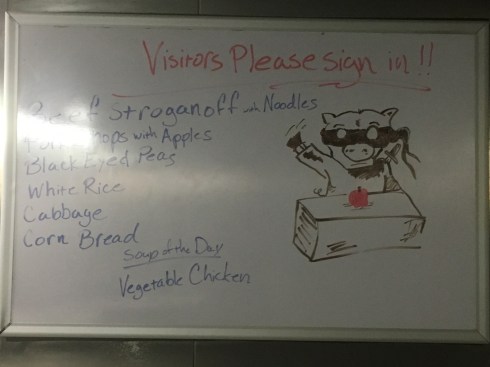
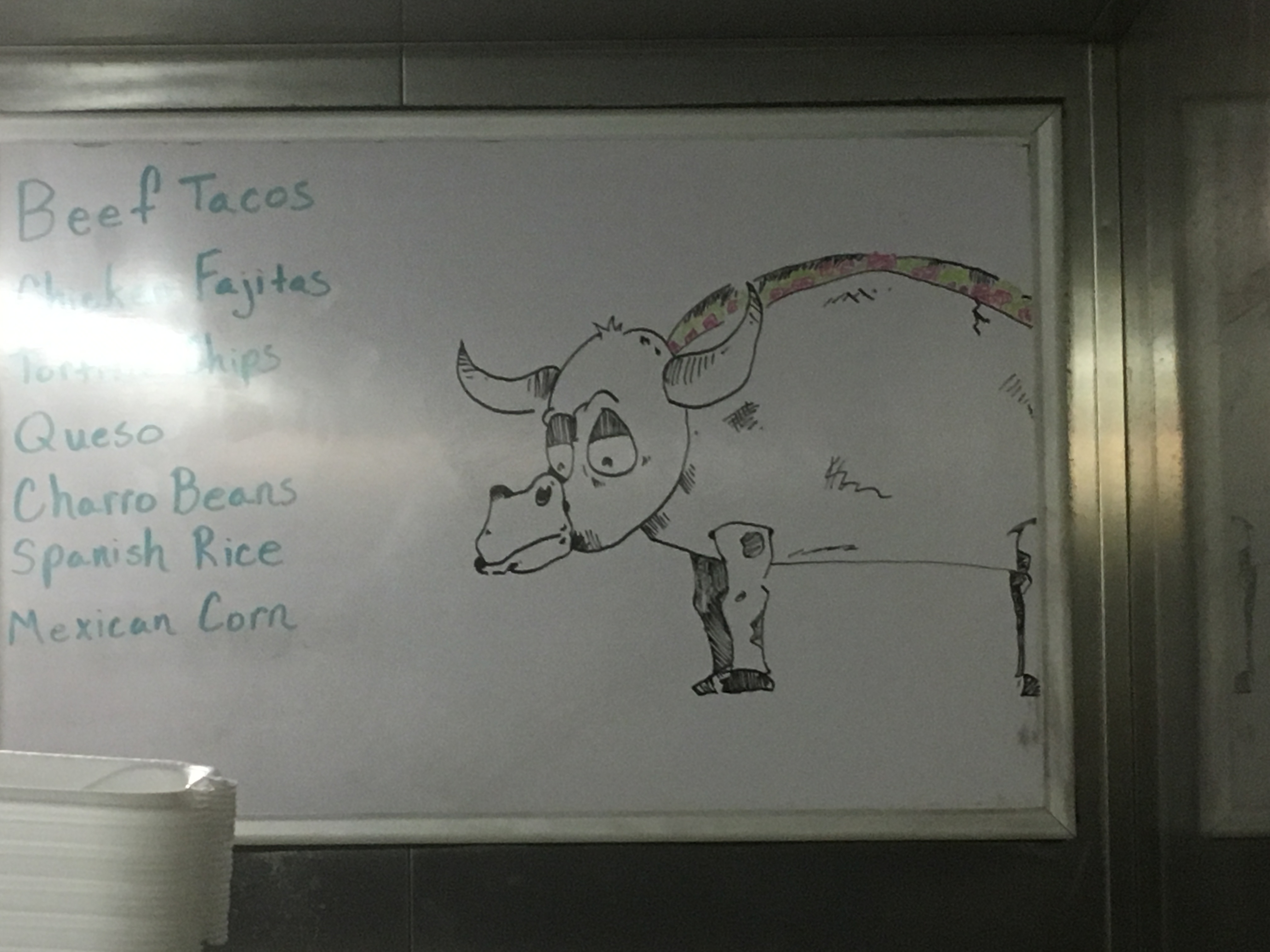
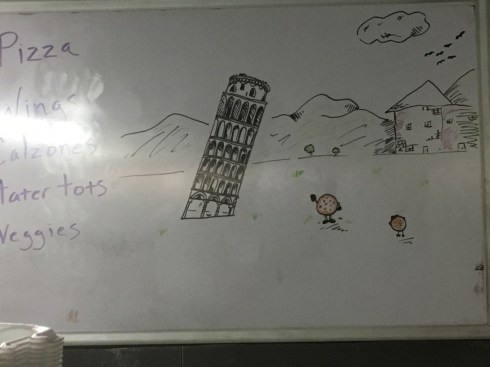
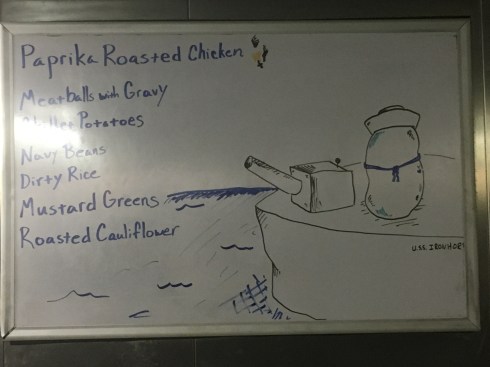
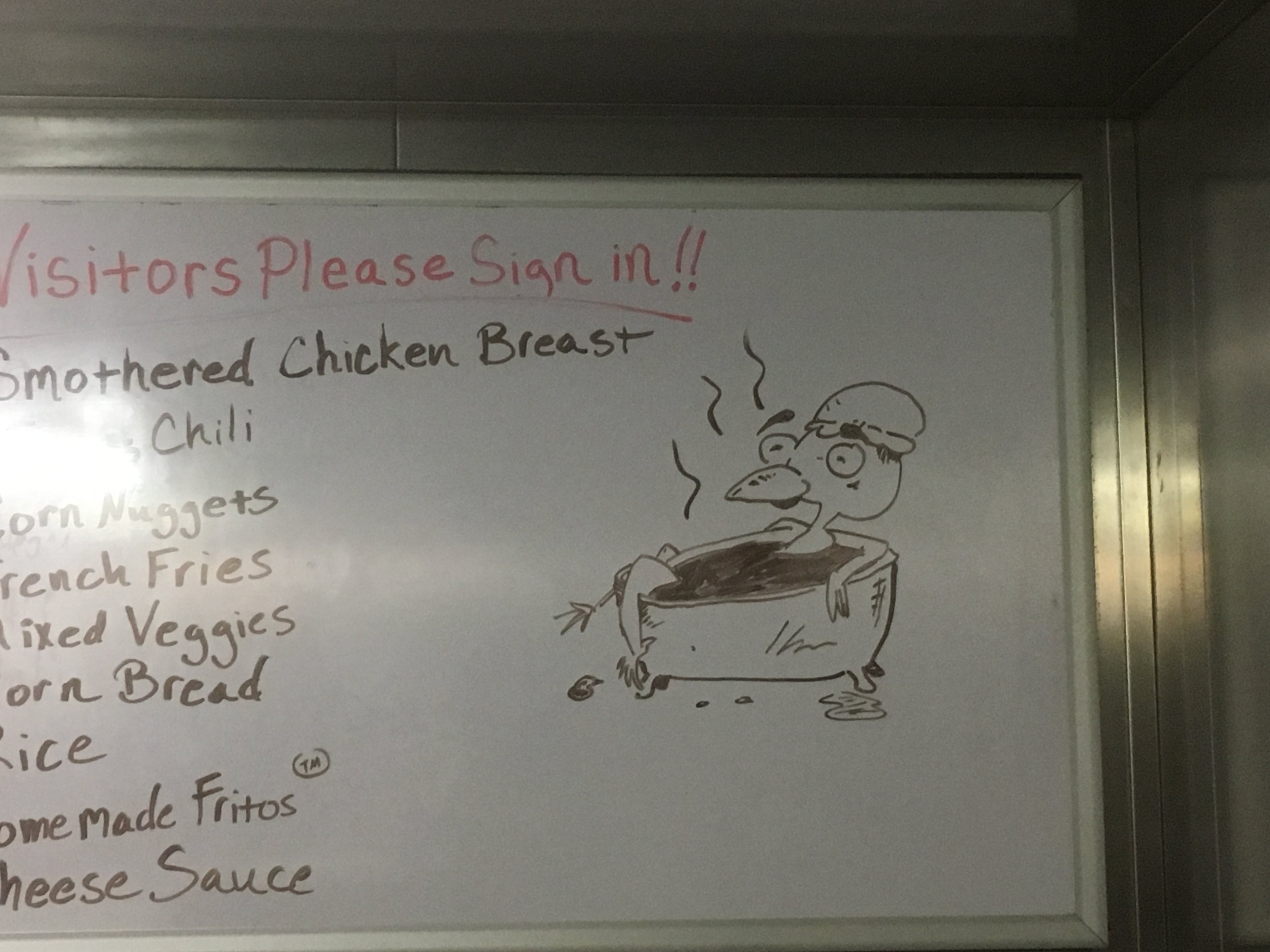
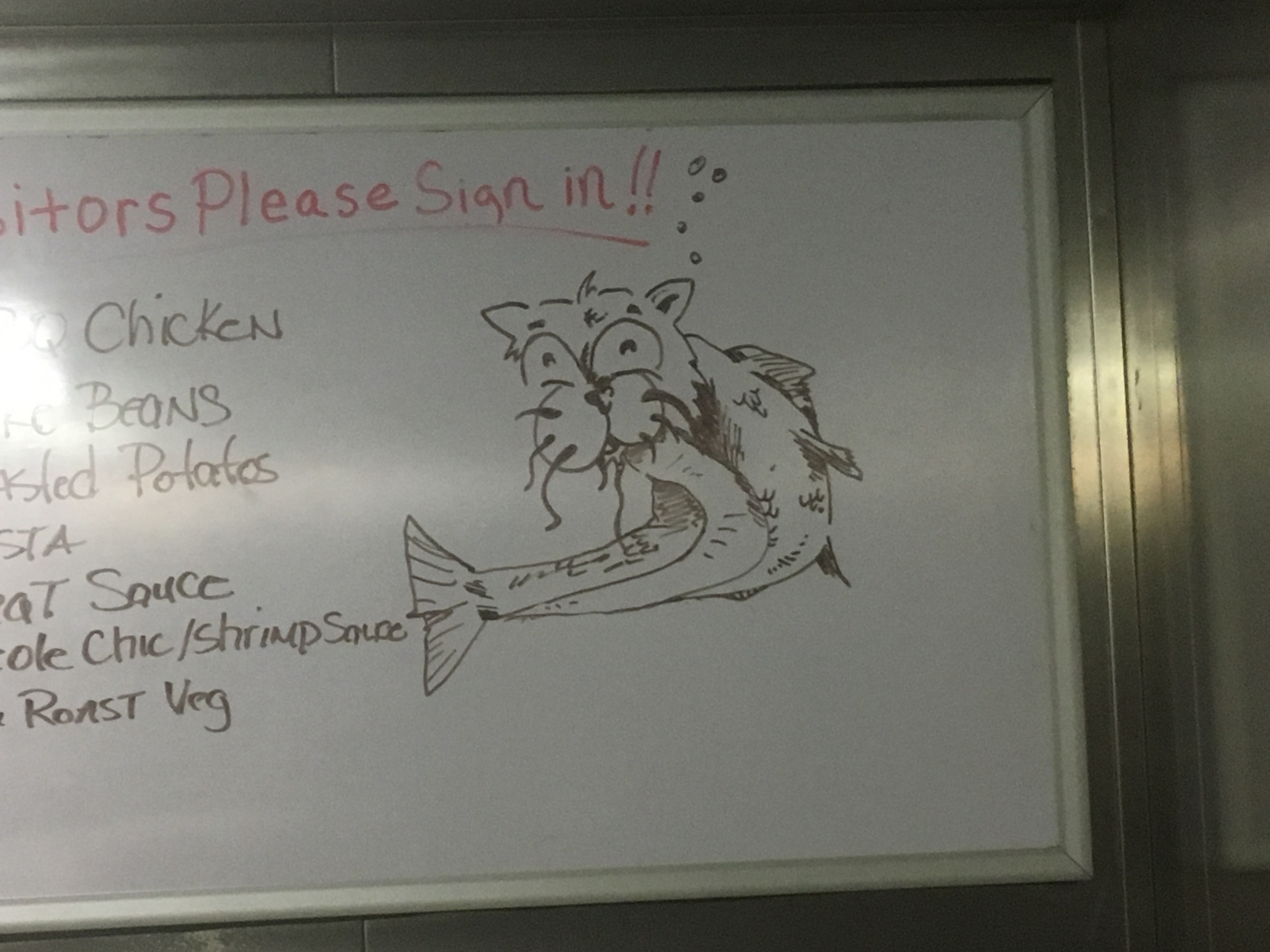
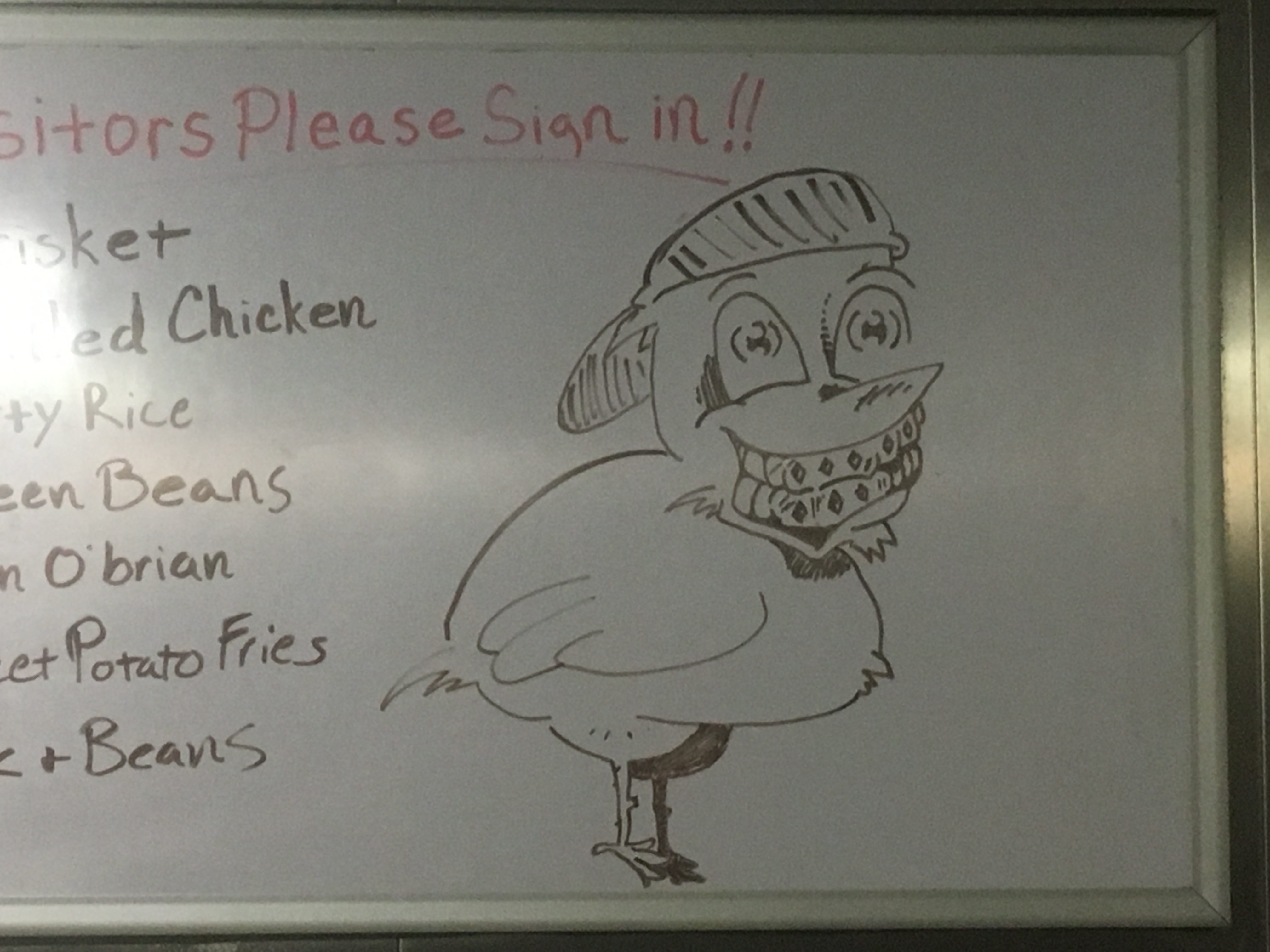
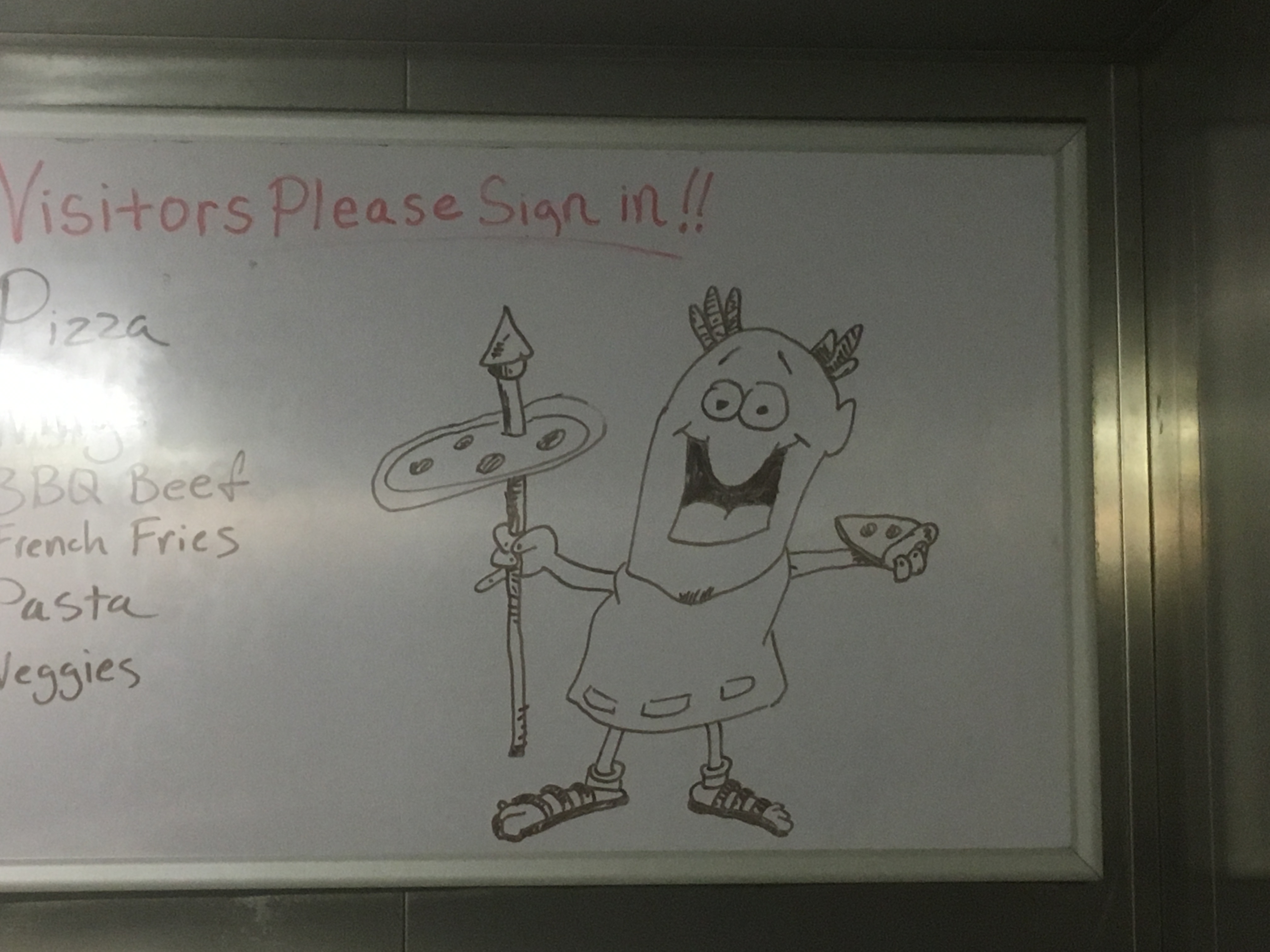
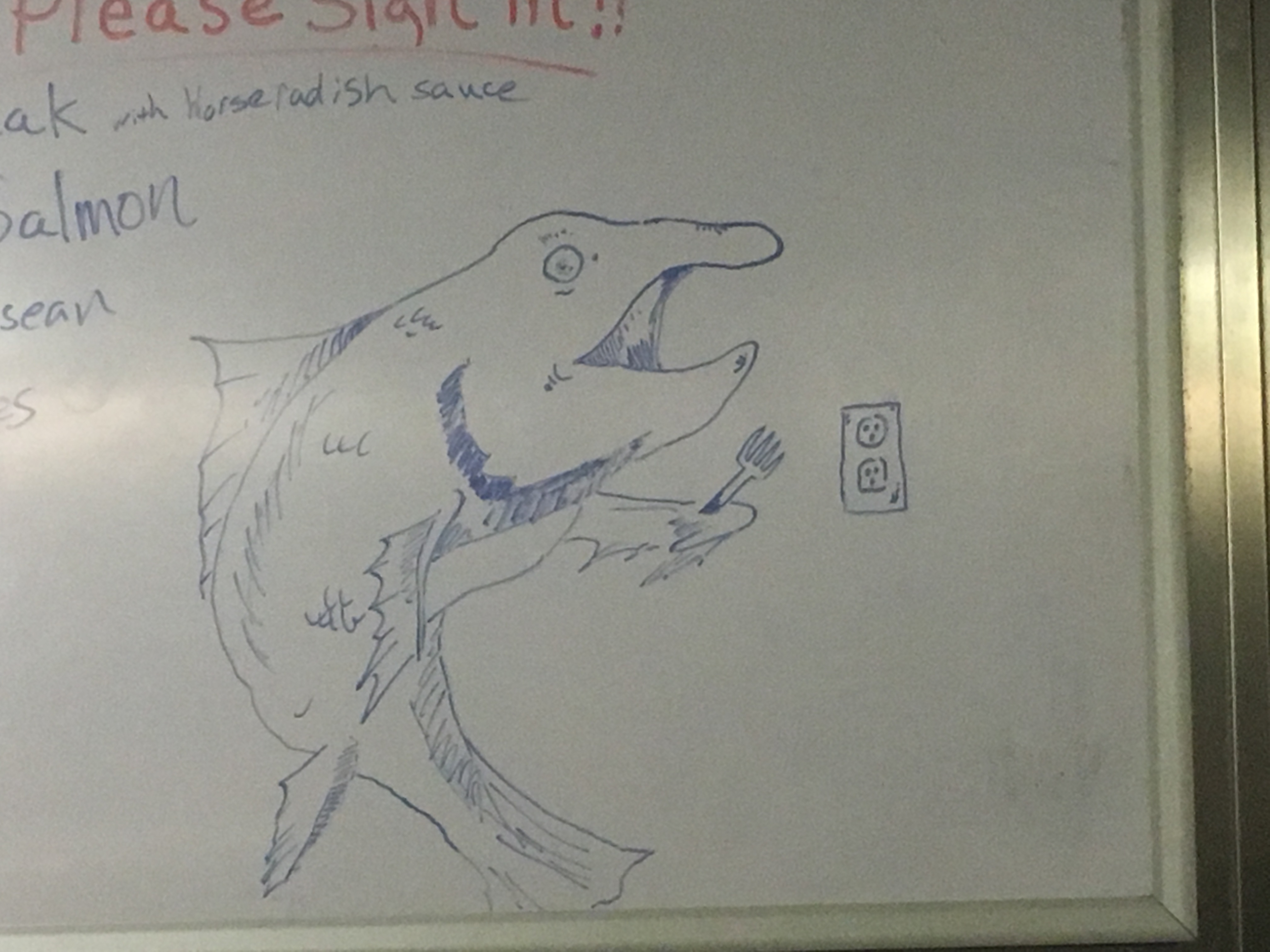
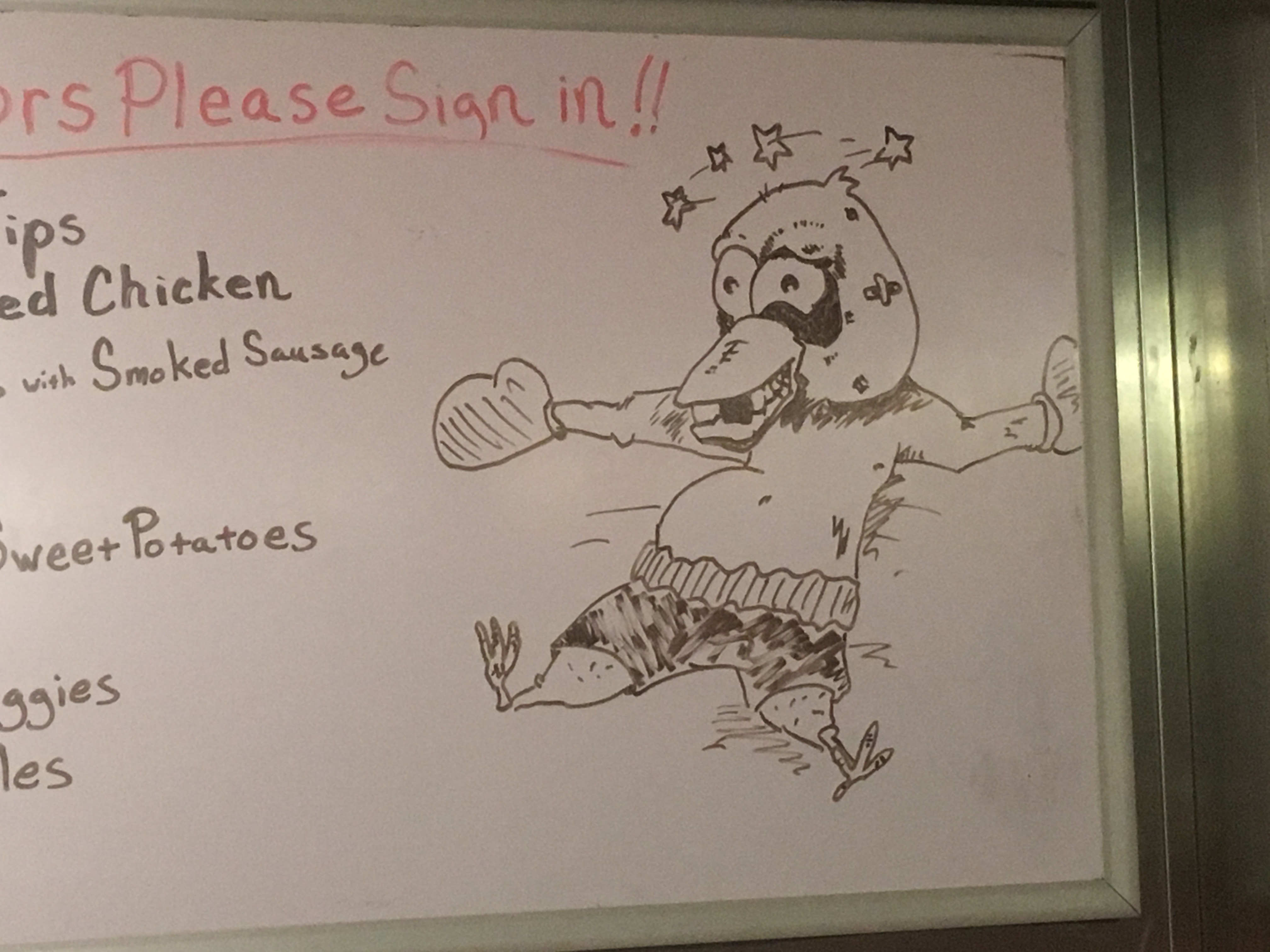
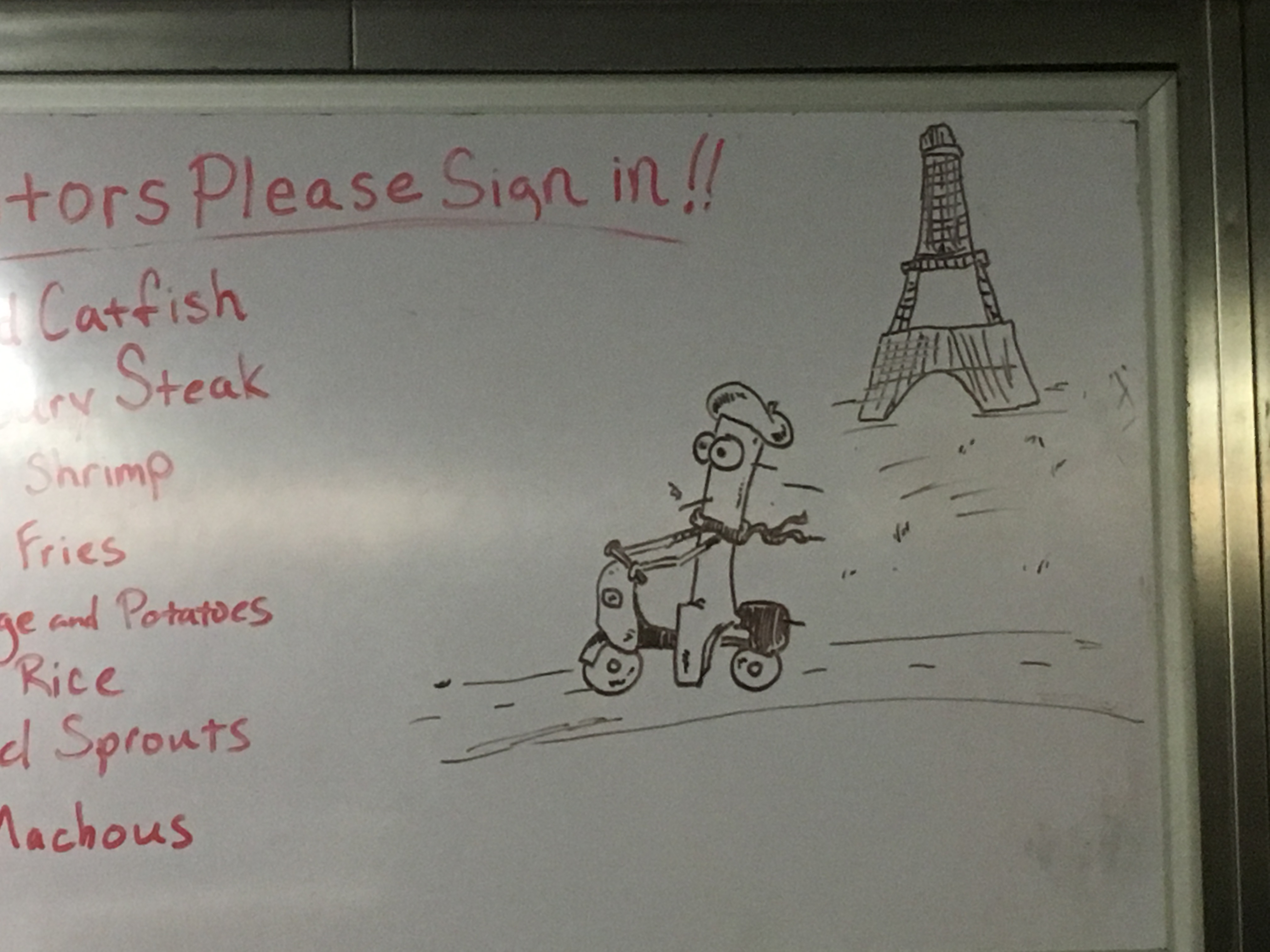
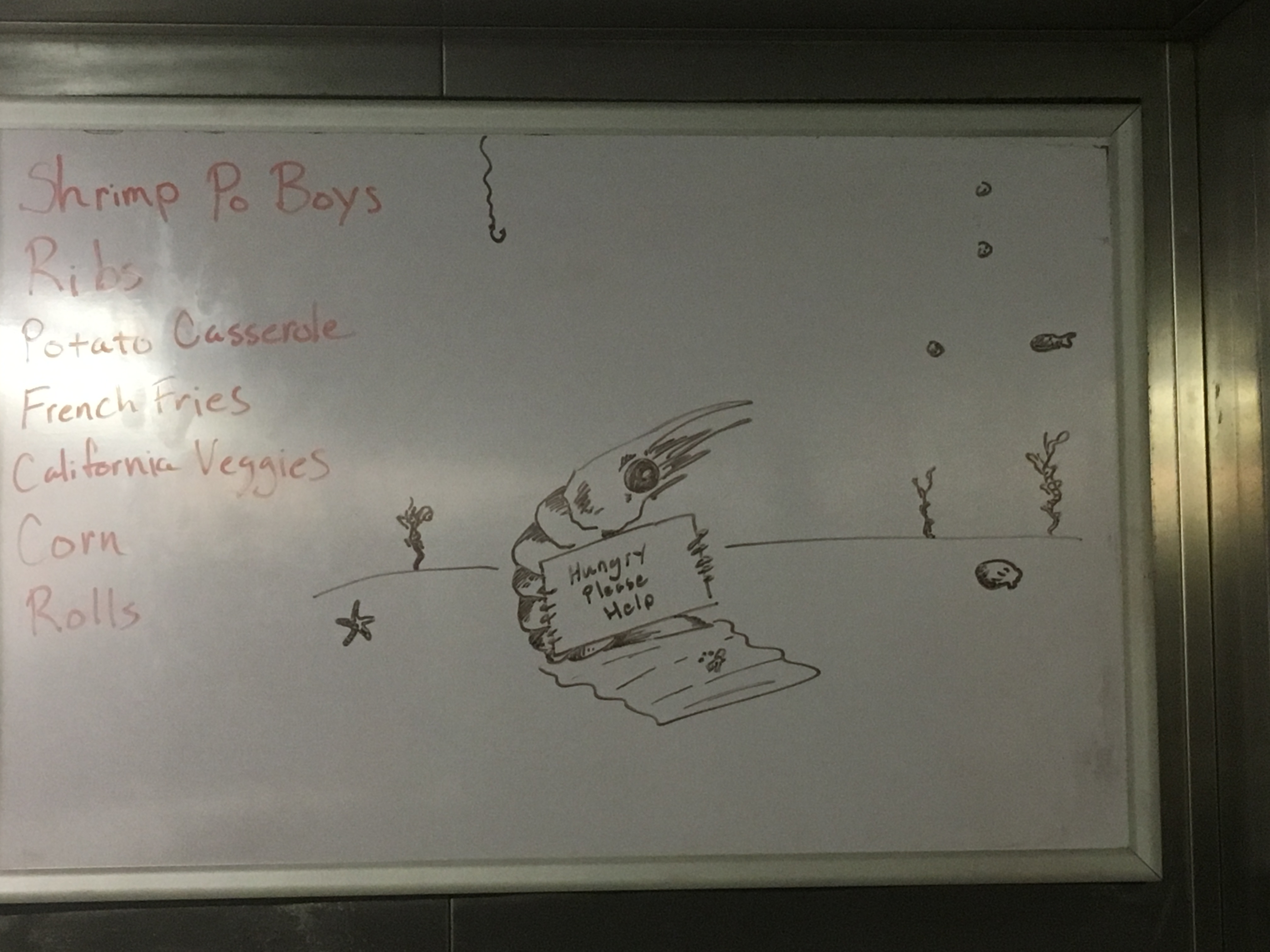
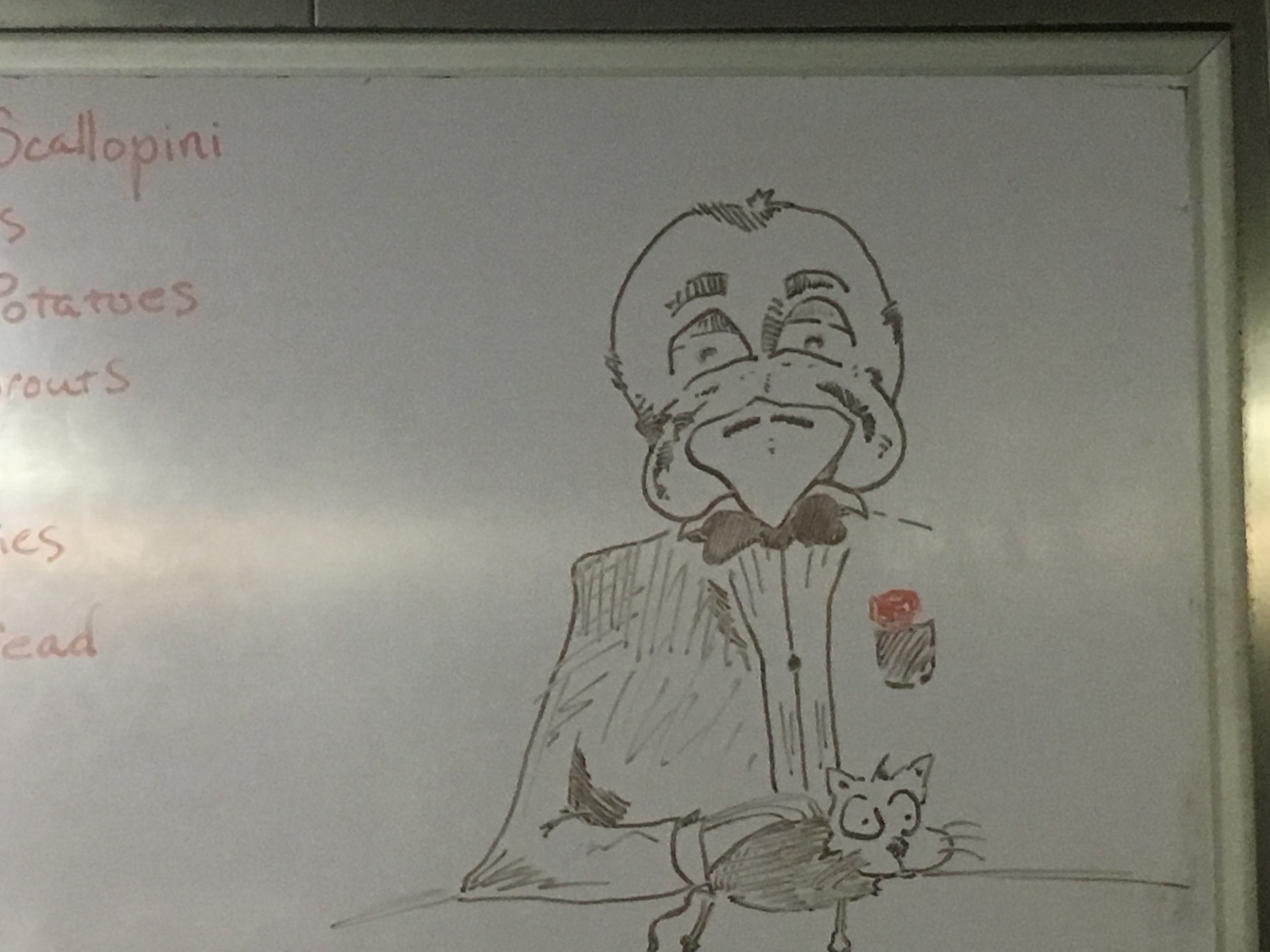
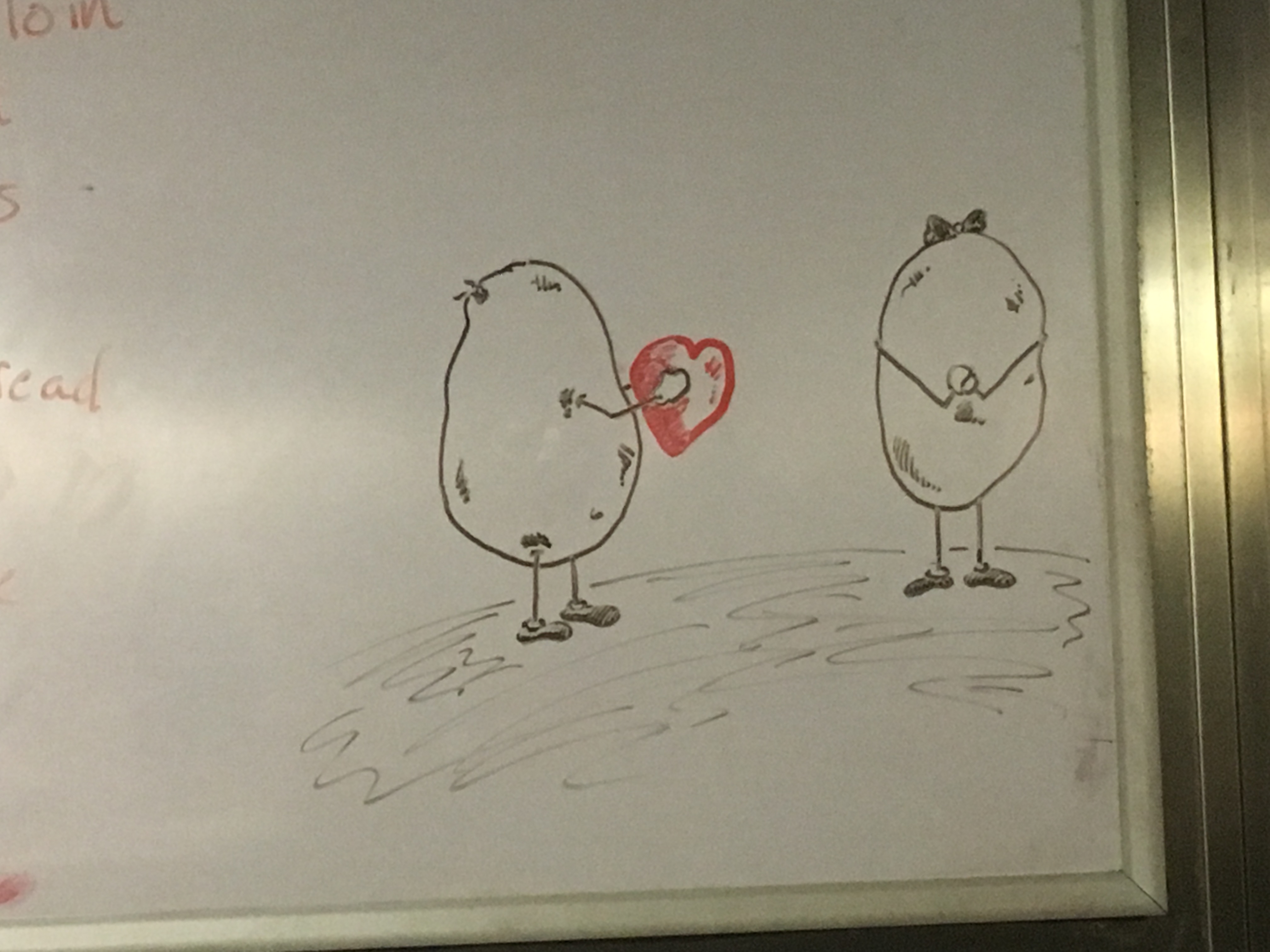
My identical twin brother works as a chef on a boat that stays out at sea for months. He started drawing pictures illustrating the meals on the menu in the cafeteria, and people started taking photos of them to send to their friends and families every day. Try to guess what the picture is depicting before reading the menu. You can also find the answer by mousing over the picture or scrolling down to the caption below each one.
Some of the whiteboards say, “Visitors sign in, please,” which may make you ask, how/why does a boat have visitors? It was docked for a while getting repaired.
My name is Travis, and I have an identical twin brother, Eric. We were born in Bryan, TX and spent our childhood bouncing around different small Texas towns. Having grown accustomed to the nomadic lifestyle, we spent our twenties and early thirties hopping cities around the world, sometimes together, sometimes solo. No matter how far we ran, somehow Texas kept sucking us back in, like roaches trying to climb out of a public toilet. A year ago, we moved into a house together in Houston. Three days ago, God decided to take the metaphor of our lives to the next level and give us a Hurricane Harvey-sized swirly.
If you’ve seen the news, you know I’m not exaggerating when I say God didn’t just take a piss on Houston. He waterboarded it. Major freeways are underneath lakes that are still expected to double in size. Two million people are under self-imposed house arrest, huddled behind boarded-up windows, living like there’s a full-scale zombie apocalypse going on outside. The meaning of life has basically been reduced to one goal: Don’t go outside.
You may be wondering, why we didn’t just evacuate when we had the chance. The answer is, evacuating was never a realistic option for most of us. Eric was here for Hurricane Ike in 2008, and he tried to evacuate, but after sitting in traffic for thirty-six hours, he finally turned around and came home. This time, we knew it’d be safer staying in a brick house than getting stuck on a sinking freeway, and we weren’t wrong.
Eric and I have family and friends all over Texas. So if we could have left, we would have had a lot of free options, but most people in Houston don’t have contacts all over Texas. Anyone living paycheck to paycheck and can’t afford to go out to eat, can’t afford to drive a hundred miles and stay at a hotel while they miss work at their hourly-wage job. I believe the main reason most people didn’t leave was because they were too poor.
We didn’t leave Houston, but we did flee our home because we live in a trailer house. Even if it could survive a flood, it wouldn’t provide any protection from the tornadoes created by the hurricane. So we packed up our most valuable possessions immediately and went to stay with a friend who owns a brick house.
The entire Houston area is in a floodplain. So over the years, the city has spent millions of dollars building a vast maze of drainage channels that you can see everywhere. Until a flood tests them, you don’t know if the ones near your house are reason for alarm or relief. By sheer luck, we ended up in a neighborhood with a fantastic drainage system. If the rain continues at its current pace, our host’s carpet won’t even get wet. Honestly, for us, this week has been a morbid vacation, which will be followed by lots of work opportunities.
Friday Night
Saturday Morning
Tuesday Morning
Part of my subconscious feels like I should have survivor’s guilt, but I didn’t ask for this. It is what it is. Plus, I have no idea if my house still exists. We tried to drive over there today to check on it, but the road into our neighborhood was completely flooded, and rescue crews were boating people out. So our week of white privilege may end with us discovering we don’t own anything anymore. At least we didn’t have much to lose because we perpetually own barely more than will fit in a truck since we’re constantly moving.
Another reason not to panic is that our landlady is a psychotic bitch who lives across the street and spies on us, looking for any excuse to take her anger out on someone she knows can’t give her the punch in the face she deserves. She overcharges us to live next to a railroad track, where train horns scream at 150 decibels all day and night like the souls of the damned being dragged to Hades at 60 miles per hour. If our “home” got swept away, it would set us free more than set us back.
Even after the rain stops, which won’t be for at least another three days, water levels are still expected to rise in low areas as it drains down from higher grounds. It’s a good thing I had the foresight to bring my work clothes with me, because I’ll probably have to go back to work before I get to go home.
In the meantime, we, and most of Houston’s residents have nothing to do but wait. The endless monotony is torture to some people, but I’m an extreme introvert with a passion for writing. I already cut activities out of my schedule to spend more hours typing in solitude. I work at my day job as few hours as I can afford, not because I’m lazy, but because I’d rather spend my life working on my passion than making the rich guy who pays me the bare minimum, richer.
I still have to keep my nose to the grindstone at least twenty-three hours per week. I can do this financially responsibly because my job pays well, but it’s also very physically demanding. So my body always hurts. Since American workers get the least vacation time of any first world country, Hurricane Harvey has been a golden opportunity to have my life back for a full week. I’m sure there are hundreds of thousands of wage slaves in the Houston area who are suffering worse than me but are still relieved to get a break from working themselves to death in 100-degree weather at a thankless, soul-crushing job.
The novelty has probably already worn off for Houston’s extroverts, who are going mad with cabin fever. The past few days have taught many of us that in a long, slow, scary situation like this, you have to find ways to stay active and positive or you’ll go insane.
There are already Youtube videos of people swimming in the streets, which is life-threateningly dangerous. The water is infested with flesh-eating bacteria from human sewage, a hundred tons of pollution, sharks, and alligators, which makes the idea of your house filling up with water a whole lot scarier than it already is.
Once all the flood water drains into the Gulf of Mexico, it will be weeks before it’s relatively safe to swim in the ocean again. Most Houstonians who lived through Hurricane Ike, Katrina, Alicia or Rita already know this, and television news reporters have been warning the Hurricane noobs to stay out of the water. Hopefully they have better luck convincing Americans not to hurt themselves than they did last week when they urged Americans not to look directly at the solar eclipse.
I’d be surprised if by next week, there isn’t a Youtube video of red necks slaloming downtown on jet skis, weaving around gangsters on inner tubes. Texas already has a, “Hold my beer and watch this!” mentality, and the only major city I’ve been to with worse drivers than Houston, is Cairo, Egypt. There are a million bad decisions made on Houston’s roads every day, and two million tigers aren’t going to change their stripes overnight just because of an apocalyptic flood.
Over a dozen helicopters and fifty boats are working twenty-four hours a day rescuing people stranded on top of cars and houses. Fortunately, since Houston is right on the Gulf of Mexico, and Texan culture has a fetish for buying really big toys you don’t need and won’t use very often, like boats, every middle-class neighborhood in the entire metro area has at least one driveway with a boat parked in it.
For such catastrophic flooding, it’s amazing the official number of deaths hasn’t reached double digits yet. There’s no telling how many lives have been saved by Bubba down the street ferrying his neighbors to safety. This is a blessing for Bubba too, since he gets to take a break from the rat race to be a genuine hero while simultaneously getting to live the dream of running red lights in his speedboat and doing donuts in parking lots.
I have this theory that the reason Houston drivers are so reckless, aggressive and violently entitled, is because you can only sit in demolition derby traffic for so long before everyone else’s stress rubs off on you. Well, Mother Nature put a stop to all that madness for a week and reminded us we’re not at war with our neighbors. We’re in this together.
I predict for the next month, we’ll be able to feel the same buzz in Houston as New Yorkers did after the Twin Towers collapsed. They were in pain, but for a short while, it brought the most notoriously rude city in America together. People who used to flip each other off and shout, “I’m walkin’ heeear!” put aside their differences and treated each other like family.
The post-traumatic euphoria will wear off sooner rather than later as everyone files back into the rat race and re-experiences the same stress and disrespect that turned them into road warriors in the first place. The first major tear in the social fabric will come when insurance companies remind a million homeowners and another million renters that our economy is designed to take more from its customers than it gives.
When insurance claims officers start explaining to Houston customers how dedicated they are to not helping them, Houstonians will have to direct their pain somewhere, and since they can’t fight the system because they’re too busy working to pay off all their debt, they won’t be able to direct their anger at the source of the problem. So they’ll take it out on the first person who cuts them off in the morning. It won’t take long before we all go back to force-feeding each other rage pie.
I’m not a Houston native, and if you didn’t catch it, I hate this city. The only reason I’m still here is because I’m waiting for my girlfriend to be in a position to move away with me. I’ve cursed the people here almost every time I’ve driven on the freeway, but so do they. Hurricane Harvey taught all of us different lessons. For me, it put my metropolitan stress rage into perspective.
I’ve made a surprising number of life-long friends in Houston in a very short amount of time. It’s full of good people, but there are a critical number of bad apples in the basket. A lot of those assholes were flood victims.
After driving around town (such as you can), and seeing the cosmic indifference and hopelessness of water covering all our accomplishments, possessions, goals, opportunities, like God just took a dry erase marker and wiped away everything with an indifferent flick of the wrist… I saw a punishment nobody deserves, no matter how big of an asshole they are. But it did happen to them. That’s a mind fuck I can’t unsee.
As much as I hate to admit it, I feel like this experience has made me more of an official Houstonian. For the rest of my life, anytime I meet someone who also lived through this watery nightmare, we’ll be able to nod at each other meaningfully and bond over the fact that we were both there when the shit went down, and we pulled through together.
Having said that, I’m getting the hell out of this death trap as soon as humanly possible, and God willing, never coming back.
If you enjoyed this story, you’ll also like these:
The last week of August 2017, Hurricane Harvey dropped 33 trillion gallons of water on Texas. 9 trillion of that landed on Houston, where I live with my twin brother, Eric, in a humble trailer house. We didn’t try to evacuate because Eric did that in 2008 during Hurricane Ike. It took him 36 hours to drive 30 miles in bumper to bumper traffic before he gave up and turned around.
So we fled our trailer to spend the next five days of rain at a friend’s house, in a neighborhood with good drainage. The lawn flooded, but it never made it to the house. So we just had a morbid vacation, and we didn’t think the flood was that bad until the rains stopped and we finally ventured out.
What we saw was surreal. Most of the roads were open, but they were littered with abandoned cars at odd angles, and flood waters still blocked off random access points. So finding routes could be tricky or impossible.
If I had to summarize the nature of Hurricane Harvey’s destruction in a few words, they would be, “random and polarized.” One street would be completely underwater and inaccessible. The next road over would be completely fine. One house may be sitting in two feet of water, and their neighbor may have gotten four or none. Some businesses were open pretty much throughout the storm, and some won’t ever open again.
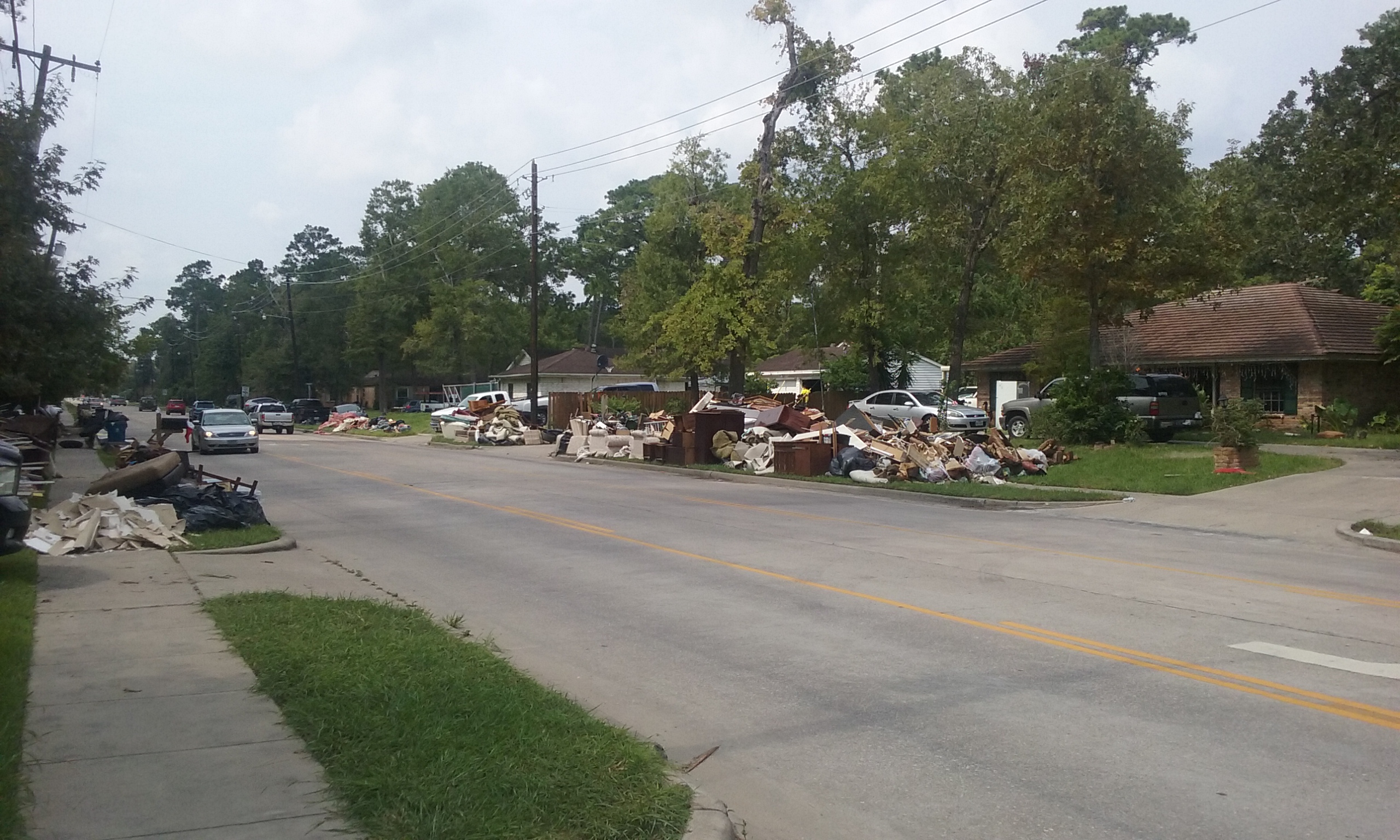
Even if you can’t see a waterline on the buildings, you can see how bad each neighborhood got hit by the amount of trash on the side of the road. Blocks that just have carpet and drywall set out by the curb only got a foot or two of water. When you see a yard covered in furniture, you know they got it bad.
Keep a good sense of humor and carry on, Houston.
The house I stayed in through the storm didn’t suffer any problems. It never even lost electricity or internet. Technically, my trailer house didn’t get flooded, since it’s propped up on cinder blocks, three feet above the ground, but the water came all the way up to the floorboards, soaking them, the carpet and the air conditioning ducts underneath. So now the entire house is an unlivable toxic mold trap.
This was the street in front of my friend’s house, where I sat through Hurricane Harvey. No problem.
This is the street to my house. Big problem.
My house after the first day of flooding.
My landlady and brother looking at fish on our front porch a few days after the rain stopped.
Eric and I moved out of our man cave, and now we’re staying with our girlfriends, who are ecstatic to have us closer to them. Thus continues Hurricane Harvey’s Twilight Zone-esque theme of polarized randomness. Everything is a cursed blessing or a blessed curse.
Disaster seems to have brought the best and worst out of the people here. When Harvey was still sitting on top of Houston, the owner of a furniture store opened his doors to anyone who needed a place with a bed to sleep on. At the same time, the owner of a mega church, Joel Osteen, locked the doors of his stadium-sized church until he was publicly shamed into letting refugees in. Then, he asked the refugees to give him donations, even though his $10.5 million mansion weathered the storm just fine.
This is where Joel Osteen lives (tax-free).
This is where the people Joel Osteen is asking for money live.
My landlady is just as greedy and sociopathic as Joel Osteen, and she has the permanent disposition of a drunk biker in a dive bar at 3 am looking for stupid shit to fight about. She won’t let me break my lease because she says my house is livable. She told me when we moved in that if we didn’t have rent on the first of the month, she’d throw all our stuff out to the curb by the end of the night, which is illegal. I could fight her on this, but I’d pay $900 to not have to spend months fighting her in court over $900.
So we paid rent like little bitches, but we get to take our time moving out and figuring out what to do with all our stuff. Most of it came from flea markets and estate sales anyway. We’ll probably just put it out by the side of the road. There are a lot of people driving around in trucks, grabbing all the free stuff they can. For the next year, Craigslist is going to be exploding in Houston with great deals on expensive furniture and household goods with mild to severe flood damage. A lot of people are going to die from the mold.
On a lighter note, both my electric company (Summer Energy) and internet provider (ATT) let me cancel my contracts with them without punishing me. I didn’t expect that, since the whole point of early termination fees is to fuck you in the first place, and ATT didn’t let my older brother, Stephen, out of his contract when he deployed to Afghanistan. Apparently, corporate greed isn’t completely bottomless… when the public is watching.
It seems if you’re more than 50% bad, disaster makes you worse. If you’re more than 50% good, disaster brings out your best. For example, an Army Ranger veteran’s house got F.U.B.A.R. flooded in Dickinson, TX, on the outskirts of the Houston metroplex. So he made a post on an unofficial Army Ranger Facebook page asking for help. Stephen and a bunch of other Ranger vets and their friends and family, drove down from San Antonio to help him fix his house.
This is the first time Stephen has been to Houston since I moved here. He never got to see my old house, but he got to see my new one, where he got to spend the night instead of. sleeping in a stranger’s home with nine other people. You can cut yourself to death with all the silver linings in Houston right now.
My twin brother, Eric, is helping our old neighbor gut his mom’s house, which flooded badly. I feel guilty because I haven’t been volunteering, but my boss put me back to work before the rain stopped. He didn’t even give us one day to pick up the pieces of our lives before sending us back to the salt mines. The joke’s on him though. He didn’t get any customers the first day or two because they were all busy picking up the pieces of their lives, unsurprisingly.
One of my coworkers asked our boss if we’d be getting paid for the time we missed, and he sent us the link to the FEMA website to apply for benefits. I hope he’s not surprised by the loyalty his employees show him in the future. I have a feeling half of them already lied to him and said they were cut off by flood water and couldn’t come to work for a few days, just so they could have a few more days of their lives to themselves.
I started back immediately, mostly because I was bored. Since I choose to work nights, my mornings are free. So I had time to drop Stephen off at the house he was clearing. My jaw dropped when I saw the next door neighbor had a sign in his front yard, facing the main highway in town that said, “You Loot We Shoot.” When I went to take a picture of it, the owner came outside and glared at me. So I took the shot real quick and left him alone, just like all the police who drove by and didn’t tell him to take it down. They didn’t turn a blind eye to it. Texas has “king of the castle” laws, which let you shoot any threatening intruder on sight.
I hoped the sign was just being dramatic until I picked Stephen up at the house where the rest of the volunteers were staying, which had a gun in every room, literally. As I got out of my truck, a lady in a minivan stopped me on the street and asked if I’d seen two young, dark-haired men run by. She said they just stole all her computer equipment. I told her I was sorry for her loss.
I’ve even heard rumors thugs have just started knocking on doors and robbing people at gunpoint. I don’t know anyone who that’s happened to, but I do have a Mexican friend who found out the liquor store next to his house got flooded. The owner couldn’t sell cases of beer in water damaged boxes. So he just put his stock on the back porch and told people walking by they could have it… but to drink at their own risk. Low-class people of every color lined up to help him clear out his damaged property.
Since the boxes were water damaged, a lot of beers fell out the bottoms and smashed on the concrete. After the frenzy, my buddy helped clean up the broken glass. So the old Asian guy gave him an extra three cases of top-shelf Texas honey whiskey. He doesn’t even really drink alcohol, but he took it because it was free. Then he showed up at my new house with a truckload of random beer covered in a thin layer of mold, which washes off easy with soap and water… hopefully.
I gave a few cases to Stephen to give to the Rangers in Dickinson, but for some reason, he didn’t. Maybe they didn’t want it. He ended up giving it to a random black who was also repairing flood damage.
I hope Stephen warned him to wash the bottles.
This is what I kept. It’s about 1/5 of the original truckload.
In the blog I wrote during Hurricane Harvey, I said this disaster would make me think twice about cussing at shitty Houston drivers, and I hoped our shared experience would teach us all that we’re on the same team. Now that danger has passed, Houston drivers are shittier than ever. If they don’t care about anyone on the highway but themselves, I see no reason why I should care about their feelings. That’s a horrible way to look at reality, but that’s what I call, “The Houstonitis.” Everybody’s shit rubs off on everyone until we’re all covered in shit and angry about it. If everybody’s guilty, is anybody?
Yesterday, a man asked me to help him settle a debate he was having with a coworker. He said the mayor should have ordered an evacuation and issued better instructions. His opponent disagreed. I said it wouldn’t have made a difference because nobody cares what the mayor thinks. Most Houstonians don’t even know his or her name, including me.
The guy I was talking to went on to complain about how flood victims didn’t do enough to evacuate and prepare, themselves. He was angry that some people could have left but didn’t. Then the government had to waste resources rescuing them. I explained to him, if you’re too poor to go out to eat, you’re too poor to go anywhere but work, ever.
If any human is to blame for the cost of Hurricane Harvey, it’s the same city planners who saved us all with the world-class drainage systems woven through the Houston metroplex. Unfortunately, we wouldn’t need a multi-million dollar drainage network and disaster response teams hopscotching in and out of flooded areas, if the city was built efficiently in the first place. Houstonians wouldn’t be rabid with Houstonitis if the city wasn’t a clusterfucked maze of economic dead zones connected by congested streets.
The supreme inefficiency of Houston’s city layout makes it necessary for humans to consume tons of resources to survive. Now that flood waters have destroyed half of the infrastructure in town, it’s going to have to be thrown into a landfill and replaced, depleting more of the earth’s resources and creating more pollution, leading to more global warming, leading to more hurricanes, which will lead to more flooding and more waste until we’re all dead.
If there’s a lesson to be learned from Hurricane Harvey, it’s that we need to build more sustainable megacities if the human race is to survive and thrive. It’s not that complicated. I can draw you a picture:
If you enjoyed this story, you’ll also like these:
Financially, 2016 was the worst year of my life financially. It hurt so bad I had to write three blogs to vent some of the emotional trauma. The disasters I experienced aren’t unusual, but that’s what makes this story poignant. My life is so normal, it’s a metaphor for every American who lives near the poverty line, who, no matter how long and hard they work, are perpetually having their life savings drained back to zero by predatory business practices.
The story of why 2016 sucked for me begins in 2008, with me being a hypocrite. Newly married and separated from the Air Force, I moved from Hickam Air Force Base, Hawaii to Austin, TX, where my wife and I bought a duplex for $250k.
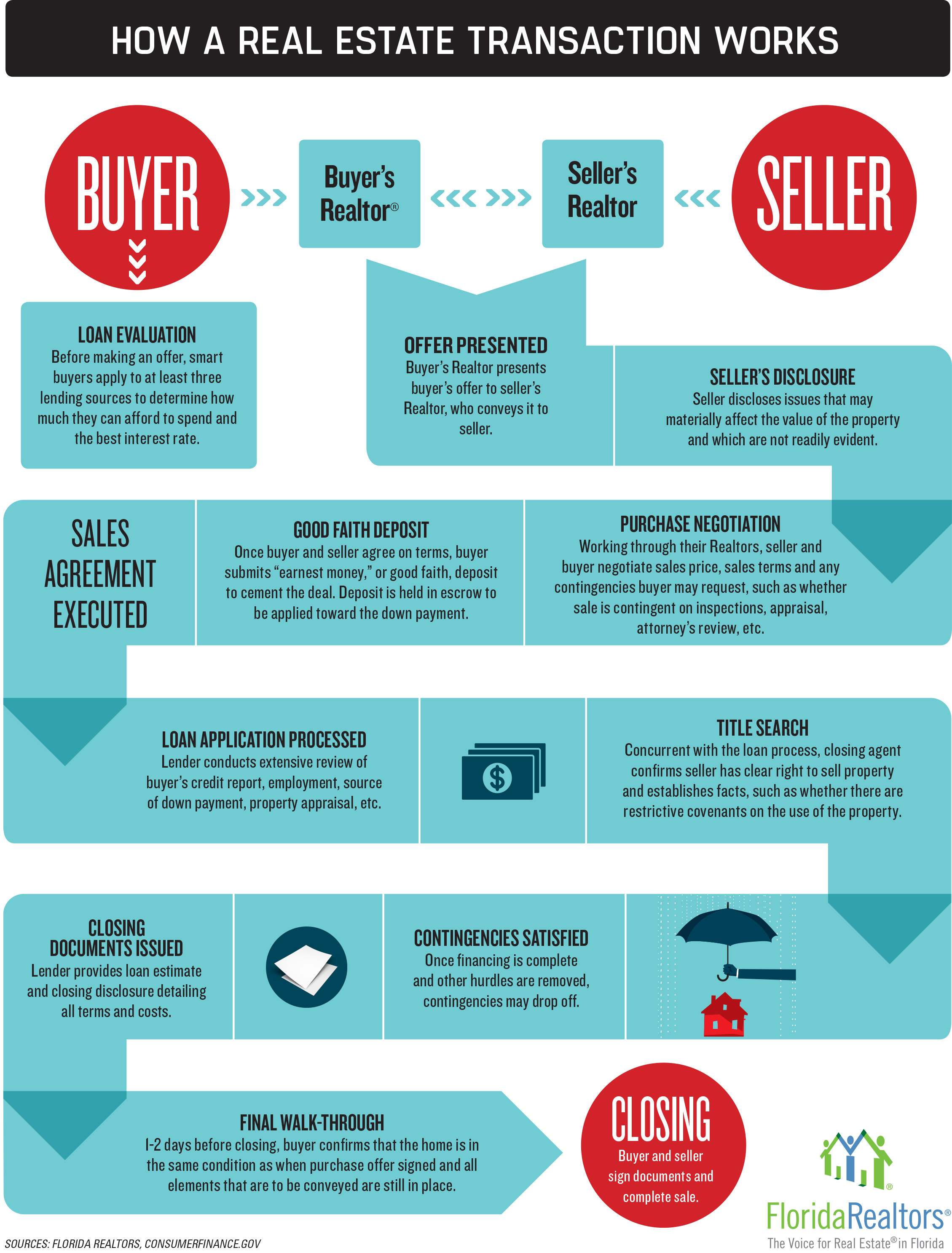
I didn’t want to pay a realtor. So I researched how to buy a house without one and immediately learned why realtors exist. There are so many laws around buying and selling houses it’s impossible to do it without having an associate’s degree worth of knowledge. After a few days of mind-numbing reading, I laid my head on my keyboard and muttered, “Why does this have to be harder than buying a car?”
The next day my wife and I met a realtor who came highly recommended from a distant relative. Our agent looked like a model and talked like an auctioneer. She picked us up in a brand new BMW equipped with space-age technology. After our first conversation, I felt like I was hiring a scout to take me on a treasure hunting expedition.
Over the next week, she showed us two trashy properties below our price range, two giant, expensive houses, and one solid option just above what we wanted to spend. So we picked that one, which in retrospect, I don’t think was an accident.
The only type of houses we looked at were duplexes, because we thought the tenant’s rent would cover our payments, and it would have if the cost of a mortgage equaled the listing price of the property, but after taxes, interest, and fees, the final price of a 30 year mortgage is double whatever the property is worth. So, after we picked the house, we learned we’d need to take out a $500k loan for a $250k property. Plus, most of the first fifteen years of payments would go to whittling down the interest, not buying equity in the house. Why do lenders have to structure loans that way? Because fuck you. That’s why.
Normally, home buyers have to put down a 20% down payment to qualify for a loan, and we didn’t have $50k. However, the Department of Veteran Affairs offers a special service to veterans. In exchange for $5k, it will vouch to pay the 20% down payment if the vet fails to pay their mortgage and the house gets foreclosed on. At that point, the VA will give the lender the 20% down payment, which in my case was $50k. So if my house got foreclosed on, I’d have to pay the VA, $50k.
This is a great deal, in the sense that it removes one of the glass ceilings stopping renters from becoming homeowners, but it’s a scammy solution to a problem created by the government. Think of it this way. The government enforces laws which make buying a home impossible to do without hiring legal representation to walk you through all the laws that inflate the cost of a property so high you can’t afford it. The government’s solution to the problem it created, is for homeowners to buy the lender an insurance policy to cover their losses if/when the veteran can’t afford to pay twice the advertised listing price of a property plus another $5k.
My real estate agent and the lender she referred us to explained all this to me and acted like it was completely normal… because it is. So I signed the paperwork and went on with my life, which consisted mostly of spending 10+ hours per week sitting in Austin’s notorious traffic and working 40+ hours per week at a computer helpdesk job getting yelled at for problems other people created.
I told myself it would all be worth it when I finally beat the game and could live life on my own terms. Seven years later my wife and I divorced and sold the house. Luckily, the divorce was “no contest.” So we didn’t have to spend $5k each for lawyers. Since we filed the paperwork ourselves, it only cost a few hundred dollars in government fees and having to stand in front of a judge who didn’t know us to beg him to let us get on with our lives.
We had already moved away from Austin halfway through our marriage and rented out both duplex units through a property manager who sent us “repair” bills for $300-$1000 almost monthly. We finally terminated our contract after he charged us $90 to replace a smoke detector battery and another $90 to look in the chimney and tell us there weren’t any birds in it. Wanting to avoid confrontation, my wife told them we were moving to Samoa and had to sell the house.
The next property management company we hired never sent us any absurd charges in the two years we used them. Since they rarely did anything to the house, effectively, we paid them $240 per month to deposit our rent checks.
Our contract also stipulated that if we sold the house, they would act as our real estate agent and take a higher-than-normal percentage of the sale. I didn’t care at the time because I wasn’t planning on getting divorced and selling the house.
When we decided to sell in 2013, Austin was experiencing a housing bubble, which means houses are overpriced. So sellers make can make a lot of money, but buyers get screwed paying inflated prices that could drop by the time they get divorced and have to sell their house.
There was so much demand for duplexes, our property manager/realtor was able to sell the house in two days for $60k more than the original listing price, which sounds great, except we’d spent at least that much on the mortgage, upgrades, fraudulent repairs and property management dues.
In the end, my wife and I received $15k each, and my realtor took $30k for doing less than ten hours of work. Just to be clear, I didn’t make $15k profit. I got a $15k return on a $60k investment. In the grand scheme of things, I lost $45k.
After signing all the paperwork, the realtor handed me my check and said, “See? It wasn’t that painful, was it?”
I wanted to tell him, “The only painful part was when you pocketed $30k I spent seven years working my ass off for in exchange for ten hours of your labor. But that’s okay because it’s normal, right? Enjoy your normal life, sending your kids to college and buying them sports cars. I’ll enjoy my normal routine of not having a retirement.”
Pictured above: My real estate agent and me at the closing table
At least I had $15k to start my new life with when I moved to Houston, TX to live with my identical twin brother. I didn’t make it out of my marriage with a vehicle but was able to pay cash for a used truck, which I bought from a small car dealership, owned and operated by a sweet, old Southern country farmer type who prided himself in his old-fashioned honesty. He won my trust and sold me a 1997 truck with 50k miles on it for $7k. It had been owned by an old lady who only drove it to church on Sundays. So even though the truck was almost twenty years old, it was practically new.
Now that I had a vehicle to drive to work, I turned my attention to job hunting. Most of my adult life, I’d worked in IT, but halfway through my marriage, after my wife and I left Austin, I couldn’t find work in the IT sector. So I worked a series of odd jobs until my IT experience became obsolete and unusable. I’ve never complained about or regretted letting that door close because I absolutely hated IT work. What good is making money if you spend your entire life doing things that make you miserable to earn it? That’s wasting the present, not investing in the future.
Theoretically, that’s true, but in America’s economy, chasing your dream is shooting yourself in the foot. Without a college degree, training certificate or relevant experience, my job options were staggeringly limited. I didn’t sit around crying about this. I drove straight to a staffing agency I knew could hook me up with “an exciting job opportunity.”
For the next few summer months, I spent 9 hours per day in a warehouse digging through vats of marble-sized ceramic balls, picking out any that were tarnished, broken or disfigured. The only break I got was an hour for lunch, and my bosses monitored me closely via the security cameras. At first, I was happy because I felt lucky to be getting paid slightly higher than minimum wage, but it didn’t take long to realize my assessment of life was wrong. In reality, my life was actually quite shit.
I had 9 hours per day to think. So I used the opportunity to weigh my options and decide how to save my life. About the time I got laid off, I convinced my twin to move to Colorado with me, where he could work, and I could attend a year-long trade school for free using the M.G.I.Bill, which would also pay me a $1,200 per month living stipend.
He agreed immediately because Houston sucks. So we settled our affairs in the local area, loaded everything we owned into our two trucks and drove to the cheapest hotel in Denver. The first night we celebrated our new beginning with overpriced legal weed and a box of Franzia. It seemed appropriate since the hotel was so low class, the Denver Police Department had a permanently reserved parking spot directly in front of the lobby.
Before leaving Texas we’d searched for apartments in Denver and made a list of places that have vacancies within our price range. There were enough options that I wasn’t worried about finding a place. My only fear was settling on the second or third best option because it’s closer to my school. After spending thousands of hours in Austin traffic, not commuting had become a priority of mine.
My brother and I spent the next week touring Denver’s ghetto-est apartments and getting turned away by every slum lord. Come to find out, Denver has a local law, which says in order to qualify to rent a property, you must either have three months of paychecks from a local business or a co-signer who makes three times the amount of rent, neither of which we had.
The apartment managers were unswayable. No matter how much we begged, nobody would bend the rules for us. At our last apartment viewing, I put $7k cash on the table and offered to pay an entire six-month lease up front. The apartment manager scowled at me like I was a hillbilly offering to pay with a bag of dead possums. He looked me in straight in the eye and said with dead seriousness, “That’s not good enough.”
Since when is having enough money to buy something, not good enough to buy it? When did the American Dream turn into The Twilight Zone? My money was good. The problem is Colorado lawmakers want to prevent poor people from immigrating to their state. So they invented a disingenuous rule that all the local apartment owners agreed to go along with. I wouldn’t be surprised to learn it was written by wealthy apartment moguls who made campaign contributions to the politicians, who signed it into law.
Unable to legally rent an apartment, we looked on Craigslist for people offering to rent out spare rooms in their private homes, which is actually illegal under Colorado’s anti-boardinghouse laws. Luckily, this rule isn’t enforced, because Denver police have better things to do thank kick poor people out of their houses. And by “better things,” I mean, “legally robbing motorists to meet their ticket quotas.”
My brother and I spent the next two weeks viewing rooms and begging people to let us pay $900 per month to live in the cupboard under their stairs. It wouldn’t have taken so long, but most landlords required a $50 non-refundable, non-binding fee just to fill out an application, in addition to paying another $30-$50 to run a criminal background and credit history check on you, which requires you to give out your social security number, date of birth and bank account number.
We refused to apply for any of those rooms, which drastically limited our choices, but it was worth not risking paying $50 to have our identities stolen. After a long, discouraging search, we finally moved into a large, trashy two-story house containing five other tenants.
Our landlady was a semi-obese, bedridden hoarder whose husband had recently died of cirrhosis of the liver, and she was dying of cancer. Since she couldn’t work, the only way she could afford rent and groceries by sub-leasing her extra rooms. Her situation wouldn’t have been so dire, except she lived with two of her children, who were both in their early twenties, didn’t pay any bills and refused to get jobs.
All three were drug addicts who took whatever narcotics they could get their hands on. The son would steal his mother’s morphine, forcing her to send the daughter to buy more off the black market when the pain of dying became unbearable. When the mother confronted him about it, he bitched her out in front of the whole house for playing the cancer card too much. She died four months after we moved out.
One of her tenants was a 20-something-year-old black, gentle giant who moved to Denver to escape the apocalyptic ghetto in Chicago where he grew up. The other housemate was a white 20-something-year-old Texan who moved to Colorado for the weed. He’d been in Denver for several years and had moved into our “boarding house” after getting kicked out of his last apartment for overdosing on a psychedelic designer drug and diving out the second-story window naked and then fighting three police officers in the parking lot until they tazed him unconscious.
My brother and I shared a room and a bed for three months until we talked our landlady into letting us convert the basement into bedrooms. She only charged us $800 per month for two rooms, which is made it the cheapest price we’d ever find Denver.
We had some good times in that house, but most of them were bad. We moved out the day the landlord’s son blasted his stereo at 7am for the hundredth time and then threatened to “fuck me up” with a golf club if I tried to turn his music down. At that point, my brother returned to Texas, and I rented a camping spot outside of town and lived there until I found another room on Craigslist.
I finished out the school year living in an elderly couple’s house, paying $700 per month. At first, I lived in a tiny room on the ground floor but was able to move downstairs into the much larger basement after the landlady found her other tenant’s crack pipe in the drier. They’d already been planning on asking him to leave anyway because he was literally insane and thought government agents were following him at all times. Other than being a moocher, he never bothered me, but I was glad to see him go because after he learned I’d worked for the NSA during my military service, he assumed I was a government agent sent to spy on him.
After graduating from school, I decided to move back to Houston as well to be with a girl I’d met after my divorce and stayed in touch with. I moved in with her at the beginning of 2016, flat broke again.
The whole trip had been an asteroid shower of unexpected expenses. I expected Colorado to be Candy Land, but it turned out to be more like Chutes and Ladders. Every time you think you’re getting somewhere, you slide back down to where you started.
The problem isn’t that Colorado is worse than the rest of America, it’s a metaphor for the rest of the country. One of my friends from the military recently moved to San Antonio and was unable to rent an apartment for the same reasons I couldn’t. In the end, he bought a house using the same VA home loan program I did, because it was easier for him to qualify to buy a house than to rent one. My friend and I didn’t do anything wrong to deserve the moving nightmare we experienced. This is just how everyone lives now.



















































 The Wise Sloth