The Conundrum Of Compromise

"Compromise is but the sacrifice of one right or good in the hope of retaining another- too often ending in the loss of both." Tryon Edwards


Marriage is the combining of two lives into one. From a romantic perspective, this is a beautiful thing. From a practical perspective, it’s counterproductive. Marriage is like a business merger. It involves two separate people with separate goals and separate resources available to accomplish their respective goals. When you get married, you join another person in a business contract. Then your assets and goals become inseparable.

This works great in two scenarios:

1: If all of your goals are exactly the same.

2: Neither of you has any goals.

The first scenario has never happened. The second is more common than it should be. If you don’t fall into either, you’re going to have to make compromises with your lover. You’ve probably heard someone say, “compromise is the key to a successful relationship.” This sounds fair, but it oversimplifies life.

Compromise means neither person gets exactly what they want so both parties can get a little of what they want. Think about this slowly: The end result is that nobody gets what they really want. Let me repeat that, “Nobody gets what they want.”

Happiness is achieved by fulfilling your wants. If you rarely get to fulfill your wants, you’ll rarely get to experience full happiness… unless you lower your expectations. In other words, unless you give up on your hopes and dreams. Marriage is a doomed business venture if it makes both parties unhappy until they give up and accept a substandard life, all the while using cognitive dissonance to excuse away the negative realities of marriage until they no longer live in reality.


If you enjoyed this post, you’ll also like these:


Sex positions and techniques
General Sex Advice
Dating Advice
Relationship Advice
Philosophy of Sexuality
Friendship
My Tweets About Romance


Society Won’t Improve Until You Do

"I told about the whole being greater than the sum of its parts. It's that way with people too, he said, only with people it's sometimes that the whole is less than the sum of the parts." Wendelin Van Draanen

If a society is nothing more than a large group of individuals, then the key to creating a Utopian society is to create a large group of Utopian individuals…

but if you can’t help an individual improve him/herself who doesn’t want to improve him/herself, then there’s no chance of helping a society of people who don’t want to improve themselves….

and if a person who does want to improve himself will do so with or without outside help, then a society of people who want to improve themselves will do so with or without outside help…

then if you don’t live in a Utopian society already, there’s a strong possibility it’s because the majority of people in your society don’t want to improve themselves. In which case, there’s little hope of your generation living to see Utopia…

and any chance your society has of improving its wants will be minimized as long as the majority of people in your society spend 3-6 hours per day watching and listening to commercials designed to make them crave fulfillment of the pettiest, self-serving, immediate desires humanity is capable of.

If you enjoyed this post, you’ll also like these:

Talk About Saving the World
Be Better People
 Build a Better World
Buy a Better World

Ten Ways People Get Dumber As They Get Older

Renaissance painting of a fool or jester sitting in a chair looking forlorn.


1. We stop going to school.

While in school you have knowledge crammed into your head for 4-8 hours per day. After graduation, most people just stop reading altogether because they have no motivation to teach themselves new information. Most people resented and resisted the knowledge were taught when they were in school. So after graduation, they’re more than happy to plop down in front of the TV for the next 60 years and let their mind turn to mush and forget everything they did learn in school.


2. Even if every adult wanted to learn, a lot of them are too busy.

Between working 8-12 hours a day, cultivating (or enduring) a marriage, raising children and doing household chores most people don’t have the spare time or energy to learn new things.  There’s not much you can do about this, but even though there’s a good excuse for it the fact remains…most people don’t learn much after graduation.


3. We assume the education we did receive proves we know everything (or at least as much as we need to know).

In theory, this shouldn’t be true. You’d think that people who went to 4-8 years of college would have a lifelong passion for learning, but the more people with higher education degrees you meet the more you’ll find out this generally isn’t the case. Instead, the higher of a degree they’ve earned the more conceited they are about how much they know. The more conceited they are the less motivation they have to learn more. So they spend the rest of their lives congratulating themselves for their past educational accomplishments and cease achieving new educational accomplishments while forgetting most of what they had learned that they’re so proud of.


4. We give up.

When we’re young we tend to be enthusiastic, hungry idealists. The world is a big, open sky to us. Every adult felt like that when they were younger, but then they got out into the real world and found out nobody gives a crap about you. You’re not a snowflake. You’re a number, and you’re expendable. Nobody really wants you to think outside the box. They want you to shut up and follow their orders.

Someday you may come to the realization that idealism is cute in cartoons, but in the real world the responsible thing to do, the adult thing to do, is to get a job you don’t necessarily take any joy from and work hard day-in and day-out for 60 years without a single complaint.

When the light goes out in your eyes and your life downshifts into autopilot you don’t think of brilliant things. You lose the motivation to explore. You just fade out. You call it “responsibility,” but your willful celebration of slavery defeats the purpose of existing in the first place, and it makes the world a duller place.


5. We come to believe that the rank makes the man.

The purest example of this is military officers. Aside from politicians, no group of people in the world are more delusional about their self-worth than military officers. Why do they think they’re so great? Because they have an arbitrary, man-made rank that tells them they’re God. And once you’re God you believe you can do no wrong. So you don’t listen to anything you don’t want to hear, and you have no motivation to improve yourself since there’s nowhere to go once you’ve reached the top. This is as true in the civilian sector as it is in the military. Give people an important title and tell them they’re important and they’ll become delusional idiots.


6. We assume the mere fact that we’re older makes us wiser.

Adults think kids are dumb shits. Adults don’t try to talk sense to kids because they know every kid is so naive they’re practically, certifiably insane. Being an adult surrounded by children is like being a one-eyed man in the land of the blind. You have more clarity and hindsight than them. True as that may be, it tends to go to adults’ heads. Even if adults are smarter than children that doesn’t make them a higher form of life. And the only reason adults are smarter than children is because they were born first. Whoopdy doo. You don’t get an award for that. If you think being born before someone else makes you better than them then you’re not as smart as you think.


7. Similar to #6 is that we tend to assume that getting married, having kids, and working at a job makes us wiser.

Again, yes, you do learn a lot about life by experiencing these trials. But those lessons are on par for what you should learn in life. Great. You can do what you’re supposed to. That’s not going above and beyond the limits. Assuming doing the bare minimum in life makes you an expert on life is foolish and shows how little you know about life. More importantly, it causes you to stop pushing yourself to learn more than the bare minimum.


8. We’ve had more time to convince ourselves of our beliefs.

Childhood is defined by our quest to understand ourselves, the world around us, why we’re here and what we’re supposed to do now that we’re here. By the end of childhood, we’ve amassed a head full of answers and explanations, and a lot of those answers are wrong. Even if they were all right, our understanding of life would still be incomplete. But people get the answers they’re comfortable with and repeat those answers to themselves over and over again until they can’t see anything else outside their tiny misshapen reality. Then they spend the rest of their life defending their answers and becoming more close-minded. After we’ve spent 50 years telling ourselves the same thing over and over again, we would have to erase part of our identity to admit that we’re wrong about our cherished beliefs. There’s a reason we have the saying, “You can’t teach an old dog new tricks.”


9. Similar to #8 is that we’ve had more time to surround ourselves with sources that confirm our biases.

We make friends who believe the same things we do. We watch television shows that are slanted to our point of view. We read news sources that cater to the spin we want to hear. The few nonfiction books that the average person reads are written by authors who just tell their audience what they want to hear. After a lifetime of confirmation bias we inevitably convince ourselves with concrete certainty we’re the good guys and anyone who disagrees with us are the bad guys.


10. We’ve invested our pride and our very identity in our tiny reality.

Growth requires change, but in order for adults to change they have to admit that their tiny worldview is either wrong or incomplete. Pride alone won’t let them do this, and even if they were willing to lay their pride aside- their identity is their reality, and their reality is their identity. Changing would be tantamount to suicide, and even though it would benefit them more in the long run, most people are too afraid to walk through the darkness to reach the light. They would rather live with a comfortable lie.


If you enjoyed this post, you’ll also like these:


The Meaning of Life
How to Think Like a Genius
Knowledge and Learning
Biker Philosophy
My Tweets About Philosophy 

My Theory On Age-Based Accountability Laws

Definition of the word, "Discrimination," The prejudicial treatment or consideration of a person, racial group or minority based on category rather than individual merit, excluding or restricting members on the grounds of race, sex or age."


The way things work today, you reach certain ages where you’ve given certain rights you didn’t use to have, like driving, drinking, having sex, and voting. At some of these milestones, you’re held to a higher level of responsibility. At the age of 17, you can be tried as an adult in a court of law. At other milestones, you’re held to a lower level of responsibility. At age 18 you’re free to smoke all the cigarettes you want and watch all the porn you can because you’re all of a sudden mature enough to handle it.  And then there’s the age of consent, which is just confusing. If you’re 17 years old you can have sex with all the 17-year-olds in the country. If you’re 18-years-old, it’s one of the worst crimes you can commit.

This is a broken system that isn’t based on any solid logic. The reason it’s still being used is because it involves taboos that nobody wants to touch with a 10-foot pole. Plus, it seems to be generally accepted that the system works well enough. So why mess with it? The reason is because the system works well enough…except for those it doesn’t work for.

Here’s what I propose. Get rid of all age restrictions as they stand. Then make it to where you can start applying for rights around the age of 14 or 15…because honestly, we all know what’s going on by 14 or 15. At that point, you can apply for the right to drive, the right to sexual freedom, the right to vote, the right to use mind-altering substances, etc.

There’s three catches though. First, you have to prove you’re responsible enough to use these rights. To drive, you have to pass a driving class. To vote, you have to pass a government class. To have legally consensual sex under the age of 18, you have to pass a sexual awareness class. To use drugs, you have to pass a drug awareness class. etc. etc.

The second catch is you’re held to a higher level of accountability. You can be tried in adult court. You’re no longer protected by statutory “rape” laws. The penalties for drinking and driving go up. Health insurance goes up. Stuff like that.

The third catch is that you can have your rights taken away if you demonstrate that you’re not responsible enough to use them…responsibly…just like how you can get your driver’s license taken away.


If you enjoyed this post, you’ll also like these:


Barack Obama
The 2016 Presidential Election
Donald Trump
Voting
Corruption and Election Reform
American Laws
My Tweets About Politics


An Old Man From Jersey Explains: How To Think

An old man sits on the steps to a dingy apartment building reading a newspaper. A ten year old boy stand on the grass nearby about to ask a question.

KID

Hey mister.

OLD MAN

I say, What do you want, kid?

KID

How do you think?

OLD MAN

Why do you want to know how to think?

KID

I don’t know. It just that, you know, you hear people say that you need to think, and I just thought maybe I should know how to do it.

OLD MAN

Well, that’s not going to do at all. Thinking is like anything else. In order to understand how to do it you need to understand why to do it, otherwise, you won’t do it. If that’s going to be the case, there’s no point in figuring out how to in the first place. First off, it enables you to do anything. You ever meet anybody who can’t seem to do anything by themselves?

KID

Well, I guess there’s this one boy in my class who always needs the teacher’s help for like everything.

OLD MAN

There you go. He has to ask other people questions because he won’t ask them himself. I tell you what, kid. That’s no way to go through life. The next reason you need to think is because it’s how you understand anything. If you don’t question the world yourself, you’ll have to rely on the answers other people give you, and we’re all idiots. So if you never ask yourself questions, you’ll only be able to see as far as the jerk next to you. When nobody asks any new questions, we all just drown in regurgitated vomit.

Now, this ties into the last reason, which a wiser man than myself summed up, “You see things not as they are but as you are.” You see, kid, you don’t experience the world, life, reality, whatever you want to call it, as it naturally is. You experience it through the filter of your understanding and beliefs. If you’re a schmuck, then you experience a schmuck reality. If you’re wise, then you experience an enlightened reality. And how do you suppose you become enlightened? There are those who would disagree with me on this, but I say it’s by asking questions and discovering the truth. That way your reality is defined by the truth…or as close as you can get, and every little bit counts as much as life itself because that is life. Hell, I’m talking in circles. Does that make sense?

KID

I guess so. I mean, it explains this one guy in my apartment. He’s always angry and mean. I guess he didn’t ask enough questions? So he doesn’t have enough answers? Or maybe he got the wrong answers?

OLD MAN

You got that right, kid. See, I told you, you got this down pretty good already. Let’s just make sure you got the rest down. Let’s talk about how to think, which is to say, how to ask questions. You’re what, 10 years old?

KID

10 and a half.

OLD MAN

Yeah, of course. So that means you’ve taken some math classes right?

KID

Yeah.

OLD MAN

Any algebra?

KID

No.

OLD MAN

Hmmm. Well, algebra is a lot like the math you’ve probably been doing. The main difference is that you don’t know what one of the numbers is. How can I explain this? Do you know what 5+5 equals?

KID

That’s easy. It’s 10.

OLD MAN

Okay. If I asked you, 5 plus what equals 10, could you answer that question?

KID

I just told you. 5 plus 5 equals ten!

OLD MAN

Great. You can figure out the missing variable. You understand algebra. This is important because asking a question in real life is the same as asking a mathematical question. And since they’re the same thing they follow the same pattern, and every math problem follows the same basic formula. Don’t get me wrong. You know that addition, subtraction, multiplication, and division follow different patterns, but the basic pattern is the same. They don’t teach you this in school, but the pattern goes like this. And I’m going to write this down on a napkin so you can take it with you.


1: Ask a question.

2: Gather data.

A: Identify the variables you have.

B: Identify the variables you don’t have.

3: Sort the data.

A: Apply formulas.

B: Ask sub-questions.

4: Question your answer.


OLD MAN

Does that make sense, kid?

KID

No.

OLD MAN

That’s what I figured you’d say. Don’t worry. It’s pretty simple, and it’ll all make sense in a minute. The first step is simple enough, right? Ask a question. You don’t ask a question, you don’t get an answer. And that’s why most people are stupid. They never ask questions. But there’s a little bit more to it than that. You ever hear the phrase, There’s no such thing as a stupid question?

KID

Yeah. My teacher says that sometimes.

OLD MAN

Well, your teacher’s heart is in the right place, but she’s crippling you and your classmates. The reason is because any question other than the most important question is a stupid question.

KID

What’s the most important question?

OLD MAN

Well, overall it’s either, ‘What is the meaning of life?’ or at least ‘What should we do now that we’re alive?’

KID

So the most important question is, ‘Why?’

OLD MAN

Er. Yeah. Yeah, I guess it is. Hmmm. Anyway, after you answer that question then the next most important question becomes the most important question. Or let’s suppose you’re being attacked by a bear. In that case, ‘Why?’ ain’t so important at the moment. In that case, ‘What the hell do I do about this friggin bear?’ is the most important question. Asking any other questions at that moment would be stupid.

KID

There aren’t any bears in…

OLD MAN

None of your sass, kid. You know what the hell I’m getting’ at. Anyway, once you establish what the most important question you should be asking is, the next step is to get answering it. However, you can’t solve a problem that you don’t know at least a few of the variables to. And just like in a math book, life usually gives you a couple of the variables…

KID

Wait. What’s a variable?

OLD MAN

A variable is a piece of the puzzle you don’t have. Hmmm. I can see I’m gonna have to break this down in simpler terms. Do you like cop shows?

KID

Oh yeah. They’re my favorite.

OLD MAN

Okay. When a cop shows up at a murder scene he’s got a question he’s gotta answer. He needs to know who committed the murder. The problem is he doesn’t know who did it. So the culprit is an unknown variable he has to solve for. Now, if the murderer was standing over the body with a smoking gun the question would be easy to answer. Unfortunately, that don’t happen too often. So the cop has to put together the clues he’s got to answer the question. That means he’s gotta gather the data that’s right in front of him. So he looks at the scene and records what he sees. Then, once he’s got that down, and only once he’s got that down he can figure out what other parts of the equation he doesn’t have. That brings us to the next step: gathering the data you don’t have.

Now, if you’re asking a question and the answer isn’t obvious it’s because there are missing variables. There are a billion ways to find out missing variables. You can do research. You can ask other people’s advice. You can deduce things logically without anyone’s help. It’s up to you. Just know that there’s something you don’t know and you need to figure out how to find that information out. Really, you’re going to have to use this method to figure out how to figure that out. That sounds kinda crazy, I know, but that’s how it is.

In order to make sense of all the information, you’ve got you’re going to have to sort it all out. The easiest way to do that is to use a formula. If you’re a cop then the formula is going to be police procedures. If you’re a scientist you’re going to use the scientific method. If you’re a lawyer you’re going to use the legal process. You see all knowledge falls into some kind of system, and a lot of those systems are well understood, and people have developed formulas for understanding the patterns in the system. If you’re lucky enough to be working in a system that people have studied before then you’re wise to use the formulas people have figured out. That’s how you figure out a multiplication problem. You follow the formula we’ve figured out to solve multiplication problems.

If you don’t have a formula to follow…and a lot of times even if you do…you’re going to have to connect the rest of the dots by ask sub-questions.

That’s not so complicated. You just keep asking questions about the unknown variables you have until you find the sub-answers that help you put the whole question together and find the whole answer. In the case of a cop the questions are going to be, ‘What is the motive? Who knew the victim? Are there fingerprints?’ Yada yada yada.

If you came home and your mother wasn’t there you’d ask, ‘Where is she? Did she leave a note? Where is she at this time usually? Who does she know? Is there something special going on today?’ You get what I’m saying. If you train yourself at finding the sub-questions that cut to the heart of the main question you’ll be able to solve anything, and then you can do anything.

KID

Wow. That’s pretty cool. I can become a detective too.

OLD MAN

Yeah, great, kid. But regardless of whether or not ten years from now you still want to do the one thing you just now thought of you still need to understand the last and maybe the most important part of the problem-solving method. You need to question your answers.

History is full of examples of the problems that come from not questioning your answers. People just accept the answers they’ve been given or the ones they’ve come to themselves and stick with them even though they’re wrong. That’s how atrocities happen and keep happening. That’s how life gets ruined. That’s why that one guy in your apartment is going to waste his whole life being a dumbass. Don’t tell your mother I used that word. Anyway, you get what I’m saying?

KID

Yeah. I get that part.

OLD MAN

Good. Any questions?

KID

Yeah, I got a bunch.

OLD MAN

Good answer…

If you enjoyed this post, you’ll also like these:


An Old Man From Jersey Explains Life
The Meaning of Life
How to Think Like a Genius
Knowledge and Learning
Biker Philosophy
My Tweets About Philosophy 


How Do You Eat An Elephant?

Once upon a time, there was a mouse named Strauss who lived in a little bakery in a little village in a little country. Strauss lived a good life by mouse standards, and mice only have three standards. One, get enough to eat. Two, find a safe place to live, and three, make enough friends that you’re not lonely but not so many that you’re overwhelmed.

Strauss had as many friends as he cared to have, but he didn’t have to share the bakery with any of them on account of they were all afraid of the baker who had a reputation for swatting mice. It’s not that the baker was a mean person, but he did have a business to run after all, and it wouldn’t do to have mice nibbling holes in the treats you’re trying to sell. The baker was well aware of Strauss to be sure, but since Strauss left the baker’s goods alone and only ate the crumbs that fell on the floor the baker left him alone in return.

Even though Strauss had everything he needed, he still had big dreams…big mouse dreams that is. He longed to eat an entire bowl of pudding, or lick all the frosting off of a cake or suck the filling out of an entire tray of jelly doughnuts. Any one of those feats would make him the envy of all the mice in the village, and the stories of his conquest would inspire future generations of mice children. In fact, it just so happened that these were the things Strauss was dreaming about when he was woken up one morning by a commotion in the front of the bakery.

Still half asleep but curious, Strauss left his little mouse bed to investigate and was surprised to see a large group of children crowding around the center table in the dining area. Strauss crept along the wall until he found an angle where he could see what exactly all the fuss was about, and when he finally caught sight of it he let out a little mouse gasp. The baker had stayed up all night making a chocolate elephant the size of a large pumpkin. It was the most wonderful and delicious thing any mouse had ever seen.

In an instant, Strauss forgot all about pudding, frosting, and even doughnuts. This was his dream come true. He was so happy he could have cried until he remembered that he couldn’t eat the food on display or else he wouldn’t be able to stay in the bakery anymore. When Strauss realized that he was heartbroken.

But just then the group of children, who were all jostling each other to be at the front of the circle, lurched forward and bumped hard against the table. Then everybody froze as the elephant teetered back and forth once, twice, three times before tipping over and falling to the floor.

When it hit the ground its trunk broke off along with two of its legs, and wide crack split right down the middle of its back. It was the baker who ended the silence with an angry shout that sent all of the children scurrying out of the bakery like mice running from an alley cat.

The baker knelt down and fumbled with the pieces of the broken elephant. He tried to put them back into place, but the pieces wouldn’t stay together. So the baker piled them back onto the tray his masterpiece had fallen off of and started to carry it towards the garbage can. To Strauss’s surprise though, the baker only took two steps towards the garbage and stopped. He shifted his feet a few times as if he couldn’t decide which direction he wanted them to take him. Then he walked straight towards the hole in the wall that led to Strauss’s den, knelt down and sat the plate right in front of it.

Strauss watched the baker walk slowly back to the kitchen, and when the kitchen door shut behind him Strauss turned his gaze back to the elephant….the elephant the baker had given to him. Strauss was sad for the baker’s loss, but then again, the baker could always make another elephant. In fact, he was probably in the kitchen this minute preparing the ingredients for a new one. For Strauss though, this was a once in a lifetime dream come true.

Strauss raced to the elephant, leaped on its trunkless head and buried his face in the deep, delicious chocolate. He ate and ate and ate and ate until he couldn’t eat anymore. Then he fell asleep right there on the platter, exhausted from eating so much chocolate. When he woke up he tried eating some more, but there wasn’t any room in his stomach.

Strauss spent the rest of the day in his bed recovering from his battle with the elephant. As he lay there he thought about how impossible it would be to eat the entire elephant. Of course, if he didn’t it wouldn’t be the end of the world. Life would still go on, but this was his personal dream and his shot at greatness. If he gave up and let the opportunity pass by him he would have to live with that the rest of his life. With these thoughts in mind, Strauss decided he was going to eat the entire elephant no matter how much work it took.

Over the next few days, Strauss went back to the elephant and ate and ate and ate until he couldn’t eat anymore. Then he rested until he could eat some more and went back and ate and ate and ate again. The baker noticed what the mouse was doing and would make it a point to stop by every once and a while to check on his progress, but the baker wasn’t the only one to notice. Eventually, the customers began to notice as well and would come to watch him. Then the rest of the mice in the village noticed how many people were coming to the bakery, and they came to watch the spectacle as well, but they didn’t go inside because they were still afraid of the baker.

In no time Strauss was the biggest attraction in town. The newspaper even printed a story on him, and after that, people came from other villages to see the mouse who was trying to eat an elephant. People and mice began making bets as to whether or not Strauss could do it. Some people believed in him, and some people said he was a fool and his dream was impossible.

Strauss certainly had shown strength and determination, but he was only just finished eating the head when his strength and determination began to fade. He had been working very hard, but he wasn’t making the progress he thought he would have by now. Despite the early support, he received the other mice were starting to doubt him, and he found this very discouraging. At any rate, he just didn’t know if he had the willpower to finish such a daunting task. So as the days went by he ate less and less until he stopped eating at all.

This caused a commotion, and some people, as well as mice, thought Strauss had finally failed. However, the baker did not remove the elephant because he believed in Strauss, and the spectacle was bringing him a lot of business. The baker tried to encourage Strauss, but Strauss was incorrigible. The baker was smart though and knew just what Strauss needed. He put the elephant in the refrigerator and made Strauss a tiny bowl of warm soup with a tiny piece of warm bread. He closed the bakery for a few days and let Strauss relax.

After Strauss was feeling better the baker cut a little piece off of the elephant and put it on a golden plate in front of Strauss’s hole. When Strauss saw the little piece of chocolate he ate it hungrily, and after he had finished it he was still hungry because it was such a small piece. However, instead of giving Strauss any more chocolate that day he simply gave him a little piece of muffin and some milk.

The next day Strauss found another little piece of chocolate sitting on the golden plate in front of his hole. He ate that hungrily as well, but he didn’t get any more that day. The next day he got another small piece, and it this went on the same way for months and months until Strauss had finished the whole elephant.

On that day there was a big celebration, and the baker baked elephant cakes, elephant candies, elephant pastries, and another chocolate elephant twice as big as the first. People came from all around to have their picture taken with Strauss and the baker and the new chocolate elephant. The people who had bet against Strauss lost their money, but they weren’t all sad about it because they were happy for Strauss. Already the other mice in town began boasting to their children about how well they never doubted Strauss for a moment and what an inspiration he was to mice everywhere.

At the end of the day, the baker shooed everyone out of the bakery and cleaned up all the mess they had made. To Strauss’s relief, the baker had sold the second elephant to someone from out of town. The baker made Strauss some warm soup and laid some extra soft cotton at his hole for him to add to his nest. That night Strauss had the best sleep of his life.

Not long after that, the baker took down the old sign that used to hang outside his bakery to one with a mouse eating an elephant.  From then on any mouse who wanted to come to the bakery was allowed to come in without fear of being swatted, and none of them ever ate anything that wasn’t given to them.

As Strauss got older he would often have young mice come to visit him and listen to him tell the tale of how he ate an entire elephant, and when the young mice asked him how he did it he would smile a sly, jolly smile and say, “One bite at a time.”


If you enjoyed this post, you’ll also like these:


Screenwriting for Movies
Screenwriting for TV
Short Stories
Erotica
Choose Your Own Adventure
Movie plot break downs
TV plot break downs
Free story prompts
Writing tips
Blogging
Art

3 Reasons We’re Not Trying To Make The World A Better Place

Our species has spent the majority of its existence and its evolution as ignorant beasts ruled by our instincts. Even today it’s still possible to get all the way through life using about as much logic as a bird uses to successfully navigate a complicated flight path. You can easily let your instincts guide you through all of your life decisions.

It would be a mistake to assume only the most misguided, weak, cowardly members of society give up and surrender themselves to their instincts. We’re all born set on autopilot, and our instincts don’t turn off after they’ve led us to our mother’s milk. By default, we stay on autopilot our entire lives. Logic is a relatively unnatural ability that has to be consciously and deliberately chosen and refined over time in order to override our instincts.

Everyone assumes they’re the exception to the rule, and they’ve taken control of their lives, but if everyone was as independent-minded as they believe they are, we would live in a peaceful, equitable, and logical world. The world is the way it is because we’re still a society of animals who consciously use the logical part of our brains as little as possible.


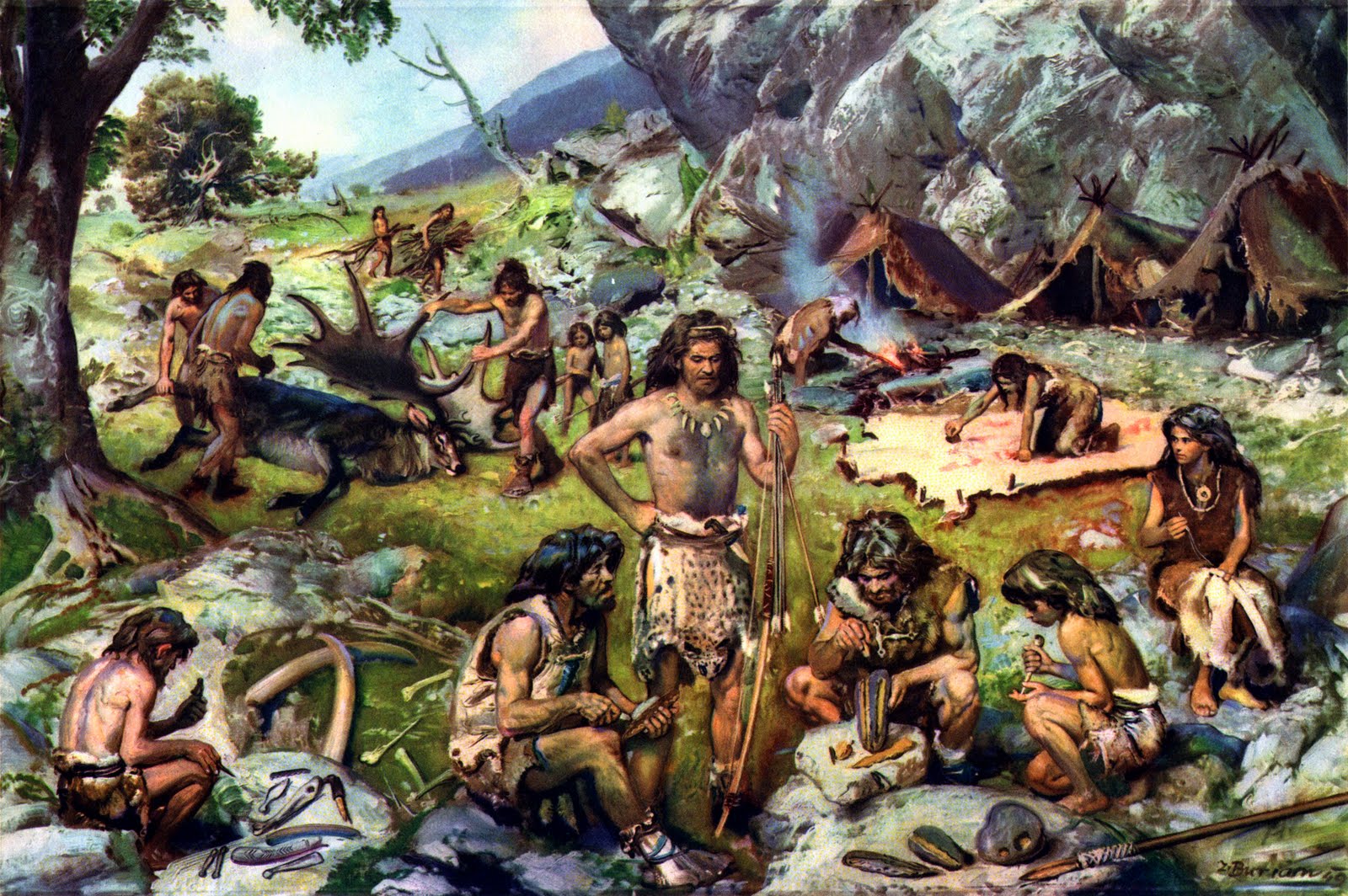
Painting of a group of primitive cave men sitting around their camp working at various tasks like skinning a deer and grinding plants


Consider our nature.

All of our emotions are animal instincts: joy, trust, fear, surprise, sadness, disgust, anger, anticipation… even love… especially love. Parents tend to automatically love their children for obvious evolutionary reasons. Men are attracted to beautiful women because they appear to be healthy mates. Females are attracted wealthy and strong males because they appear to be good providers and strong mates. Guys want to sleep with as many girls as possible to spread their genes. They’ll even rape women despite all logic. Girls want to hold onto one guy to help them raise their offspring, and both men and women will remain in abusive relationships despite all logic. We tell ourselves falling in love is one of the “highest” intellectual activities we do. In reality, it’s as primitive as taking a dump.

Masculinity reflects the hunter/protector role male animals traditionally filled for the past 2 million years. Femininity reflects the camp-tending/child-rearing role female animals traditionally filled for the past 2 million years. Today we look to leaders to run society for us because we’re pack animals, and that’s how we‘ve done it for millions of years. Tall people get promoted at work more because we see them as more “alpha” pack members. Feeble kids get picked on at school because even as children we feel compelled to establish our dominance in the pack hierarchy. The same instinct motivates bosses at work to bully their subordinates. Our brains go on to undermine our ability to use logic by providing us with mental shortcuts like schemas, confirmation bias, the fundamental attribution error, fear of the unknown, etc.

This sounds sinister, but the fact that our species has survived this long is evidence that these instincts are helping us. They tell us what to do when life is too complicated to think all the way through. They guide us towards the path of least resistance and help us navigate our way through life with minimal need to think for ourselves. In other words, we’re not supposed to use our brains because we can’t be trusted to.


Consider our nurturing.

Infants can’t think objectively much less distrust the people they view as gods: their parents. So as infants, it’s only logical for us to trust our parents and assume that the way they teach us to live was the way to live. And since we assume that that’s the way it never occurs to us to question it. And when someone tells us we’re wrong it’s only logical for us not to believe them. Even if we do ever decide to look at our beliefs objectively we can only change the beliefs we have, not the ones we don’t have, and we don’t how much we don’t know. So we’re inclined to believe that we know as much as there is to know (or at least as much as we need to know). From that point of view, it’s logical (or at least inevitable) to have a closed mind (initially). To make matters worse, the more we know the more we tend to believe we’ve reached the apex of human knowledge. So ironically, the more we know the more close-minded we tend to become. Even when we admit that we don’t know everything we tend to think that admitting our ignorance makes us wise, which again closes our mind.

It’s human nature to have a closed mind, and that’s why it was inevitable that the religions we created would say that blind faith in the answers you’ve been given will earn you a place in paradise while questioning the answers is a crime so terrible that those who do it deserve to be punished for eternity. It was inevitable that the governments we’ve created would say that to be a good citizen you have to be a patriot and support your government no matter what and anyone who doubts their country is a traitor or a terrorist or at least a cry baby. It was inevitable that our parents and school officials would say to respect them and that to question them is insolent, disrespectful, stepping out of our place, rude, etc. It was inevitable that society would tell us to be optimistic and grateful for what we have and that to question your position in life or your society’s social model is pessimistic and ungrateful. It was inevitable that our business model would reward those who don’t rock the boat (even if it’s sinking) and labels people who criticize the system as insolent, troublemakers, lazy, or not tough enough to handle “it.”

Businesses love to talk about thinking inside and outside of the box, but these terms are misleading. There’s no inside or outside the box thinking. There’s being guided by your instinct while repeating the patterns you’ve learned from society and then there’s thinking, period. And for those who define their reality by repeating the processes they already know, anything and everything outside of their experiences appear radical. To them, the world is black and white, and they tend to view anybody who thinks at all as an extremist and a heretic. We say we value thinking, but nobody takes it upon themselves to practice thinking as an art form. We don’t think on our own time, and even when someone barges into our lives and pushes ideas into our hands that don’t fit into our preconceived schemas, we tend to automatically naysay it and label it stupid…and the more we label everything outside our box stupid the smarter it makes us feel and the more it cements us into our box.


Look at our group behavior.

Just like our individual brains, society seeks the path of least resistance. Society is set to autopilot. It embraces beliefs that are familiar, vague, and shallow. It embraces behavior that is routine, immediately gratifying, and physical. It shies away from beliefs that are too unusual, self-critical, complicated, or far-sighted. While society will accept superficial forms of deviance such as wearing slightly unusual clothing and using slightly unusual slang, it opposes behavior or beliefs that contradict or undermine society’s fundamental values, which again, are vague and shallow. After generations of this modus operandi, cultures naturally sift out a functional level of equilibrium that it calls maturity, responsibility, being grown up, sane, normal, moral, acceptable, natural, etc.

Children usually don’t have all of these standards explicitly spelled out for them,  but society will give them hints when they step off the path and will guide them to normality and mediocrity. When they get there, they’ll be rewarded with acceptance, praise, and the internal peace that comes with having your mind completely whitewashed. All of this sounds sinister, but again, these tendencies have evolved because they help us survive. However, our instincts are blind, and when left unchecked they can actually drive us to our deaths through over-consumption, overpopulation, and over-competition.

Unfortunately, despite possessing the ability to reason, our individual instincts and our societal tendencies oppose the development of logic, the fail-safe that could save us from our instincts. The more you question yourself and take yourself off of autopilot the more you have to come face to face with your own inadequacies, and the truth hurts. The more you confront these difficult truths the less simple your world will become, the more responsibility you’ll have to take for your welfare and the harder life becomes for you. The more you question society and see the world more clearly the more society will reject, ridicule, fear, hate and persecute you. So we’re classically conditioned to become safe, unthinking, self-congratulatory automatons who are going to over consume, overpopulate, and over compete ourselves into extinction.

History provides plenty of examples of individuals who pursued the art of thinking despite the immediate, negative consequences, and while they did find answers that lay outside the accepted model of human understanding and improved life for future generations…many of these individuals were killed for their trouble. Make no mistake, society is not a docile herd of sheep following a sly pied piper. They’re a ravenous pack of wolves kowtowing to the fiercest wolves, and the only thing worse than being at the bottom of the hierarchy is to be outside the group because that makes you a common enemy, and pretty much the only thing they’ll all put their differences aside for is to kill an outsider who threatens to upset the status quo of the pack.

Yeah, we all want society to improve, but all we really need to do to improve society is become better individuals. We don’t become better individuals though because anytime anyone tries, they’re descended upon by the wolves (who are usually their friends and family). We all want the system to improve, but anytime someone tries, the same thing happens. Theoretically, we all want change, but in practice, it’s the one thing we fear and hate most.

The point of all this isn’t to say change isn’t possible. Obviously, society has changed a great deal throughout the history of civilization. It’s just worth knowing why you’re unlikely to see all the changes you want in your lifetime. Don’t get me wrong. You’ll see some change in your lifetime, but most of the change will be unimportant (like fashion). You’ll see some baby steps on the important issues even though people will fight that progress kicking and screaming and then spend the rest of their lives bitching about how these advances in society are proof of the crumbling of society and the end of the world. Then you’ll see the children of this generation grow up accepting those baby steps as true, but most of our children won’t think any farther past that. Only a few of our children will grow up to be sinful, heretical, preposterous, ungrateful nerds who will push the envelope of human understanding. They’ll be persecuted by those of our children who grow up to be good, normal, decent people. Then our children’s generation will die off, and their children will grow up accepting some of the advances that the deviants of the previous generation made, and the cycle will continue improving at a snail’s pace…

Unless we start rigorously, systematically teaching children to think. If we can raise just one generation of children with legitimately curious, logical, objective minds we can break the cycle of ignorance. But in order to do that we’re going to have to teach them to be sinful, heretical, preposterous, ungrateful nerds, and most parents will fight that tooth and nail. That’s why society won’t change…much… unless you can think of a way to undermine the system.


If you enjoyed this post, you’ll also like these:


Talk About Saving the World
Be Better People
 Build a Better World
Buy a Better World


An Old Man From Jersey Explains: The Difference Between Republicans and Democrats

An old man sits on the steps to a dingy apartment building reading a newspaper. A ten year old boy stand on the grass nearby about to ask a question.

So I was sitting on the front steps to my apartment building the other day watching the people walk by when this kid comes up to me and says, “Hey mister.”

I say, “What do you want, kid?”

He says, “Can you explain the difference between republicans and democrats to me?”

I think about it for a minute, and then I tell him, “No.”

“You don’t know?”

“Yes and no. The thing is your question is like asking the difference between someone from the East Coast and someone from the West Coast. When you get right down to it they have more in common than they have at odds. And while they may have a few ideological differences you could point out, there’s so many people who don’t fit the stereotype you just end up looking like you got a narrow view of society when you point out those generalizations.”

“My momma says Democrats want to steal all the hard working people’s money and give to lazy people who don’t want to work.”

“Ah hell. Looks like we gotta do this. Look here, kid. That’s an over generalized stereotype that Republicans have against Democrats. In turn, the Democrats over generalize the Republicans for wanting to exploit the poor people and horde all the money in the world for themselves.”

“So the difference between them is how they want to spend money?”

“Well, there’s a few more differences. In theory, democrats tend to think less social structure is better for society. In theory, republicans tend to think more social structure is better for society, and generally speaking. In reality most people don’t think. So most democrats and republicans only have a vague emotional reaction to vague summaries of the terms “democrat” and “republican.” As for those few who actually do research in their free time, and understand what these concepts mean, they’re both right…and they’re both wrong. But yeah, if I had to say what the bottom line difference is I’d say it’s about money. For all the fancy bla, bla, bla you hear on television you’d be surprised how many of the world’s problem boil down to just money.”

“So who’s right about what we should do with the money?”

“Well, that’s why they resent each other so much. They both want what’s best for society, but they’re both wrong about how to go about it. One side theoretically wants to use the government’s money to help the poor under the assumption that handouts won’t encourage a culture of dependency. The other side theoretically wants to use the government’s money to help the rich…or at least keep the government from taking the rich’s money under the assumption that handouts won’t build a culture of dependency.

Even if both of those tactics weren’t fundamentally flawed, they still only address the symptoms of a broken system while ignoring the source of the problem.”

“So what’s the problem?”

“The problem is inequality. Why do the rich have more money than the poor? Because they worked harder? Kid, when I was a little older than you I spent my evenings and weekends washing dishes at a little Italian joint around the corner that’s not there anymore. You don’t know the meaning of words ‘hard work’ until you’ve washed dishes for 8 hours a day, and I got paid crap.”

“But you went to school, didn’t you? That’s how you know all this stuff.”

“After high school I went to college for a year before I ran out of money. After that I went to the library, and ever since then I’ve worked under people who couldn’t tell their brain from their ass. The reason they make all the money and get all the respect is because they screwed and drank their way through 4 years of college on their parent’s dime and got that degree that says they’re a hard working, intelligent member of society.  Never mind that they haven’t read a book since. Those are the people who run this friggin country. Is it any wonder this place is screwed up?”

“So how do we fix the problem?”

“Like I said, the problem is inequality in how much money people have. The reason there’s inequality between how much money they have is because there’s an unequal opportunity for success. Sure, theoretically, everybody can make it, but there’s a huge difference between how much work it takes for a poor kid to make it and a rich kid to make it. Think what you want, but most poor kids get the shit beat out of them by life. And you expect them to have the optimism and strength to climb a mountain after that?

Even if they did have the optimism and strength it still costs money to get an education. But the jobs open to people without an education don’t pay real money, and the bills poor people have to pay cost more of a percentage of their income than rich people have to pay.

You think the poor stay poor because they don’t want money or because they don’t want to work? There might be a few bad apples, but I see poor girls out here selling their bodies for money. I see the poor boys out here selling drugs, risking going to jail or getting shot for money. What’s it say about our system that fighting on the streets is more promising than entering the work force?”

“Well, they can get scholarships or loans to go to school. Why don’t they do that?”

“Not many people can get scholarships, and even if they can it won’t pay for much. They could get loans, but then they’re going to be in debt for half their life. After spending half their life paying off their debt they’ll still be poor. So why bother?”

“Well, I think they should do something.”

“They are doing something. They’re working hard just to stay alive. If they had the same opportunities as the rich they’d be working hard at doing what the rich do.”

“So what’s that?”

“A kid that has his college paid for by his parents gets to go to college for free as far as he’s concerned. If he gets to drink and screw for four years and then get a high paying job after he gets out of course he’s going to go to college. Anybody would.

So make college free for everybody, and pretty much everybody will go to college. Then people can get the jobs they deserve and make a decent wage. Plus, with everybody being smart they’ll all be able to fix society’s problems and run things more efficiently.”

“But then who will wash the dishes.”

“The people who can’t or won’t do anything else, not the people who can’t afford a degree.”

“But who will pay for everyone to go to college?”

“If there are free websites on the Internet that have 15 million videos of white kids getting hit in the nuts there’s no reason we couldn’t have a website with 15 million videos of school lessons. And anybody could go to that school anywhere any time and have the same access to education as anybody else.”

“But how do you get a degree out of that?”

“Let me ask you something. What kind of person asks a question he could answer for himself?”

“…”
“Think about that. But to answer your question, as it stands, degrees don’t represent shit except that you could afford to go to college and had enough brain cells left between beer bongs to retain enough rote facts to pass a couple of tests on a Bell Curve.

Now computer certifications on the other hand mean something though because you can’t get one without knowing a thing or three about what you’re talking about. Replace meaningless degrees with meaningful certifications. That’s what I say.”

“And that’ll solve the world’s problems?”

“That’s only part of the solution. The other reason the rich are rich and the poor are poor is because the way the global business model works is businesses work their employees as hard as possible while paying them as little as possible. Then they charge their customers as much as possible for the cheapest quality goods and services possible. So what little money the poor have gets sucked up to the top, and it don’t trickle back down to the poor. It trickles down to the rich people’s children and grand children and great grandchildren who get to use it to open doors of opportunity for themselves without having to work as hard as everybody else for it.

I’ll tell you what, if you pay people the fair percentage of the profits that they helped the business they work for earn and you put a cap on how much profit you can extort off the goods and services you sell you’re going to see two things happen. One, poor people are going to have money to accomplish things with as well as having the peace of mind to take risks, and two, the rich are going to have more incentive to work harder to make as much money as they used to without being penalized for it with taxes only to have their money go to people who didn’t work for it. But you know why that hasn’t happened yet?”

“Why?”

“Because there’s a difference between the normal citizens who call themselves Republicans and Democrats and the politicians in power who call themselves Republicans and Democrats.

Just like the people, the politicians have more in common than they have at odds. And the thing Republican and Democrat politicians have most in common is their need for money and security. See, they don’t have much motivation to pass laws based on ideological reasons. They’re motivation is securing kickbacks from lobbyists and campaign contributions from large corporations. That’s how they keep their jobs and make enough money to secure their family legacy. Their job description is essentially to kowtow to the people who control 90% of the wealth in the country, the people with the most to gain from the system staying how it is and the most to lose by the establishment of an equitable system.

That’s why the system won’t change. Because despite all the fancy blah, blah, blah you hear on the television the poor people have an unequal amount of influence in the government, and as long as the masses stay sitting on their asses blaming these vague phantoms we call Republicans and Democrats for all the world’s problems nothing real changes. ”

“Gosh, I’m confused.”

“About what?”

“Should I be a Republican or a Democrat?”

“Jesus Christ, kid. You’re killin’ me here. You know that?”


An Old Man From Jersey Explains: The Difference Between Right and Wrong

An old man sits on the steps to a dingy apartment building reading a newspaper. A ten year old boy stand on the grass nearby about to ask a question.


If you enjoyed this post, you’ll also like these:


An Old Man From Jersey Explains Life

TRANSCRIPT


So I was sitting on the front steps to my apartment building the other day watching the people walk by when this kid comes up to me and says, “Hey mister.”

I say, “What do you want, kid?”

He says, “Can you explain to me the difference between right and wrong?”

I think about it for a minute, and then I say to him, “Tell me a few things that you think are right and wrong.”

“Well, you’re not supposed to kill anyone. You’re not supposed to steal. You’re supposed to honor your parents. Then you’re…uh…”

“Stop right there,” I tell him. “Are you trying to list off the Ten Commandments?”

“Yeah.”

“Okay. It looks like we’re going to have to start there. Why are the things the Ten Commandments tell you to do right and the things it tells you not to do, wrong?”

“Because God said so.”

“Uh, huh. Did you know there are more than ten commandments? After the Bible lists those ten it just keeps on listing a whole bunch of other things. One of them is that you should kill a child who disrespects his parents. Have you ever disrespected your mother?”

“…”

“Well?”

“Yeah, I guess I have.”

“Well I guess we’re going to have to kill you then because God said so, and whatever God says must be right.”

“But Jesus said to turn the other cheek, didn’t he?”

“Look at you, kid. Yeah, he did. Funny that. So which one is it? Does your mother kill you or turn the other cheek? More importantly, why did God change His mind about the difference between right and wrong? I mean, God’s supposed to perfect and never make a mistake, right?”

“Yeah, but I guess He did. ”

“That’s one theory. Here’s another one. God didn’t write the Bible; people wrote the Bible. Actually, a lot of people wrote the Bible over the course of several thousand years. And over the course of several thousand years, their ideas about right and wrong changed as their culture changed, evolved, and diffused with other cultures who had their own ideas about right and wrong.

That’s why people, including Jesus, who claim to live their lives by the Bible ignore all the values in there that have become culturally obsolete and come up with elaborate excuses for why they don’t have to follow them. But in reality, they were never really living according to Bible at all. They were living according to their own culture’s values…and to some extent their own reason…but not the values of a primitive Middle Eastern theocratic tribe that said to kill children and such.”

“But the Bible says not to kill, and we still follow that one.”

“Pretty much every culture in history has figured out that we shouldn’t kill each other for no reason. That’s a no-brainer. But I’ll give you this much, the Bible has affected our culture, and we still hold onto the few parts that have stood the test of time. You know what though? The Beatles affected our culture too, but you don’t hear them on the radio much these days though because the music industry celebrated them, learned from them and then used them as a stepping stone to move on. That’s the way culture works.

Anyway, enough about the Bible. Let’s get down to brass tacks. If God’s Heavenly word isn’t what defines the difference between right and wrong then what does? Why is one action inherently good and another action inherently evil?

“I don’t know. That’s why I asked you.”

“Well I don’t know either, and neither does anybody else because right and wrong and good and evil don’t exist. They’re not like these cosmic forces of nature woven into the fabric of the universe like gravity or density or cold. They’re just ideas humans came up with to tell us what to do and make us feel less lost and give some structure to the universe.”

“But if that’s true then you can do whatever you want. Even kill people.”

“Well, on the cosmic scale of things that’s technically true, but think about this. God didn’t tell us how to drive a car, but there’s still a right way and a wrong way to drive. Wait. You can’t drive. How about this? God didn’t tell you how to beat your favorite video game, but there’s a right way and a wrong way to beat your game. Now how is that possible?”

“That’s different. With my game, you know you gotta save the princess.”

“And you probably know where to go and what to do to make that happen, right?”

“Yeah.”

“And some people are better at the game than other people, right?”

“My momma’s not very good at it. She can’t get past the second level.”

“Fair enough. Here’s a tip for you and your mom. Once you’ve identified a goal you want to accomplish then you can measure the value of any action according to whether it helps or hinders you from accomplishing that goal. That’s true for driving to the store, saving the princess or living.”

“So what’s the point of living?”

“You have to figure that out for yourself, and until you do that you won’t be able to establish a logical system of ethics that separate right from wrong. Unfortunately, you can’t conclusively prove that any  theory is the one true one, but you gotta come up with something or you won’t have any goal to measure your actions against.

Having said that, here’s my theory…for what it’s worth. Living isn’t a means to an end. It’s an end in and of itself. The point of living is to live, and living is experiencing reality, being aware of your own existence, refining your soul or identity or consciousness or whatever you want to call that thing which makes you who you are so you can more fully experience the majesty of existence and finally exercising your free will because that’s part of how you exercise being you.”

“Sometimes I don’t understand you.”

“I’ll write it down on a napkin so you can take it with you and think about it later, but let me finish and maybe it’ll make sense by the end.”

“Okay.”

“Basically all that stuff I just said can be summed up by saying the most important goal in life is to grow up. That’s true for everybody because we’re all the same things, humans. That means anything that helps you grow up is good and right. Anything that hinders you from growing up is bad and wrong.”

“But you still haven’t said why it’s wrong to kill people.”

“…because we’re all equal.”

“Is that all there is to it?”

“Yep.”

“And the Ten Commandments are still right, yeah?”

You want some commandments to explain how to live? I’ll sum it up in four. One, fulfill your potential. Two, don’t hinder anyone else from fulfilling their potential. Three, help others fulfill their potential as long as it doesn’t hinder you from fulfilling yours. Four, everything else is permissible. How’s that?”

“You could have just said that from the beginning.”

“Yeah, well, would it have made sense if I didn’t explain things?”

“I didn’t understand most of it anyway.”

“You know, if you don’t try to understand the reasons behind the things you believe you’ll end up believing in anything anyone tells you.”

“You don’t have to tell me that. I know that already.”

“Is that a fact? Wait here. I’m gonna go get some napkins and write down a few things for you to think about.”


An Old Man From Jersey Explains: Growing Up

An old man sits on the steps to a dingy apartment building reading a newspaper. A ten year old boy stand on the grass nearby about to ask a question.

So I was sitting on the front steps to my apartment building the other day watching the people walk by when this kid comes up to me and says, “Hey mister.”

I say, “What do you want, kid?”

He says, “Can you explain to me how to grow up?”

I think about it for a minute, and then I ask him, “Where do you want me to start from?”

“From the beginning.” The kid says.

So I think about it some more and decide this is the first thing a kid needs to understand about growing up. “How you do something depends on what you’re trying to do. So you’re gonna need to define what constitutes a grown up before you can figure out how to become a grown up. That’s the first thing.”

“My momma is a grown up.”

“Uh, yeeaaah. About that…it looks like we’re gonna have to back up. I guess the first thing you need to know is what a grown up isn’t. The second thing you need to know is what a grown up is.

The thing is, your momma doesn’t know what a grown up is. She woke up one day between the age of 3 and 6 and found herself stranded in this great, big, beautiful, lonely, indifferent universe. She didn’t have any idea who she was, where she was or what was going on, but her parents…that would be your grandparents…were there to teach her everything they knew…or at least as much of what they knew as they were inclined to teach her.

Now, parents are like Gods to children. You fear and respect your momma like God, and your momma feared and respected her parents like Gods too. Naturally, she assumed she could trust them to show her the ropes. She started mimicking their actions and beliefs because she assumed whatever they did is what everyone is supposed to do.

That’s how she learned how to navigate the clusterfuck of life. Don’t tell your momma I used that word. Thing is though, your grandparents, they never gave your momma an instruction book to life that explains what a grown up is and gives step by step instructions on how to become one. Now you tell me. Do you think you could build a watch without any instructions?”

“I can’t even tell time.”

“Well growing up is a bit more complicated than putting a watch together, and your momma only got a few pieces of the instructions from your grandparents by watching them, but those were only pieces.

Well, eventually she started going to school and meeting people from outside her house. All these people, they acted like they knew what was going on too. So she copied them too, but inevitably she started getting conflicting messages. Every once and a while she’d meet someone who would tell her that the things she did and believed in were wrong. Every once and a while she’d meet someone who did and believed things she felt wrong based on her understanding of how the world is supposed to work.

Now how do you suppose your mama figured out what to believe? I’ll tell you what she didn’t do. She never sat down with a pencil and paper and worked out the difference between right and wrong, what a grown up is, or how to become one.

I don’t mean to speak ill of your mother. She’s a wonderful woman, but when she was around your age she would just reject any idea that contradicted what she didn’t already believe. It’s not because she was a bad person. She believed what she was taught by the people she trusted. So when someone told her something that contradicted her basic understanding of the world she wouldn’t believe em’. It’s only natural.

As you mama got older and her brain finished developing she became capable of higher level thought.  After that she started thinking critically about things on those occasions when she’d meet a person with an idea that challenged hers. Thing is though, she’d only think critically when life brought a challenge to her door. She never really pushed the envelope herself. So her personal growth was pretty haphazard. Do you know what ‘haphazard’ means?”

“No sir.”

“Don’t call me ‘Sir.’ Remember all people were created equal. Anyway, ‘haphazard’ means like, ‘random’ or ‘completely by chance.’ See what I mean?”

“Yes. Si-“

“The third thing you need to know about growing up is that it doesn’t happen by itself any more than you could accidentally put a watch together. You gotta put your mind to it and work on it everyday.”

“Hey, you just jumped to the third thing, but you haven’t even explained the second thing, what an adult is.”

“You got a good memory kid. I was seeing if you were paying attention. Anyway, who says I can’t throw the third thing in there when I think it’s a good time to mention it?”

“Okay, I guess you’re right. But before you get to what an adult is, I gotta know, if my momma’s not a grown up then what is she?”

“That’s what I was trying to tell you. Your dear mother…is a product of her environment. She’s a combination of the behaviors and beliefs of her family and the culture she was raised in. On the one hand, that might not seem like such a bad thing, and some people would say that’s what a grown up is: someone who has fully assimilated to their culture. Usually when someone tells you to grow up that’s what they really mean. They’re telling you to assimilate to their standards.

The problem here is that every culture all over the world since the beginning of civilization have believed their culture had it figured out, but every culture all over the world since the beginning of civilization has had different standards of behavior and beliefs. So depending on what culture you grew up in, you’d take for granted different ideas about what it means to be a grown up. Now, how can all these people be right if they’re all different?”

“My momma took me to an Amish town one time. They seemed pretty nice.”

“Uh…yeah…anyway.  Where I was going with that was…well, yeah, okay. We’ll start with the nice Amish people. They’re a good example for what I was going to say, and that was that every culture developed their beliefs and behaviors in response to their environment. That’s why the Jews worshipped an angry tribal God, why a couple thousand years later Jesus changed the idea of God, why the Eskimos wear parkas and have like a hundred words for “snow,” why pretty much every Mexican food is some combination of corn, flour, beans and tomatoes, why the children of the people who grew up in the wild west frontier of America tend to be a little less refined than the children of people who grew up in one of Europe’s old, old city cultures and why the Amish live the way they do: because culture develops as a reaction to whatever random environment a group of people find themselves living in, and over generations of addressing life’s problems the best practices just become the way. When people move or their environment changes then their culture changes. And it’s culture changes. And I’m not just talking about rain and snow here. Roads, technology, access to education, economies, governments, these are all environmental factors that cultures have to adapt to…but that’s more than you need to know.

Look, one thing that’s true everywhere in the world is that life’s hard. If you want to survive you gotta learn how to be responsible, and what it takes to survive changes depending on your environment. So all these cultures were right in one sense.”

“So an adult is someone who is responsible, and someone who is responsible is someone who knows how to survive.

“Look at you. You’re a quick one, kid, but that’s not the whole answer even though a lot of parents raise their kids like it is. Responsibility is a paradox. You probably don’t know what that word means, but it doesn’t matter.

If being responsible means learning and doing whatever it takes to survive then the most responsible thing to do would be to work all day everyday and make all the money you can and never have any fun. There comes a point where obsessing over survival defeats the purpose of surviving.

“So what’s the purpose of surviving?”

“It’s the same for you and me as it is for a flower, to grow to your full potential and bloom, not because it accomplishes anything else in the world but just for the sake of experiencing the majesty of existing for its own sake, and since what you experience is defined by who you are then in order to experience life to its fullest you have to become you to your fullest. So that’s what it means to be a grown up, to become you to the fullest extent possible.”

“Are you a grown up? You seem pretty smart.”

“I’m not dumb enough to claim to be anything but lost, but if you want some good examples of grown ups, there’s Leonardo Da Vinci, Socrates, Benjamin Franklin, Confucius, people like that.”

“I don’t know all of those people, but the ones I do know were really, really smart. I mean, they were born smart. I won’t ever be that smart.”

“Kid, if you put as much effort into growing as you do making excuses and defending where you’re at you could become 10 times greater than Leonoardo Da Vinci.

Okay, I didn’t mean to hurt your feelings, but sometimes the truth hurts. Anyway, it’s not all about being smart. It’s about being you.  Being smart is just one facet of who you are. Granted, part of growing up is figuring out life and getting your bearings straight in this great, big, beautiful, lonely, indifferent universe. If you don’t have a bag of philosophies to explain your way around this place you’ll wander around lost your whole life and never get anywhere.

That’s why every culture is wrong. They don’t have life figured out. So assimilating to your culture is going to keep you a kid your entire life even if it does teach you how to survive. You gotta transcend your culture intellectually in order to grow up.

But growing up isn’t just about surviving and understanding the world around you. What happens if you’re stuck on a deserted island where nothing you ever do will ever matter outside of yourself and you can never go anywhere else? Would your life be meaningless? No. Of course it wouldn’t.  Why? Because you’d still be you, and that was the whole point all along anyway.

In order to finish growing up you gotta figure out who you are, how you became who you are…so as your not controlled by your past, who you want to be and what you’re going to do to become who you want to be.”

“What do I do after I become who I want to be?”

“After that you just…be. And you can do that anywhere. Why, you can do it right on your front porch steps even.”

“Huh. Well, I just got one more question.”

“Shoot.”

“So why isn’t my momma a grown up? She seems like her to me.”

“…Because your momma never really decided who she wanted to be. She let the world decide that for her.”

“Huh. Well I Gotta go home now. I’m already late.”

“I thought you couldn’t tell time. Eh, whateva, run along. Say hello to your mother for me.”

Check out the rest of the Old Man From Jersey series of philosophical comics: