Tips On Conversation: Part 2

A painting of two old men dressed in nice suits and top hats having a lively conversation in a cafe over drinks


1: Talking about touchy subjects ends in absurdity often, violence sometimes, and cohesion rarely.

There’s an old saying, “Never talk about politics or religion.” This is because nobody has the exact same beliefs, and we tend to defend our beliefs more than we question them. We behave this way partly because we’re cognitive misers and party because we’ve been indoctrinated not to question certain topics. Either way, talking about those topics is more likely to end in conflict than cohesion. However, people are more likely to avoid conflict than jump at the chance to escalate it. So you’ll probably spend the whole conversation dancing around taboos, trying not to offend each other.

The whole exercise was probably futile to begin with because most people only have a vague idea what they believe. So the deeper you dig, the more excuses and flimsy justifications you’re likely to find than useful or interesting knowledge.


2: Disagree respectfully.

By some people’s definition, an enemy is anyone who disagrees with them. Yet, everyone disagrees with everyone on something. If you perceive disagreements as battle lines, you’ll have to go war with everyone, and the only thing that would accomplish is making enemies out of all your potential allies and friends.

The chances of you changing anyone’s mind about anything are slim. The odds fall to zero the moment you speak disrespectfully towards them, but the more polite you are, the more kindly they’ll have to view you and your ideology.

Even if you can’t convert them on the spot, you may plant a seed that will germinate later. Regardless, you can still win their respect by treating them with respect and presenting your arguments professionally.


3: The only person who wins an argument is the one who learns something.

Since you’re unlikely to change people’s minds about anything, and it usually doesn’t really matter whether or not you do, the only thing you stand to gain by arguing is learning something yourself. And since arguments usually happen when both people are half right, the fact that you’re arguing in the first place, probably means you need to learn something. Fighting the other person is the worst way to accomplish that goal.


4: Accepting responsibility for your actions will get you out of trouble better than making excuses.  

The topic of hundreds, if not thousands, of conversations you’ll have throughout your life will be about how you did something wrong. People tend to instinctively defend themselves when criticized, which is one of the worst things a person can do to themselves. When people say to your face, that you did something wrong, they’re almost always at least half right. Their criticism is like a gift from God because it warns you what’s wrong with you and tells you what you need to fix, before you suffer any real consequences. Getting defensive and/or fighting the people who try to hold you accountable is like fighting a doctor who is trying to remove the knife you stabbed yourself with.

There are two kinds of people in the world: those who make excuses and those who don’t need to. The more excuses you make, the fewer people will take you seriously. If you want to impress people, then listen to them, and admit when you’re wrong. You might think weaseling out of accountability lets you save face, but it really just makes you look like a weasel. If you accept responsibility for your actions, admit when you’re wrong and fix your flaws, the people you once disappointed will come to look up to you.

 

 5: Take advice. 

You can learn how to fix your flaws before they get you in trouble. You probably ask people for advice all the time. The more you bitch about your problems, the more advice people are going to give you whether you want it or not, because that’s the only way they can unburden themselves of the problems you’re dumping on them. People’s advice is rarely 100% true, but it’s also rarely 100% useless. You have nothing to gain by rejecting advice and everything to gain from embracing it.


6: Don’t give much advice.

Everybody needs advice, but people rarely take it, even when they ask for it. Trying to give someone advice, or expecting them to take it, almost always ends in nothing but frustration for the giver. You’re more likely to burn a bridge than saving a life. I’m not saying you should never give people advice. I’m just saying, be aware that you’re playing with fire. If you start to see smoke coming out of the other person’s ears, stop.


7: Ask for advice. 

People like to give advice, as long as you listen to them and take what they say to heart. It’s flattering and creates a meaningful connection between the confidant and confessor. Plus, it just feels good to help people. This is convenient because you need advice. You’re so lost, you don’t even know how lost you are. Everyone around you is a treasure chest of information waiting to be opened. Not asking for advice is leaving money on the table.


8: Don’t let people constantly dump their problems on you. 

You should try to help whoever you can because all life is equally valuable. So it’s as good to help others as it is to help yourself. This also means it’s important for you to make the most of your own life, and it’s a waste of your invaluable time and energy to coddle people who just want to bitch about everything with no intention of changing anything.

It doesn’t even help the person with the “apocalypse of the week,” because it enables their parasitic behavior. As long as they have a willing host, they’ll stay an emotionally crippled parasite forever, guaranteeing their trivial problems will always be your emergencies.


9: People tend to mimic your emotional tone.

Humans learn about the world by mimicking others. Even as adults, we’ll stand up if everyone in the room stands up. It’s almost impossible to frown in a room full of laughing people, and it’s just as hard to laugh in a room full of crying faces.

Behavior is contagious. This doesn’t mean you always act like the last person you spoke too, but you will get swept up in their emotion. For example, if you meet someone who is crying, you’re going to react with sadness. If you someone screams at you, you’re going to want to scream back. When someone shows you kindness and love, you’re probably going to be nice to them.

If you want people to like you and be nice to you, then approach them with happiness and friendship. If you want someone to listen to you, don’t scream at them. If you don’t want people to be stressed out and anxious around you, don’t act like everything is always hopeless.


10: Everyone uses and reacts to emotional tones differently.

As children, we tend to assume everyone is more or less exactly like us. We reason that if we’re all human, then we must all express emotions the same, but we’re all unique snowflakes when it comes to that. For instance, you’d think you could judge how mad a person is by how loud they raise their voice, but some people shout when they’re not mad, while other people perceive any outburst over a whisper to be apocalyptic.

It’s harder than you’d think to accurately assess people’s emotional state or intentions. So it’s a generally good idea to stay on guard not to let yourself get swept up by people’s emotions. Hear them out while wearing a dumb leopard expression on your face. If there really is an emergency, getting swept up in their hysteria won’t help you fix it. On the same token, don’t shout at people or react to minor inconveniences with excessive emotion. Even if you’re calm in your head, you’re freaking everyone out.


11: Don’t interrupt.

You’d think it goes without saying not to interrupt people when they’re talking, but it happens every day because the point of being rude is you don’t think about how your actions affect other people. Look at conversations from the other person’s point of view. They’re in it for what they can get out of it. They probably feel insecure and want to prove their worth. They’re just hoping someone validates their existence by saying their name and complimenting them. No matter how you look at it, they just want to have an experience that makes them happy.

When you interrupt someone, you may as well stop the whole conversation, point to the person you just interrupted and declare whatever they’re saying isn’t important because they’re not important. Then carry on the conversation. Nobody deserves to be made to feel unimportant. It’s unjust and will probably make an enemy out of the person you cut down. Plus, observers are more likely to view you as rude, than as the savior of the conversation.


12: You don’t have to lie to kick it.

Lying to make yourself look better never works in the long run. Eventually, people will see what you’re doing and lose respect for you. If they do believe all your outlandish stories, they’ll resent you for making them feel inferior or just for talking about yourself all the time.

People don’t stay friends with those who impress them the most but with those they feel the most comfortable around and don’t have to compete with. If you believe you need to constantly impress your friends, the problem is either in your head or you need new friends.


13: Talk about cops, blood, sex, and drugs.

If you’re ever in a group that’s either struggling to keep a conversation going, or the topic is boring, ask if anybody has any good stories about themselves or a friend involving cops, blood, sex and/or drugs. You’d be surprised how many stories everyone has involving those topics. They’re as fun to tell as they are to hear. Plus, it creates a meaningful connection with people when they share mildly taboo information about themselves. However, the more formal the social gathering, the more inappropriate it would be to raise these topics.


14: Always have a few jokes up your sleeve.

Jokes are always enjoyable, but it’s rare to hear one person tell more than five jokes in a single conversation. Anyone can memorize five jokes to have ready. You don’t need to tell a joke in every conversation, and you certainly shouldn’t tell the same five jokes every time you talk. Tell a joke if someone asks, if it’s relevant to the current topic, or to bridge a silent gap in conversation. People will like you for it, and your conversation will be more fun.


15: You are what you talk about.

If all you ever talk about is children’s cartoons, then that’s what your mind will consist of. If all you ever talk about is how angry you are about injustice, you’ll live in a bitterly unjust universe. If all you ever talk about is pop culture, your life will amount to a television commercial. If you spend your whole life bitching about other people, then you fit the definition of a bitch.

If you always speak nicely to people, you’ll feel nice, and you’ll have nice memories to look back on. If you ask everyone for advice, your mind will fill up with superpowers. If you meet people from all over the world and listen to their stories, you internal universe will become as colorful as a Holi festival.


16: Mind your karma ghosts.

The emotional impact of how you treat people lasts long after you’re gone. If someone walks away from you happy, they’ll probably be nicer to the next person they meet. If someone walks away from you angry, they’ll probably be meaner to the next person they meet. The bigger an impact you have on people, the longer they carry the ghosts of your actions with them. The memory of a single conversation with you could pop up in their mind periodically for the rest of their life, bringing those old feelings back to the surface, like a ghost from the past haunting them.

Your actions have ripple effects that extend across time and space. Every time you make someone feel good, you make the world better. Every time you make someone feel bad, you make the world worse.


17: Mind your appearance.

The cleaner and more professional you look, the more professionally people will assume they should interact with you. The more sexually attractive you are, the more people will try to woo you and overlook your flaws.

The sloppier you dress, the less seriously people will take you. The more you dress like a stereotypical violent criminal, the more people will be afraid of you. The blander you dress, the less you’ll excite people.

The weirder you look, the more likely people are to reject or dismiss you, which can be a blessing or a curse, because the more you look like the person you’re talking to, the more likely they’ll accept you… and hold you accountable to the cultural standards and values of people who dress like you. In other words, when in Rome, do as the Romans do, but if you don’t want to be held to Roman standards, don’t dress like a Roman, but don’t be surprised when the Romans don’t accept you.


18: Surround yourself with people who enjoy talking about the same things as you. 

Conversation is an opportunity to learn, have fun and build connections. If you’re constantly bored by the conversations you have with the people in your life, then you probably need to surround yourself with new people who want to talk about the same things as you. Life is too short, and the potential for joy is too great, to spend time with people you don’t find interesting.

Cutting people out of your life doesn’t mean you think you’re better than them. There’s no such thing as “the best people.” There are just the best people for you. The people you’ll enjoy talking to the most tend to be the ones who share most of your interests as strongly as you.


If you enjoyed this post, you’ll also like these:


Dating Advice
Relationship Advice
Sex positions and techniques
General Sex Advice
Philosophy of Sexuality
Friendship
My Tweets About Romance

The Non-Believers’ 10 Commandments

Etching of Moses holding the Ten commandments over his head as lightening flashes overhead and people flee in fear below him


Religious believers often ask where non-believers get their morals without God. This is ironic, because to the non-believer, all religions are tantamount to mythologies. So to them, it’s like being asked, “Where do you get your morals, if you don’t believe in mythology?”

The answer lies in the question, because if all religious rules were written by men, then the only way anyone has ever defined any moral rules was by making them up. That doesn’t mean no rules have any value. The value of a rule isn’t determined by who says it, or how they came by it, but by how useful it is.

For example, it’s no accident that multiple religions and governments all around the world had already invented the rule, “Do not murder,” before the authors of the 10 Commandments. Anybody tasked with making rules for a society would immediately come to the logical conclusion that forbidding murder should be one of the first rules on the list.

At the same time, the authors of the 10 Commandments also list human beings as things that can be legally owned as property, but any rational person would come to the immediate conclusion that legalizing slavery dishonors the value of life and should be forbidden.


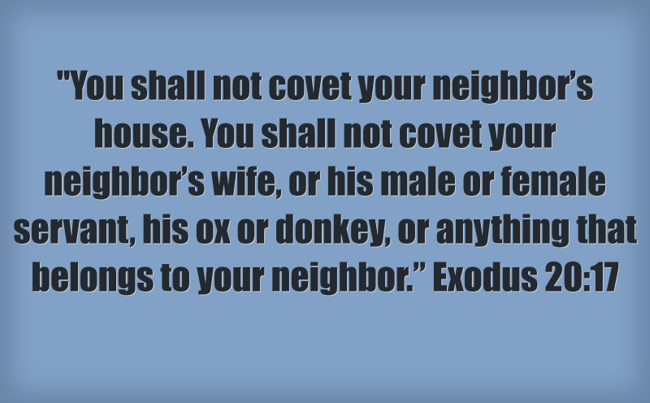
"You shall not covet your neighbor's house. You shall not covet your neighbor's wife, or his male or female servant, his ox or donkey, or anything that belongs to your neighbor." Exodus 20:17


Nobody speaks for God. Every moral rule you’ll ever encounter was created by existentially lost humans, but that doesn’t mean we’re helpless. We all have cosmic supercomputers inside our skulls, and rules are nothing more than guidelines or best practices for accomplishing goals. So if you can use your brain to figure out that people should wear safety goggles when operating a table saw, you can invent useful rules for any and every aspect of your life.

If you don’t know where to start, try looking at other people’s rules and finding what you like or dislike in them. Use that as a springboard to developing your own list of life’s best practices. You can start by constructively criticizing mine:


1: All life is infinitely valuable. Treat it accordingly.

You don’t need God to tell you all life is infinitely valuable. Even if there’s not enough evidence floating around the universe to deduce why life exists, there’s enough evidence lying in plain sight, a child could come to the conclusion that all life is infinitely valuable.

The universe may seem like a savage, cruel place, but that’s just because it’s indifferent. The universe is operating on autopilot, and it might seem like the universe is out to get you when it runs you over, but if you step back and look at the grand design, you’ll find so much elegance and perfection you’ll have to come to terms with the fact that the universe is too elegant and genius for a human being to comprehend.

From what we know, the universe shouldn’t even exist at all, let alone life. Yet we live in a universe that has been meticulously designed to sprout life on giant, spinning balls of compressed matter that perpetually rearrange themselves according to fixed rules. The universe is an inexplicable life machine that shouldn’t exist. Every living thing is lucky to be here, and we only have a flicker of time to make the most of the privilege. Value life according to its rarity, elegance and the amount of work that went into creating it. Treat your life and others accordingly.


2: Your life is your responsibility.

The universe is not out to get you or help you any more than it already has by giving you the universe and the tools to make the most out of your life. You don’t deserve, and will not receive, any miracles, bargains or any other entitlements from the universe.

You may receive aid and instruction from people, but you’re not entitled to any. Society doesn’t owe you anything you haven’t signed a contract for. The responsibility to make sure your life is good and complete falls entirely on your shoulders.


3: You are lost. It’s up to you to find life’s purpose.

Life doesn’t come with an instruction manual, but you have all the tools necessary to find answers, and ultimately, purpose, in life. Your life will only be as effective and meaningful as the purpose you live towards. Nobody can decide your purpose for you, though many will try. You must find it yourself for it to be yours. Choosing not to find purpose is choosing to live without it.


4: Consider and honor the cost/benefit analysis of your actions.

The value of your actions are determined by how productively they accomplish a goal. Ultimately, the value of all actions are relative to how productively they fulfill the meaning of life. Whatever you do, ask yourself if the benefit to the end goal outweighs the cost. Take risks at your discretion, but always honor the cost/benefit analysis of your actions.


5: Never stop learning and studying.

You are your mind. The quality and quantity of your mind is relative to the information inside it. Never stop learning and teaching yourself so that you may never stop growing.


6: Think rationally.

Mastering the art of thinking is a moral imperative because every mental and physical action you’ll ever perform are based on decisions you calculate in your mind. The more effective your reasoning skills are, the more effective you’ll be at everything.


7: Put everything you learn to the test of truth.

Nothing is true by divine authority. The truth of a fact is determined only by the quality of the evidence supporting it. So question everything, especially your answers, because the more reality-based your beliefs are, the more effective they’ll be in the real world.


8: Find and define yourself

Some aspects of your personality were set at birth, and others you get to pick. Discover what makes you who you are, decide who you want to be, and then become that person. The more you, you are, the more you exist, and the more able you are to fulfill your purpose. The less you, you are, the less you exist.


9: Take care of your body.

Your mind and body are parts of the same machine. The better you take care of your body, the better your mind and body can do what they’re designed to do. The less care you take of your body, the less you can do and the harder everything is.


10: Enjoy the moment.

No one knows why we’re here or what happens after death, but we do know we’re here now. If we can’t know anything else about life, we know the current moment is an opportunity to enjoy yourself. No one has found any irrefutable reasons why we shouldn’t enjoy ourselves. If you take nothing else from this life, find ways to take joy out of it before it’s too late.


If you enjoyed this post, you’ll also like these:


Agnosticism 
Atheism
Secular Living
Islam
The Bible is mythology
Christianity is Harmful to Society
Preaching, witnessing and arguing with Christians
Christian Culture
My Tweets About Religion


Believing in Christianity is always absurd, but more so for certain ethnic groups.

It’s absurd for anyone to believe in Christianity, because Christianity is mythology, and you don’t have to be a genius to prove it. Children are famous for pointing out the holes in Christianity. There are so many, an entire branch of academics had to be created to account for them all. It had to be because you can’t believe in Christianity without using speculation and logical fallacies to explain everything in the Bible that contradicts reality.

At least half of all Caucasian Americans, African Americans, Pacific Islanders, Hispanics, and Latinos believe in Christianity. I couldn’t find an exact number for Native Americans, but it’s definitely higher than zero. It’s historically absurd for any member of these groups to believe in Christianity because Christianity was spread to their races specifically for the purpose of erasing their culture and controlling their communities.

It doesn’t take a genius or conspiracy theorist to come to this conclusion. It’s the theme of Judaism and Christianity’s history. The Torah is mostly a timeline of the Jewish state’s creation and expansion, which officially began with Moses uniting the factions of his tribe under one religion, driving out all other beliefs, customs, and competition. The story ends after thousands of years of military expansion and ethnic cleansing.


"This is what the Lord Almighty says... 'Now go and strike Amalek and devote to destruction all that they have. Do not spare them, but kill both man and woman, child and infant, ox and sheep, camel and donkey.'" 1 Samuel 15:3


The only reason the leaders of the Jewish theocracy stopped adding lists of victories and biographies of their kings to the Torah is because the Romans conquered Israel. Since Israel’s government leaders were also its religious leaders, their religious authority died with their political power.

The occupying Romans had a much more fluid attitude towards religion than the Jews. They already had experience reducing civil unrest by absorbing religions and spreading their own. In fact, they were the world’s leading experts in expansion and oppression.

That’s why there was so much civil unrest in Jerusalem during the time of Jesus. The Romans were trying to force their government and culture on the Jewish people, who were descended from generations of militant religious fanatics who believed God had been smiting their enemies for thousands of years. The zealousness and ferociousness of the Jewish resistance fighters earned them a reputation in Rome as formidable opponents who would never surrender.

It’s beyond convenient that the story of Jesus began circulating through Israel at this time. Jesus claimed to be Yahweh incarnate and had come to Earth in human form for the first time in history, to change His covenant with the Jews. He no longer wanted Jews to expand Israel by military force. He wanted them to accept foreigners as brothers and let Roman soldiers slap them.

It’s also telling that the author of the Bible made it a point to blame Jesus’s murder on the Jews and absolve the Roman government of any crime. The chances of anyone associated with the Jewish religion writing those words after The Siege of Masada, is slim to none, but the practicality of a Roman writing those words is obvious.

The Jewish insurrection ended as Christianity gained popularity. Within a few hundred years of Christianity’s invention, the leaders in Rome made Christianity the official state religion and published the official version of the New Testament. Then their church leaders added a million more rules outside of the Bible in the form of church doctrine, still claiming the same divine authority they canonized the New Testament with. The chances of the creator of the universe completely reversing the theme of his commandments and abandoning his literal home on Earth in Jerusalem, which He meticulously described how to build, and moving to Rome to speak through Italians, is slim to none.

After Yahweh converted to Catholicism, churches were established in every European country, converting warring Pagans and barbarians into standardized, slap-accepting, Christian workers whose goal is life was to be servile and give God money. So when you read about white Christians oppressing minorities and erasing their culture, keep in mind that white European cultures were the first victims of Christian colonization.

Once Europe became Christianized, the Catholic church sent missionaries with explorers from every European country to spread Christianity to the new world. These explorers weren’t noble woodsmen who just wanted to make maps and build log houses. They had a very specific agenda to loot and plunder. In their own words, they viewed all the indigenous people they encountered as work animals to be yoked or vermin to be exterminated.


"The Indians are so naive and so free with their possessions that no one who has not witnessed them would believe it. When you ask for something they have, they never say no. To the contrary, they offer to share with anyone. they would make fine servants. With fifty men we could subjugate them all and make them do whatever we want." Christopher Columbus


The chances of the church sending missionaries with looting murderers to save the souls of God’s children are slim to none. Even if that wasn’t the church’s intention, Christian culture still eroded indigenous cultures everywhere missionaries established churches.

Historian, Adriaan van Oss wrote, “If we had to choose a single, irreducible idea underlying Spanish colonialism in the New World, it would undoubtedly be the propagation of the Catholic faith. Unlike such other European as England or the Netherlands, Spain insisted on converting the natives of the lands it conquered to its state religion. Miraculously, it succeeded. Introduced in the context of Iberian expansionism, Catholicism outlived the empire itself and continues to thrive, not as an anachronistic vestige among the elite, but as a vital current even in remote mountain villages. Catholicism remains the principal colonial heritage of Spain in America. More than any set of economic relationships with the outside world, more even than the language first brought to America’s shores in 1492, the Catholic religion continues to permeate Spanish-American culture today, creating an overriding cultural unity which transcends the political and national boundaries dividing the continent.”

In many places, notably, Hawaii, the early British missionaries became wealthy land and slave owners while locals lost access to their hunting, fishing and gathering grounds. The more scarce their land rights became, the more scarce the necessities of life became, which made them proportionally more expensive. Since the job markets couldn’t grow on isolated islands, poverty, and drug use became epidemic among Pacific Islanders, and they still are today.

Since church attendance is too, Christian leaders are still stockpiling donation from the poorest of the hopeless. To be fair, not all island churches are rich, and many have outreach programs that help their community, but their efforts are lip service towards fixing the fundamental problem they helped create and continue to profit from.

As the world’s island nations were being turned into resource farms for Christian, European nations, so was mainland America. After the British Empire lost control of its colonies, many of the Christian governments left in its wake, notably the United States of America, continued to use Christianity to justify slavery.

As much as African Americans still resent and fear slavery, the Bible still approves of slavery multiple times in both the Old Testament and New Testament. So slavery can only remain illegal in America as long as Americans don’t follow the teachings in the Bible.


"Slaves, obey your masters." Colossians 3:22


If a white man told an African American that slavery should be legal today, most people would agree the white guy had it coming if the black guy beat him up. However, when the Bible says slavery should be legal today, most African Americans ignore it or make excuses, even though those passages are the exact ones used to justify enslaving their ancestors.

After slavery ended, Jim Crow laws and Biblical-inspired racism kept African Americans living like second class citizens. To overcome living in a state of perpetual psychological oppression, the African American culture evolved to value racial empowerment and personal independence more zealously than white Americans, who didn’t have the same motivation to prove their worth.

African American culture’s attitude towards self-empowerment directly conflicts with the Bible’s philosophy of perpetual servility, self-loathing and guilt. A black person wouldn’t accept a white person telling him he’s an unworthy dog, but there are black people with pictures of blonde hair, blue eyed, white Jesus hanging on their walls. And when He says to kneel, they do, just like many Vikings did.


Mexican Americans didn’t officially have to endure Biblical-inspired slavery, but they’ve been treated like slaves most of America’s history. Today, the crime, poverty and church attendance rates in their communities are almost equal to African Americans.

The Bible didn’t create poverty, capitalism did, but the Bible teaches beliefs and behaviors that stimulate poverty and make it harder to escape. The Bible is against birth control, but higher birth rates lead to higher crime rates. The Bible says, “Spare the rod, spoil the child,” but higher child abuse rates lead to higher crime rates. The Bible says divorce is immoral, but higher rates of dysfunctional relationships lead to higher domestic violence rates. The Bible says the poorer you are, the better it is to give more, but the only way to get out of poverty is to save money, and the less money you have, the worse every aspect of your life gets.

In order to be successful in a capitalist economy, you need confidence and education. The Bible indoctrinates you to believe you’re lucky God loves you because you’ll never be good enough to deserve love. It also teaches you to believe stories that contradict scientific evidence, which sets you up to distrust logic and facts. And all the time you spend reading your Bible, praying and attending church functions, wastes time that could be used to succeed in life.

Poor people have been praying and giving money to God for centuries, and it hasn’t helped them out of poverty. It’s only made poverty worse. There’s enough evidence to prove beyond a reasonable doubt that prayer doesn’t work. The Gospel of Prosperity doesn’t work. The Bible’s instructions on life don’t work.

The DSM-4 defines a mental disorder as, “A clinically significant behavioral or psychological syndrome or pattern that occurs in an individual and that is associated with present distress or disability or with a significantly increased risk of suffering death, pain, disability, or an important loss of freedom.”

The DSM-5 defines a mental disorder as, “A syndrome characterized by clinically significant disturbance in an individual’s cognition, emotion regulation, or behavior that reflects a dysfunction in the psychological, biological, or developmental processes underlying mental functioning. Mental disorders are usually associated with significant distress in social, occupational, or other important activities.”

It’s counterproductive to give money to churches or practice Biblical beliefs. They both lead to emotional distress and dysfunctional behavior. And to continue believing in Christianity, you have to deny overwhelming evidence and use irrational logic; in other words, you have to think and behave in ways that fit the definition of insanity. It’s literally insane for anyone to believe in Christian mythology, but it’s poignantly ironic when the victims of Christianity’s cultural extermination campaigns do it.

I don’t say this in bitterness. It just tastes that way because it’s a bitter pill to swallow. The call to action these observations raise is not to ridicule Christians. They need treatment, and the only cure for their condition is knowledge.

Most Christians don’t realize how absurd the Bible is because they never read the whole thing. They only know and practice the parts they learned about in church. Nobody wants to accept that they’ve been basing their life on an ancient state-sponsored mythology, especially if they’re afraid of going to Hell. But you can only see so much evidence before you can’t unsee it. Once you see it, you’ll see it on every page of the Bible.

If the Bible is true, then it will stand the test of truth. In that case, the only thing to be gained from testing it is strengthening your beliefs. If there really is enough evidence in the Bible to prove it’s mythology, you stand to gain everything from looking for it.


If you enjoyed this post, you’ll also like these:


Agnosticism 
Atheism
Secular Living
Islam
The Bible is mythology
Christianity is Harmful to Society
Preaching, witnessing and arguing with Christians
Christian Culture
My Tweets About Religion


Two Feminist Ladies #2

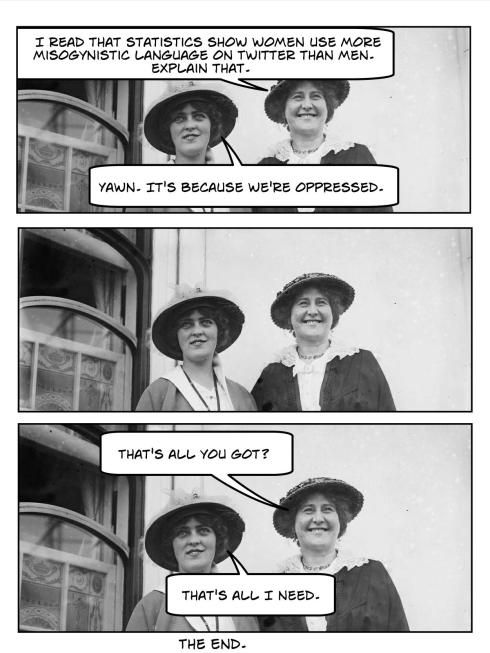
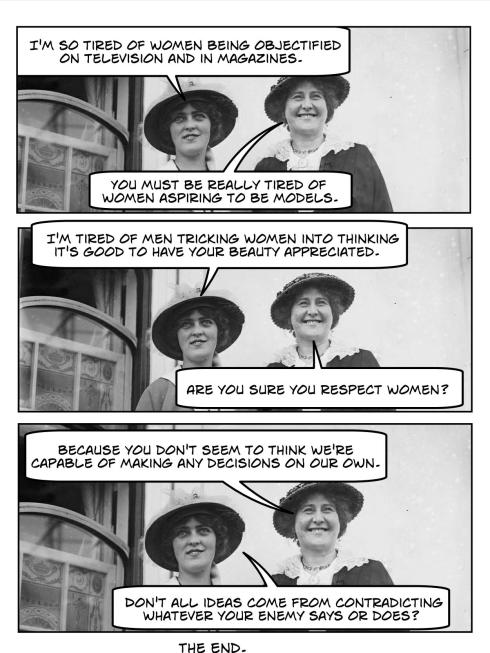
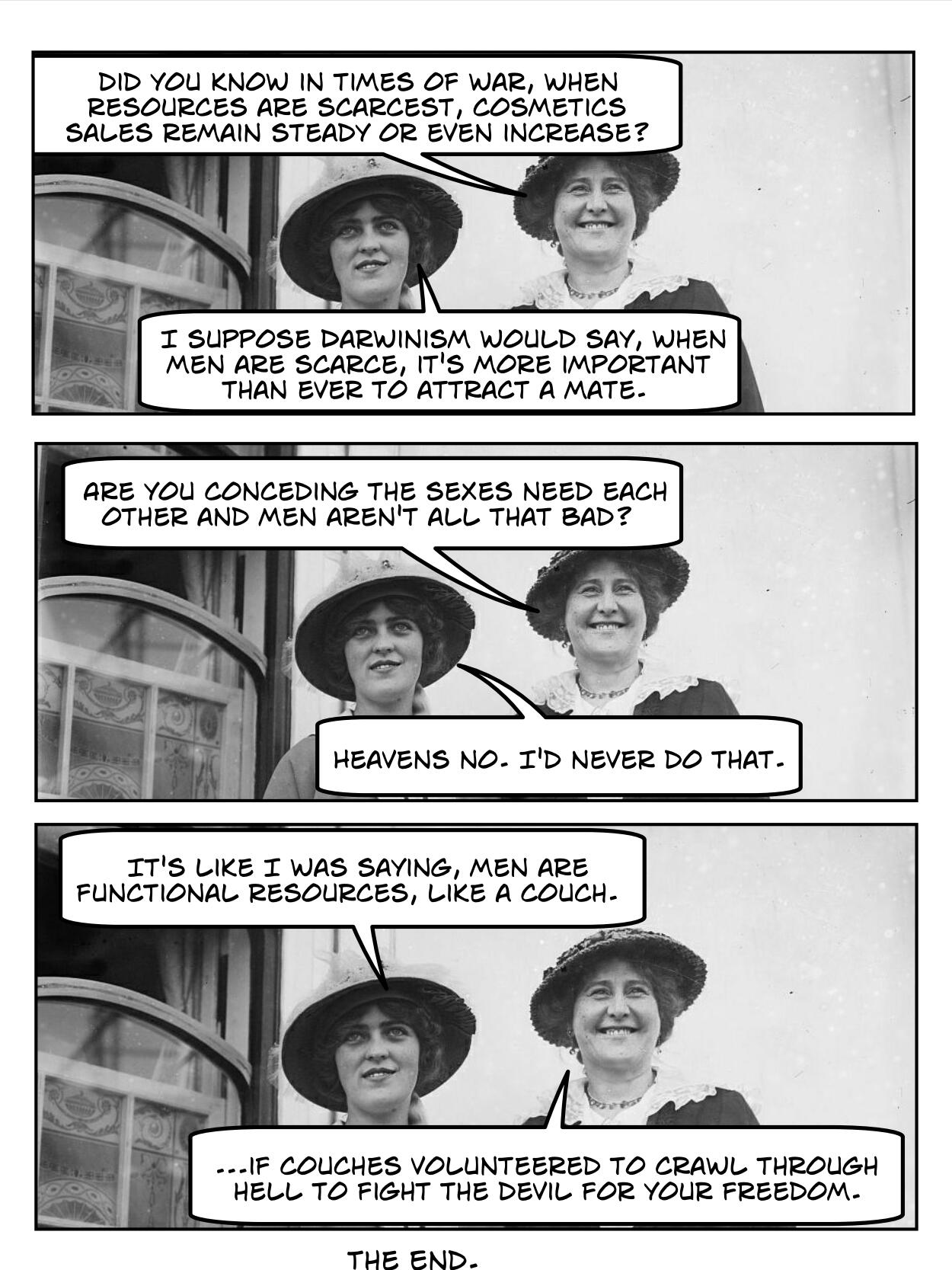
“Two Feminist Ladies” is a series of dark-humored, satirical, three-panel comic strips about two old fashioned women discussing modern radical Feminist talking points.

page_07

page_06

page_07

two feminist ladies 20

page_09

page_12


page_09

page_06

two feminist ladies 18

page_11


If you enjoyed this post, you’ll also like these:

  • Two feminist ladies #13
  • Two Conservative Ladies #1234567891011121314

Why you shouldn’t mock aspiring writers

Renaissance painting of a scribe writing on parchment in a writer's workshop, surrounded by scrolls and books.


In Biblical times a country town was lucky to have a single literate member. In the middle ages only the aristocracy, clergy, and merchant class could read or write. At every stage in history, the few people who could read and write controlled where history would go next and what ideas every educated school child would be raised on afterward. It’s no exaggeration to say writers are as valuable as doctors to any society.

They always have been and always will be, but individual writers today aren’t as valuable as they used to be since they’re not as rare. The supply outweighs the demand. Nobody is going to bow down to you or even pat you on the back for being able to read and write. You’re expected to know how to do that. That’s the bare minimum. That’s 15 pieces of flair. And the bar is set even higher than that. Ask any high school English teacher to show you the standards children are tested to. They’re very articulate. Ask any high school English teacher what they think the standards should be, and you’ll get a broader impression of where the bar sits today.

So while you won’t get a pat on the back for being able to form coherent sentences anymore, you will get a pat on the back for being able to form coherent essays. You’ll get a standing ovation if you can write a great book. You’ll change the course of history if you can write the most profound thing anyone has ever written. In all walks of life, the better you communicate ideas, whether on paper or in speech, you’re a greater and greater asset to yourself and to society and by rights should be regarded as such. There are writers and speakers alive today who are already legends, but for every sung hero there are countless unsung heroes… especially in the digital age. There was a time in history when finishing a book at all practically made you a publishable author. Now, authors are practically expected to give their first ten books away for free just to prove their worth.

Even in real life, if someone at a party tells you they’re an aspiring author, your first reaction will likely be to mock them for being an unemployed bum who’s too nancy and irresponsible to get a real job. If you meet an aspiring blogger at a party they’ll probably introduce themselves as an “author…” not a “blogger.” Even if they’re personally proud of what they do, they know they’ll get mocked for it and quizzed about why they don’t do something better with their lives.

When authors are a dime a dozen we lose sight of how difficult and vital good writing is. The call to action there is to give aspiring writers the credit they’re due… if not with your pocketbook, then at least with your heart. I’m not trying to guilt trip you. I’m trying to help you understand that writers are important, and if you understand why they are then you’d already be patting aspiring authors (and even bloggers) on the back at parties and buying them shots. If you think writers are lazy then you must not understand how much effort and skill goes into writing even a semi-decent book or blog.

The only way to get good at anything is to do it all the time. You can’t learn to snowboard well enough to bomb a mountain by going up on the slopes two or three times a year. You can’t learn to hit a home run consistently by playing backyard baseball in the summer. The same is true for writing. So say what you will about the quality of books and blogs written by noob writers, but give them a pat on the back for soldiering on. And acknowledge another thing right before you give them another pat on the back. Sports are as brutal on the body as writing is on the mind. It hurts, but it’s a good hurt. It’s not for everybody, and that’s fine. But for those few who are so into snowboarding, baseball, writing, dance, yoga, music, martial arts or building little miniature ships and putting them in big glass bottles that they stick with it when they could be doing anything else with their lives, then why not be happy for them? They found something productive they were so passionate about that they did it long enough to get even half decent at. There’s nothing laughable about that. And at least in the case of writers, they were so passionate about following their dream that they stuck with it after the honeymoon phase ended without being driven or inspired by the people around them. In fact, they’ve likely been soldiering on despite the fact that they’ve been getting booed and dismissed since day one. So if nothing else, give them credit for having the fortitude to put in the man-hours in private and take a beating in public.

If you’re still not impressed, then you’re still not seeing the whole picture. The piece of the puzzle you might be missing is how much concentration and technical skill are required to write well enough to finish a book or maintain a blog at all. How much concentration does it take to write well? Consider how much concentration reading a book takes. It absorbs your whole reality. Everything else in your mind fades away and you’re no longer a stressed out suburbanite worrying about bills and how much work you have to do. Reading transports you to an alternate reality, and as fun as that is, you’ll have to put the book down or step away from the internet eventually because the effort will exhaust you. If it’s exhausting to slide down that rainbow road, imagine how absorbing and exhausting it must be to lay the bricks. It’s beyond words. But you know that. If you’re not an aspiring writer, you’ve got your reasons, and one of them is probably because the idea of spending your evenings and weekends grading English papers makes you want to choke yourself on used toilet paper. But grading grammar is what writers do. The difference is that writers have to write the papers they grade first. Then they have to know how to grade them, and they can’t settle for a B.

I’m not saying you need to kiss your barista’s ring each time you order a latte. It’s not that what they’re doing is so much more difficult and specialized than whatever you do for a living is, but think about this.  You (or half the people you know) probably sit in chairs all day and stare at computers and solve complicated problems and devise articulate, useful answers, which you effectively communicate to other people. All day at work everyone’s brains are crunching more numbers than their computer, and everyone deserves a round of applause for that… even authors… even though they don’t sit in an office; they sit in their mom’s basement.

Just because authors wear the same clothes you wear when you’re being lazy doesn’t mean they’re being lazy. They’re working just as hard as school teachers, secretaries and anyone who writes performance reviews for a living. You wouldn’t walk up to a first, third or fifth-grade teacher and tell them they suck and should quit just because they’re not Jamie Escalante. You wouldn’t be condescending to someone at a party who told you they wrote memos and performance reviews for a living. You might not necessarily look up to them either, but life isn’t a dick-waving competition. So next time you run into an aspiring author at a party, pour them a drink and raise to toast to working hard, following your dreams and never giving up.


If you enjoyed this post, you’ll also like these:


Screenwriting for Movies
Screenwriting for TV
Short Stories
Erotica
Choose Your Own Adventure
Movie plot break downs
TV plot break downs
Free story prompts
Writing tips
Blogging
Art

Two Conservative Ladies #9

“Two Conservative Ladies” is a series of dark-humored, satirical, three-panel comic strips about two old fashioned women discussing modern Conservative talking points.

Lady #1: I saw a Muslim on the news burning an American flag and saying that America is waging a holy war against Islam. Lady #2: Muslims are so silly. I've been saying all along we should just bomb them back to the stone age. Lady #1: But that's what Obama has been doing... and isn't Obama a Muslim? Lady #2: Of course, dear. Lady #1: But why would a Muslim wage war on Muslims? Lady #2: Well... Obviously he's just the worst Muslim ever.Lady #1: I'm fiscally conservative but socially liberal. Lady #2: What is that supposed to mean, dear? Lady #1: It means I want to help everybody except the poor.Lady #1: Do you think overcharging our customers and underpaying our workers entitles us to a tax break? Lady #2: The issue is moot, dear. Lady #1: Why is that? Lady #2: Funding politician' campaigns entitles us to whatever we want.

Lady #1: Remind me again why we love capitalism and hate socialism so much? Lady #2: Okay, pretend you're a worker and not a trust fund baby. Lady #1: Okay, I'm pretending. Lady #2: When your boss gets to keep all your money, that's capitalism. When you get to keep all your money, that's socialism. Lady #1: Ahhh. Yep. Better not let that catch on.

Lady #1: Can you really call a country the land of the free when it has more prisoners than any other country? Lady #2: Try to stop me.

Lady #1: Getting all your news from Jon Stewart and "The Daily Show" is exactly teh same as getting all your news from Fox News. Lady #2: I didn't realize Jon Stewart told so many out-and-out lies. Lady #1: You were just supposed to agree with my statement, not analyze it.

Lady #1: Why don't we let seventeen year olds vote? Lady #2: Obviously, they're too god damned stupid to vote responsibly. Lady #1: But turning 18 doesn't prove you're smart. Lady #2: Why not require voters to take actual competency exams before being allowed to vote? Or why not disqualify senile old people from being able to vote? Lady #1: ... Lady #2: Oh, wait. Never mind.

Lady #1: My daughter is so excited! This is the first year she's getting to vote! Lady #2: Why is she so excited about that? Lady #1: Because she's on the Electoral College.

Lady #1: So explain to me how you plan to do your job. Lady #2: No, and fuck you for asking. Lady #1: Well, I'd never hire you to work for me, but I'll sure vote for you to be president.

Lady #1: Things are getting out of hand out there! People are talking about voting for a third party all over the place! WHAT ARE WE GOING TO DO!? Lady #2: Uhhh. Buy them out if they ever get in office. Lady #1: Oh yeah. I forgot how easy corruption is.

Lady #1: There's only one thing I hate worse than the liberal news. Lady #2: What's that, dear? Lady #1: How liberals won't listen to conservative news since they're all hopelessly biased.


Read the rest of the Two Conservative Ladies comics:

#1, 2, 3, 4, 5, 6, 7, 8, 9, 10, 11, 12, 13, 14

TRANSCRIPT


Comic # 1

Lady #1: I saw a Muslim on the news burning an American flag and saying that America is waging a holy war against Islam.

Lady #2: Muslims are so silly. I’ve been saying all along we should just bomb them back to the stone age.

Lady #1: But that’s what Obama has been doing… and isn’t Obama a Muslim?

Lady #2: Of course, dear.

Lady #1: But why would a Muslim wage war on Muslims?

Lady #2: Well… Obviously he’s just the worst Muslim ever.


Comic # 2

Lady #1: I’m fiscally conservative but socially liberal.

Lady #2: What is that supposed to mean, dear?

Lady #1: It means I want to help everybody except the poor.


Comic # 3

Lady #1: Do you think overcharging our customers and underpaying our workers entitles us to a tax break?

Lady #2: The issue is moot, dear.

Lady #1: Why is that?

Lady #2: Funding politician’ campaigns entitles us to whatever we want.


Comic # 4

Lady #1: Remind me again why we love capitalism and hate socialism so much?

Lady #2: Okay, pretend you’re a worker and not a trust fund baby.

Lady #1: Okay, I’m pretending.

Lady #2: When your boss gets to keep all your money, that’s capitalism. When you get to keep all your money, that’s socialism.

Lady #1: Ahhh. Yep. Better not let that catch on.


Comic # 5

Lady #1: Can you really call a country the land of the free when it has more prisoners than any other country?

Lady #2: Try to stop me.


Comic # 6

Lady #1: Getting all your news from Jon Stewart and “The Daily Show” is exactly the same as getting all your news from Fox News.

Lady #2: I didn’t realize Jon Stewart told so many out-and-out lies.

Lady #1: You were just supposed to agree with my statement, not analyze it.


Comic # 7

Lady #1: Why don’t we let seventeen year olds vote?

Lady #2: Obviously, they’re too god damned stupid to vote responsibly.

Lady #1: But turning 18 doesn’t prove you’re smart.

Lady #2: Why not require voters to take actual competency exams before being allowed to vote? Or why not disqualify senile old people from being able to vote?

Lady #1: …

Lady #2: Oh, wait. Never mind.


Comic # 8

Lady #1: My daughter is so excited! This is the first year she’s getting to vote!

Lady #2: Why is she so excited about that?

Lady #1: Because she’s on the Electoral College.


Comic # 9

Lady #1: So explain to me how you plan to do your job.

Lady #2: No, and fuck you for asking.

Lady #1: Well, I’d never hire you to work for me, but I’ll sure vote for you to be president.


Comic # 10

Lady #1: Things are getting out of hand out there! People are talking about voting for a third party all over the place! WHAT ARE WE GOING TO DO!?

Lady #2: Uhhh. Buy them out if they ever get in office.

Lady #1: Oh yeah. I forgot how easy corruption is.


Comic # 11

Lady #1: There’s only one thing I hate worse than the liberal news.

Lady #2: What’s that, dear?

Lady #1: How liberals won’t listen to conservative news since they’re all hopelessly biased.


School And Work Should Be Fun, And They Can Be.

"Why is it called 'Sunday fun day' when it's the day before Monday and we all have to go back to work; it should be called 'Sunday fuck day' cause we all realize it's Sunday and say to ourselves, 'fuck.'"


When I was in third grade almost all of the teachers at my school looked and acted like somber versions of The Golden Girls. Between classes, they would gossip in the halls, and sometimes I’d overhear them. One time I overheard my homeroom teacher telling the teacher next door that they heard someone on television say that learning should be fun. Those two old mother hens vehemently disagreed with that philosophy. They said, and I quote, “You don’t go to school to have fun; you go to school to learn.”

A little over twenty years later and schools are still run under the philosophy that classrooms shouldn’t be fun…. because fun is the opposite of disciplined. Granted, there have been advancements in academic culture since I was in third grade, but most of them have already been trampled under the foot of standardized testing. I don’t have to make a big list of ways school sucks to convince you that it does. You know that. If you liked everything about school then you were the 1% it was designed for. The rest of us were varying degrees of miserable. And to our credit, the fact that we graduated shows that we toughed it up and dealt with it… to varying degrees of success.

If you went to college then you know that the amount of fun you had partying was only matched by the misery of your classes and assignments. University courses are traumatically stressful. That’s why so many people fail out of college. Most of the people who fail out of college aren’t stupid or lazy. They just don’t have the stress tolerance to get hit in the head with a sledgehammer constantly for four years. A lot of the people who do pass the gauntlet manage to do so because they treat the stress with drugs and alcohol until they pass the finish line. A lot of them don’t let go of the bottle or the pills afterward, and then the solution becomes the problem. Those who do tough it without chemical assistance are still shattered and traumatized by it to varying degrees, and they all carry these problems with them to their jobs where they’re supposed to be the leaders. And since four years of basic training has conditioned them to take it for granted that traumatically stressful workloads are the norm… that’s the standard they hold everyone else to. In addition, they run their offices using the same rote, discipline-oriented (or nonsensical new age bullshit) approach their professors used to to make class miserable. Now, since the workforce reflects the education system, and the education system is based on archaic, degrading, inhumane, unproductive, unenjoyable standers, the end result is that everyone has to live in Stick-Up-Your-Butt Land.

This is ironic because America is famous for its nightlife… and to the extent that America is famous for how fun its nightlife is, it’s also famous for how dull and soul-crushing its working hours are… starting in first grade and ending at retirement or death. The American workplace is so soul-crushing that America’s youth are famous all over the world for being broken and giving up. The most absurd thing about that statement is that everybody knows it, but we’re still going to be doing the same thing this time next year…. and the year after that… and the year after that… until the nightly news won’t report on a shooting spree unless there are more than ten dead bodies.

We don’t have to do that, yet we keep doing it. We don’t have to drive ourselves insane and hate life. Classrooms and jobs could just as easily be places we enjoy and look forward to going to. The only reason life sucks is because the rules are written to butt hole standards. We just need to tear up the rule books and write new ones that aren’t built around the philosophy that life is supposed to be as anal retentive and exploiting as possible.

To this you might say, of course, we all wish life was more fun, but that’s easier said than done. To that I would reply, it’s easier than you think. You know how you change the whole world? You do one thing right and then ask yourself how to change the whole world again. Repeat those two steps ad infinitum, and you’ll change the world. So until you’ve done one thing differently, it’s illogical to sit there with your thumb up your ass wishing your butt didn’t hurt.

The only way the game was ever going to change was for each classroom and each office to change… one at a time. The education problem is the easiest to fix. All you have to do is donate to free online education and get other people to do the same. Brick and mortar schools with elderly teachers will likely always exist, but total free online education will change the nature of their jobs to full-time tutors instead of full-time drill instructors, and that’s vital for everybody. So if you’ve never donated to free online education or encouraged other people to do so, then don’t ask what you can do to change the world. That’s step number one.

If there’s no hope of you changing the rules in your office then you should be burning the midnight oil figuring out how to start your own business so you can work for yourself and create a fun environment for yourself and for your future coworkers. That’s ambitious to the point of arrogance, but what’s the alternative? Spending the rest of your life in shit, soul-sucking offices and letting your children grow up in shit classrooms only to escape to shit offices after they graduate where they’ll drown in shit until the light in their eyes goes out.  The point is… it doesn’t take courage to run from a tiger.

On a side note, it’s worth noting (and lamenting) that we’ve all been so conditioned to accept shit as the norm that we consider it immature to seriously consider living any other way, and we rationalize all the reasons we need to justify why it’s a good idea to stay in our shit lives and throw shit at other people who seriously consider, let alone try, to learn or work differently.  The mature, rational solution to this problem is not to suck it up and deal with it. That’s confusing optimism with apathy.

If your environment is inhumane and you don’t have the power to change it then the mature, rational thing to do is to leave that environment and find or create a more ideal one. Unfortunately, since shit is the standard, running away will just take you from McDonald’s to Burger King.

The only option that leaves left is creating your own environment, and the road to Utopia is realistically short because you don’t have to change the whole world to get there. It should also take a little more weight off your shoulders to know that you shouldn’t change the whole world anyway, because your utopia is everyone else’s nightmare. Conformity is the problem. Freedom is the solution, and diversity is the product.

It’s not easy to start your own business, and it’s not without significant sacrifices, but it’s achievable, and the benefits outweigh the costs. Dumber, lazier people than you have succeeded. Having said that, if you’re the exception who is truly, hopelessly locked into too many contracts, debts and obligations that neither change or escape are possible…. there’s no risk in shaming the status quo on the internet and hoping you inspire some boss out there somewhere to pull the stick out of his ass, let down his hair and let go of his grip around his employees’ throats. If you can play any role whatsoever in changing any office anywhere in the world, then you’ll have brought the professional culture one step closer to the tipping point where fun catches on and becomes the norm. So if you do nothing else, don’t stop bitching about how much school and work suck. Every public bitch session is a butterfly, and the more butterflies that get released into the internet, the more likely it is the winds will change.


If you enjoyed this post, you’ll also like these:


The Importance of Public Education
Flaws in the Public Education System
Improving Public Education


The 28th Amendment

Picture of an old piece of parchment that says, "Amendment XXVII"


The American government needs a new amendment to its constitution that states, no state or federal government shall pass or enforce any law that prohibits people from harming themselves or behaving in ways considered indecent unless the actions of the individual directly or indirectly hinder another person’s right to the pursuit of life, liberty, ownership or happiness. You might also make an exception that people can harm others if the person being harmed has given full consent because there are some exceptions like euthanasia and selling tobacco where people want to be hurt.

Here are 6 reasons why we need this amendment:


1. Without this rule, we have no way to systematically limit what kind of culturally relative laws will be passed that will oppress people. 

Look throughout history. People were locked in stocks for gossiping. Women have been killed for doing pretty much anything, including eating bananas. Today countless laws are enforced that don’t actually protect anyone. All they do is reinforce cultural norms to the detriment of the individual’s right to the pursuit of life, liberty, ownership, and happiness. Women still can’t take off as many clothes in public as men. Blasphemy is still a crime in many countries. Alcohol prohibition was a disaster, and marijuana prohibition is currently destroying countless lives. Censorship laws reinforce an oversimplified explanation of reality that debilitates people’s minds.  People who just happened to be naked at the wrong place at the wrong time are being jailed as sex offenders. Curfew laws are blatant oppression. If you look long enough you’ll find countless minor local laws that are just ridiculous and only serve to fill the police coffers.

None of these rules should be brushed off as exceptions and mistakes. They were inevitabilities in a system that has no fail-safe to limit the control of moral fanatics, and as long as no fail-safe exists you leave open an avenue for laws to be passed in your country that legalizes oppression.


2. The cost-benefit analysis of these kinds of laws doesn’t add up. 

It would be one thing if these laws actually protected society from itself, but as it stands they do more to tear society down and hold it back. What happens after a woman gets thrown in jail for smoking a joint on her front porch while not wearing her shirt? How is society protected? Since these are victimless crimes nobody has been protected. The only way society has been affected at all is this woman has been made to live in fear, been blacklisted with a criminal record and had her money stolen from her by the police to pay unjust fines. Now, what happens when this isn’t just one woman? What about when it’s 2 million people? That’s systematic oppression. That’s living in a terror state. There’s no cost-benefit analysis here because there’s no benefit. There’s just cost in the form of destroyed human lives.


3. Victimless crime laws waste resources. 

Every time someone is jailed for a victimless crime the labor they could have devoted to improving society is temporarily eliminated, and the labor used to apprehend and incarcerate these people is wasted when it could have been used to apprehend and incarcerate actual criminals.

Everyone who knows anything about criminology knows that locking up criminals is an ineffective way of reducing repeat offenders. Rehabilitation would be more productive, but at this point, rehabilitation isn’t even an option because our resources are stretched too thin by apprehending, prosecuting and locking up people for victimless crimes. If we ever hope to reduce real crime it’s vital that we stop wasting our resources enforcing subjective, victimless taboos.


4. Victimless crimes contradict the Constitution of the United States and the Universal Bill of Human Rights. 

These documents don’t place conditions and exceptions on the manner or extent to which people can choose to pursue life, liberty, ownership or happiness except to say that our actions may not infringe another person’s own pursuit of life, liberty, ownership or happiness. Victimless crime laws do.


5. One of the big arguments against the idea of legalizing victimless crimes is that society will break down; society won’t break down.

People do what’s in their best interest, and it’s not in anyone’s best interest to sleep with every whore in every brothel and shoot up heroin at work. The people who would do such things are in such dire positions in their lives that these actions appear to be in their best interest. If this is truly unhealthy behavior then the causes need to be addressed. These people need to be given what they’re missing in their lives and rehabilitated, not punished and have more of their life taken away from them. This will only push them further past the limit of desperation and increase the chances that they’ll actually harm other people.

Furthermore, most of the people who want to sleep with hookers and do heroin are already doing it. The only difference is that we’re wasting our resources and theirs by trying to stop them when we could just let them do what they’re going to do anyway and get on with solving real problems.


6. It’s not our place to play God. 

If we allow people to disobey the various mythologies humans have created to explain God then we would be denying the sovereignty those mythological deities have over mankind. While atheists would applaud this step, others fear it. However, even if one of these mythological deities were the real one then by passing judgment for Him we’re playing God. Therefore, it would be more blasphemous to enforce God’s will than to leave judgment to God.


If you enjoyed this post, you’ll also like these:


Barack Obama
The 2016 Presidential Election
Donald Trump
Voting
Corruption and Election Reform
American Laws
My Tweets About Politics


The Mechanic: A parable about story telling

THE STORY OF THE MECHANIC

A Parable About Storytelling

Black and white vintage photo of a mechanic fixing an engine in a messy garage

When I was just a little boy my pappa would take me with him when we needed to have our family car looked at. The only mechanic in town was a real nice guy . He was young, but he was already what you’d call a man’s man. He had that strong, skilled, confident presence you usually only see in people like the president, people who make being strong look effortless. Made you wonder what he was doing here and what he’d grow up to be.

Having said that, to be completely honest, not everybody thought as highly of the mechanic as I did, but I think they just didn’t understand him.

Sure, he had a few flaws…like his language….and his lack of social etiquette all together (except when he went to solemn events. Then he was as charming and proper as a vintage dixie gentleman).

But sometimes he’d get kind of drastic in his approach to fixing cars, and that scared some folks. Some folks said one of his wild ideas was going to get somebody hurt one day.

So even though the mechanic meant well, he would step on toes and frighten the more timid ladies in town from time to time, but I say that’s okay because his solutions always seemed to work out for the best in the end.

Well, to show you what I’m talking about I’ll tell you the story of the most memorable trip I took with my pappa to see the mechanic. This is literally a word for word transcription of what he said as he was fixing our car:

“Awww, what the fuck is that? Is that what I think it is? Oh, fucking shit. It is. Goddamnit. Yep, that fucking sucks. This is gonna be fucking impossible to fix. You’re shits fucked. I mean, the only thing we could possibly even try that might work, but it’s a long shot is…uh, you know what? Fuck it. Let’s try it. Might as well try something. It’s either that or just bury this fucking thing out back.

Hmmm. Well, shit. Let’s try this. Nope. That didn’t work at all. Oh crap. I think that actually just made it worse. Eh, let’s try something a little more drastic. Ooh yeah. that helped a little. I’ll keep doing that. Oh, yeah, there it goes. Almost got it. Almost got it. Amost….fucking…. Shit! God damned it! God…damned…fucking…mother fucker in a fucking basket.  Agh, it’s fucking jammed. up completely. We’re never going to get this fucking this working now.

Alright, well now let’s hold our horses.  Let’s just take a step back and look at this logically. What did we do wrong here? There’s gotta be one tiny detail we missed. Once we figure that out then, BAM. We’re home free.

Ah, there it is. Alright, let’s give this one more push and do it right this time. GrrrrrraaaaahhooooYEAH! There it goes! Fucking problem solved, man. Whoo. Kick ass. Let’s celebrate.”

I couldn’t believe my ears. His dialogue had just described the plot to almost every movie I’d ever seen up until then or ever seen for that matter, and that was the day I became a writer.

And I lived happily ever after….well, except for that one incident with the deaf gun shop owner, but that’s another story for another day.


If you enjoyed this post, you’ll also like these:


Formula Plot Templates
Screenwriting for Movies
Screenwriting for TV
Short Stories
Erotica
Choose Your Own Adventure
Movie plot break downs
TV plot break downs
Free story prompts
Writing tips
Blogging
Art


A Theory On Improving College Education


The value of a college education is undeniable. Unfortunately, that value is difficult to quantify.  Perhaps this is part of the reason why the higher education system is racked by some major problems. Costs are prohibitively high, drop out rates are unacceptably high and a college degree doesn’t open as many doors in the job market as it used to.

As a result of these problems, many young people can’t get into college much less finish. Most of those who do will be burdened with crippling debt for at least half their adult life. Business are having a difficult time finding skilled labor, and many graduates coming out of university have only mastered rote memorization and test-taking skills. These are dynamic problems that require dynamic solutions, but one thing is certain; we’re not going to get different results by doing the same thing. If we want a critical change in the results, we need to make critical changes to the fundamentals of the system. Here’s one fundamental change we could make the university system that will seriously improve the matriculation and retention rates of students, as well as improve the quantity and quality of graduates entering the workforce.

Eliminate the standard bachelor’s degree that requires students to major in one core subject, minor in a secondary subject and take a number of classes that don’t directly apply to their career path. Instead, only require students to take the core classes related to their career path. Once those classes are completed give them a mini degree. Then if they want to go on to study a more broad spectrum of useful subjects then let them pursue that path, and give them another mini degree for having completed those classes. Remove the requirement to minor in a second subject altogether but leave the option open.

Now let’s weigh the pros and cons of this kind of system and see how well it will fit the needs of the modern world. We’ll start with the pros. Each item on the cons list will be followed by an analysis of how insurmountable that problem is.


Pros:

1: Students who can’t afford 4 years of school will be able to attain valuable job skills previously unavailable to them.

2: Students who can are willing to take on debt will have more options to choose how much debt they need to take on.

3: Students who could excel in a career field but can’t excel at the extra classes required by the current system will be able to get a useful certification.

4: The drop out rate will shrink drastically.

5: The equivalent of a full bachelor’s degree will be more valuable when competing against the mini degrees.

6: Workers will be able to enter the career field quicker.

7: It will be quicker, cheaper and easier to earn a second degree if you want to change career fields later in life

8: A more focused path of education will allow less free time for partying, which will force students to focus on their studies.

9: A more focused path of education will force faculty to better streamline their courses to follow a more logical, goal-oriented curriculum.


Cons:

1: Students won’t get as broad of an education.

2: It would be more accurate to say that every student won’t get as broad of an education. Those who want to take more general classes will still be able to. Students who don’t want to, don’t need to, can’t afford to or aren’t academically inclined enough to won’t have to. And not every student needs as broad of an education, nor does every business want/need to employ/pay renaissance men/women.

3: A degree won’t mean as much.

4: A mini degree won’t mean as much. A full degree will mean more.

5: Harder for students to switch majors.

6: This will only be as difficult as colleges make it.

7: Students who want to change majors will have wasted their time and credits.

8: This is true to an extent, but this is also often true in the current system. Plus, if students are forced to focus on their career path they might actually discover that their current path isn’t for them quicker than if they piecemealed it over 4 years.

9: Harder for schools to start new courses.

10: While this is true it would be more accurate to say that it will be more difficult for schools to start new classes that don’t fit a career path. In that case, this would mean it’s harder for schools to start new classes that serve no purpose.

11: Less flexibility for universities will drive up costs.

12: Yes. There are instances where this will be true. However, if students don’t have to pay for 4 years of school it will be easier for them to pay higher costs if they have to pay for fewer classes.


If you enjoyed this post, you’ll also like these:


The Importance of Public Education
Flaws in the Public Education System
Improving Public Education